
Key takeaways
-
State-by-State Regulatory Complexity: Expanding into new US states creates more work because every state has its own separate legal rules, reporting requirements, and compliance standards.
-
Jurisdiction-Specific Configuration: A good platform lets you change betting rules, promotions, and responsible gambling settings for each state without needing to rebuild the software.
-
Modular Integration Architecture: Different states require different payment, geolocation, and ID verification providers, so the platform must allow quick third-party integrations.
-
Centralized Management: Managing all your state operations from a single dashboard stops your team from repeating the same daily administrative tasks over and over.
-
Automated & Consolidated Reporting: Combining trading data and player activity from every state into one automatic report saves time and lowers the risk of compliance errors.
-
Commercial Scale Efficiencies: Scalable platforms lower your long-term costs because you can reuse existing tech setups, workflows, and staff training for every new launch.
How the Right Sportsbook Platform Helps US Operators Scale Across Multiple States
For many US sportsbook operators, the first state launch is just the beginning. The bigger challenge comes afterwards. Why do some operators seem able to expand steadily into new regulated markets, while others find every additional state requires more time, more resources and more operational effort than the last?
And to offer a clue, the answer isn't found in licensing alone. Nor is it simply a question of adding more people or more technology. In many cases, it starts with a decision made long before the second state ever enters the picture.
This article explores the platform capabilities that determine whether expansion becomes progressively easier or progressively more demanding as the business grows.
Reasons Why Multi-state Expansion Becomes Progressively More Complex
Expanding into another regulated state should not mean reinventing a sportsbook. It will, however, mean accommodating another set of operational requirements. Individually, most of these differences are manageable. The problem is that they accumulate with every new jurisdiction, increasing the number of configurations, workflows and exceptions operators need to oversee.
Over time, the ability to manage those differences efficiently becomes increasingly important. Here are the main issues:
Different regulatory requirements
Every regulated state operates within its own legal and compliance framework. Reporting obligations, technical standards and operational requirements can all vary, making it important to configure each market individually while managing compliance efficiently from a single environment.
Licensing and reporting
Operating across multiple states means dealing with different regulators, reporting schedules and documentation requirements. A sportsbook platform with centralised reporting and market-specific outputs helps reduce administrative effort while supporting accurate and timely regulatory compliance.
Betting rules and market availability
Not every betting market or wagering option is permitted in every jurisdiction. Operators need the flexibility to configure sportsbook content, betting rules and market availability at the state level without rebuilding the underlying platform for each new launch.
Responsible gambling requirements
Responsible gambling regulations continue to evolve independently across different states. Configurable player protection tools, deposit controls and compliance settings enable operators to meet local regulatory requirements while maintaining consistent responsible gambling policies across the wider business.
Payment and verification partners
Payment preferences, geolocation providers and identity verification requirements typically differ between jurisdictions. A platform with flexible, modular integrations makes it easier to introduce market-specific providers while avoiding unnecessary development work as the business expands.
Promotions and marketing
Bonuses, promotional rules and advertising restrictions are not always consistent across regulated markets. Platforms that support localised promotions and configurable campaign management allow operators to tailor marketing activity while maintaining central oversight and operational consistency.
Operational oversight
As new states are added, so too are the day-to-day operational demands. Managing multiple jurisdictions through a single administrative environment reduces duplication of work, simplifies operational oversight, and provides a clearer view of business performance across all regulated markets.
Platform Capabilities that Make Multi-state Operations Easier
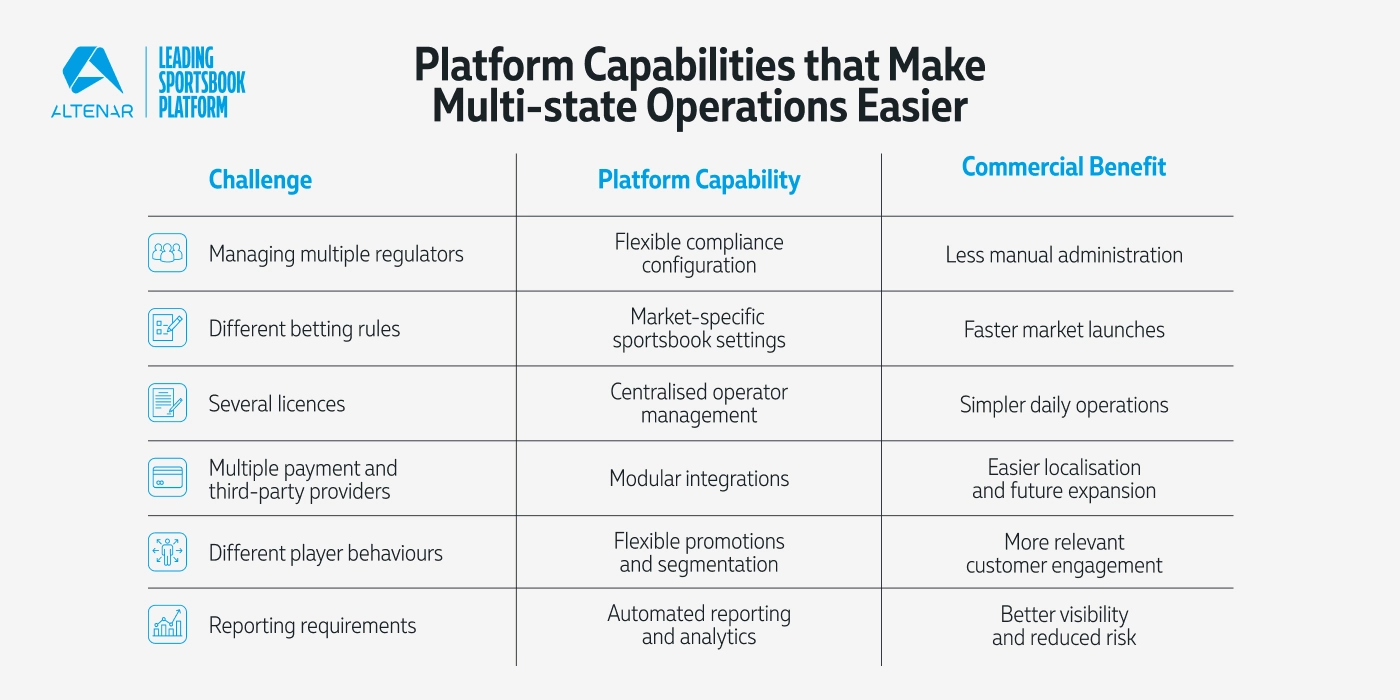
Expanding on the above, the most important platform capabilities are those that reduce complexity, accelerate launches, and simplify day-to-day operations. The capabilities below are among the most important when evaluating a platform for long-term US expansion.
Centralised management with local flexibility
One of the biggest operational advantages of a scalable sportsbook platform is the ability to manage multiple regulated markets through a single environment. While individual jurisdictions inevitably require different compliance settings, betting rules or promotional configurations, the wider business should remain consistent. To this end, centralised administration reduces duplication of work and provides a clearer view of performance across all markets without sacrificing the flexibility needed to meet local requirements.
Flexible compliance and market configuration
No two regulated markets are identical, and sportsbook platforms should be designed with that reality in mind. Instead of creating a separate sportsbook for each state, operators should be able to configure state-specific betting markets, responsible gambling controls, taxation settings and regulatory requirements within the same platform. This approach reduces the operational disruptions that can occur when compliance requirements evolve independently across different jurisdictions.
Integration architecture that supports future expansion
Technology doesn’t stand still. As operators expand, they invariably introduce new payment providers, identity verification services, geolocation solutions, CRM platforms, data suppliers, and the like. A sportsbook platform with flexible integration capabilities allows these additions to be made efficiently without disrupting existing operations. Instead of becoming increasingly difficult to maintain, the platform should make future integrations routine parts of growth rather than major development projects.
Operational reporting across multiple jurisdictions
As sportsbook operations grow and serve more regulated markets, operators need a clear, accurate picture of what's happening across every jurisdiction. Timely access to trading performance is needed, as well as deep insight into customer activity, compliance reporting and operational metrics across every regulated market. Centralised reporting helps identify trends, compare market performance, and support more informed commercial decisions, while reducing the administrative effort required to manage separate reporting processes for individual jurisdictions.
Tools that support local market optimisation
Sustained growth depends on understanding how customers behave in each market and responding accordingly. Platforms that support flexible promotions, player segmentation and configurable sportsbook settings allow operators to tailor the player experience without rebuilding the underlying platform. That balance between consistency and localisation helps operators remain competitive while maximising efficiency across the wider business.
Checklist: What should a scalable sportsbook platform deliver?
-
Centralised management across all regulated markets
-
Configurable compliance and responsible gambling settings
-
Market-specific sportsbook configuration
-
Flexible third-party integrations
-
Automated reporting and operational analytics
-
Support for multiple payment and verification providers
-
Localised promotions and player segmentation
-
Consistent operational workflows across jurisdictions
-
Tools that reduce manual administration as the business grows
How Scalable Platforms Reduce the Cost of Expansion
The real test of a scalable sportsbook platform is whether expansion becomes more efficient as the business grows, rather than requiring the same level of effort every time a new state is added.
As platforms, processes, and internal teams become more experienced, operators spend less time recreating the same work for every new launch. Existing integrations can be reused, proven operational workflows can be applied across multiple jurisdictions, and engineering teams spend less time solving the same implementation challenges. Staff training also becomes more straightforward because employees work within familiar systems and established processes rather than having to adapt to different tools and workflows for every new state.
These efficiencies extend well beyond the launch phase. Fewer manual processes reduce operational overhead, while shorter deployment times support faster expansion into new states. Standardised workflows improve operational governance, helping businesses maintain consistency as they grow, while a unified platform supports a more consistent customer experience regardless of where players are located.
Ultimately, the commercial value of a scalable sportsbook platform rests in its ability to create economies of scale. Rather than requiring more resources every time another state is added, it enables operators to expand with greater efficiency, lower long-term operating costs and increasing confidence that growth will remain both sustainable and profitable.
Choosing a Sportsbook Platform for Long-term US Growth
A sportsbook platform reveals its true value over time. Almost any advanced modern platform these days can support a successful launch, but sustained multi-state growth places very different demands on technology and operations. In this regard, the real measure of success is whether expansion becomes progressively easier to deliver, even as regulatory requirements, suppliers and operational complexity continue to grow.
With that in mind, operators should look beyond feature comparisons and ask how well a platform will support the business five years from now. Questions worth considering include:
-
How easily can additional regulated markets be added?
-
How much configuration is needed to support state-specific requirements?
-
Can compliance changes be managed centrally across multiple jurisdictions?
-
How quickly can new suppliers and third-party services be integrated?
-
Will operational processes become simpler or more complex as the business expands?
-
Can reporting provide a single view across every regulated market?
-
How much engineering and operational effort is required for each new launch?
Ultimately, the answers to these questions reveal far more than the capabilities of a sportsbook platform. They indicate how well it can support sustainable growth across multiple regulated markets without increasing complexity. For operators planning long-term expansion in the US, that may prove to be one of the most important technology decisions they make.
Planning to expand across the US? Book a personalised demonstration tailored to your US expansion plans to discover how Altenar's sportsbook platform supports sustainable multi-state growth with flexible configuration, centralised management and powerful operational tools.