

Key takeaways
-
From Gambling to Engagement: Sportsbook retention is evolving beyond responsible gambling checks towards responsible engagement, balancing customer experience, player wellbeing and business growth.
-
Rethink Retention Metrics: Betting frequency, deposits and turnover show activity, not loyalty. Measure sustainable engagement, customer satisfaction and gambling-risk indicators alongside revenue.
-
Retain Through Experience: Competitive odds, relevant markets, reliable live betting, simple navigation and strong performance give players reasons to return without constant bonuses or promotions.
-
Personalise Responsibly: Tailor markets to genuine interests, but assess unusual deposits, timing and betting patterns before promoting activity. Relevance must never outweigh player harm concerns.
-
Make AI Responsible: AI spots behavioural changes and risks, but cannot confirm gambling harm alone. Combine risk-aware systems, expert oversight and suitable interventions for safer decisions now!
-
Connect Data and Protection: Integrate retention, marketing and player-protection systems to coordinate promotions, share risk signals and balance customer experience with safer gambling practices.
From Responsible Gambling to Responsible Engagement: The Next Evolution of Sportsbook Retention
What if some of the most valuable decisions a sportsbook makes about player retention are the ones that don't lead to another bet? It's an unusual way to think about retention, admittedly, particularly in an industry where success is typically measured through betting frequency, turnover and player activity. Keeping customers engaged, after all, has traditionally meant finding more reasons for them to place bets, whether through bonuses, promotions, personalised offers or new betting opportunities.
But there's a problem with that approach. Not every increase in activity is a sign of a stronger customer relationship. And as operators become better at understanding individual player behaviour, knowing when not to encourage another bet is becoming just as important as knowing when to present an opportunity.
This creates an interesting challenge for sportsbook operators. The same technology that can identify what a player is likely to bet on can also help recognise when encouraging further activity may be inappropriate. Meanwhile, tighter responsible gambling requirements are raising expectations for how operators use that information.
Maybe the next stage in improving sportsbook retention isn't about coming up with ever more effective methods for getting the next person to place a bet; instead, it's about creating a sportsbook that players want to come back to, while at the same time realising that keeping a customer doesn't necessarily mean keeping them from betting.
So what then does a successful retention strategy look like when encouraging another bet isn't necessarily the best answer?
More Activity Doesn't Mean Better Retention
To answer that, we first need to look at what operators measure. A customer who bets several times a week, deposits regularly, and responds to promotions might appear to be exactly the kind of player a sportsbook wants to retain. On a conventional retention dashboard, those numbers would almost certainly look very encouraging.
But what do they really tell us? They show that the customer is active. They don't necessarily tell us whether that activity is sustainable, whether the player is satisfied with the sportsbook, or whether their betting behaviour is becoming a cause for concern.
And that's where retention becomes more complicated. Two customers might generate similar turnover over a month, yet have very different relationships with the sportsbook. One might bet regularly on a favourite football team, stay within their chosen limits and enjoy the experience. The other might be depositing increasingly large amounts, betting more frequently and showing signs of chasing losses.
So ultimately, from a commercial perspective, their activity might initially look similar. But from a responsible gambling perspective, however, they require very different responses.
This doesn't mean traditional retention metrics have lost their value. Active users, betting frequency and customer lifetime value still tell operators important things about business performance. Issues arise when operators treat those numbers as evidence of a healthy customer relationship without considering the behaviour behind them.
A more useful approach is to measure engagement along with indicators of player well-being and risk. That might include changes in deposit patterns, repeated attempts to exceed limits, responses to responsible gambling interventions and whether customers continue using the sportsbook without depending on constant promotional incentives.
Consider what happens when a successful intervention reduces a customer's betting activity. By conventional measures, that could look like a decline in engagement. Yet, from a player-protection perspective, it might be precisely the outcome the operator would want.
And increasingly, this is more than a question of how operators choose to measure success. Regulation is also influencing what they can reasonably do to encourage continued betting.
Regulation Is Changing the Rules
That influence is becoming harder to ignore. For years, sportsbook operators have invested in understanding what makes customers more likely to return, from the timing of promotions to the types of bets they prefer. But regulators are increasingly interested in what happens when those same techniques encourage potentially harmful behaviour.
The UK provides a useful example. The Gambling Commission's requirements around customer interaction mean operators must identify signs of potential harm and take appropriate action. This can include changing how they communicate with customers, restricting certain activities, or intervening directly when behaviour gives cause for concern.
Deposit limits add another consideration. Under the UKGC's updated rules, operators must make gross deposit limits available to customers and clearly distinguish them from other financial controls. Players therefore have more consistent ways to set boundaries around their gambling, regardless of which sportsbook they use.
For retention teams, this creates a practical challenge. A customer who reaches a deposit limit, shows signs of harm or requires an intervention cannot simply be treated as another opportunity for reactivation. Promotional decisions need to account for what the operator already knows about that customer's circumstances and behaviour.
And this isn't just a matter of adding responsible gambling checks to existing marketing campaigns. It requires closer coordination between the systems responsible for player protection, customer data, promotions and the sportsbook.
The wider implication is that operators cannot always separate the question of how to keep a customer engaged from whether encouraging further betting is appropriate.
But that doesn't mean retention has to become less effective. It does suggest that operators need to reconsider what gives customers a reason to choose their sportsbook in the first place. And much of that has very little to do with encouraging them to bet more often.
Give Players a Reason to Return Beyond Another Bonus
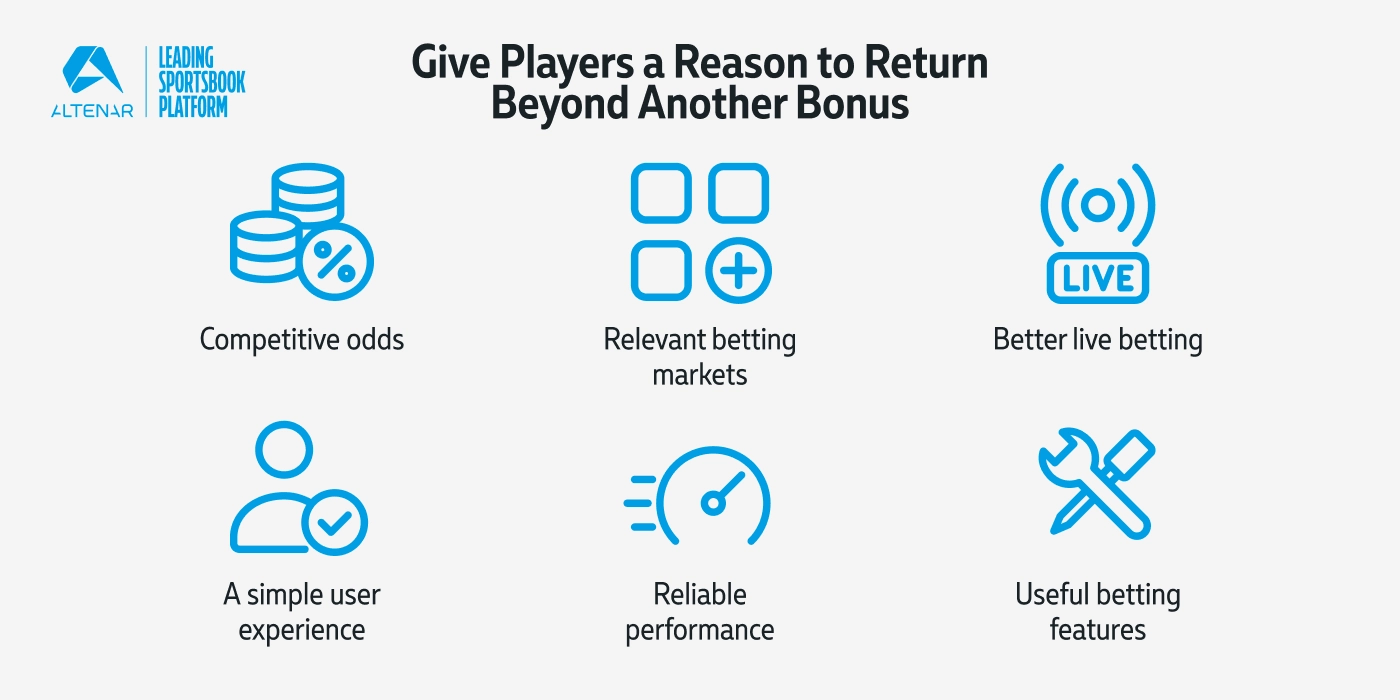
So, if operators can't always rely on encouraging more betting activity, what else can they do to keep customers coming back?
Much of the answer comes down to the quality of the sportsbook experience. Think about why a customer chooses one betting platform over another. The following are all areas where operators can give customers a better experience without continually relying on promotional incentives:
Competitive odds: Customers can compare prices across sportsbooks, particularly on popular events. Consistently competitive odds give them a practical reason to choose one platform over another.
Relevant betting markets: A large selection means little if customers struggle to find what interests them. Strong coverage of preferred sports, leagues and competitions makes the sportsbook more useful.
Better live betting: Fast market updates, reliable odds and clear event information improve the experience of following a match, without requiring operators to encourage additional betting activity.
A simple user experience: Customers shouldn't have to navigate multiple screens to find familiar markets or manage their accounts. Straightforward navigation makes returning to the sportsbook easier.
Reliable performance: A sportsbook that remains responsive during major sporting events, processes bets correctly and avoids unnecessary interruptions gives customers fewer reasons to consider competing platforms.
Useful betting features: Bet builders, cash-out options and relevant match statistics can improve the experience when presented clearly, giving customers more control over how they use the sportsbook.
Personalisation Also Needs to Know When to Stop
Of course, offering a better sportsbook experience is only part of the answer. The next question is how much of that experience should be tailored to the individual customer.
Personalisation can be genuinely useful. A customer who regularly follows Serie A probably doesn't want to search through dozens of unrelated competitions every time they open the sportsbook. Showing their preferred leagues, teams and markets first makes the platform easier to use. And if their interests change, the sportsbook can adapt.
But there's an important difference between using customer data to make the sportsbook more relevant and using it to encourage someone to bet when they otherwise might not.
Consider a player who normally bets on weekend football but suddenly begins placing bets late at night on unfamiliar sports while increasing their deposits. A personalisation system focused entirely on engagement might interpret that activity as an opportunity to recommend more markets or send targeted offers.
A responsible approach, however, might ask a different question. Is this simply a change in interests, or could it indicate that the customer's behaviour deserves closer attention?
That doesn't mean every unusual betting pattern is evidence of harm. It means operators need to consider risk information alongside customer preferences before deciding what to recommend, promote or communicate.
And perhaps this is where responsible engagement becomes most meaningful. The overriding aim isn't to stop making the sportsbook relevant to the customer. It's to recognise that relevance alone isn't always a good enough reason to encourage further activity.
The technology to identify those differences is becoming increasingly sophisticated, particularly with advances in AI. But having more information about a player doesn't automatically mean an operator will make better decisions about how to engage them.
AI Recognises Opportunities. But Does it Know When to Hold Back?
The challenge becomes even more interesting when AI enters the picture, because predicting behaviour and responding responsibly to it are two different things. Much of the commercial appeal of AI comes from being able to identify patterns in customer behaviour that would be difficult to recognise manually. It can help predict which markets a player might find interesting, personalise the sportsbook experience and identify when a customer may be losing interest.
But those same capabilities can also identify potential gambling harm. For example, AI-supported monitoring can examine changes in betting frequency, deposit behaviour, session duration and other indicators that might warrant closer attention. By looking at several behaviours together, AI can help operators spot changes that might otherwise go unnoticed.
What happens next depends on what the system is designed to achieve. Imagine a system identifies a customer who has become significantly more active over a short period. A conventional engagement model might recommend a promotion to maintain that momentum. A system designed with player protection in mind could instead flag the behaviour for review, suppress promotional messages or recommend an appropriate intervention.
In both cases, the technology is responding to the same information. The difference lies in what the operator has asked it to achieve. Of course, AI cannot reliably determine whether someone is experiencing gambling harm simply by analysing their betting history. Its assessments depend on the quality of the data, the indicators being monitored and how its recommendations are evaluated. Human oversight remains important, particularly when decisions affect a customer's account or access to gambling services.
For operators, the real opportunity is therefore not simply to automate more engagement decisions. It's to connect personalisation and player protection so that one doesn't operate without considering the other. And when those decisions affect how customers are treated, another factor becomes increasingly important whether players trust the sportsbook to act fairly and consistently.
A Different Approach to Retention Requires a Different Kind of Thinking
So if operators want to measure retention differently, they also need to consider whether their technology can support that approach. It's one thing to recognise that betting activity, customer satisfaction and player protection should be considered together. It's another to make that happen when the information is spread across different systems.
A sportsbook might have detailed information about a customer's betting preferences, while its responsible gambling tools identify behaviour that warrants closer attention. Meanwhile, the marketing system could be preparing another promotional offer. If those systems don't communicate effectively, the operator risks making decisions based on only part of what it knows about the customer.
This is why the technology supporting retention matters. Operators need access to relevant customer information, configurable controls and the ability to coordinate personalisation, promotional activity and player protection. They also need reporting that helps them understand not only how customers engage with the sportsbook but also how that engagement changes over time.
The objective isn't to make every customer interaction more sophisticated. It's to make sure the different parts of the sportsbook work toward compatible goals. That requires a sportsbook platform that supports an engaging customer experience while accommodating the controls and operational decisions needed for responsible gambling.
iGaming retention is changing, and your sportsbook needs to keep pace. Book a software demonstration with Altenar to explore the technology behind a more considered approach.