
One of the incentives for expanding a sportsbook across Latin America is the opportunity to build on what already works. An operator with an established business in Mexico, for instance, has valuable technology, trading capabilities and operational experience that could support expansion into Colombia, Argentina or Peru. But how much of that success is actually transferable?
A sportsbook's performance is influenced partly by decisions made to suit its original market. Over time, many of these decisions become embedded in its technology and everyday operations. Replicating them elsewhere can introduce problems that weren't apparent in the original market.
For operators, the challenge is knowing which parts of their sportsbook give them an advantage across multiple markets, and which need to change without making every new country a separate technology project.
Key Takeaways
-
A successful sportsbook configuration in one LATAM country may not perform as well in another. Sports coverage, betting markets, promotional priorities and customer expectations can differ considerably.
-
Localisation doesn't necessarily require a separate sportsbook platform. Core technology and trading infrastructure can remain consistent while individual markets receive different configurations.
-
The most important product requirements vary by country. Mexico calls for a broader approach to sports coverage, Colombia places additional emphasis on operating within an established regulatory framework, while Argentina introduces jurisdiction-specific requirements.
-
Operators need to distinguish between what is technically available and what is appropriate for the local market. Extensive betting markets or promotional features are only useful when they reflect local demand and applicable regulations.
What Actually Needs to Change When Entering a New LATAM Market?
The difficulty with having one regional sportsbook strategy isn't necessarily that operators overlook local differences. Most experienced operators already understand that customers in Mexico and Colombia, for example, have different preferences and expectations. The harder question is how far those differences impact the technology and processes that support the sportsbook.
Consider a Mexican operator planning to expand into Colombia. Adjusting the prominence of local football competitions or introducing promotions aimed at Colombian customers might be relatively straightforward. But the changes don't end with what customers see. Local regulatory obligations and operating conditions can also influence which sportsbook features are available and how they are configured.
There is also the question of how much commercial experience can be transferred. An operator may have developed a successful approach to organising sports coverage, selecting betting markets and managing promotions in Mexico. Those decisions were informed by Mexican customer behaviour, however, and there is no guarantee they will produce the same engagement or betting activity in Colombia.
From a sportsbook product perspective, localisation generally involves several areas:
-
Sports coverage and betting markets: Choosing which competitions to prioritise, how much market depth to offer and how prominently local events should appear.
-
Frontend experience: Adapting language, betting terminology, homepage content and the organisation of sports and events.
-
Trading and risk management: Adjusting margins, betting limits and market availability to reflect local operating conditions and commercial priorities.
-
Promotions: Configuring campaign structure and eligibility according to local preferences and applicable restrictions.
-
Regulatory requirements: Ensuring relevant sportsbook functionality, technical standards and operating configurations meet the needs of the market.
The question then becomes how to manage these differences without introducing unnecessary complexity. As operators enter additional countries, they must decide which configurations need to be specific to each market and which capabilities can remain consistent across their sportsbook operation.
LATAM Sportsbook Localisation at a Glance
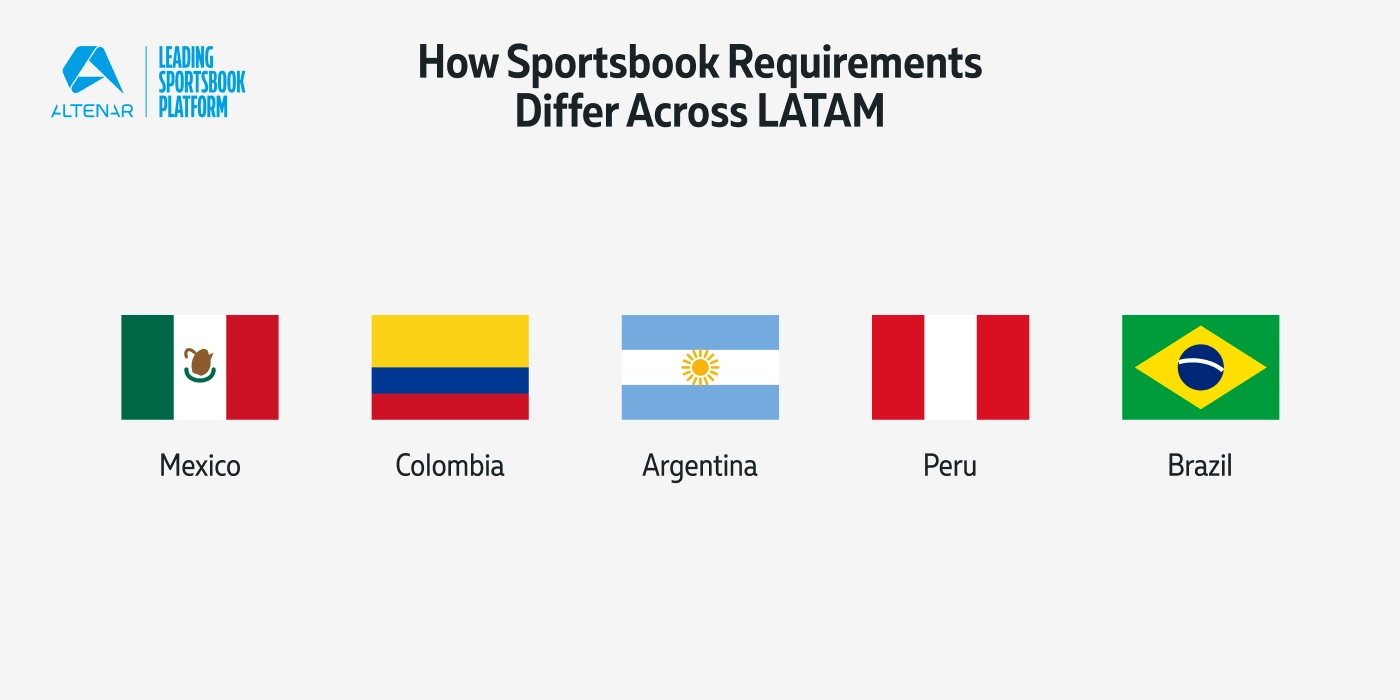
Mexico, Colombia, Argentina, Peru and Brazil present different challenges, some tied to customer preferences and others that reach deeper into sportsbook operations.
The following comparison highlights where those differences can have the greatest impact on an operator's product decisions.
| Market | Main localisation challenge | Sportsbook product considerations |
|---|---|---|
| Mexico | Football alongside significant interest in US sports | Sports coverage, homepage priorities, betting market selection and promotional calendar |
| Colombia | Local betting preferences within an established regulatory framework | Football coverage, sportsbook controls and applicable technical requirements |
| Argentina | Different requirements across provinces and Buenos Aires City | Jurisdiction-specific configurations, market availability and promotional restrictions |
| Peru | National regulatory framework with local market preferences | Technical certification, sportsbook configuration and local sports coverage |
| Brazil | Distinct language and sporting preferences, alongside major regulatory restrictions | Regulatory feasibility before investing in market-specific sportsbook configuration |
Although the same sportsbook technology may support more than one of these countries, the decisions operators make about its configuration can vary considerably.
Market-by-Market Sportsbook Requirements
Mexico: Balancing Football with a Broader Sports Audience
Mexico presents an interesting challenge for sportsbook operators because football's popularity exists alongside a strong appetite for several other sports, particularly those associated with the United States. This creates opportunities for operators with sufficiently broad sports coverage, but also requires some careful decisions about what to prioritise.
Liga MX, international football and major tournaments remain important, but NFL, MLB, NBA and boxing also deserve attention. Operators should consider how these competitions influence their event coverage, betting markets and promotional calendars.
Language and terminology are another consideration. Mexican Spanish should guide betting terminology, promotional messages and customer communications rather than relying on translations developed for Spain or other Latin American countries.
Market entry and sportsbook operations must also comply with applicable permit arrangements under Mexico's gambling framework, overseen by the Secretaría de Gobernación (SEGOB).
What does this mean for the sportsbook product?
For operators accustomed to prioritising European or South American football, Mexico demonstrates why a broader sports offering may be necessary. But simply adding NFL, MLB and NBA markets to an existing sportsbook isn't necessarily enough.
The key considerations are how prominently those competitions are featured, whether the available betting markets reflect local demand, and how resources are allocated throughout the sporting calendar.
For example, an operator may already offer extensive NFL coverage, but if the competition is difficult to find or receives little attention on the homepage, that coverage may not deliver its full commercial value.
An operator's experience in other LATAM markets can provide a useful starting point, but decisions about sports coverage, homepage configuration and promotions in Mexico need to be informed by the audience it actually serves.
Colombia: Local Betting Preferences and Regulatory Requirements
Colombia offers a useful contrast with Mexico. Football remains central to the sportsbook offering, but operators must also work within an established national regulatory framework that influences how betting services are operated.
Colombia's Categoría Primera A, national team fixtures, Copa Libertadores and major European competitions all warrant attention. Operators should consider how domestic fixtures and local rivalries influence their betting markets and promotional schedules.
Coljuegos administers Colombia's online gambling framework. For sportsbook operators, this means that applicable technical standards, regulatory controls and responsible gambling obligations need to be accommodated alongside decisions about sports coverage and betting functionality.
What does this mean for the sportsbook product?
Colombia demonstrates why localisation involves more than adapting the betting offer.
A sportsbook may already have strong football coverage and trading capabilities, but these must operate within the requirements of Colombia's regulated market. Operators need to consider whether their existing market configurations, betting controls and promotional features are appropriate for local operations.
The practical challenge is accommodating these requirements without unnecessarily duplicating the technology and operational resources already supporting the business.
Argentina: One Country, Multiple Regulatory Requirements
Argentina presents a rather different challenge for sportsbook operators. While its strong football culture creates familiar opportunities for operators already active in LATAM, the country's gambling regulations are established at provincial level, with Buenos Aires City operating under its own framework.
This means localisation requirements can vary even within the same country.
Argentina's Primera División, the Boca Juniors–River Plate rivalry, national team fixtures and major international competitions are key considerations. Basketball and rugby also offer opportunities to broaden coverage beyond football.
The greater operational challenge, however, comes from regional regulation.
Buenos Aires City regulates online gambling through LOTBA, while Buenos Aires Province operates under its own licensing framework administered by the Instituto Provincial de Lotería y Casinos (IPLyC). Authorisation in one jurisdiction does not automatically permit operations in another.
Jurisdiction-specific requirements can affect player eligibility, technical certification, sportsbook controls and reporting. Advertising and promotional activities must also comply with applicable restrictions.
What does this mean for the sportsbook product?
Argentina demonstrates why configuring a sportsbook for a country isn't always the same as preparing it for every jurisdiction within that country.
An operator might use the same underlying technology and sports coverage across several provinces, but still need different configurations for market availability, betting controls and promotions.
For operators planning expansion across Argentina, the important question is whether these differences can be managed within a shared sportsbook infrastructure rather than treating every jurisdiction as a separate product.
Peru: A National Framework with Local Product Requirements
Peru shares many sporting interests with its South American neighbours, but its regulatory requirements create a different set of considerations for sportsbook operators.
Unlike Argentina's with its provincial approach, Peru has a national framework governing remote sports betting, making the requirements more consistent across the country.
Peru's Liga 1, national team fixtures, Copa Libertadores and major European football competitions provide important opportunities. Operators can also consider volleyball and other sports where local audience demand justifies additional coverage.
Remote sports betting is regulated by MINCETUR under Law No. 31557 and its implementing regulations. Peru requires authorisation and technical certification of sportsbook platforms and relevant components, alongside applicable operating and regulatory requirements.
What does this mean for the sportsbook product?
Peru illustrates how a centralised regulatory framework can simplify certain aspects of multi-market planning without eliminating the need for local adaptation.
An operator may be able to reuse much of its existing sportsbook technology and football coverage, but the platform must still satisfy Peru's certification and technical requirements.
The important distinction is between having a sportsbook that can serve Peruvian customers and having one that is properly configured and authorised to operate in Peru.
Brazil: A Regulatory Exception
Brazil differs from its Spanish-speaking neighbours in several key respects. Its language, sporting culture and payment environment create specific requirements for sportsbook operators.
Brazilian Portuguese requires its own betting terminology, customer communications and promotional content rather than adaptations of Spanish-language material.
The Brasileirão, Copa do Brasil, regional football rivalries and major international competitions are also central to understanding Brazilian audience preferences.
However, recent regulatory developments have introduced a more fundamental consideration: whether operators can legally offer sports betting at all.
As described in the current regulatory context, Brazil's September 2026 prohibition on fixed-odds sports betting presents a barrier to market entry.
For operators, this changes the immediate product question. Before deciding how to adapt sports coverage, trading configurations or the frontend experience, they need to establish whether the regulatory environment permits the proposed operation.
Brazil therefore illustrates an important point: a market can present substantial localisation requirements and commercial potential while remaining unsuitable for immediate launch planning.
What Can Operators Standardise Across LATAM?
Having explored the differences between individual LATAM markets, the next question is how much of a sportsbook operation actually needs to change from one country to another.
For operators already established in the region, there is considerable value in retaining the technology, trading expertise and operational processes they have developed. Building separate systems for every country would add unnecessary costs and work, making it harder to manage an expanding business.
But there is an important distinction between sharing technology and applying the same operating arrangements everywhere.
A common sportsbook platform can support several markets while allowing individual configurations to reflect local customer preferences, commercial priorities and regulatory requirements.
The following comparison shows which aspects of the sportsbook can remain consistent and which may require a different approach.
| Can remain consistent | May require local configuration |
|---|---|
| Core sportsbook platform | Sports and competition priorities |
| Trading and risk management infrastructure | Market availability, margins and betting limits |
| Frontend framework | Language, homepage layout and content hierarchy |
| Promotional management technology | Local campaigns, eligibility and promotional settings |
| Centralised operational support | Market-specific trading and operational priorities |
The advantage of this approach is that operators can build on their existing capabilities without forcing every market into the same operating model.
Consider an operator expanding from Mexico into Colombia. It may already have the technology to offer local football competitions, manage betting markets and support promotional campaigns. Rather than developing these capabilities again, the operator can focus on the configurations that need attention in Colombia.
Of course, this depends on how much flexibility the underlying sportsbook technology actually provides. A platform that supports multiple languages or currencies isn't necessarily equipped to accommodate different betting controls, market-specific rules or regulatory requirements.
Operators should therefore establish which changes can be handled through existing configurations and which may require additional product work.
Prioritising Localisation Before Launch
Not every localisation requirement has the same impact on a new market launch.
Some are essential for operating within the market's regulatory framework. Others determine whether the sportsbook offers a competitive experience from the beginning, while further adjustments can be made as operators learn more about local betting activity.
A practical approach is to consider three priorities:
-
Regulatory and technical readiness. Confirm that the sportsbook meets applicable requirements for the intended market or jurisdiction, including necessary technical approvals and product restrictions.
- A competitive local betting offering. Prioritise the competitions, betting markets, language and frontend configurations that are most relevant to the intended audience.
- Ongoing product optimisation. Review trading settings, promotional performance and customer engagement to identify where further local adjustments may improve results.
This allows operators to focus on the changes that matter most before launch, instead of trying to introduce every possible localisation feature.
It also makes future expansion easier to manage. When a new country introduces different requirements, operators can focus on the configurations that need attention rather than reconsidering the entire sportsbook infrastructure.
Expanding Across LATAM Without Rebuilding Your Sportsbook for Each New Market
The real test of a multi-market sportsbook platform comes when operators need to make changes. Different betting priorities in Mexico, jurisdiction-specific requirements in Argentina or technical standards in Peru shouldn't automatically mean reconsidering how the entire sportsbook operates.
This is where the choice of technology partner matters most.
Operators need the freedom to configure individual markets while retaining the trading capabilities, risk management and operational infrastructure that already support their business. They also need to accommodate new brands and jurisdictions without introducing unnecessary duplication.
Altenar's sportsbook technology is designed around this approach. Its configurable platform allows sports coverage, betting markets, margins, limits, homepage configurations and promotional features to be adapted to different audiences. Operators can work with their dedicated Altenar Client Success Manager and support team to implement the configurations required for individual markets.
Its trading and risk management services also provide an established operational foundation, allowing operators to build on existing capabilities as their businesses expand.
Ultimately, the question is not just whether an existing sportsbook can support another country, but how efficiently it can accommodate the next one, and the one after that.
The ability to adapt without unnecessary duplication can make a real difference when expanding across LATAM. Book a software demonstration today and discover how Altenar's flexible sportsbook technology can support your expansion plans.