
Key takeaways
-
Attention vs Conversion: Getting clicks is only the first step. Real success depends on whether players find a relevant market, competitive price, and timely opportunity that leads to a bet.
-
Trading Shapes Experience: Market availability, odds, event coverage, and timing directly influence whether players can act on the opportunity that first attracted them.
-
Smarter Personalisation: Personalisation must combine player behaviour with current events, active markets, pricing, and timing to deliver relevant betting opportunities in real time.
-
Opportunity-Led Engagement: Engagement can start with a valuable market, identifying interested players rather than relying solely on static customer segments.
-
Quality Over Quantity: More engagement isn't always better. Operators must balance player relevance with pricing, risk liability, and trading exposure.
-
Connected Data Drives Results: CRM data, sporting context, market availability, pricing, and trading conditions must work together to turn attention into active bets.
From Engagement to Bets: What Makes a Sportsbook Stand Out?
You may have noticed that sportsbooks have become increasingly sophisticated at attracting a player’s attention. In practice, personalised recommendations, notifications, promotions and other engagement features can identify an interest, choose a moment and give someone a reason to return to a sportsbook.
And when players click and interact, the numbers suggest those features are doing their job. But what happens when the player reaches the sportsbook?
The simple truth is that if the relevant market is unavailable, the price has changed, or what they find simply isn’t compelling enough to bet on, how successful was that engagement really?
That is where attracting attention and generating a bet become two different things entirely. Getting the right player to respond is only one half of the equation. What those players find when they arrive in terms of the markets available, the odds on offer and whether the opportunity is still there, etc., will help determine whether that attention becomes a bet.
So You Got the Player's Attention. What Happens Now?
Let’s consider the betting journey for your player for a moment. They first receive a notification or see a recommendation, something catches their interest, and they click through to the sportsbook. Marvellous, so far, everything has worked as it should. But the journey is not notification, then click, then success. Several steps still remain between attracting attention and getting a bet.
Perhaps the player arrives to find only a limited selection of markets. The odds have adjusted since the promotion caught their eye. The market they expected has disappeared, or finding it requires more searching than anticipated. The reality is, during live sport, even a short delay can mean the recommendation no longer aligns with what is happening in the event.
Typically, this won’t become apparent in the initial engagement metrics. Impressions, clicks, visits, and interactions can tell an operator whether something attracted attention, but reveal much less about whether the betting opportunity delivered. The commercial outcome is found further along the journey - notification or recommendation, click, sportsbook, relevant betting opportunity, bet.
So ultimately, improving the beginning of that journey while overlooking the end can create more activity without producing the outcome the operator expected. Winning attention and converting that attention are therefore two different problems. Solving the second requires the operator to look beyond the engagement feature and assess what the sportsbook is actually offering when the player arrives.
Trading is Part of the Player Experience
This is where trading enters the conversation. Players are unlikely to think about trading when they use a sportsbook. They simply experience the decisions it produces, like which events are covered. How many markets can they choose from? What odds are available? These factors influence whether a player finds a betting opportunity interesting enough to act on.
Imagine, for example, that a basketball bettor receives a personalised recommendation around a game they regularly follow. The message does its job and brings them into the sportsbook. But perhaps they are interested in player props and the available selection is limited. Or the price that originally made the opportunity attractive has changed by the time they arrive.
The engagement may have correctly identified the player, sport and event, yet still fall short because the underlying betting proposition no longer matches the reason they responded. That is why trading alignment shouldn't simply mean closer coordination between trading and marketing teams. The more useful objective is to connect what the sportsbook promotes with what it can deliver.
Personalisation Shouldn’t Stop With the Player
This also changes how operators think about personalisation. Much of the discussion around sportsbook personalisation starts with a straightforward question: What does this player like?
Behavioural data can provide increasingly detailed answers. Perhaps the player follows Arsenal, regularly bets on football, prefers player props, tends to bet in-play, or repeatedly returns to particular competitions. Those data points can help determine which content, recommendations or promotions are most likely to attract their attention.
But knowing the player is only half of the equation. The sportsbook also needs something relevant to offer them. That, in itself, raises a second question: What worthwhile betting opportunities does the sportsbook have for this player right now?
Consider the difference. Knowing that somebody regularly bets on Premier League player props might justify sending them another football recommendation. But personalisation becomes much more useful when you can consider that preference alongside today's fixtures, the player markets currently available, their prices, and how close those matches are to kick-off. During live play, the context becomes even more immediate.
The decision is no longer based simply on player preference, but potentially on: player preference + current event + available market + price + timing and context.
This moves personalisation from deciding which message is most likely to interest a player towards deciding which actual betting opportunity is most relevant to them at that moment.
The difference is important. A sportsbook can become exceptionally good at personalising communications while leaving the betting experience itself largely unchanged. Connecting player behaviour with what is happening across the sportsbook creates the opportunity to personalise something much more valuable, and that is what the player discovers when they arrive.
What If the Betting Opportunity Triggered the Engagement?
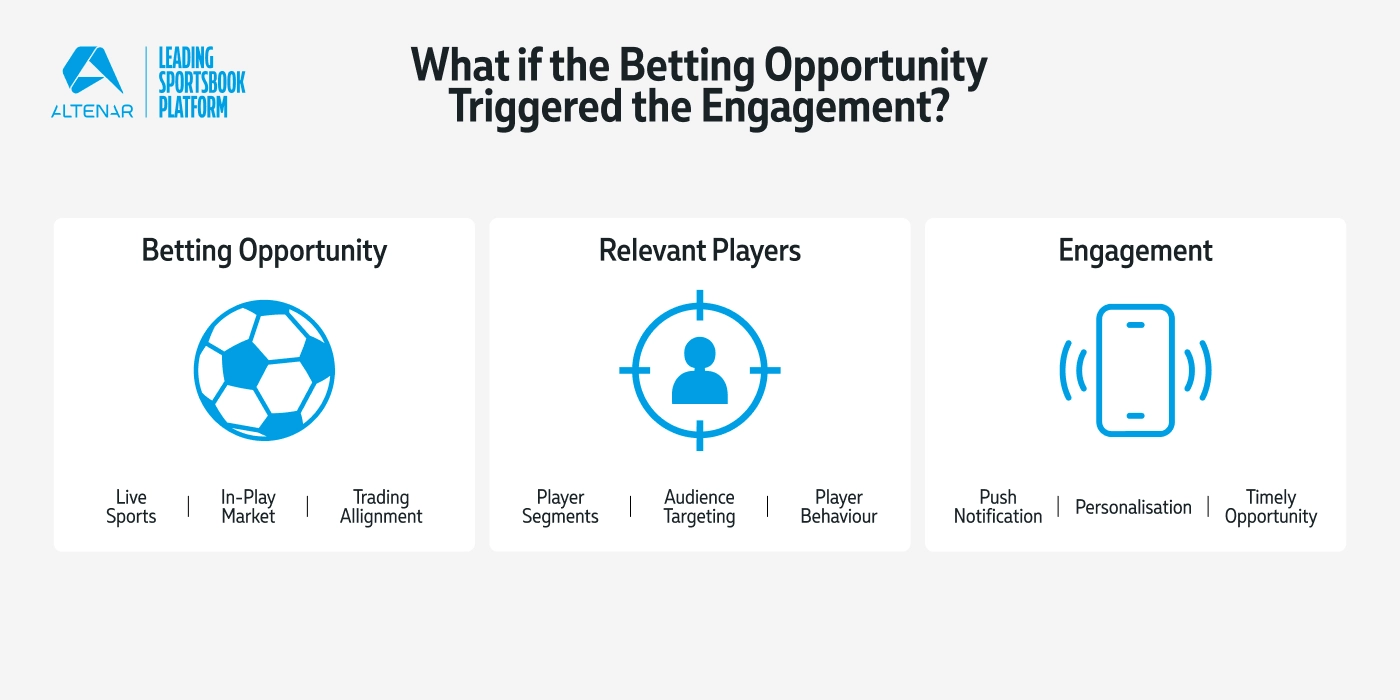
So far, the player has been the starting point for personalisation, meaning we understand what someone likes, then find something relevant to show them. But trading alignment introduces another possibility. What if the sportsbook could sometimes start with the betting opportunity instead?
Imagine then, if an in-play market becomes particularly relevant as a match develops. The market is available, the price meets the operator’s criteria, and the sporting context makes the opportunity timely. Rather than waiting for a predetermined campaign to reach a broad player segment, that opportunity could trigger the identification of customers whose previous betting behaviour suggests genuine interest.
The direction of engagement then effectively reverses, from betting opportunity to relevant players to engagement. It effectively starts with something worth promoting and works backwards to determine who might be interested in such a bet. That could be especially useful during live sport, where the relevance of individual betting opportunities can change far more quickly than conventional customer segments.
It also gives operators another way to think about real-time engagement. Speed remains important, but being fast is not the objective by itself. The more valuable capability is recognising when the sportsbook has an opportunity worth communicating and connecting it with the players most likely to find it relevant.
Instead of only asking ‘What should we show this player?’, engagement can therefore ask a second question: ‘We have something worth betting on right now. Who should know about it?’
More Engagement Is Not Always Better Engagement
There is another reason to think carefully about which betting opportunities drive engagement. From an operator’s perspective, generating more activity is not necessarily the only objective.
If an engagement system is measured primarily by clicks, sportsbook visits, or bets placed, the logic is fairly straightforward. Find the opportunities most likely to generate another interaction. But a trading operation has other information that could change that decision.
Two markets might be equally relevant to a player, for example, while presenting very different considerations for the sportsbook. Their pricing may differ. The operator may already have significant exposure on one outcome. One market may attract plenty of activity but offer relatively little commercial value, while another presents a better opportunity for both the player and the sportsbook.
That opens up a more useful question than simply ‘What is this player most likely to bet on?’ Can the sportsbook identify an opportunity that is relevant to the player and commercially appropriate for the operator?
This is where trading alignment can bring more than real-time market information into engagement. Pricing, liability, exposure and other trading considerations can potentially help determine which opportunities are worth highlighting in the first place. The objective then becomes more sophisticated than maximising interaction. It is about finding the right fit between what the player is likely to value and what the operator has good reason to put in front of them.
Six Inputs - One Engagement Decision
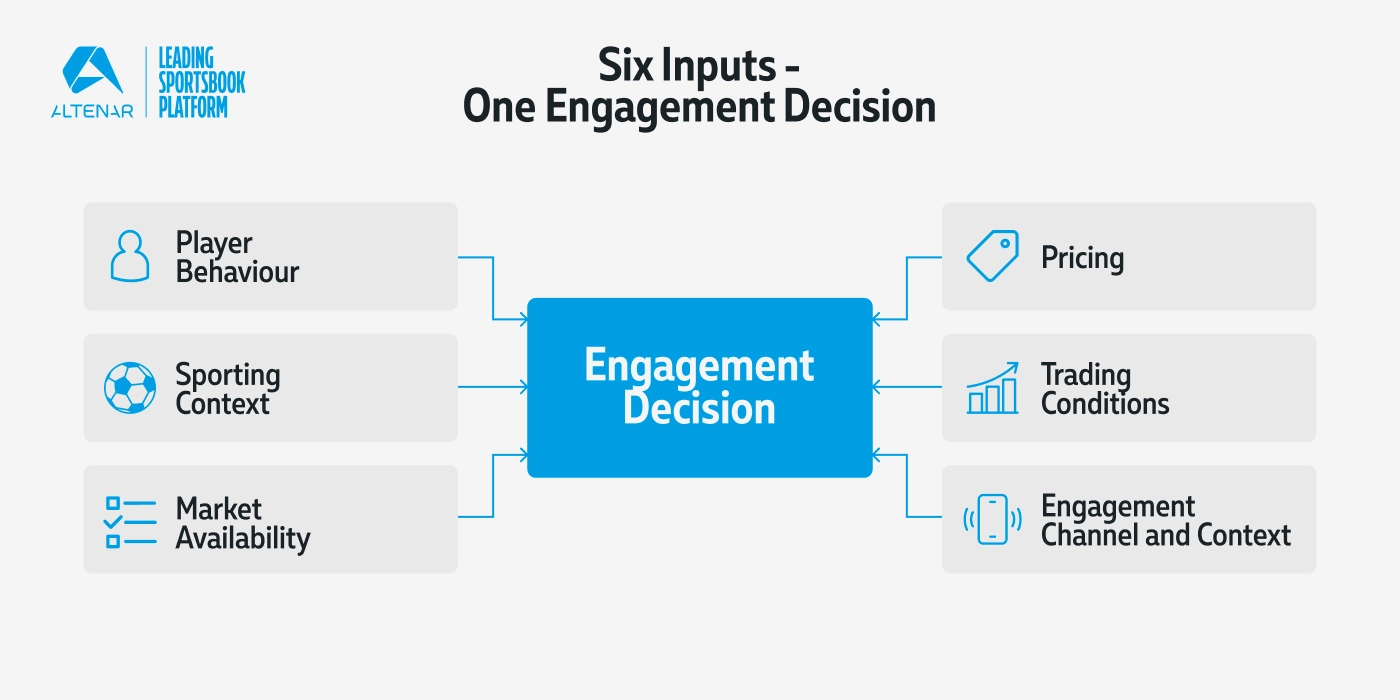
None of this, however, requires operators to abandon the engagement tools they already use. The more useful question is whether those tools have enough access to what is happening elsewhere in the sportsbook to make better decisions.
A useful starting point is to look at the information involved in deciding whether a betting opportunity is worth putting in front of a particular player.
| The sportsbook needs to understand | The question it helps answer |
|---|---|
| Player behaviour | What is this player interested in? |
| Sporting context | What is happening in the event right now? |
| Market availability | What can the player actually bet on? |
| Pricing | What opportunity are we presenting? |
| Trading conditions | Does highlighting this opportunity make sense? |
| Engagement channel and context | Where and when should the player encounter it? |
Most operators will already have much of this information somewhere. The bigger question is whether it can be considered together and quickly enough to influence what the player sees.
If player behaviour lives primarily in CRM, live sporting context elsewhere, market and pricing information in trading, and engagement decisions in another platform, each system can do its part while the overall experience stays disconnected. That makes the integration between them just as important as the capability of any individual engagement feature.
For product and technology teams, this creates a useful test when assessing their current setup or evaluating new sportsbook technology. How easily can information from one part of the sportsbook change a decision being made somewhere else?
The closer those inputs can work together, the easier it becomes to move from identifying a player worth engaging to identifying a relevant opportunity for that player at a moment when it is actually worth presenting.
The sportsbook itself becomes the engagement engine
The direction of travel, then, may be less about adding another engagement feature and more about bringing together capabilities that already exist across the sportsbook.
Trading understands the markets, prices and conditions under which bets can be offered. Sports data provides the context of what is happening in an event. Player data helps identify what is likely to be relevant to an individual. Engagement technology determines what gets presented and when, while the sportsbook product determines how easily the player can act on it.
The opportunity presents itself when those capabilities stop operating as separate entities. A changing event, an available market, an appropriate price and evidence of player interest can collectively become reasons to present an opportunity.
That is a considerably different proposition from simply becoming better at generating clicks. It also makes the connections between trading, data, personalisation, engagement and the sportsbook itself increasingly important. Altenar’s approach brings these capabilities within the wider sportsbook environment, giving operators greater scope to connect what they know about players with the betting opportunities available to them.
Getting attention will remain important. The difference may increasingly lie in what the sportsbook does with that attention once it has it.
What could your engagement strategy achieve with a closer connection to the sportsbook behind it? Book a software demonstration with Altenar and explore how trading, data and personalisation can work together to make better use of player attention once it reaches the sportsbook.