
Key Takeaways
-
Limited control creates hidden costs: Repeated development delays, manual workarounds and provider dependencies can slow decisions, reduce efficiency and cause missed commercial opportunities.
-
Speed and precision matter: Operators need to make changes exactly where required and quickly enough to respond to customer behaviour, market conditions and emerging opportunities.
-
Control supports better decisions: Greater flexibility across product, trading, CRM and data allows teams to act on insights rather than adapting their strategies to platform limitations.
-
Renewal reveals real limitations: Contract renewal gives operators a chance to identify which ideas were delayed, opportunities missed and processes made harder by their current provider.
-
Growth changes control needs: A platform that worked well at launch may become restrictive as the sportsbook expands, enters new markets and develops more capable internal teams.
-
The right balance is key: Operators do not need to control everything themselves; they need flexibility in areas where greater control creates value while retaining specialist provider expertise where it matters.
Why Sportsbook Control Matters More as You Grow
Most operators today have experienced this situation. Your team wants to make what seems like a straightforward change, only to find it requires provider support, development work or another workaround. When it happens once or twice, you can put it down to the challenges of running a sportsbook. But when the same frustrations keep appearing, it is worth asking whether they are starting to hold the business back.
The difficulty is that limited control is not usually one obvious problem. Invariably, it shows up in many smaller issues, like a trading adjustment that cannot be applied precisely enough, or customer data that cannot be acted on immediately. Each issue is manageable on its own, but those compromises add up over time. The question eventually becomes ‘does your team have enough control to make the decisions your business needs, when they need to make them?’
Where the Cost of Limited Control Begins to Show
When choosing a sportsbook provider, it is natural to focus on what you can assess upfront. Functionality, sports and market coverage, reliability, integrations, support, and commercial terms are among the primary areas of focus. What is much harder to evaluate is how the platform will respond to the hundreds of smaller decisions your teams make once the sportsbook is live.
This is where it is generally useful to ask three questions.
-
Can you make the change you want?
-
Can you apply it exactly where it is needed?
-
And can you do it while the opportunity still matters?
A limitation in any one of these areas will not be minor, since high costs can occur when compromises become routine.
More to the point, repeated constraints and limitations can start changing the way staff make decisions. Instead of asking what would produce the best commercial outcome, a pattern of asking what the platform will allow them to do starts to emerge. Ideas are simplified, opportunities are judged against implementation effort, and workarounds become part of normal operations. At that point, the cost of limited control is not simply that which takes too long. It is the growing distance between what the business wants to do and what it can realistically execute.
So, How Much Control Does Your Sportsbook Really Need?
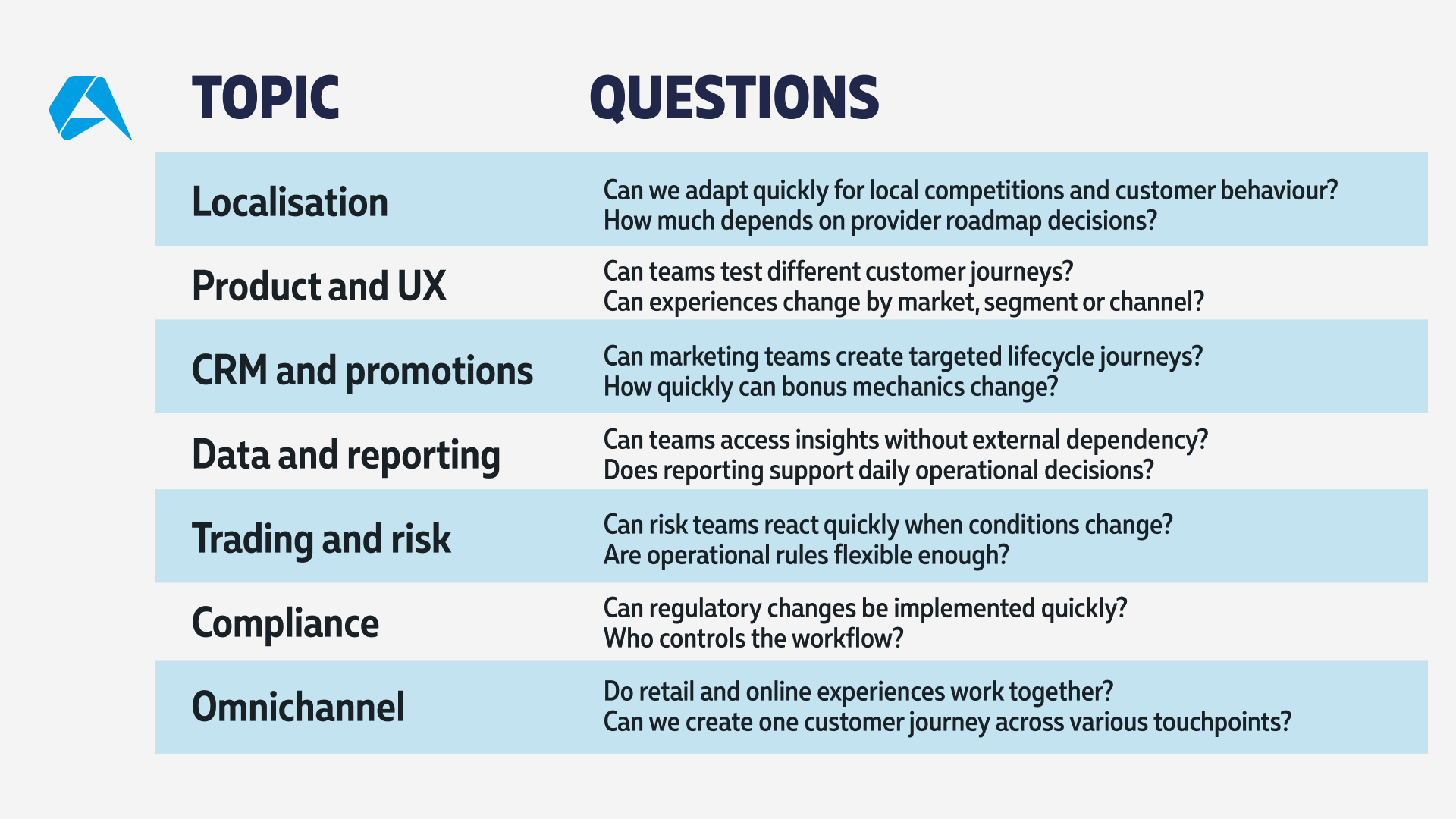
Having more control is not automatically better. That’s to say, not all operators need, or would benefit from, managing every aspect of their sportsbook themselves. What matters is having sufficient control where your internal teams have the knowledge, data and experience to make better decisions for the business and its customers.
In practice, there are several areas where having the right level of control can make a measurable difference:
Product, UX and localisation
Player behaviour does not follow the same pattern across every market, yet that knowledge has limited value if your product team cannot act on it. Perhaps customers favour different competitions, use the sportsbook differently or respond better to a different mix of pre-match and live content. The advantage comes from being able to turn those observations into changes, measure what happens and adjust again. When routine UX decisions depend on external development, not only does the initial change become slower, but the entire learning cycle slows with it.
Trading and risk
Trading control is as much about accuracy as it is speed. If exposure increases around one competition or customer group, a risk team should not have to change limits or margins across a much wider part of the sportsbook simply because the platform cannot distinguish between them. The more precisely teams can manage odds, margins, limits and bet acceptance, the more accurately they can respond to risk without unnecessarily changing the experience for everyone else.
CRM and promotions
Good customer insight is only commercially useful when marketing teams can act on it. Knowing that a particular segment is likely to return for a local derby, for example, is not so advantageous if the right promotion cannot be configured, targeted and delivered before maximum interest. Greater control allows CRM teams to connect customer segmentation more closely with execution, rather than simplifying campaigns to fit the tools available.
Data and reporting
Of course, acting on customer insight ultimately depends on being able to access it. The same applies across the sportsbook, where having more data does not necessarily give more control. What matters is how quickly they can get from a question to an answer they can use. If performance changes unexpectedly during a major event, a report delivered several days later, for example, may explain what happened, but the opportunity to respond has already gone. Good reporting should shorten the distance between identifying a problem, understanding it and then deciding what to do next.
Roadmap and integrations
There is no escaping the reality that some changes will always require provider involvement, and there is nothing inherently wrong with that. The problem is when ordinary commercial requirements repeatedly become development projects. If new integrations, configurations or product changes depend on custom work, the operator's own priorities gradually become tied to the provider's. The focus is subsequently not whether you ever need external support, but whether that dependency routinely determines what your business can do, and when it can do it.
The Contract Renewal Audit Operators Should Conduct
The interesting thing about renewing a sportsbook provider is that you are making a very different decision from the one you made a few years earlier. Back then, much of your assessment was necessarily based on what you thought you would need. This time, however, you know.
Your product team knows which changes took too long. Trading knows where the controls proved to be too broad or restrictive. Marketing knows which campaigns were harder to execute than expected. And across the business, your people will know exactly where manual processes and other workarounds have appeared.
So, ask your teams what they would change if they could. Which ideas never made it beyond the discussion stage because they were too difficult to implement? Which opportunities were missed while waiting for development or provider support? Where have the provider's priorities started influencing your own?
There is no reason to assume the answer is always more control. Taking greater responsibility for something your provider already does extremely well may simply create more work and cost.
Instead, look for the areas where your teams know they could make better decisions if the platform gave them more room to do so. That is the control worth thinking about when contract renewal comes around.
Control Levels that Change with Growth
There is also another good reason to review how much freedom your sportsbook teams actually need when renewal time arrives. Your business is probably not the same one that chose the platform in the first place.
As your sportsbook grows, so do the demands you place on it. What gave you everything you needed a few years ago may feel very different once the business is larger, more experienced and competing in more markets. In other words, what worked at launch can gradually become restrictive, even when the provider is still doing a perfectly good job.
That is why asking whether the sportsbook still works is not enough. Of course it works. The more useful question is whether it still gives the business enough room to do what it needs to do now.
That does not mean taking everything in-house or demanding control over every part of the sportsbook. Quite the opposite. There will be plenty of areas where relying on specialist technology, trading expertise and operational support remains the better choice.
What operators need is the ability to change that balance over time. As their own capabilities grow, they should be able to take greater control where it makes commercial sense without giving up the expertise and support they still value elsewhere.
Ultimately, future-proofing a sportsbook relationship means not trying to predict everything the business will need five years from now, but choosing a platform and provider that give it enough room to change as those needs inevitably evolve.
If your sportsbook needs have outgrown your current set-up, book a personalised demonstration with Altenar to see how greater flexibility and operational control could support the next stage of your growth.