
DISCLAIMER
This information is not intended to be legal advice and is solely extracted from open sources. It should not be relied upon as a substitute for professional legal advice, and Altenar does not accept any liability for its use.
Key Takeaways
-
The Current Legal Situation: Under Law No. 2020-480, Côte d'Ivoire operates a unique "dual-regime" system that is neither a pure state monopoly nor fully liberalized, dividing games into a concession regime and an authorization regime.
-
Financial and Market Growth: The market is growing rapidly, with the total gambling sector estimated at around US$564.8 million in 2025 and sports betting accounting for roughly US$121.2 million.
-
Digital and Infrastructure Trends: Long-term investment is supported by expanding technology, as the country counted approximately 12.8 million internet users and a 40% internet penetration rate at the start of 2025.
-
The Strategic Concession Regime: Commercially significant activities like sports betting, online gambling, and lotteries are reserved under an exclusive state concession held by LONACI, though private operators can still participate through specific structural arrangements.
-
The Authorization Regime and Regulators: Land-based casinos and slot venues must get direct approval from the central regulator, the ARJH, while operators must also follow strict financial rules set by the financial intelligence unit, CENTIF.
-
Market Challenges for Operators: Entering the market requires navigating complex regulatory relationships due to the concession structure, meeting strict technical software certifications, and dealing with a lack of public transparency regarding licensing fees.
Côte d'Ivoire Gambling Law and Regulatory Framework Explained
Many operators will dismiss Côte d'Ivoire before they’ve properly researched and analyzed the market. Some assume the gambling sector remains dominated by state-controlled operations with little room for private participation. Others see a French-speaking African jurisdiction and expect a small lottery-driven market with limited commercial potential.
The reality is considerably more nuanced. Côte d'Ivoire now has a dedicated gambling regulator, a modern legal framework, regulated online gambling, and a growing portfolio of domestic and international operators. Combined with rising internet penetration, strong soccer betting demand, and one of West Africa's largest economies, the country is increasingly attracting attention from operators looking beyond the continent's traditional gambling hotspots.
This guide explores whether that attention is justified and what operators need to understand before entering the market.
Early development of gambling in Côte d'Ivoire
Informal betting on sporting events, card games, raffles, and lottery-style activities has been commonplace in Côte d'Ivoire for decades. For much of the country's post-independence history, however, gambling remained largely under state control and was organized through a limited number of authorized channels. The sector developed gradually, with regulation focused primarily on traditional lottery products rather than on the broader commercial gambling market.
A major milestone in the development of the modern gambling sector came with the establishment of the Loterie Nationale de Côte d'Ivoire (LONACI), which became the central institution responsible for organizing and promoting lottery and betting activities. For many years, LONACI operated as the dominant player in the sector, reflecting a regulatory philosophy that viewed gambling as an activity requiring close state oversight. While this model provided some stability, it was designed for a largely land-based market that was considerably smaller than the one that would emerge later.
The rapid growth of sports betting across Africa during the 2000s and 2010s began to transform the Ivorian gambling scene. Increased internet connectivity, widespread mobile phone adoption, and growing interest in international soccer created demand for new betting products and digital gambling services. As private operators entered the market and online gambling became more accessible, the limitations of the existing framework became increasingly apparent. Regulation was underdeveloped, enforcement powers were limited, and the legal status of some gambling activities remained uncertain.
The turning point came in 2020 with the adoption of Law No. 2020-480 on the Legal Regime of Games of Chance. The legislation fundamentally restructured the sector by creating a modern regulatory framework and establishing the Autorité de Régulation des Jeux de Hasard (ARJH) as the national gambling regulator. Rather than adopting a fully liberalized licensing system, the law introduced a dual framework based on concessioned and authorized gambling activities, reinforcing the government's desire to encourage market development while maintaining control and oversight of key gambling products.
Since then, additional compliance requirements, stronger enforcement measures, and increased supervision of online gambling have continued to influence market development. Today's regulatory framework reflects Côte d'Ivoire's transition from state-dominated gambling to a more sophisticated system that accommodates both traditional and digital forms.
Timeline of key milestones
Côte d'Ivoire's gambling sector evolved from a state-controlled lottery model into one of the most sophisticated regulatory frameworks in Africa. The following milestones highlight the key developments that have shaped the modern market:
1970: The Loterie Nationale de Côte d'Ivoire (LONACI) is established, creating the foundation for organized lottery and betting activities under state supervision.
1972: LONACI launches its first national lottery products.
1980s: Lottery and pari-mutuel betting products expand, with gambling activity primarily concentrated within state-controlled channels.
1990s: Economic liberalization encourages growth in private-sector entertainment and gaming activities, while sports betting begins to attract greater public interest.
2000s: Commercial casinos and betting establishments became increasingly available in major urban centers, particularly Abidjan.
2010s: Rapid growth in internet access, mobile technology, and international soccer betting drives demand for online gambling products.
2020: Law No. 2020-480 on the Legal Regime of Games of Chance was enacted, establishing the foundation of Côte d'Ivoire's modern gambling framework and creating a dual system of concessioned and authorized gambling activities.
2021: The Autorité de Régulation des Jeux de Hasard (ARJH) becomes operational as the country's central gambling regulator.
2021: Decree No. 301/2021 establishes the organization and operational structure of the ARJH.
2023: Decrees No. 2023-945 and No. 2023-946 are adopted, implementing the concession and authorization regimes established under the 2020 law and providing detailed rules for gambling operations.
2024: ARJH intensifies enforcement against illegal gambling operations, including actions targeting unauthorized slot machine operators and illegal gaming equipment.
2024–2025: Regulation moves toward online gambling supervision, software certification, responsible gambling measures, and enhanced monitoring of digital betting activity as the market continues to mature.
The framework for gambling operations today
The modern gambling sector in Côte d'Ivoire is essentially governed by Law No. 2020-480 of May 27, 2020 on the Legal Regime of Games of Chance. The legislation replaced an outdated regulatory framework with a comprehensive governance model that accommodates both traditional and digital gambling activities.
Prior to the adoption of the law, gambling regulation was largely centered on state-controlled lottery products and a collection of rules that had not been designed for a rapidly evolving commercial market. The growth of online betting, for example, increased participation in sports wagering, and the emergence of new gambling technologies created a need for a modern legal framework capable of addressing both market development and consumer protection concerns.
Law No. 2020-480 was enacted with several key objectives. These include establishing a coherent legal framework for gambling activities, preventing excessive gambling, combating fraud and money laundering, safeguarding consumers, and ensuring that gambling operations contribute to national economic development. The law also created the Autorité de Régulation des Jeux de Hasard (ARJH), which today serves as the country's central gambling regulator.
The scope of the legislation is broad, covering virtually all major forms of gambling. This includes lotteries, sports betting, horse-race betting, casino gaming, slot machine operations, promotional lotteries, virtual betting products, and online gambling services. Ultimately, the law recognizes digital gambling activities and provides a legal basis for regulating online gambling products, emphasizing the growing importance of mobile and internet-based betting in the Côte d'Ivoire betting market.
The dual-regime structure
The defining feature of gambling regulation in Côte d'Ivoire is the dual-regime structure introduced by Law No. 2020-480. Rather than adopting a fully liberalized licensing model, the legislation separates gambling activities into two distinct categories: activities subject to a concession regime and activities requiring prior authorization.
This distinction is key to understanding how the market operates and explains why Côte d'Ivoire differs from many other African gambling jurisdictions.
The concession regime
Under Articles 8 and 9 of the law, certain gambling activities are reserved for an exclusive concession framework. These activities are considered strategically important and are operated within a system centered on the Loterie Nationale de Côte d'Ivoire (LONACI), which serves as the State's concessionaire.
Activities falling within the concession regime include:
-
Lottery products
-
Sports betting
-
Horse-race betting
-
Virtual betting
-
Online gambling
-
Online casino games
-
Online slot machine games
The concession granted by the State is exclusive and is not subject to ordinary market competition. However, this does not mean that gambling services are offered solely by LONACI itself. In practice, several private operators participate in the market through arrangements operating within the concession framework, creating a structure that combines elements of state control with private-sector participation.
This approach allows the government to maintain oversight of the most commercially significant gambling activities while still encouraging investment, technological development, and market growth.
The authorization regime
The second component of the framework is the authorization regime established under Article 10 of the law.
Unlike concessioned activities, gambling products falling within this category require prior approval from the ARJH before they can be legally operated. Activities requiring authorization include:
-
Land-based casinos
-
Slot machine venues
-
Promotional lotteries
-
Charitable lotteries and similar fundraising activities
Operators seeking to conduct these activities must obtain the necessary regulatory approvals and comply with ongoing obligations relating to responsible gambling, anti-money laundering controls, technical standards, and operational integrity.
Neither a monopoly nor fully liberalized
The structure created by Law No. 2020-480 places Côte d'Ivoire in a unique position within the African gambling landscape. At first glance, the existence of an exclusive concession policy suggests a state monopoly. However, the presence of multiple private operators participating in concessioned gambling activities indicates that the market is not a traditional monopoly.
At the same time, Côte d'Ivoire cannot be described as a fully liberalized gambling market either. In jurisdictions such as Kenya and Uganda, private operators typically obtain licenses directly from the regulator and compete openly across most gambling verticals. The Ivorian model is considerably more structured, with certain categories of gambling subject to exclusive concession rights.
The result is a regulatory model that seeks to balance market growth, consumer protection, and public policy objectives. As the market continues to develop and digital gambling becomes increasingly in demand, this dual-regime structure is likely to remain the defining characteristic of gambling regulation in Côte d'Ivoire.
Gambling regulators in Côte d'Ivoire
Unlike in other African nations, regulation in Côte d'Ivoire is not concentrated within a single institution. Instead, the market is supervised through a coordinated network of institutions with distinct responsibilities. Together, these institutions help maintain the balance between market development, consumer protection, and state oversight that lies at the heart of the Côte d'Ivoire gambling model.
Autorité de Régulation des Jeux de Hasard (ARJH)
The Autorité de Régulation des Jeux de Hasard (ARJH) is the central gambling regulator in Côte d'Ivoire and the institution with which operators will interact most frequently. Created by Law No. 2020-480 (Articles 24 and 25), the ARJH is responsible for supervising gambling activities, enforcing regulatory requirements, promoting responsible gambling, and combating illegal gambling operations. The regulator also oversees the authorization regime, monitors operator compliance, conducts inspections, and approves gaming software before it can be deployed in the market.
For casinos, slot machine operators, and other authorized gambling activities, the ARJH serves as the primary point of contact throughout the licensing and compliance process. As the gambling sector continues to expand, the regulator has increasingly focused on online gambling supervision, consumer protection, and market integrity.
Loterie Nationale de Côte d'Ivoire (LONACI)
The Loterie Nationale de Côte d'Ivoire (LONACI) occupies a unique position within the country's gambling framework. Unlike a traditional state lottery operator, LONACI resides at the center of the concession regime established under Law No. 2020-480. The organization holds the State concession covering lottery products, sports betting, horse-race betting, virtual betting, and a range of online gambling activities.
This structure allows the State to retain strategic oversight of key gambling products while facilitating private-sector participation within the concession system. Understanding LONACI's role is essential for any operator considering entry into the Ivorian gambling market.
Cellule Nationale de Traitement des Informations Financières (CENTIF)
The Cellule Nationale de Traitement des Informations Financières (CENTIF) serves as Côte d'Ivoire's Financial Intelligence Unit and is responsible for overseeing compliance with anti-money laundering and counter-terrorist financing activities. Gambling operators are required to implement customer due diligence procedures, maintain transaction records, and report suspicious activities where appropriate.
CENTIF receives and analyzes these reports as part of the country's broader financial crime prevention framework. Although operators may not interact with CENTIF on a daily basis, its requirements significantly influence operational compliance programs.
Licensing and market entry requirements
On the surface, Côte d'Ivoire's dual-regime approach to its gambling markets can seem more complex than other liberalized African markets that operate under a straightforward licensing model.
However, while this structure requires careful planning, it also provides a degree of regulatory certainty that many find attractive. Understanding who can apply, which regulatory route applies to specific gambling activities, and what practical requirements must be satisfied is therefore essential before committing resources to market entry.
Who can apply?
Côte d'Ivoire does not restrict participation in the gambling sector exclusively to domestic businesses. Both local and foreign investors may enter the market, provided they operate through an appropriately structured corporate entity and satisfy the requirements established by the relevant authorities.
Gambling approvals are granted to corporate entities rather than individuals, meaning applicants should expect to demonstrate a clear ownership structure, adequate financial resources, and the operational capability to conduct gambling activities responsibly. The presence of multiple international operators demonstrates that foreign participation is possible under the current framework.
While the legislation does not expressly favor domestic applicants, regulators are likely to assess ownership transparency, beneficial ownership information, financial standing, technical capacity, and management suitability before granting approval. As a result, strong corporate governance and regulatory preparedness are likely to be important considerations throughout the application process.
Typical licensing requirements
Although the precise application process varies depending on the gambling activity, prospective operators should expect to provide substantial corporate, financial, and operational information as part of the approval process:
-
Corporate registration documents
-
Shareholder and beneficial ownership information
-
Financial statements
-
Business and operational plans
-
Technical platform documentation
-
Responsible gambling policies
-
Anti-money laundering procedures
-
Internal control frameworks
Technical and compliance expectations
Obtaining approval to enter the Côte d'Ivoire gambling market is only the beginning of the journey. Operators should also be prepared to meet a range of ongoing technical, reporting, and compliance obligations throughout the lifecycle of their business.
Under the framework established by Law No. 2020-480 (Articles 12, 13, 14, and 15), licensed and authorized operators are subject to regulatory supervision by ARJH and may be required to maintain appropriate accounting records, submit periodic reports, and comply with applicable anti-money laundering and consumer protection requirements. ARJH also places particular emphasis on the integrity and reliability of gambling systems, with gaming software and technical platforms subject to certification.
The cost of market entry
One of the more challenging aspects of evaluating Côte d'Ivoire as a gambling destination is the limited public transparency surrounding license fees, concession payments, and other regulatory charges. Unlike some jurisdictions that publish detailed fee schedules, this market does not currently provide prospective operators with a single, easily accessible overview of market-entry costs. As a result, operators should expect to engage directly with the authorities before obtaining a complete picture of the financial commitments.
That said, market entry costs are likely to extend beyond licensing alone. Operators should budget for corporate establishment expenses, legal and regulatory advisory services, technical certification and software requirements, compliance infrastructure, responsible gambling measures, and ongoing reporting obligations. Depending on the activity concerned, additional concession-related payments or regulatory fees may also apply. Consequently, operators should expect that a successful market-entry strategy will require both regulatory preparation and adequate financial planning from the start.
Opportunities and future outlook
Côte d'Ivoire is gradually emerging as one of the most interesting gambling markets in West and Central Africa. While it does not yet command the same attention as established markets like Nigeria, Kenya, or South Africa, Côte d'Ivoire is showing many of the characteristics that have historically preceded periods of rapid growth elsewhere on the continent.
The clearest signal is market momentum. As reported in iGamingToday’s Ivory Coast iGaming Market Research Report, the total gambling market was estimated at around US$564.8 million in 2025, with sports betting accounting for roughly US$121.2 million. The same report cites LONACI handle of 561.24 billion FCFA in 2024, up 8.29% year over year, and notes that the state operator is targeting 629 billion FCFA in 2025 through digitalization and new products.
For operators, the attraction is not just size, but direction of travel. Sports betting appears to be the dominant gambling product in Côte d'Ivoire, driven by strong interest in domestic and international soccer competitions. The popularity of the English Premier League, UEFA Champions League, and major international tournaments mirrors betting patterns observed across many African markets and has helped support the growth of mobile and online wagering. That creates a familiar African betting pattern — short, frequent mobile sessions built around European soccer, local promotions, and event-led surges during top tournaments.
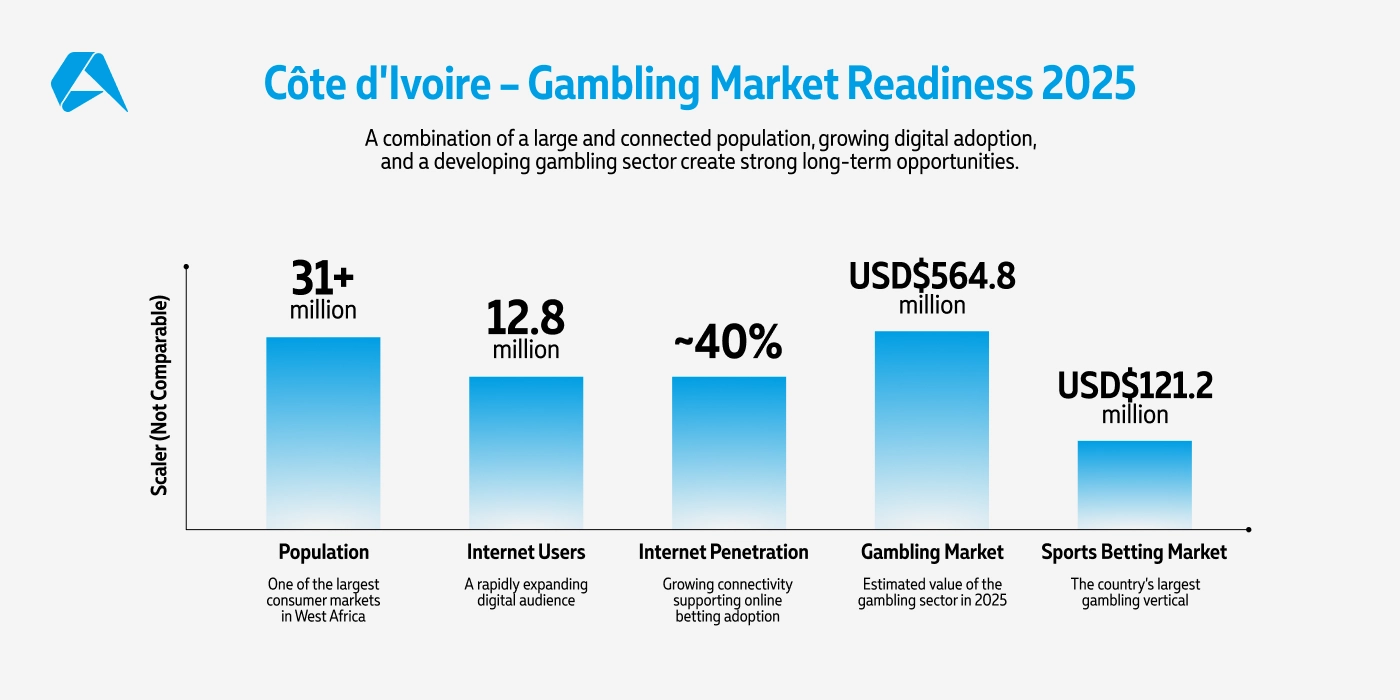
Digital adoption is another factor that strengthens the long-term case for investment. According to DataReportal's Digital 2025 Côte d'Ivoire report, the country had approximately 12.8 million internet users at the beginning of 2025, representing an internet penetration of around 40% of the population. The report also highlights continued growth in mobile connectivity and social media usage, trends that have historically supported the expansion of online betting in other African markets. For operators evaluating market entry, these indicators suggest a consumer base that is becoming increasingly accessible through digital channels rather than traditional retail networks.
The broader digital economy is also moving in a favorable direction. According to the U.S. International Trade Administration, Côte d'Ivoire has prioritized investment in telecommunications infrastructure, digital services, and internet access as part of its wider economic development strategy. While internet penetration still trails more mature betting markets, the direction of travel is unmistakable. Improved connectivity generally lowers customer acquisition costs and increases the long-term viability of online-first gambling products.
In addition, there is a strong argument to say that regulation may ultimately prove to be one of Côte d'Ivoire's most important competitive advantages. In many African jurisdictions, regulatory uncertainty remains a persistent concern for operators and investors. Côte d'Ivoire appears to be moving in the opposite direction. Since the introduction of Law No. 2020-480, the ARJH has steadily expanded its supervisory role and has identified online gambling, virtual betting, and evolving consumer behavior as strategic priorities within its 2024–2028 planning process. This suggests a regulator that is actively preparing for market growth rather than simply reacting to it.
That does not mean the market is without challenges, of course. The concession-based framework remains unusual by international standards and can be difficult for new entrants to grasp. Compliance expectations are also becoming increasingly sophisticated, particularly in areas such as responsible gambling, anti-money laundering controls, technical certification, and consumer protection. However, these same requirements may, in fact, strengthen the market by creating higher barriers to entry and reducing opportunities for unlicensed operators.
For operators willing to take a long-term view, Côte d'Ivoire offers a combination of factors that are becoming increasingly difficult to find in emerging markets. Specifically, we are talking about a growing consumer base, expanding digital infrastructure, a modern gambling law, an active regulator, and visible investment from both domestic and international stakeholders. While the market may not yet rival Africa's largest gambling jurisdictions, current indicators suggest that Côte d'Ivoire is positioning itself as one of the most promising regulated gambling markets in West Africa.
Market pros and cons for operators
Like most emerging gambling markets, Côte d'Ivoire presents a mixture of opportunities and challenges that operators should carefully evaluate before entering the market.
Advantages
✔ Growing gambling market with positive growth potential.
✔ Strong soccer-driven betting culture.
✔ Large and youthful consumer base.
✔ Expanding internet and smartphone penetration.
✔ Modern legal framework under Law No. 2020-480.
✔ Increasing regulatory certainty and market oversight.
✔ Growing interest from international operators and investors.
Drawbacks
X Concession-based market structure limits market accessibility.
X Limited transparency regarding fees and entry requirements.
X Market access may involve complex regulatory relationships.
X Online gambling remains subject to significant oversight.
How to apply for a gambling license in Côte d'Ivoire
The process for obtaining approval to operate gambling activities in Côte d'Ivoire depends on whether the proposed activity falls under the concession or authorization regime. As a result, there is no single application process that applies to all operators.
Regardless of the route involved, however, prospective operators should engage with the Autorité de Régulation des Jeux de Hasard (ARJH) at an early stage to determine the applicable regulatory framework, documentation requirements, and approval procedures.
The regulator serves as the primary point of contact for market-entry inquiries and can guide licensing, compliance obligations, and the regulatory requirements applicable to specific gambling activities.
ARJH Contact Information
Autorité de Régulation des Jeux de Hasard (ARJH)
Operator Information Portal: https://www.arjh.ci/operators
Telephone:
+225 25 22 01 34 40
+225 07 02 27 27 27
Postal Address:
17 BP 247 Abidjan 17
Côte d'Ivoire
Physical Address:
Cité Attoban, 7ᵉ Tranche Vallons
Abidjan, Côte d'Ivoire
Office Hours:
Monday to Friday
07:30 – 17:00
Messaging: ARJH Contact Information
Prospective operators should consult the ARJH website directly for the latest contact information, application requirements, and regulatory guidance before commencing the market-entry process.
Entering a concession-led market requires careful preparation. Schedule a live demonstration today to see how Altenar supports operators with flexible technology, local integrations, and compliance-focused growth strategies.