
DISCLAIMER
This information is not intended to be legal advice and is solely extracted from open sources. It should not be relied upon as a substitute for professional legal advice, and Altenar does not accept any liability for its use.
Key Takeaways
-
Massive Market Growth: Driven by a mobile football culture, the total market is projected to hit $3.63 billion by late 2025, with online gambling alone approaching $500 million for 2025/2026.
-
Loyalty and URC Licensing: Consistent payouts build fast brand loyalty. The 2025 Universal Reciprocity Certificate (URC) lets participating states recognize each other's licenses for easy expansion.
-
State-by-State Control: Following a November 2024 Supreme Court ruling, individual states hold the primary power to license operators, meaning Nigeria is no longer a single uniform market.
-
Two-Tier Legal Setup: State licenses grant local access, but operators must still follow federal laws for data privacy, anti-money laundering, and the January 2025 mandatory winnings tax.
-
Lagos as the Main Hub: Lagos is the top commercial launchpad due to its 17 million population. However, it has intense competition and a steep ₦50 million first-year online betting fee.
Gambling Laws in Nigeria
Nigeria is one of those markets where the upsides quickly become obvious, but the optimal route to market takes more thought than the news headlines suggest. State licensing, federal oversight, and changing conditions require comprehensive strategic planning. Most regulatory overviews tell you what the law says, but what matters in Nigeria right now is how the market actually behaves in practice, and how licensing links to real commercial access.
This in-depth guide breaks down what’s legal, what’s changing, and which states matter most, giving operators a clear, practical view of how Nigeria works in reality in 2026.
History of Gambling in Nigeria
Before betting apps became part of everyday life, gambling in Nigeria was something far more familiar. Draw-based games, promotional prizes, and scratch cards were the formats regulators understood, and they became the legal reference point for almost everything that followed. Even today, that early lottery language still resonates through the way Nigerian gambling laws describe betting activity.
Change came as sports betting turned into something far more cultural. Nigeria’s soccer obsession, a young population, and the rise of low-cost mobile access created the perfect conditions for betting to grow quickly. Retail shops and agent networks spread quickly, and digital channels became increasingly prominent, eventually taking over. Betting fundamentally moved from being a product you went looking for to something that was always within easy reach, on a phone, in a kiosk, or through a local betting platform.
As the market grew, product availability expanded too. Fixed-odds soccer was only the start. Operators added virtuals, casino-style games, and even esports betting, and the line between lottery and gaming became harder to draw in practice. That’s where Nigeria’s regulatory trajectory gets complicated. Nigeria’s gambling market expanded faster than its laws evolved, revealing that it wasn’t regulated by a single center of power.
For years, federal and state regulators disagreed over who had the authority to license operators and collect gambling revenues. In some states, local regulators pushed hard to control the market within their borders, while the federal regulator continued to treat gambling as a national jurisdiction. The result was a cycle that local operators will instantly recognize. Overlapping obligations, mixed messages, and constant uncertainty about what being ‘fully compliant’ actually means.
That deadlock finally reached a turning point in November 2024, when the Supreme Court limited the National Assembly’s power to legislate on gambling, effectively moving the balance of power toward state-level oversight. The decision didn’t instantly simplify the market. However, it did change the direction of travel, and ultimately, it’s the reason Nigeria now feels less like a single jurisdiction and more like a collection of overlapping regimes that operators need to approach individually, state by state.
Timeline of Key Events
Nigeria’s current gaming environment has evolved through lottery-based regulation, the rapid rise in sports betting, and an ongoing federal/state struggle over control. The key milestones include:
2005: National Lottery Act establishes a federal gambling framework.
2007: National Lottery Regulation expands operational and compliance rules.
2010s: Sports betting accelerates through kiosks and mobile.
2018: Oyo State Gaming Law formalizes state licensing powers.
2021: Lagos LSLGA Law strengthens state control over licensing.
2021: National Lottery concession awarded to Elrae Technologies.
2022: Lagos High Court dispute intensifies federal–state divide.
2023: Nigeria Data Protection Act modernizes privacy rules.
2024: Supreme Court ruling moves authority toward states.
2025: Withholding tax on winnings comes into force.
2025: State regulators adopt multi-state reciprocity (URC) for licensing.
2025: President Bola Ahmed Tinubu declines assent to the Central Gaming Bill.
The Current Legal Framework
Gambling is legal in Nigeria, but it is not regulated as a single, uniform national market. In practice, what operators can offer, and where they can offer it, depends heavily on the state in which the activity takes place, alongside a smaller set of federal rules and requirements that still influence day-to-day operations.
In general terms, Nigeria permits both land-based and online gambling products in some parts of the country. Sports betting and lottery-style products are widely available through licensed operators, while casino-style gaming and gaming machines are typically treated as state-licensed activities rather than a nationally governed category. This is why the Nigerian market often feels state-led in real commercial terms. Individual states set their own licensing requirements, fee structures, and compliance expectations for operators active in their territories.
Significantly, gambling is not permitted everywhere. Nigeria has 36 states, and some, particularly in the north, where religious and cultural restrictions are more stringent, prohibit or severely restrict gambling activity. As a result, licensed operators generally focus their commercial activities on states that explicitly allow gambling and have established gambling regulators, such as Lagos and several other southern jurisdictions.
For residents and players, the practical reality is straightforward. Nigerians can legally participate in licensed betting and lottery products in states where gambling is permitted, with participation restricted to adults (18+). For operators, Nigeria remains a regulated market, but one in which the idea of ‘legal’ is closely tied to jurisdiction, licensing status, and player location.
Federal Regulation and National Oversight
Even as Nigeria’s regulatory center of gravity edges toward the states, the federal level still matters in ways operators can’t ignore. Historically, the National Lottery Regulatory Commission (NLRC) sat at the heart of Nigeria’s gambling framework under the National Lottery Act 2005 and the supporting National Lottery Regulation 2007. It positioned itself as the national authority for licensing, oversight, and enforcement, particularly for lottery activity, sports betting permits, and remote gaming approvals.
That ‘national gatekeeper’ role is now part of an ongoing constitutional debate, but commercially, many of the levers linked to federal rules still influence how operators build and run betting products in Nigeria. Tax is the clearest example. The withholding tax (WHT) model for gambling winnings, effective from January 2025, applies under the federal tax framework and affects payout handling regardless of where an operator is licensed. For residents, the rate is set at 5%, and for non-residents, 15%, making player withdrawals and settlement flows a compliance matter.
The same applies to the direction of travel on transaction-level monitoring. Federal policy has increasingly focused on collecting gambling-related revenue at the point of transaction, and systems referenced in national compliance discussions are designed to create greater visibility over deposits, payouts, and tax owed. For operators, that means payments architecture, reporting capability, and audit readiness are becoming operational requirements rather than optional best practices.
Beyond tax, another area where federal rules still carry real weight is in nationwide compliance. Anti-money laundering obligations are bound in national legislation, such as the Money Laundering (Prevention and Prohibition) Act 2022, and are supported by oversight bodies, including the Nigerian Financial Intelligence Unit (NFIU) and SCUML for designated non-financial businesses. These rules determine KYC expectations, recordkeeping requirements, and suspicious-transaction reporting thresholds across the market.
Data protection works the same way. Nigeria’s Data Protection Act 2023 and the Nigeria Data Protection Commission establish national standards for consent, breach reporting, and the protection of personal data, which are growing operational priorities for gambling operators handling high volumes of customer identity and payment information.
States Where Gambling is Legal in Nigeria
Nigeria’s gambling market now works state by state, with each jurisdiction setting its own licensing structure, permitted products, and market entry requirements. This places greater emphasis on choosing the right base location to launch.
Here are the key states where gambling is regulated:
Primary Legal Gambling States in Nigeria
| State | Market Potential | Gambling Activities Offered | Advantages | Drawbacks |
|---|---|---|---|---|
| Lagos | Very high | Online betting, lotteries, casinos, machines, and pool betting | Biggest economy, deepest liquidity, and strongest commercial upside | Costly entry, intense competition, and high compliance expectations |
| Oyo | High | Sports betting, lottery, casinos, pool betting, and gaming machines | Large population, defined categories, clear licensing structure | Less national visibility than Lagos. Compliance still state-specific |
| Ekiti | Moderate | Remote gaming, sports betting, lottery, sweepstakes, slots | Broad product coverage. Good option for multi-state operators | Broad product coverage. Good option for multi-state operators |
| Cross River | Moderate | Betting, casinos, lotteries, esports, and interactive games | Esports are explicitly recognised. Progressive positioning | Key statute not public. Licensing details hard to verify |
| Imo | Moderateto high | Wide categories incl. remote + retail licensing | Broad product scope. Structured online/retail licensing approach | Limited public operator data. Practical processes vary by engagement |
| Benue | Moderate | Betting, lotteries, casinos, machines, and pool betting | Central-Nigeria location option. Known licensing jurisdiction | Less market transparency. Weaker public documentation vs Lagos |
Lagos State
If Nigeria has a central gaming hub, Lagos is it. The state’s sheer scale and spending power make it the commercial launchpad for most serious operators, with an urban population of roughly 17 million and a constant pipeline of mobile-first bettors. Sports betting demand is widely reported as mainstream in Nigeria, and Lagos sits at the center of that momentum.
Regulation is handled by the Lagos State Lotteries and Gaming Authority (LSLGA), which licenses online sports betting, public online lotteries, casinos, gaming machines, pool betting, and promotional competitions. Entry is professional and commercial, with published requirements including a ₦50 million (≈$35,216) first-year online sports betting license fee and defined capital thresholds.
Oyo State
Oyo is one of Nigeria’s more established regulated states, with a defined licensing structure overseen by the Oyo State Gaming Board (OYSGB). With a projected population of around 8 million, and Ibadan functioning as a major commercial hub, it’s a credible market for retail betting networks, digital sportsbooks, and lottery-style betting products.
Operators typically license for sports betting, lotteries, casinos, gaming machines, scratch/interactive products, and pool betting, with tax obligations linked to monthly sales depending on the vertical. As in Lagos, competition is active, so new entrants tend to succeed by building strong agent distribution, reliable payments, and a compliance position that can scale across multiple jurisdictions.
Ekiti State
Ekiti is a smaller state than Lagos or Oyo, but it stands out because its gambling framework was established much more recently and drafted in a way that directly accommodates modern, remote-style operations. Population projections place the state at around 3.6 million (2022 estimate), which means it’s not a volume-led market, but it can still be commercially relevant as part of a wider multi-state rollout.
Regulation rests with the Ekiti State Lotteries & Gaming Commission (EKSLGC), which licenses both retail and online activities across betting, lottery, casino-style games, gaming machines, and remote gaming. The key entry feature is its use of ‘operational accords’ as the legal foundation for gaming and betting business in the state. For operators, this structure creates a more straightforward route to market than many other states.
Cross River State
Cross River positions itself as one of Nigeria’s more investor-friendly jurisdictions, and it’s one of the few states where licensing guidance is publicly accessible. The Cross River State Lottery and Gaming Agency (CRSLGA) regulates online sports betting and public online lotteries, with structured application requirements and an online portal for registration and renewal.
From an operator’s perspective, the state is notable for its explicit licensing list (including interactive products) and a stronger narrative around market ‘clean-up’, with public messaging aimed at discouraging unlicensed activity. It’s also one of the states most commonly referenced in modern discussions around regulated online gambling expansion and enforcement momentum.
Imo State
Imo is one of Nigeria’s more intentionally structured gambling jurisdictions, with a regulator that treats online and retail licensing as part of a single commercial licensing framework. Oversight is governed by the Imo State Lotteries and Gaming Authority (IMOLGA), which regulates sports betting, lotteries, pool betting, casinos, gaming machines, and remote/online gaming products under the state’s 2021 law framework.
For operators, Imo stands out for the breadth of permitted categories and its relatively clear license positioning for online formats, including public online offerings. From a commercial perspective, it benefits from strong sports interest and a young mobile-first audience, though competition tends to favor brands that can localize payments, marketing, and agent-led distribution.
Benue State
Benue is a recognized licensing state for betting and lottery-style products, regulated by the Benue State Sports Marketing and Lottery Board (BSMLB). While it doesn’t carry the commercial weight of Lagos, it matters for operators building a genuinely multi-state presence, particularly across central Nigeria. In practice, Benue’s licensing structure covers online sports betting, public online lottery, casinos, gaming machines, pool betting, scratch/interactive products, and a broader ‘other games’ category.
The state’s framework mirrors the broader Nigerian pattern, which is to say annual licenses, defined capital expectations, and recurring gaming taxes tied to sales revenue in certain verticals. Public operator lists are limited, so market visibility tends to rely more on direct regulator engagement and licensing confirmation.
Emerging states (Enugu, Edo, Ondo)
Beyond the better-known licensing states, Nigeria’s regulatory direction appears to be growing. Several other jurisdictions have shown signs of active gambling oversight or formal regulatory bodies, which reinforces the state-by-state reality industry operators now have to plan around. Enugu, for example, has established a dedicated gaming commission with a stated mandate to license, monitor, and enforce compliance across gaming and lottery activity.
Edo has also moved to strengthen state-level regulation, including recent state action around lottery and gaming oversight, supported by published legislation and public announcements. Meanwhile, states such as Ondo have issued public warnings to unlicensed operators, signaling that enforcement expectations may extend well beyond the current primary jurisdictions.
What matters commercially is the message. Even where full license schedules and fee tables are not easy to validate from open sources, these states are increasingly positioning gambling as something that should come under formal control rather than informal market activity. That has practical implications for operators. Due diligence cannot stop at compliance with Nigerian law. It needs to include local regulator engagement, confirmation of licensing expectations, and a realistic plan for multi-state compliance if national political momentum continues to head toward stronger state authority.
The Practical Reality for Operators
For operators assessing Nigeria in 2026, the market has clear potential, but the current regulatory landscape is rather complex. Ask 10 iGaming professionals how Nigeria’s licensing works and you’ll hear 10 versions of ‘it depends’.
The market still has a federal level sitting on top of a fast-developing state system, and the legal direction is visible, even if the operational reality feels less so. After the Supreme Court’s November 2024 ruling, the message from many state regulators has been simple. The licensing authority reigns locally, and operators should treat Nigeria as a state-by-state market first.
That raises the question every serious entrant will eventually ask. ‘Do you need a federal license, a state license, or both?’ In practice, the cautious approach is to assume the safest answer is both, where relevant, at least until the Central Gaming Bill debate (Federal vs State) is fully resolved and the federal regulator’s role is formally redefined. This matters commercially because several high-impact obligations, such as withholding tax on player winnings, national AML requirements, and broader data protection requirements, cross state borders, even when licensing does not. For operators, the result is a two-tier reality. State licenses determine market access, while national compliance disciplines continue to define how businesses are expected to operate.
But rather than waiting for a single federal reset, regulators have tested a more practical solution — the URC. The Universal Reciprocity Certificate (URC) is a meaningful development because it suggests states are seeking a way to reduce barriers for multi-state expansion. The idea is that it serves as a shared recognition framework among participating state regulators. What it does not do, at least not yet, is remove the need for strong underlying compliance or eliminate the practical need to align with each state’s regulator.
Ultimately, in today’s market, the easiest route is not to launch everywhere at once. The operators that tend to gain ground in Nigeria pick one core licensing state, build strong compliance and operational stability there, then expand methodically, treating each new state as a fresh market entry rather than a sequential rollout.
Opportunities and Future Outlook
Nigeria’s gambling industry is one of the largest and fastest-growing on the African continent, driven by its large population (over 220 million), widespread mobile internet access, and a cultural appetite for sports betting. Industry projections estimate the total gambling market could reach around US$3.63 billion in revenue by the end of 2025, reflecting continued expansion as more than 60 million Nigerians place bets daily and mobile-first engagement grows. Online gambling alone, largely sports betting, is expected to approach US$500 million in 2025/2026, growing at double-digit annual rates. Participation surveys suggest over half of adults bet on sports, with mobile apps driving the lion’s share of activity.
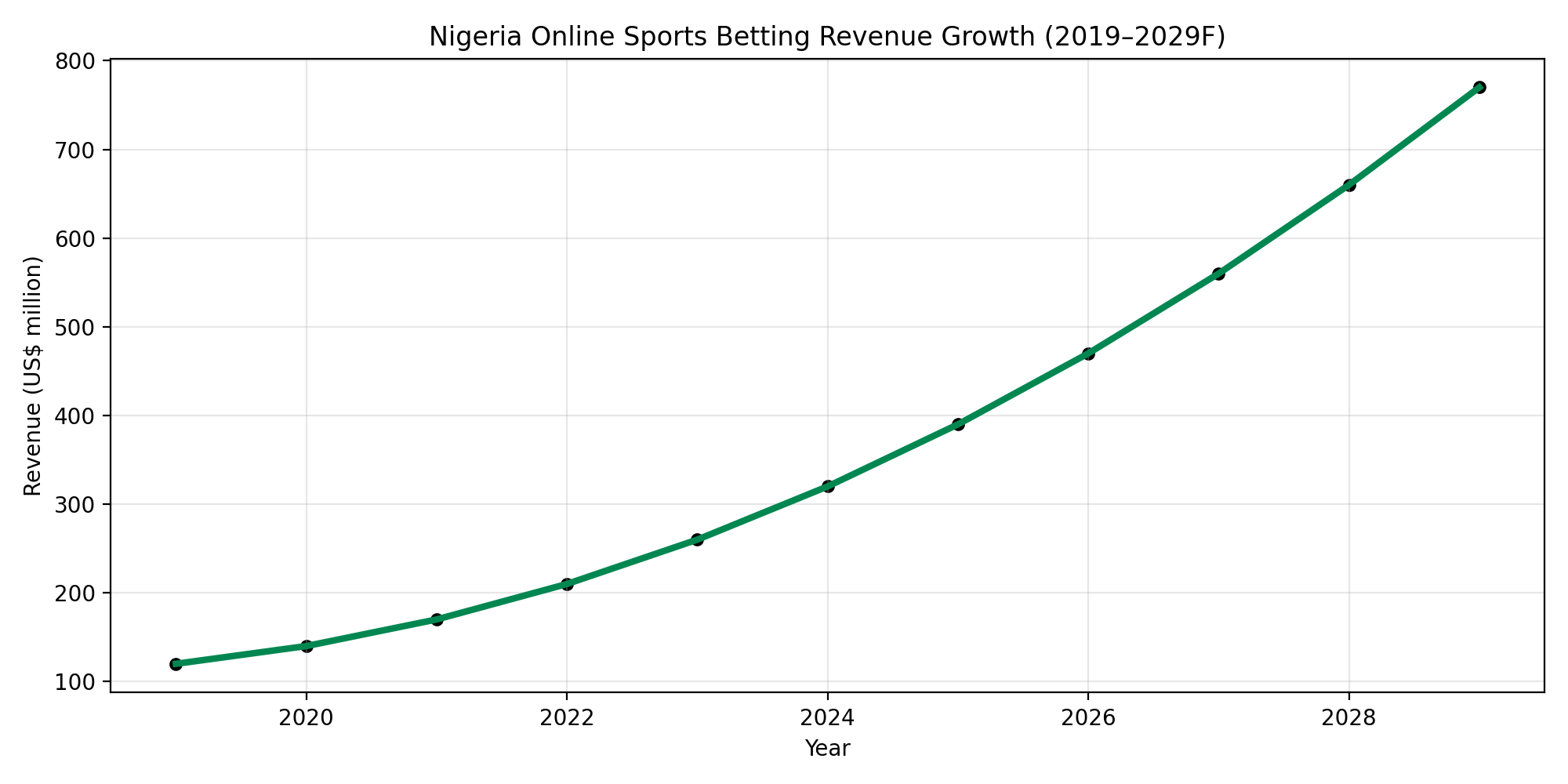
Sources: Statista Market Insights Nigeria: Online Sports Betting revenue (historic + forecast), 2019–2029F. DataReportal - Nigeria Digital Reports (internet and mobile adoption context; used for narrative support, not values)
While regulatory uncertainties remain, these figures illustrate a sizable and expanding consumer base and revenue pool that continues to attract investment interest from both local and international operators.
Looking ahead, the most significant near-term development is unlikely to be product, since sports betting is already normalized in many states. It’s more about how closely the market is supervised and monetized. One clear direction of travel along these lines is tax collection. Nigeria’s withholding tax approach to player winnings has already been formalized on the policy side, and operators should expect greater scrutiny of reporting, settlement timing, and audit trails.
Another trend worth watching is the formal monitoring of transaction flows, not only through tax rules but through the wider compliance climate around the movement of money. Nigeria’s federal AML framework applies across all states, and as regulators place more emphasis on auditability and traceability, operators with efficient payment flows will find the market easier to manage.
Ultimately, for operators weighing up market entry, the opportunity is hard to ignore, despite the ongoing uncertainty. Few jurisdictions combine this level of population scale with such a fondness for sports betting, and behavior that is already mobile-first. The market is competitive, yes, but it’s also still evolving in a way that rewards operators who can execute properly rather than simply spend the most on acquisition.
The more important takeaway is that Nigeria is entering a phase in which professionalism begins to separate serious operators from opportunistic newcomers. The brands most likely to succeed over the next few years will be those that treat Nigeria as a long-term investment, not a quick win. If you enter with that mindset, Nigeria starts looking like what it really is — one of Africa’s most commercially meaningful betting markets.
Nigeria Market Pros and Cons for Operators
For operators weighing market entry, Nigeria offers both volume and volatility. The points below summarize the upsides and challenges that affect the speed of entry and long-term stability:
Pros
-
Huge population base with strong betting participation.
-
Mobile-first sports culture supports frequent wagering.
-
Rapid online growth gives room for new brands to scale.
-
Retail + online coexist well.
-
Brand loyalty can build quickly when UX and payouts are consistent.
-
Significant upside for localized products (payments, promos, etc.).
Cons
-
Regulatory structure remains unsettled.
-
Multi-state compliance adds cost and operational complexity.
-
Tax scrutiny is rising, including withholding tax expectations.
-
Competition is crowded, particularly in major betting states.
If Nigeria is on your radar for 2026, start with the right foundation. Let’s run a personalized demonstration of Altenar’s advanced sports betting technology and map what a phased, state-by-state launch looks like.
```