
Quick article overview - 2 min read
Ontario is no longer the only big market in Canada. Alberta is opening its doors to commercial iGaming companies, creating one of the most exciting new opportunities in North America.
This matters because players in Alberta already love to bet. The province is simply moving this activity from offshore websites to local, regulated platforms. Around 70% of online gambling in Alberta currently happens on unregulated sites. The province has over 4.8 million residents, high incomes, great internet usage, and a massive sports culture built around NHL teams like the Edmonton Oilers and Calgary Flames.
Alberta offers a very attractive business model. Operators keep 80% of net revenue, while the government takes 20% (with 3% of gross revenue going to First Nations and social causes). Experts predict the market could make over C$700 million a year when it matures.
Navigate the dual-regulator framework
You must work with two main provincial groups to launch legally:
-
Alberta Gaming, Liquor and Cannabis Commission (AGLC): This is the main regulator. They handle licenses, check rules, set technical standards, and register suppliers.
-
Alberta iGaming Corporation (AiGC): This group manages the commercial business contracts with operators.
The eight steps to market entry
Getting your license in Alberta is a test of your operational readiness. You must finish these steps to go live:
-
Get legal status: Register as an official operator under the iGaming Alberta Act.
-
Register with AGLC: Pay a one-time C$50,000 application fee, a C$150,000 annual operator fee, and a C$10,000 background-check deposit.
-
Sign your commercial deal: Complete your business agreement with AiGC.
-
Get supplier approvals: Make sure your platform and game providers register and pay their C$15,000 annual fee. Other suppliers pay C$3,000 a year.
-
Set up your company structure: Pass AGLC background checks and meet federal FINTRAC anti-money laundering rules.
-
Plan your technology: Prepare your servers and software to pass AGLC location and security checks.
-
Get certified: Pass independent system tests and connect to the official provincial self-exclusion list for problem gamblers.
-
Add player safety tools: Put identity checks (KYC), deposit limits, and risk tracking into your system before you take any bets.
The countdown to launch
The market is moving very fast. Keep these key dates in mind for your planning:
-
January 2026: AGLC published the official rules and technical standards.
-
March 2026: Alberta opened applications for operators and suppliers. Approved brands can start marketing and signing up players right now.
-
July 13, 2026: Industry experts expect this to be the official launch day for betting.
More than 50 brands want to enter Alberta. Companies like DraftKings, FanDuel, and BetMGM are using their existing systems from Ontario to get a fast start.
Lock in your Western Canada growth strategy
Alberta does not need to become another Ontario to be commercially attractive. It only needs to convert enough existing offshore activity into regulated play...
Winning in Alberta requires careful entry planning, local focus, and strong tech systems. Read more in the original piece to see how flexible technology can help you launch before heavy competition drives up marketing costs.
Are you currently operating in Ontario, or will Alberta be your team's first entry into the Canadian regulated market?
Alberta’s iGaming market in 2026: what operators need to know
For operators watching Canada’s online gambling market, Ontario has traditionally been the province attracting most of the attention. But that’s all beginning to change. Alberta is now preparing to open its doors to commercial iGaming operators. Across the industry, the province is quickly becoming one of the most closely watched opportunities in North America.
The attention is understandable. Ontario has already demonstrated that Canadian players have a clear preference for regulated operators that deliver trust, competitive products, and high-quality digital experiences. Alberta enters the regulated market with the advantage of hindsight. Operators considering the province today are doing so with a clear understanding of acquisition costs, compliance pressures, responsible gambling expectations, localization challenges, and what competition inside a newly regulated Canadian market actually looks like.
Collectively, these factors point toward a market where adaptability and operational efficiency may outweigh the advantage of arriving first. For many operators, suppliers, and sportsbook providers, the bigger question is whether Alberta can become a commercially sustainable long-term market once the major brands arrive. And based on the level of industry interest already surrounding the province, competition could become fierce.
Part of Alberta’s appeal lies in the fact that the market already exists. The province combines high digital adoption, a strong sports culture, and an established online gambling audience that has historically engaged with offshore operators. In other words, Alberta is not trying to create demand from scratch. It is attempting to regulate, channel, and monetize activity that is already happening on a meaningful scale.
At the same time, important questions remain. Operators are now weighing licensing requirements, launch timelines, supplier approvals, taxation, advertising restrictions, responsible gambling obligations, and the practical realities of preparing for a market that is moving from political discussion into operational reality surprisingly fast.
Why Alberta matters to North American iGaming
There is a reason Alberta has become one of the most closely watched jurisdictions in the North American gambling industry. For operators, suppliers, and investors alike, the province represents far more than another regional launch. It represents the next major test of Canada’s long-term commercial iGaming potential.
Part of the reason Alberta is generating such strong commercial interest lies in what Ontario already demonstrated to the wider industry. According to iGaming Ontario, the province generated billions in wagers. It rapidly attracted major international sportsbook and casino brands, creating one of the most commercially active regulated online gambling markets outside the United States. Alberta now enters the conversation with the advantage of observing Ontario’s rollout in real time, including both its commercial successes and its operational pressures.
The province itself also presents several characteristics that make the opportunity difficult for operators to ignore. Alberta has one of Canada’s wealthiest populations, supported by high household incomes, strong digital adoption, and a long-standing gambling culture tied to casinos, lotteries, sports betting, and charitable gaming. The province’s population now exceeds 4.8 million residents according to Statistics Canada, making it one of the country’s largest provincial economies outside Ontario and Quebec. Calgary and Edmonton are two of Western Canada’s most commercially important urban centers, providing access to a concentrated, digitally engaged consumer base.
Sport plays a major role as well. Hockey remains deeply rooted within Alberta’s sporting identity through franchises such as the Edmonton Oilers and Calgary Flames, while North American leagues, including the NFL, NBA, MLB, and UFC, continue to attract strong betting interest across Canadian markets. For sportsbook operators, this creates a player base already familiar with digital wagering products, particularly following the expansion of single-event sports betting in Canada in 2021.
Strategically, Alberta also offers something Ontario could not: expansion into Western Canada under a commercial framework. Until now, Ontario has been the primary destination for operators seeking regulated growth opportunities in Canada. Alberta changes that situation by opening access to a second major province with a different regional audience, strong spending power, and an already active online gambling economy.
The implications extend beyond Canada itself. Alberta’s launch is being watched closely by operators across North America because it may influence how other Canadian provinces approach commercial iGaming regulation in the future. If Alberta successfully channels offshore activity into a regulated, competitive market while maintaining strong consumer protections and stable tax revenues, pressure may gradually increase on other provinces to reconsider their own models.
What Alberta’s iGaming sector is expected to look like
Alberta’s commercial iGaming framework is now moving beyond political discussion and into operational preparation. While the province is clearly taking cues from Ontario’s regulated market structure, Alberta is also introducing its own commercial arrangements, controls, and technical compliance expectations ahead of launch.
For operators preparing for market entry, understanding how the various compliance components and regulatory obligations work is becoming increasingly important as registration windows and launch timelines continue to advance.
Alberta Gaming, Liquor and Cannabis Commission (AGLC)
The Alberta Gaming, Liquor and Cannabis Commission (AGLC) will act as the province’s primary gaming regulator, overseeing licensing, compliance, enforcement, technical standards, and supplier registration across Alberta’s regulated online gambling market. The regulator has already published detailed Standards and Requirements for Internet Gaming covering operational controls, cybersecurity, responsible gambling obligations, advertising standards, and technical certification requirements ahead of commercial launch.
Alberta iGaming Corporation (AiGC)
Alongside AGLC, Alberta has established the Alberta iGaming Corporation Act, creating the Alberta iGaming Corporation (AiGC) to oversee the commercial management of the market. Similar to Ontario’s iGO structure, AiGC is expected to manage commercial agreements with operators while AGLC focuses on regulatory enforcement, compliance oversight, and licensing administration.
Alberta’s Ontario-style commercial model
Alberta’s framework represents a major departure from the province’s previous government-controlled online gambling structure centered around Play Alberta. According to Alberta’s official iGaming Strategy, the province intends to open the market to private commercial operators under a regulated model that channels existing offshore gambling activity into a licensed environment. The structure closely mirrors Ontario’s commercial approach, although Alberta may ultimately adopt its own variation.
Responsible gambling and player protection
It is anticipated that responsible gambling standards will play a central role. AGLC’s published standards require operators to implement measures covering self-exclusion integration, player protection tools, behavioral risk monitoring, deposit controls, and responsible gambling messaging. Alberta’s Phase 3 iGaming Fact Sheet also outlines restrictions relating to minors, advertising practices, and protections for high-risk or self-excluded players as part of the province’s wider regulatory approach.
AML, KYC, and identity verification
Operators entering Alberta must also comply with Canadian anti-money laundering obligations administered federally through FINTRAC. This includes customer identity verification, transaction monitoring, record keeping, suspicious activity reporting, and broader Know Your Customer (KYC) obligations. Alberta’s regulatory framework also emphasizes account security, auditability, and player verification standards to support both consumer protection and financial integrity across operators.
Technical certification and security standards
Technical certification requirements under Alberta’s framework are already among the more detailed standards seen within North American iGaming regulation. AGLC’s published standards reference cybersecurity expectations, encryption controls, independent testing requirements, data protection obligations, and operational resilience standards for gaming systems and suppliers. The framework also places importance on independent assessments, approved testing facilities, and internationally recognized security standards such as ISO 27001 and SOC-based compliance controls for critical gaming infrastructure.
Launch timeline and go-live expectations
The province’s commercial iGaming sector is now moving quickly from legislation into operational rollout. While certain commercial and regulatory details may still evolve before launch, Alberta has already established a far more developed implementation timeline than many operators initially expected, with registration, supplier approvals, and technical preparation now actively underway.
-
May 2025: Alberta passed the iGaming Alberta Act, formally creating the legislative foundation for a commercial online gambling market.
-
Late 2025 to early 2026: Alberta continued developing its commercial model, technical standards, supplier requirements, and operational structure through AGLC and the Alberta government.
-
January 2026: The AGLC Standards and Requirements for Internet Gaming were officially published, outlining compliance, technical certification, cybersecurity, responsible gambling, and supplier obligations.
-
March 2026: Alberta formally opened registration for operators and suppliers preparing to enter the regulated market ahead of launch. According to Alberta’s Phase 3 iGaming Fact Sheet, approved operators may begin pre-launch marketing and customer registration activities before wagering officially opens.
-
Expected July 13, 2026 launch: Multiple industry and legal sources reference July 13, 2026, as Alberta’s expected commercial go-live date.
The operators expected to launch first
Although Alberta has not yet published a final list of approved commercial operators, industry expectations are already forming around which brands appear best positioned to establish an early presence once the market opens.
Much of that discussion centers around operators already active in Ontario. Companies that have already spent several years operating inside Canada’s regulated environment possess a natural advantage heading into Alberta’s launch phase. In many cases, these operators have already established Canadian-facing compliance systems, responsible gambling controls, payment integrations, localization infrastructure, AML procedures, customer support operations, and player acquisition strategies that can potentially expand into Alberta faster than starting from scratch.
Several industry publications have also reported growing operator interest ahead of launch. According to Covers.com’s Alberta market coverage, more than 50 operator brands have reportedly expressed interest in entering the province as the July 2026 launch window approaches.
| Operator | Why They’re Well Positioned |
|---|---|
| DraftKings | Existing Ontario operations, established Canadian compliance infrastructure, and reported Alberta launch budgeting discussions. |
| FanDuel | One of Ontario’s strongest-performing sportsbook brands with established Canadian market infrastructure. |
| BetMGM | Existing Ontario presence and reported interest in Alberta registration activity. |
| Caesars Sportsbook | Reportedly involved in pre-registration preparation ahead of Alberta’s commercial launch. |
| theScore Bet | Strong Canadian brand recognition, combined with existing Ontario operations. |
| BetRivers | Existing regulated Canadian operations and established localisation capabilities. |
| PointsBet | Existing Ontario infrastructure and prior North American market expansion experience. |
At the same time, Alberta’s market may still create opportunities for smaller operators capable of differentiating through regional partnerships, niche product positioning, localization strategy, or targeted customer acquisition. While major North American brands are expected to attract significant early attention, Alberta’s long-term commercial success will likely depend on whether the market can support meaningful competition beyond a small number of dominant operators.
Market entry and licensing in Alberta
Alberta’s licensing process is best understood as an operational readiness test rather than a simple application exercise. Operators must prove they can enter the market legally, connect with the province’s regulatory systems, meet technical and responsible gambling standards, and secure the commercial approvals needed before taking deposits or wagers.
Alberta’s market-entry process is expected to develop through a series of operational and compliance stages that operators must complete before going live:
1. Establish the right legal status
Under Alberta’s framework, an ‘Operator’ is an iGaming supplier registered to host an online gaming site in the province. The legal foundation rests under the iGaming Alberta Act and the AGLC Standards and Requirements for Internet Gaming, which set the rules for operators and goods or services suppliers. At this stage, the key requirement is not simply brand presence, but registration as a recognized participant in Alberta’s regulated iGaming market.
2. Register with AGLC
Operators must apply through the Alberta Gaming, Liquor and Cannabis Commission for a provincial iGaming license, which opened registration for operators and goods or services suppliers in January 2026. The published fee structure includes a one-time C$50,000 application fee, an annual C$150,000 operator registration fee, and a C$10,000 deposit or other amount specified to cover background-check costs.
3. Secure the commercial relationship with AiGC
Registration with AGLC is only part of the process. Operators will also need to enter the appropriate commercial arrangement with the Alberta iGaming Corporation, which was created to support the management of Alberta’s commercial internet gaming market.
4. Prepare supplier and platform approvals
Operators cannot treat supplier readiness as a later-stage detail. Platform providers, game suppliers, customer e-wallet providers, oddsmakers, independent integrity monitors, and accredited testing facilities may all require registration where their services support the operation of an iGaming site. Platform providers and critical gaming systems providers are subject to an annual C$15,000 registration fee, while other goods or services suppliers are generally subject to an annual C$3,000 fee.
5. Registered office and corporate structure
Alberta’s public standards do not appear to impose a simple headline requirement that every operator must maintain a registered office in Alberta. However, this should not be read as a light-touch corporate process. Operators will need an entity structure capable of satisfying AGLC due diligence requirements, entering into commercial arrangements with AiGC, supporting financial reporting, and meeting Canadian regulatory obligations.
6. Confirm server, data, and remote gaming
Alberta does not currently impose a straightforward public requirement that all gaming servers must be physically located within the province. However, Alberta’s framework places significant emphasis on gaming system approval, operational integrity, cybersecurity controls, geolocation compliance, and certification obligations under Section 4 of the AGLC Standards and Requirements for Internet Gaming. As part of the broader approval and onboarding process, gaming systems, hosting environments, remote gaming infrastructure, and technical operations remain subject to AGLC oversight and compliance review.
For operators relying on international hosting environments, cloud infrastructure, or multi-jurisdictional technology stacks, infrastructure planning becomes an important consideration during certification, supplier approval, and operational readiness preparation.
7. Complete certification, security, and go-live compliance
Before launch, operators must be ready to demonstrate compliance with Alberta’s technical standards, including system integrity, cybersecurity, encryption, data governance, incident management, and independent testing requirements. AGLC describes this as a three-pronged process involving supplier registration, technology certification by an accredited testing facility, and integration with AGLC’s centralized self-exclusion program.
8. Responsible gambling and player verification
Alberta’s framework places significant emphasis on player protection, identity verification, account security, and responsible gambling controls from the outset. Under Sections 3.3, 3.5 and 4 of the AGLC Standards and Requirements, operators must maintain auditable player records, authenticate account access, support self-exclusion measures, implement responsible gambling protections, and apply broader operational controls before legal gambling activity can begin.
In practical terms, this means compliance requirements must be integrated into onboarding, payments, CRM systems, fraud prevention, and customer interaction workflows well before go-live.
Market opportunity and future outlook
Alberta’s appeal is not built solely on population size. With around 5 million residents, it is smaller than Ontario, but that does not make the opportunity any less significant. The province has high spending power, a strong urban base across Calgary and Edmonton, and an online gambling audience that already exists outside the regulated market. According to Alberta’s own iGaming strategy, around 70% of online gambling activity in the province currently takes place on unregulated platforms, which creates an unusually clear channelization opportunity from the start.
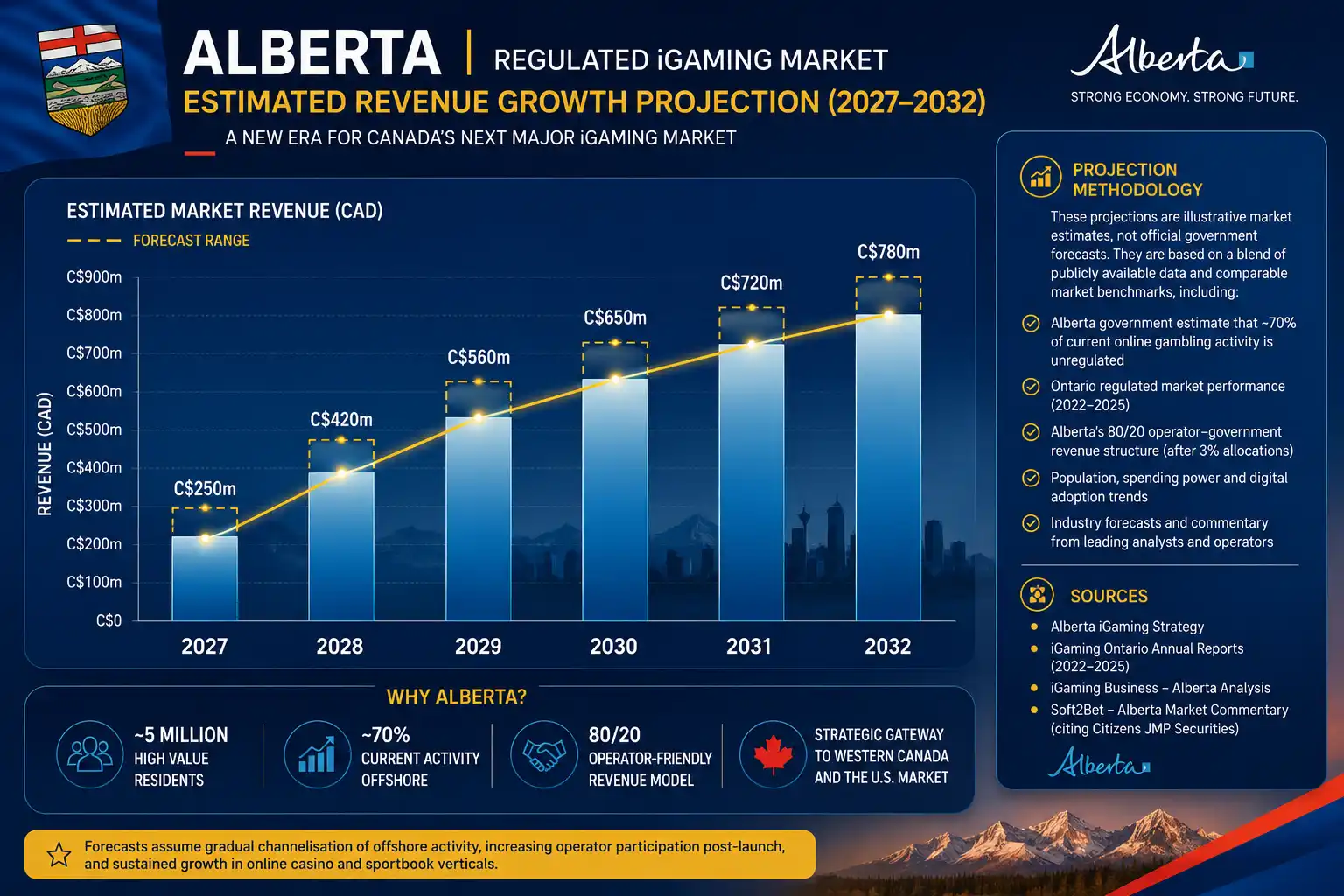
Ontario remains the natural benchmark. Its regulated market generated C$3.2 billion in gross gaming revenue in 2024–25, according to iGaming Business reporting on iGaming Ontario’s annual data, after only three full years of commercial operation. Alberta will not match that scale. It does not have Ontario’s population, operator density, or national advertising weight. But the comparison still matters because Ontario proved that Canadian iGaming can mature quickly when major brands are allowed to compete under a regulated framework.
| Metric | Ontario | Alberta |
|---|---|---|
| Population | ~16 million | ~5 million |
| Market Status | The regulated market has been operational since April 2022 | Expected commercial launch in 2026 |
| 2024–25 Regulated GGR | ~C$3.2bn | Forecast to exceed C$700m at maturity* |
| Commercial Structure | Open competitive iGaming market | Open competitive iGaming market |
| Operator Environment | Mature and highly competitive | Early-stage expansion opportunity |
| Estimated Offshore Activity | Lower following regulation | ~70% currently unregulated |
| Primary Commercial Strength | Scale and established liquidity | Channelisation and spending power |
| Sportsbook Potential | Strong national market presence | Strong regional sports engagement |
| Long-Term Commercial Risk | Rising acquisition costs and saturation | Smaller total addressable audience |
Sources: Statistics Canada, iGaming Ontario Annual Report 2024–2025, Alberta iGaming Strategy, Soft2Bet Alberta Market Commentary * Forecasts represent external market projections rather than official Alberta government revenue estimates.
The more realistic question is how much Alberta can generate on a per-capita basis once the market settles. Some external projections are already optimistic. Soft2Bet, citing Citizens JMP Securities, has referenced forecasts suggesting Alberta’s regulated iGaming market could exceed C$700 million in annual revenue at maturity. That figure should be treated as a market forecast, rather than a definitive projection, but it does point to why operators are paying attention. Alberta does not need to become another Ontario to be commercially attractive. It only needs to convert enough existing offshore activity into regulated play while maintaining a competitive tax and revenue model.
Product mix will also matter. Ontario’s market has shown that online casinos can become the main revenue driver, with casino accounting for the majority of wagers and gaming revenue in several market reports. Alberta’s sportsbook opportunity is highly prominent because of the province’s sports culture, NHL presence, and broader North American betting habits. Still, long-term operator value may depend just as heavily on casino, live dealer, and cross-sell performance.
The economics are also notably different from high-tax U.S. states. Alberta’s published model allocates 80% of net iGaming revenue to operators and retains 20% for government, after allocating 3% of GGR to First Nations and social responsibility funding. That gives Alberta a more operator-friendly profile than markets where tax pressure quickly reduces margins.
For now, Alberta should be viewed as a market with genuine upside but limited room to grow. Major brands will likely arrive early, acquisition costs may rise quickly, and the total addressable audience is still finite. The opportunity is real, but success will depend on disciplined market entry, efficient localization, strong retention, and the ability to convert existing demand into regulated, long-term player value.
3 Market Pros and Cons
Alberta offers operators a commercially attractive market with strong long-term potential, but early entrants will still face meaningful competition, compliance pressure, and operational requirements as the market develops.
Market Advantages
-
Existing offshore player migration opportunity
-
Operator-friendly revenue share structure
-
Wealthy and digitally engaged population
-
Expansion beyond Ontario’s regulated market
-
Strong sportsbook engagement potential
-
Flexible commercial market access structure
-
Early mover brand-building opportunities
Market Disadvantages
-
Smaller scale than Ontario’s market
-
Major brands will likely dominate early
-
Responsible gambling obligations are extensive
-
Rising acquisition costs are likely over time
-
Complex technical and infrastructure market preparation
What Operators Will Need to Compete in Alberta
Alberta’s commercial potential is attracting significant industry attention, but entering the market successfully may prove more challenging than many operators expect. By the time the province fully opens, competition is likely to move quickly, particularly as operators race to establish market share, secure player loyalty, and build a presence before acquisition costs begin rising.
The challenge is not simply launching a sportsbook and/or online casino. It is building an operation capable of adapting quickly inside a newly regulated environment while maintaining compliance, performance, and long-term retention.
Operators preparing for Alberta will need to balance several pressures simultaneously: regulatory onboarding, certification, payments integration, responsible gambling controls, localization, geolocation compliance, CRM flexibility, and the ability to deliver stable sportsbook and casino experiences from day one.
And there’s also the question of differentiation. As more brands enter the market, competing purely through promotional spend may become increasingly difficult. Operators capable of delivering flexible sportsbook experiences, stronger casino integration, personalized engagement, and efficient retention strategies may ultimately place themselves in a stronger long-term position than those relying purely on early acquisition momentum.
This is where technology infrastructure starts becoming commercially important. Flexible infrastructure and scalable sportsbook and casino capabilities will help operators manage growth more efficiently as the market develops.
Request a private demonstration to see how Altenar’s flexible sportsbook technology and integrated casino solutions can support efficient expansion into Alberta’s regulated market.