
Key takeaways
-
Localization goes beyond translation: A truly local sportsbook adapts content, navigation, payments, promotions and user experience to match the expectations of each market.
-
Prioritize what local players value: Sports, competitions, markets and betting formats should be organized around local preferences, making relevant opportunities easier to discover.
-
Layouts should reflect regional habits: Different markets may expect different navigation, odds formats, betslip visibility and betting features, so one interface rarely fits every audience.
-
Small details shape familiarity: Local odds, currencies, dates, terminology and betting language reduce friction and help players understand and use the sportsbook more naturally.
-
Regulation is part of localization: Local rules can influence promotions, verification, betting products, responsible gambling tools and required information throughout the player journey.
-
Flexibility supports long-term growth: A configurable sportsbook platform makes it easier to adapt layouts, payments, promotions and compliance requirements as markets evolve.
To many, localizing a sportsbook can sound straightforward. Players need to understand what they are looking at, so the platform is translated into the local language, the right currency is added, and perhaps the odds format changes too. But compare sportsbooks across different markets for a while, and it quickly becomes apparent that localization goes much deeper than that.
The sports given the most space can change. So can the competitions, markets and promotions players see first. Navigation may be organized differently, familiar payment methods can vary, and even the amount of information presented on screen can reflect local betting preferences.
These differences matter because entering a market and competing effectively within it are two different things. A sportsbook may be available in the right language and currency, but if players have to work harder to find what they want, use unfamiliar ways to bet or navigate a product built around somebody else's preferences, then speaking the local language does little to make the sportsbook feel local.
Perhaps the real measure of localization isn't whether it exists, but the extent to which it actually changes the player experience.
What Does Sportsbook Localization Actually Mean?
A useful way to think about localization is not as a checklist of changes, but as a decision about what should stay the same and what should not.
An operator expanding into five markets does not need five completely different sportsbooks. Much of the underlying technology, functionality and betting content may remain consistent. The challenge is identifying where keeping everything the same would make the product less suitable for a particular market.
That decision can happen at several levels. Sometimes it is a small adjustment to terminology or presentation. Sometimes it means changing which content receives the most attention or how players navigate toward a bet. In other cases, regulation leaves little choice about how part of the experience must work.
This also explains why localization is difficult to define by the number of features that have been adapted. Changing twenty minor details does not necessarily make a sportsbook more local than changing three important ones.
What matters is whether you've recognized and addressed the differences that influence how players actually use the sportsbook. So the objective is not to make every market different. It is to know where being the same creates a problem.
The Sportsbook Catalog Changes with the Market
You can see this principle at work as soon as you look at how betting content is presented. The challenge with a large sportsbook catalog is not usually finding enough content to offer. It is deciding what deserves the player's attention. This question becomes increasingly important when localizing for a new market. Two sportsbooks could have access to many of the same sports, competitions and betting markets, yet make very different choices about what players encounter first.
Think about the decisions involved. Which sports make the main navigation? Which competitions rest at the top of those sports? Which events do you promote on the homepage? Once a player opens an event, which markets appear immediately and which reside further down the list? Those decisions create a hierarchy. And that hierarchy can matter just as much as the depth of the underlying catalog. It also means localization needs to go further than moving a country's domestic league higher up the page.
The way players explore betting opportunities can differ too. Altenar's Italian sportsbook layout, for example, lets players select a market and view it across multiple matches within a league. Its US approach to sportsbook layout puts domestic leagues front and center instead and focuses on fast access to the markets surrounding them.
That is a more useful way to think about local content. The question should be more than “Do we offer what players in this market bet on?” It is also, “Does the sportsbook make those opportunities easy to discover in the way those players expect to discover them?”
As catalogs grow, that second question becomes increasingly important. More choice only creates more value if the sportsbook knows what to bring to the foreground and what it can afford to leave in the background.
Even the Sportsbook Layout Can Change by Region
Once you start deciding what deserves the most attention, another question naturally comes to mind. Where do you put it?
This is where localization starts changing the very structure of the sportsbook. A layout determines what players can see at a glance, how much information they receive and how many steps stand between landing on a page and finding a bet.
Those expectations are not necessarily universal. Altenar's Italian layout, for instance, puts greater emphasis on the betslip and organizes markets into groups that make a large amount of betting information easier to navigate. Compare that with the US. A cleaner layout puts the major domestic leagues high in the hierarchy, uses American odds and presents fixtures in the familiar Away. Parlays, teasers and prop-betting features also receive greater visibility.
The difference is more significant than moving a few boxes around. If players tend to approach betting in different ways, presenting the same information in exactly the same structure can create unnecessary work for them. Altenar's regional guides show how those decisions can change in practice:
-
Italian sportsbook layout guide: An information-rich presentation, a prominent betslip, and easier market comparisons across matches.
-
African sportsbook layout guide: Simplified access to substantial betting information, with prominent accumulator betting and football content.
-
European sportsbook layout guide: A flexible regional framework in which menus, widgets, sports, and featured content can be further adapted by country.
-
US sportsbook layout guide: Domestic-sports-first navigation, American event conventions and prominent US betting formats.
-
North American sportsbook layout guide: Extends many of those layout principles across US and Canadian audiences.
The lesson is not that every market needs a completely different interface. It is that the layout should follow the way players use the sportsbook, rather than asking players to adapt to the layout.
The Small Details Can Make a Sportsbook Feel Local
Layout may determine how players move around the sportsbook, but the sense of familiarity also comes from much smaller decisions they encounter along the way.
Odds are a good example. Decimal, fractional, and American odds can all describe the same underlying probability, but they don't communicate it the same way. A player accustomed to seeing +150 immediately understands what that number means. Show the same price as 2.50 and you have not changed the betting opportunity, but you have asked that player to interpret it differently.
The same principle applies elsewhere. Currency symbols, date and time formats, and familiar betting terms all provide small signals that tell players they already understand how to use the product.
Language itself can be more complicated than translation suggests. The technically correct term is not necessarily the term bettors actually use. Sports have their own vocabulary, while individual markets can develop familiar names for bets, features and competitions. A literal translation can therefore be accurate but still sound unnatural.
Moreover, a player should not need to convert the odds mentally, check whether 09/10 means September or October, work out which time zone an event uses or decipher unfamiliar terminology before placing a bet. Good localization removes those small moments of interpretation. Ultimately, the less attention players have to give to understanding the sportsbook, the more they can give to using it.
Payments and Promotions Have Local Expectations Too
Getting the sportsbook experience right is one thing, but what happens when a player is ready to put money into it?
This is another point where assumptions made in one market do not always travel well. Players tend to have payment methods they already know and trust, and those preferences can vary considerably between countries. So, offering cards, bank transfers and a selection of digital wallets is only part of the job. The more useful question is whether the methods local players expect to use are there when they need them.
The same thinking applies to promotions. An offer that works well in one market cannot automatically be expected to carry the same appeal somewhere else. The sport, event, bet type and timing all influence how relevant it feels. A promotion built around a major local sporting moment, for example, starts from a very different position from one imported from another market's promotional calendar.
Regulation Decides What You Can Localize, and What You Must
However, there is another reason the same promotion cannot simply follow an operator from one market to another. Sometimes the decision is simply not theirs to make. This is where localization starts to overlap with regulation. Until this point, many of the choices we have discussed have been about making the sportsbook more relevant or familiar. Regulation introduces a different question. What does the product have to do differently to operate in this market?
Take promotions, for instance. In Great Britain, bonus wagering requirements are now capped at 10 times, while incentives cannot require players to gamble across more than one product type. In the Netherlands, bonuses are treated as advertising and cannot be targeted at young adults under 24 by online gambling operators. Cashback bonuses based on player losses are also prohibited.
Those rules do more than change compliance requirements. They change the offers players can receive and, in some cases, how those offers have to work.
The same principle can reach much further into the sportsbook. Regulation can affect which betting products are permitted, how players verify their identity, the limits and responsible gambling tools they encounter, and even what information must be displayed. In Great Britain, for example, players must be prompted to set a financial limit before making their first deposit.
So compliance isn't always just in the background. It can directly influence what players see and how they use the sportsbook. This means local adaptation can come from two directions. What players expect and what regulation requires. A properly localized sportsbook needs to account for both.
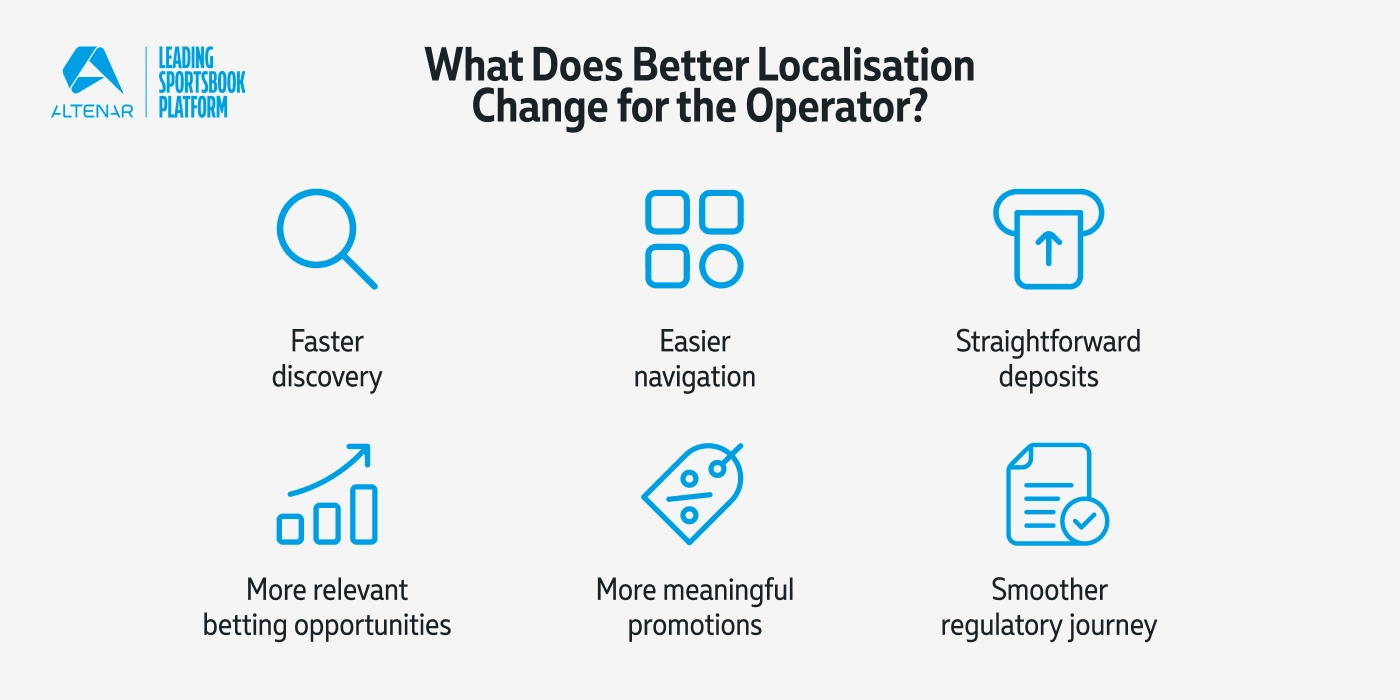
What Does Better Localization Change for the Operator?
All of these decisions eventually lead to the same commercial question. Does making the sportsbook more appropriate for the market actually change how players use it?
Potentially, the answer is yes. But localization does not magically create engagement or retention. Its value comes from removing specific points of resistance and making the sportsbook easier and more relevant to use.
That can happen in several ways:
-
Faster discovery: Players can reach the sports, competitions, events and markets they care about without digging through irrelevant content.
-
Easier navigation: Familiar layouts, terminology, and conventions mean players spend less time figuring out how to use a sportsbook.
-
Straightforward deposits: Recognizable, trusted payment methods remove one reason players might abandon the journey when they're ready to fund an account.
-
More relevant betting opportunities: Bringing locally important markets and bet types forward can expose players to opportunities they might otherwise never discover.
-
More meaningful promotions: Offers connected to relevant sports, events and betting habits have more reason to attract the player's attention.
-
Smoother regulatory journeys: Local requirements can be built naturally into registration, verification, deposits and responsible gambling interactions rather than feeling bolted on.
Localization Is a Platform Question Too
When you consider how many parts of a sportsbook can change from one market to another, the next question is a practical one. How difficult is it to make those changes? This matters more when operators move beyond one or two markets. If adapting the layout, market hierarchy, payment options or promotional experience repeatedly requires bespoke development, localization can quickly become expensive and slow.
The alternative is not to build a different sportsbook for every market. It is to have enough flexibility within the platform to make the differences that matter without changing everything that does not.
That makes configurability an important part of market expansion. Operators need to know which parts of the sportsbook they can adjust themselves, which changes depend on their provider, which require development and how easily the product can evolve after launch. After all, localization doesn't end the day a sportsbook enters a market.
Regulations change, payment preferences develop, new betting behaviors emerge, and commercial priorities move with them.
So don't just ask whether a sportsbook platform supports a market. Ask your sportsbook provider what you can actually change for that market, how easily you can change it and what happens when you need to change it again.
If you want to see how Altenar combines sportsbook flexibility with regional expertise to support expansion across different markets, book a software demonstration today and explore the platform in action.