
Key takeaways:
- Technical Debt Quietly Builds Up: Legacy systems, quick fixes and complex integrations can make future sportsbook changes increasingly difficult and expensive.
- Technical Debt Hits Margins: Longer development, testing and scaling processes consume resources, delay launches and reduce capacity for innovation and revenue growth.
- Fix the Debt That Matters: Operators should prioritize technical debt that affects scalability, development speed, compliance, maintenance and the player experience.
- Flexible Architecture Matters: Modular systems and well-defined APIs reduce dependencies, making it easier to add, replace or upgrade sportsbook services.
- Modernize Step by Step: High-impact technical debt can often be reduced through targeted refactoring, component replacement and optimization instead of a complete rebuild.
- Build for Future Change: Scalable infrastructure and flexible integrations help sportsbooks adapt to new regulations, suppliers, markets and changing player expectations.
‘We only need to change one thing.’ Those words can be expensive when a sportsbook has accumulated years of technical debt.
A seemingly straightforward request, such as adding a provider or altering the customer journey, quickly becomes a mission involving several parts of the technology stack. That invariably means more developers getting involved, more testing, and other priorities moving down the queue.
This is the point when operators should be asking: ‘How much is yesterday’s technology costing the sportsbook we’re trying to build for tomorrow?’
The difficult part is that technical debt does not necessarily mean the platform is failing. Quite the opposite. Everything may keep working, though each new change becomes progressively harder.
Understanding technical debt therefore starts with looking beyond whether the sportsbook works today. More useful questions are why change has become so difficult, what that difficulty costs the business, and what, if anything, should be done about it.
What Do We Mean by Technical Debt?
Technical debt is easier to understand if you think about what happens when a business chooses the quickest workable solution rather than the solution it would ideally build for the long term.
Yes, the immediate problem gets solved, but some of the work has effectively been postponed. Like financial debt, it may eventually come at a cost. In technology, that price can be additional development, maintenance, testing and complexity every time something needs to change.
That does not mean the original decision was wrong. An operator may have needed to launch quickly, meet a regulatory deadline or integrate a commercially important service. Equally, a reporting system built when data volumes were relatively small may struggle as betting activity, markets and regulatory reporting requirements increase.
The debt, therefore, silently accumulates and only becomes apparent when yesterday’s solution starts getting in the way of today’s requirements. Adding a new payment provider, for example, might sound like one integration. But if doing so requires changes to the wallet, player account, reporting and front end, the operator is also paying for the complexity that has accumulated around it.
That accumulated burden is what we mean by technical debt.
How Does a Working Sportsbook Accumulate Technical Debt?
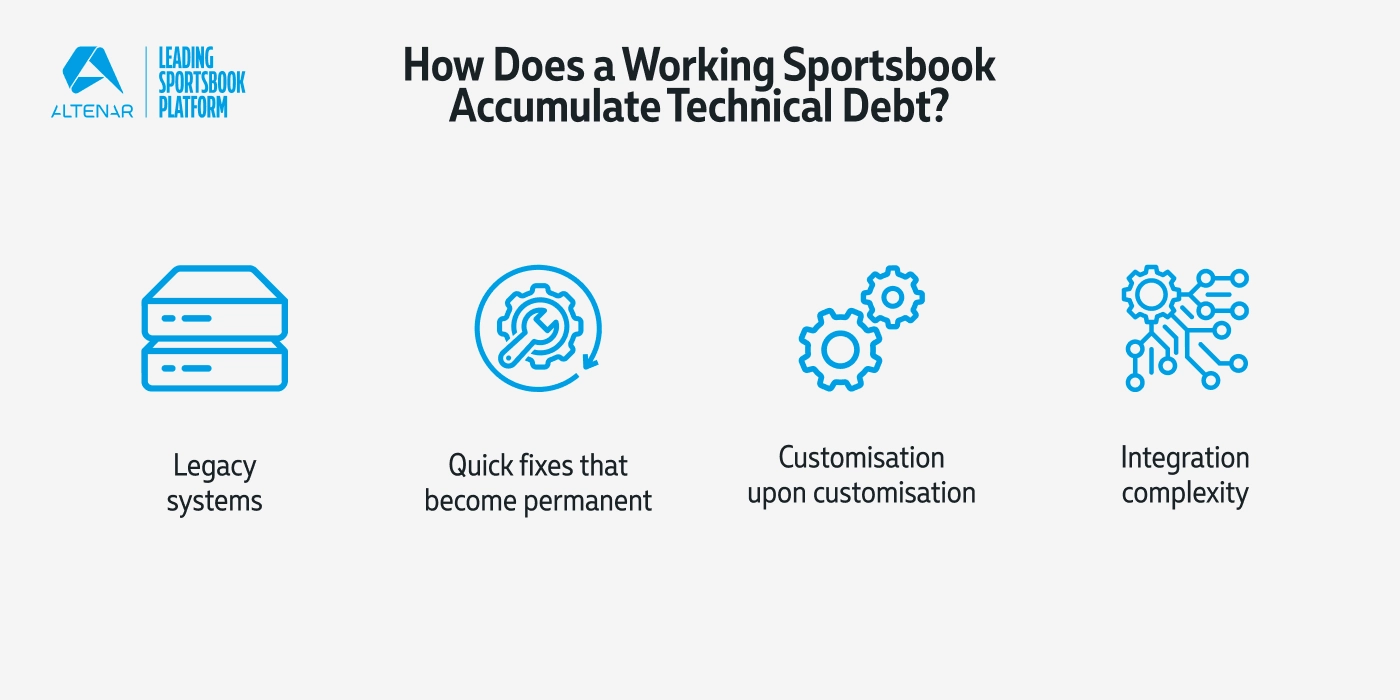
So, where does all that additional complexity come from? Unsurprisingly, it is not from one decision. In a sportsbook that has been operating and evolving for years, several contributors are usually at play, and many began as perfectly reasonable solutions to genuine business problems.
Legacy systems
Older technology is not automatically a problem. If a system remains reliable, affordable and easy to work with, its age alone is largely irrelevant. The difficulty comes when newer technology has to accommodate its limitations, specialist knowledge is required to maintain it, or apparently simple changes become difficult because of how the system was originally built.
Quick fixes that become permanent
Sometimes the quickest solution is the right commercial decision. For example, an urgent product requirement may leave little reason to spend months building the ideal long-term answer. Problems arise, however, when the temporary solution stays in place, and subsequent development has to be built around it.
Customization upon customization
Sportsbooks, as you know, do not stand still. New jurisdictions bring different requirements, operators develop new products, and individual commercial needs lead to bespoke functionality. Each addition can make perfect sense when it's needed. But years of exceptions and customizations can leave developers maintaining multiple dependencies and considering increasingly complex knock-on effects whenever something changes.
Integration complexity
Payments, KYC, data feeds, CRM platforms, suppliers and other services all have to connect somewhere. The number of integrations is not necessarily the problem, but how dependent they become on one another is. If replacing one service means changing several others, an integration that once added capability may now also be adding technical debt.
When it Starts Eating into Margins
Technical debt costs the business in several ways. More development is required, testing takes longer, infrastructure becomes more expensive, and launches can take longer and be delayed.
Put the following costs together, and the commercial impact becomes much easier to see.
| Operator wants to… | Technical debt can mean… | The business pays through… |
|---|---|---|
| Enter another market | More redevelopment and testing | Higher launch costs and delayed revenue |
| Add a supplier or service | Changes across dependent systems | More engineering time and integration costs |
| Launch a new feature | Longer development and testing cycles | Slower product innovation |
| Handle increased traffic | Additional infrastructure or engineering | Higher scaling costs |
| Improve the player journey | Changes across interconnected systems | Slower UX improvements |
| Respond to regulation | Workarounds or urgent custom development | Higher compliance and development costs |
| Maintain existing technology | More specialist work and fixes | Less engineering capacity for other work |
The last of these is particularly easy to overlook. Every hour developers spend maintaining aging technology, tracing dependencies or working around previous fixes is an hour they cannot spend improving the sportsbook.
The same applies elsewhere. If scaling requires disproportionately more infrastructure, margins feel the effect. If testing becomes more complicated, releases take longer. If an integration that should take weeks takes months, its commercial value is delayed too.
This is where technical debt stops being primarily a technology concern. It becomes commercially significant when maintaining yesterday’s decisions consumes resources that could be creating tomorrow’s revenue.
How Much Technical Debt Should You Actually Fix?
If technical debt is consuming resources and restricting growth, the obvious answer might seem to be to get rid of it completely. But in practice, that can be just as questionable as ignoring it.
Removing every workaround, replacing every aging component and rebuilding anything that is less than ideal could consume enormous amounts of time and money without delivering equivalent commercial value. Some technical debt may be inexpensive to carry and cause very few problems.
The better question is which debt is costing enough to justify fixing?
That means looking at business impact rather than the technology's age. A component that is ten years old but reliable, inexpensive and easy to maintain may be less urgent than a much newer integration that repeatedly slows development.
A few practical questions can help establish these priorities:
- How much maintenance and developer time does it require?
- How often does it complicate changes elsewhere?
- Is it making the sportsbook unnecessarily expensive to scale?
- Is it delaying launches, integrations or regulatory changes?
- Is it limiting product or player-experience improvements?
- What would it cost to fix compared with continuing to work around it?
The ultimate aim is not a sportsbook with zero technical debt. It is to stop the debt that really impacts the business negatively from becoming an increasingly expensive burden.
A Practical Approach to Reducing Technical Debt
Once you've identified expensive technical debt, dealing with it doesn't necessarily mean replacing the platform. A better approach may be to tackle the problems with the greatest commercial impact first, while making future changes less likely to add more debt.
Find out where the debt is costing you
Start with the recurring problems. Which systems require disproportionate maintenance? Where do developers repeatedly encounter the same dependencies or workarounds? Mapping those connections and measuring the development time, operating cost, and delays they cause helps turn technical debt from a general concern into something the business can prioritize.
Prioritize the expensive constraints
Not every problem deserves the same attention. Give greater priority to debt affecting reliability, scalability, development speed, or regulatory responsiveness, particularly where it already restricts commercial plans. The aim is to direct investment toward problems whose removal creates a meaningful operational or financial benefit.
Reduce unnecessary dependencies
If changing one component repeatedly requires changes elsewhere, examine whether those systems need to be so closely connected. More modular architecture and appropriate decoupling can allow individual components to change more independently. The aim is to make individual components easier to change without creating unnecessary work elsewhere in the platform.
Make integrations easier to change
APIs and clearly defined interfaces can make it easier to add, replace or upgrade services without extensive redevelopment elsewhere. For a sportsbook continually connecting payments, data, KYC, content and other services, that flexibility can prevent each new integration from becoming another permanent dependency.
Modernize incrementally
A complete migration is not always necessary. Refactoring problematic code, replacing a costly component or optimizing a particular service can address high-impact debt without rebuilding everything around it. Larger migrations make more sense when the underlying architecture itself has become the problem.
Keep optimizing
Paying down existing debt only solves half the problem. Regular platform reviews can identify new workarounds, outdated components and growing dependencies before they become expensive to address. The goal is to ensure temporary compromises do not quietly become permanent architecture.
Build for the Next Change
Dealing with existing technical debt is one part of the job. The other is reducing the chances that every new requirement simply starts building it up again. That means thinking not only about what the sportsbook needs to do today, but how easily it can adapt to whatever comes next.
There is no way to know exactly what your sportsbook will need five years from now. Regulations will change, new suppliers and products will emerge, player expectations will move on, and expansion may take the business into markets that were never considered when the platform was first built.
The better preparation is therefore not trying to predict every requirement. It is making sure that when change comes, the technology can accommodate it without each new development becoming progressively more difficult or expensive.
That means looking beyond what a sportsbook platform can deliver at launch. How easily can it scale? How much can be configured without development? Can new services be connected through flexible APIs and integrations? And how regularly is the underlying technology reviewed and optimized?
These are the principles that guide Altenar’s approach to sportsbook technology, combining scalable infrastructure with flexible integration and configuration capabilities alongside ongoing platform development.
Technical debt may never disappear entirely. The goal is to ensure it doesn't determine what your sportsbook can do next.
Your next opportunity shouldn’t require another workaround. Book a demonstration with Altenar now and explore the benefits of a sportsbook built to accommodate change, integration and growth.