

Key takeaway
-
Betting Volume Isn't Everything: High handle doesn't guarantee profit. Net revenue, promotional efficiency and operating costs reveal the true financial performance of a sportsbook.
-
Player Value Goes Beyond Activity: Customer profitability depends on LTV, betting preferences, retention, promotional costs and acquisition spend—not just how much they wager.
-
Smarter SGP Pricing Protects Margins: Accurate correlation modelling helps sportsbooks price Same Game Parlays competitively while managing risk and maximising revenue potential.
-
More Markets Don't Always Mean More Revenue: Offering player props strategically, based on demand, pricing accuracy and risk, can deliver better returns than simply expanding market selection.
-
Higher Hold Doesn't Guarantee Higher Profit: Sustainable margins require balancing pricing, promotional efficiency, customer retention and operating costs—not just retaining more from wagers.
-
Technology Is a Profitability Driver: Advanced trading tools, automation and real-time exposure management help sportsbooks improve efficiency, make smarter decisions and protect margins.
What Drives Sportsbook Profitability in the US Market in 2026?
For much of the history of sports betting in the US, success has been measured by growth. How many customers could an operator attract? How much market share could it capture? And how much betting activity could it generate? With billions being spent competing for customers, these were understandable priorities.
But, as you already know, attracting new customers and making money from them are two very different things. And as the market matures, the success of a sportsbook in the US is being judged by the profitability of its operations rather than the scale of its customer base.
Consider two sportsbooks with similar numbers of customers, taking roughly the same amount in bets, for instance. On paper, their businesses might look remarkably alike. Yet one could be generating significantly more profit than the other. So, what's making the difference?
Customer acquisition costs, retention and promotional spending are part of the answer, of course. But they don't fully explain why two sportsbooks with similar customers and betting volumes can produce such different financial results. What else is making the difference? And could some of the biggest opportunities to improve profitability be found in areas that have received considerably less attention in recent times?
Betting Volume No Longer Tells the Whole Story
For years now, competition among US sportsbooks has predominantly been about attracting customers and building market share. Generous welcome offers, free bets and expensive marketing campaigns helped operators establish themselves, particularly as new states opened up to regulated sports betting.
But that approach is harder to justify as customer acquisition costs rise and investors demand stronger returns. Operators still need to attract and retain players, of course, but the economics of doing so are coming under greater scrutiny.
And this is where the numbers can become misleading. A sportsbook might report impressive betting volumes, or handle, but that doesn't tell us how much money it actually makes. Once winnings are paid, the resulting gross gaming revenue can be substantially less impressive. Deduct promotional costs and other applicable adjustments, and net revenue tells another story. Operating expenses then determine how much profit, if any, remains.
Two operators can therefore generate similar betting volumes but achieve very different financial results.
So, while customer acquisition costs, payback periods and lifetime value remain important, there's a more fundamental question worth asking. What makes the betting activity generated by one customer more valuable than that of another?
Are You Measuring Player Value or Just Player Activity?
The question brings us back to something operators already spend considerable time measuring: customer lifetime value (LTV). But how accurately does that figure reflect what individual customers actually contribute to the business?
Consider two customers who each wager $5,000 over the course of a month. One mainly places straight bets, while the other prefers Same Game Parlays. Both generate the same handle, but their contribution to the sportsbook's revenue could be quite different. The customer placing Same Game Parlays could actually generate more revenue, depending on how those bets are priced and the results that follow.
But betting preferences are only part of the calculation. How much promotional support does each customer receive? How frequently do they return? And how much revenue does their betting activity generate over time?
And that's all before considering what it cost to acquire them in the first place. Customer acquisition cost (CAC), promotional expenditure and the time needed to recover that investment all influence whether a customer relationship ultimately becomes profitable.
This is why looking at player activity in isolation can be misleading. Operators need to understand how different customer groups perform over time, including their betting preferences, reliance on promotions and retention, rather than assuming that early activity will translate into lasting value. Of course, that value must also be generated within the requirements of responsible gambling and appropriate player protections.
But even when an operator understands its customers, there's another important consideration. How much control does the sportsbook have over the commercial value of the bets those customers choose to place?
Why Same Game Parlay Pricing Can Make a Difference
One area where sportsbooks have considerable influence over their margins is how they price Same Game Parlays (SGPs). These bets have become an important part of the US sports betting experience, particularly around major NFL and NBA games, where customers can combine multiple outcomes from the same event into a single wager.
But pricing these combinations isn't as straightforward as it might appear. Consider an NFL bet that combines a quarterback throwing for over 250 yards, his leading receiver gaining over 80 yards and their team scoring more than 27 points. These outcomes are connected. If the quarterback has an outstanding game, the chances of the other two selections winning may increase as well.
That relationship is significant because the sportsbook needs to calculate the probability of all three outcomes happening together. If it underestimates that probability, it could offer odds that pay out more than the risk justifies. But if it prices the bet too cautiously, customers may find better value elsewhere.
This is where accurate correlation modeling can make a difference. It helps operators offer competitive SGPs while protecting themselves against incorrectly priced combinations.
The commercial opportunity is that Same Game Parlays can generate more revenue from a given amount of betting activity than individual straight bets. But that advantage depends on getting the pricing right. Operators need to understand how the different outcomes are connected, rather than assuming that combining more selections will automatically produce better margins.
With that said, pricing is only half the story. Operators also need to consider which betting markets are worth offering in the first place.
Does Offering More Player Props Make a Sportsbook More Profitable?
Accurate pricing is important, but operators also need to consider which betting opportunities they offer. And in the US, player props have become an important part of that decision.
Rather than simply betting on which team will win, customers can wager on individual performances, from a quarterback's passing yards to an NBA player's points or rebounds. These markets give customers more ways to engage with their favorite sports and provide additional selections for Same Game Parlays.
So, wouldn't offering more player props automatically mean more betting activity and greater revenue?
Well, as it turns out, not necessarily. Every additional market needs reliable data, accurate pricing and appropriate risk management. A wide selection of player props for a major NFL game might attract considerable interest, but offering the same depth for a less popular event could create additional work without generating enough betting activity to justify it.
There's also the question of how reliably those markets can be priced and how much liability the operator is prepared to accept.
For sportsbooks, the challenge is therefore not simply to offer the largest possible selection. It's to understand which markets customers actually want to bet on, which ones generate worthwhile revenue and whether the operator can manage them profitably. And that, in turn, leads to another question. Even when a sportsbook attracts substantial betting activity, how much of that money does it actually retain?
Is a Higher Hold Percentage Always Better for Business?
With so much attention on pricing and market selection, it's worth asking whether a higher sportsbook hold percentage always means better financial performance.
Hold measures the percentage of money wagered that a sportsbook retains after paying out winnings. Naturally, operators want to improve that figure, but there is a difference between the margin built into their odds and what they actually retain once sporting results are known.
DraftKings provides a useful example of why this distinction matters. According to its 2025 annual report, the operator's sportsbook net revenue margin increased from 6.0% in 2024 to 7.1% in 2025. Significantly, this wasn't simply a measure of hold. It reflected the combined effect of improved sportsbook hold and more effective promotional spending.
The distinction is important because a sportsbook can improve its net revenue margin in more than one way. Better pricing can increase the revenue generated from bets, while more efficient promotional spending can improve how much of that revenue the operator retains. And improvements in one don't necessarily mean improvements in the other.
The choice of betting products matters, too. Multiples and Same Game Parlays can let operators generate more revenue from a given amount of betting activity than straight bets, provided those combinations are priced appropriately. But the commercial benefit still depends on customer demand, competitive pricing and the costs of generating that revenue.
And even a strong hold percentage doesn't account for everything. You still need to pay gaming taxes, technology, marketing, and other operating expenses.
A higher hold percentage may look good on paper, but what really matters is whether you can maintain those margins without losing customers or undermining the sportsbook's competitiveness. Of course, even accurately priced bets can create substantial liabilities when customers concentrate their wagers on particular outcomes.
Are Your Risk Controls Protecting Profitability or Limiting Growth?
Even when a sportsbook gets its pricing right, it still needs to manage what happens when large numbers of customers back the same outcome.
Consider a major NFL game in which thousands of bettors wager on a particular quarterback to exceed his passing-yard total. Some place straight bets, while others include the same selection in same-game parlays. If the quarterback delivers an exceptional performance, the sportsbook could face significant payouts across several different markets.
This is why operators need to understand their total exposure, rather than looking at each market separately. Once operators understand their exposure, they have several options for managing it.
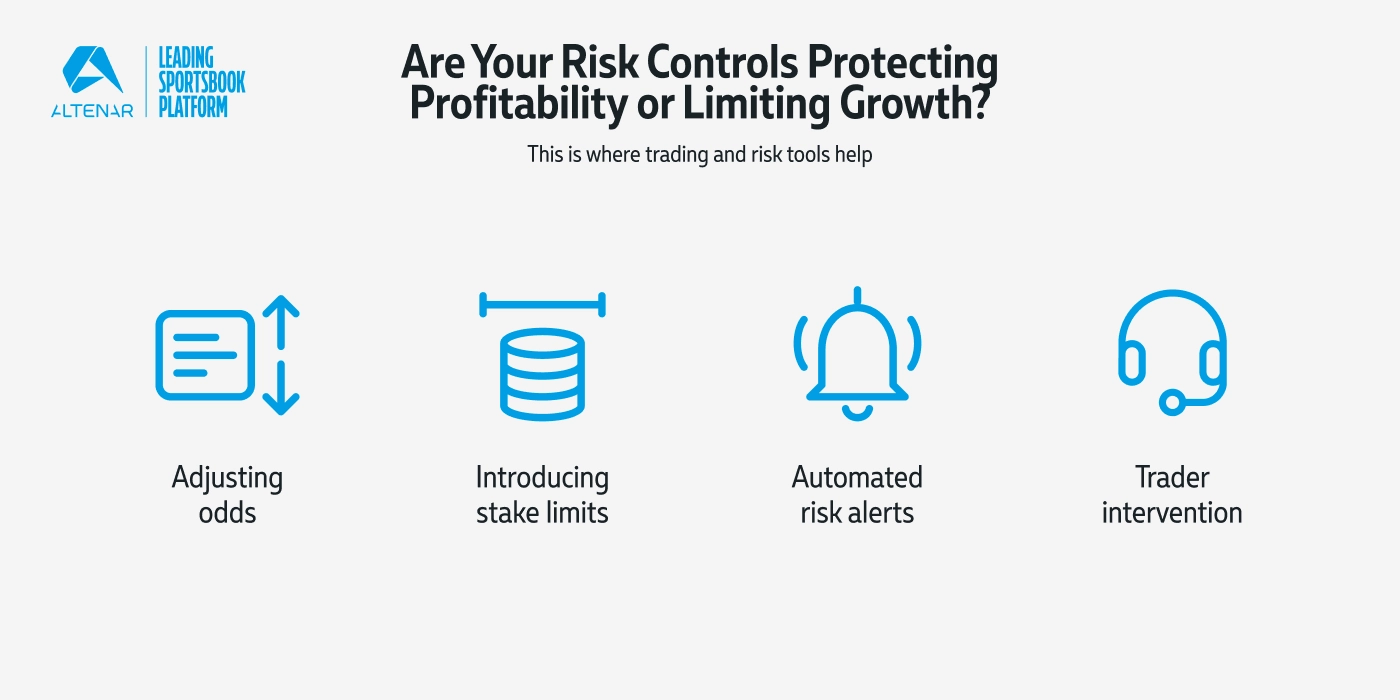
This is where a range of trading and risk-management tools becomes useful:
-
Adjusting odds: Changing prices can discourage further betting on heavily backed outcomes while keeping the market available.
-
Introducing stake limits: Limiting bet sizes can control potential payouts, although excessive restrictions may frustrate customers.
-
Automated risk alerts: Real-time warnings help trading teams identify growing liabilities before they become more difficult to manage.
-
Trader intervention: Experienced traders can assess unusual betting patterns and determine whether pricing or limits need to be adjusted.
The important point is that these measures shouldn't be applied indiscriminately. Different customers and betting patterns present different risks, and unnecessary restrictions can make a sportsbook less competitive.
Effective risk management, it has to be said, isn't about avoiding every potential loss. It's about understanding the exposure well enough to make informed commercial decisions. And increasingly, the ability to make those decisions depends on the technology supporting the sportsbook's trading operations.
How Much Is Technology Influencing Your Margins?
All the decisions we've discussed, from pricing Same Game Parlays to choosing which player props to offer and managing betting liabilities, depend on the technology supporting the sportsbook.
And this raises an important question. Is that technology giving operators the information and flexibility they need to make better commercial decisions, or is it limiting what they can do?
For example, a trading team might want to expand its player prop offering, but can the platform support the additional markets without creating unnecessary work? Can traders see their exposure across related bets and respond quickly when liabilities increase? And can operators identify which betting products are actually contributing to revenue?
These aren't simply technical considerations. They influence which opportunities a sportsbook can pursue, how efficiently its trading team can operate and how effectively it can manage risk.
Automation can help teams respond faster and manage more markets, but experienced traders still need the information and control to make informed decisions.
Ultimately, sportsbook technology isn't just another operating expense. Its capabilities can influence how much revenue an operator can generate and how much of that revenue it can retain.
And that makes it worth asking whether the technology running a sportsbook is helping the business improve its margins or making that task more difficult.
Can your sportsbook offer the markets customers want while effectively managing pricing and exposure? Book a software demonstration with Altenar to explore technology designed to support competitiveness and sustainable profitability.