
Key Takeaways
-
Players compare sportsbooks: Finnish bettors already compare different betting sites, so strong sports coverage, useful features, and a smooth experience are key to winning their preference.
-
Ice hockey matters: Finland is not simply a soccer-first market. Ice hockey leads sporting interest, while skiing, athletics, soccer, biathlon, and other sports matter across audiences and seasons.
-
All ages bet online: Finnish online bettors span many age groups, making clear navigation, readable interfaces, mobile performance, and simple payment journeys important for a better experience.
-
Personalization is important: One Finnish sportsbook experience will not suit everyone. Differences in age, gender, sports interests, and online behavior make personalized content more useful for players.
-
Make betting simple: A strong sportsbook should reduce reasons to look elsewhere through easy discovery, simple bet placement, reliable payments, smooth live betting, and useful features.
-
Bonuses are not enough: Bonuses can influence first choice, but lasting loyalty needs relevant markets, easy navigation, reliable payments, personalization, and a strong live betting experience.
Product-Led Retention: How Finnish Sportsbook Operators Can Build Player Loyalty
What should a sportsbook built for Finland look like in 2026? The answer requires more than translating an existing European product.
Finnish betting behavior, sporting interests, and digital habits reveal some important differences. Players already use alternatives to the domestic monopoly, and their sporting preferences don't necessarily fit the soccer-first model familiar across much of Europe.
For operators entering Finland’s newly competitive market, understanding those differences could determine more than what appears on the homepage. It could ultimately decide whether players simply try their sportsbook or find enough reasons to keep choosing it.
Rather than relying on assumptions about player loyalty, this article examines what Finnish data specifically tells us and turns those findings into practical sportsbook recommendations.
What Makes the Finnish Bettor Different?
There is, of course, no single type of Finnish bettor. But national gambling data, along with academic research, reveals some useful differences in how Finns gamble, where they already exercise choice, and what they look for elsewhere. For operators entering the licensed market, these behaviors provide a better starting point than assumptions about what might build loyalty in this specific jurisdiction.
Finnish players already exercise choice
Competition may be new to Finland’s regulated market, but let’s be clear, comparing gambling products is not new to Finnish players. That’s a different thing entirely. A peer-reviewed Finnish population study about gambling motives and offshore gambling asked 214 offshore gamblers why they used sites other than Veikkaus. Of those respondents, 76.3% cited a larger game selection and features, while 33.5% mentioned benefits, bonuses, or website usability.
This behavior is commercially significant. Finland’s 2023 national gambling study estimated that 36.1% of online gambling expenditure went to non-monopoly games, although the confidence interval around that estimate was relatively wide.
For incoming operators, the benchmark is therefore not simply Finland’s former monopoly product. It includes alternative products that Finnish players have already experienced, as well as the reasons some chose them.
Finland isn't simply a soccer-first market
Soccer matters in Finland, but it does not dominate sporting interest in the way operators may expect from other European markets. A 2025 Sponsor Insight survey reported by Yle found that more than 3,100 Finnish adults ranked ice hockey first, followed by athletics, cross-country skiing, soccer, and biathlon. Ice hockey also ranked first among both men and women.
Age adds another dimension. Earlier Finnish sports-interest research from the same source found esports particularly prominent among 18–29-year-olds, while sports such as cross-country skiing attracted considerably greater interest among older groups.
These are measures of sporting interest rather than betting behavior, but they highlight an important product consideration, which is that there may be no single Finnish sports hierarchy. What deserves priority can change by audience, event, and season.
Online gambling isn't confined to younger Finns
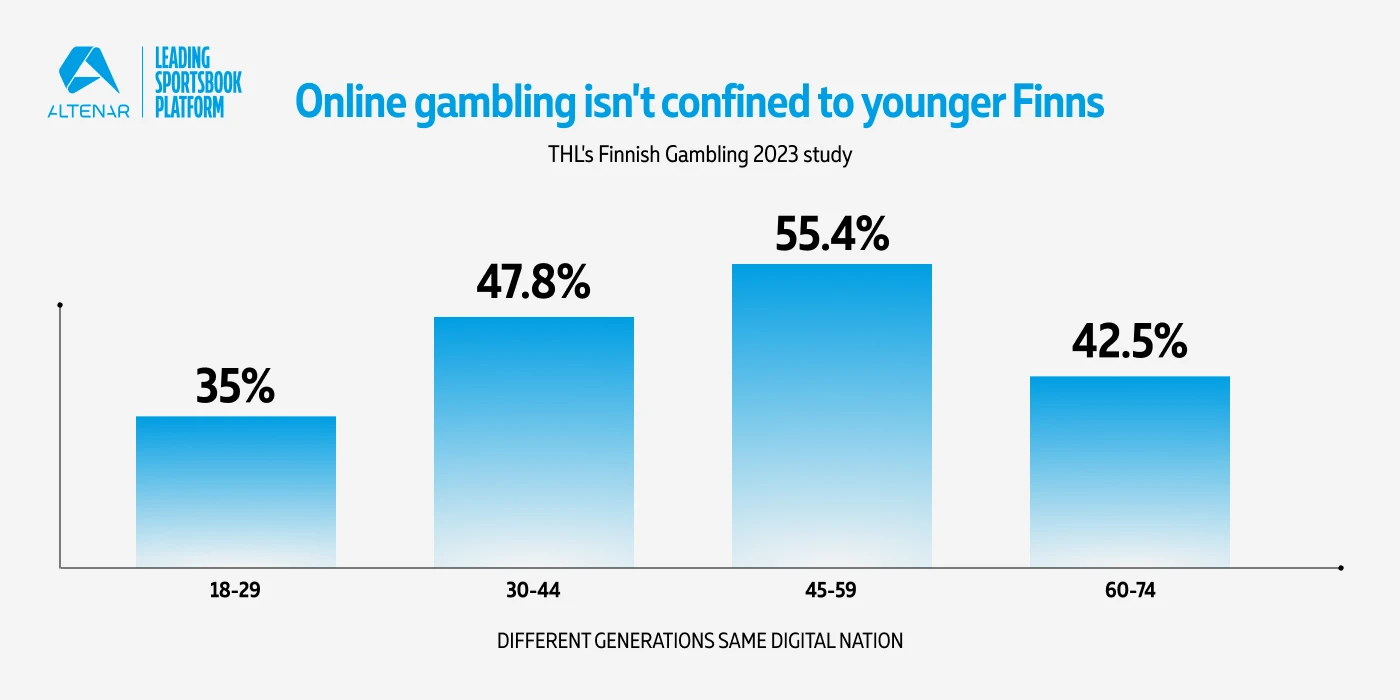
It would be easy to associate Finland’s increasingly digital gambling market primarily with younger players, but the national data suggests otherwise. THL’s Finnish Gambling 2023 study found past-year online gambling was highest among 45–59-year-olds at 55.4%, compared with 47.8% among 30–44-year-olds and 35% among 18–29-year-olds.
Perhaps more strikingly, 42.5% of 60–74-year-olds gambled online in 2023, up from 24.1% in 2019.
For operators, digital maturity therefore should not be confused with designing exclusively for digital natives. Finland’s online audience spans generations, making clear navigation, readable interfaces, and straightforward account and payment journeys important considerations alongside speed and mobile functionality.
Finnish customers live in an unusually mature digital market
Finland’s online gambling habits sit within a much broader digital culture. According to Statistics Finland, 94% of Finns aged 16–89 used the internet in 2024, and 90% owned a smartphone. In addition, Eurostat reports that 97% of Finnish internet users used online banking in 2025, compared with 74% across the EU.
These figures do not tell us how Finnish bettors choose a sportsbook. They do, however, show the wider digital environment in which those decisions are made. Registration, authentication, deposits, and withdrawals are joining an established routine of digital transactions rather than introducing one.
For operators, that makes unnecessary barriers harder to justify. A sportsbook’s digital experience is competing with expectations formed well beyond the betting industry.
The Finnish audience isn't one audience
The differences extend beyond age and sporting interests. THL’s 2023 national gambling study found a particularly pronounced gender divide in sports betting, soccer pools, and multibet participation — 18.2% of men participated in the previous year, compared with just 2.9% of women.
Combined with the differences in sports preferences and online behavior we have already seen, this makes it difficult to justify treating Finnish bettors as a single audience. National localization can put an operator in the right market, but it does not necessarily put the right content in front of each customer.
That is where personalization becomes more useful. Localization identifies what matters in Finland. Personalization can help identify what matters to the individual Finnish player.
The players most willing to switch require the greatest attention
There is another side to Finland’s existing offshore activity. Research into offshore gambling among Finnish players found that offshore gambling was more common among younger people and men. Offshore gamblers also gambled more frequently, reported a wider range of gambling motivations, and, as a group, recorded higher problem-gambling severity scores than those gambling only with Veikkaus.
That creates an important tension for incoming operators. Players already comfortable using alternatives may be obvious customers to compete for, but some within that audience may also require greater protection.
Retention in Finland therefore cannot simply mean maximizing activity among the easiest players to convert. The more relevant challenge is making the licensed product attractive enough to win their preference while providing the protections Finland’s regulated system is designed to deliver.
Turn Finnish Relevance into Product Experience
But understanding Finnish betting behavior is only useful if the sportsbook translates those differences into experiences for the player. The first step is obvious. Offer the sports, competitions, and markets that matter locally. But genuine localization goes further than simply having them somewhere in the catalog. It raises a more practical question. How quickly can the player find what is relevant to them?
A hockey bettor should not have to navigate a sportsbook organized primarily around soccer to reach the NHL or Liiga. Equally, Finnish sporting interest does not remain fixed throughout the year. Ice hockey, skiing, biathlon, motorsport, and major international events can rise and fall in relevance as their seasons and competitions unfold.
That creates a case for seasonal localization. Instead of defining one permanent Finnish sportsbook hierarchy, operators can adjust priority as the sporting calendar changes. The important question becomes not only whether a market is available, but whether the operator has enough control over the interface to change it when Finnish interest is likely to be highest.
From national relevance to personal relevance
Even that only takes localization so far. As we have seen, Finnish players differ considerably by age, gender, sporting interests, and online behavior. Showing every customer the same locally adapted homepage still assumes that one version of ‘Finnish relevance’ works for everyone.
This is where personalization can bridge the gap between what matters in Finland and what matters to this particular customer.
Altenar’s sportsbook, for instance, gives operators tools to segment players and vary what they see. Operators can use Player Tags to create customer segments, and those tags can work with Bet Cards and Boosted Odds to present different betting content and offers to different groups. Bet Cards can also highlight curated selections and pre-built Bet Builder combinations.
The objective is not personalization for its own sake. The point is to show players more of what interests them, without making them search through content that does not.
Remove the Reasons to Choose Another Sportsbook
Getting the right content in front of Finnish players solves only part of the retention problem. The Finnish offshore gambling study found that website usability, alongside benefits and bonuses, featured among the reasons players gave for gambling outside Veikkaus.
That is significant because every unnecessary complication gives a customer another opportunity to compare. Product breadth may attract comparison. Product issues encourage it.
For operators, the useful question is therefore where those complications occur. Can players find the sport or market they want quickly on mobile? How many steps separate discovery from bet placement? Are registration, authentication, deposits, withdrawals, and account management straightforward? And does the experience remain consistent when a player moves from researching an event to following and betting on it live?
Keep the experience moving with the event
Live betting is particularly relevant to that final question. There is no need to assume Finnish bettors have an unusually strong preference for in-play betting. Once an operator has attracted someone through ice hockey, soccer, motorsport, or another relevant sport, however, the experience shouldn't deteriorate once the event starts.
Markets need to be easy to find, odds need to update reliably, and placing or managing a bet should remain straightforward. Features such as Bet Builder and cash-out can then add choice without complicating the underlying journey.
There is already a Nordic example of this approach. In its work with Wildz Group, Altenar combined a customizable sportsbook with Bet Builder, cash-out, and daily streaming, supported by Nordic trading specialists and regional expertise. Altenar reports increased activity around the NHL, NBA, NFL, leading European soccer, and local competitions, while its Finland sportsbook offering includes mobile options, live odds, and in-play functionality.
The primary lesson to be learned is not that every Finnish sportsbook needs the same features. It is that relevant content has less value if accessing, betting on, or following it becomes unnecessarily difficult.
Loyalty in Finland Cannot Depend on Bonuses Alone
The evidence discussed earlier makes one thing abundantly clear. Bonuses and other benefits do influence where some Finnish players choose to gamble. So there is little value in pretending promotions will suddenly become irrelevant when the licensed market opens. The more useful question is how much of the retention job they can realistically do.
Finland’s new regulatory framework places clear boundaries around that role. Under the new Gambling Act, bonus money must be moderate and cannot be linked to how long someone gambles or how much they spend. Operators must also consider their responsibility to protect players from excessive gambling before awarding it.
That makes building loyalty through the sportsbook itself more important. Promotions can influence the first choice. They cannot be the only reason for the next one. Relevant markets, easy navigation, reliable payments, personalization, and a strong live experience give players reasons to return without continually increasing the incentive to bet.
This also suggests a more appropriate definition of retention for Finland. The objective is not simply to increase how often or how much a customer gambles. It is to build enough trust and product preference that, when players choose to bet, they prefer the regulated sportsbook rather than looking outside the licensed market.
Build for the Finnish Player, Not Just the Finnish License
Preparing for Finland requires operators to solve two different problems. Regulatory readiness determines whether you can enter the market. Product readiness determines whether Finnish players keep choosing your sportsbook.
The evidence we have examined suggests that the second question deserves more attention than simply translating an existing sportsbook and adding local payment methods. Before launch, operators should be asking:
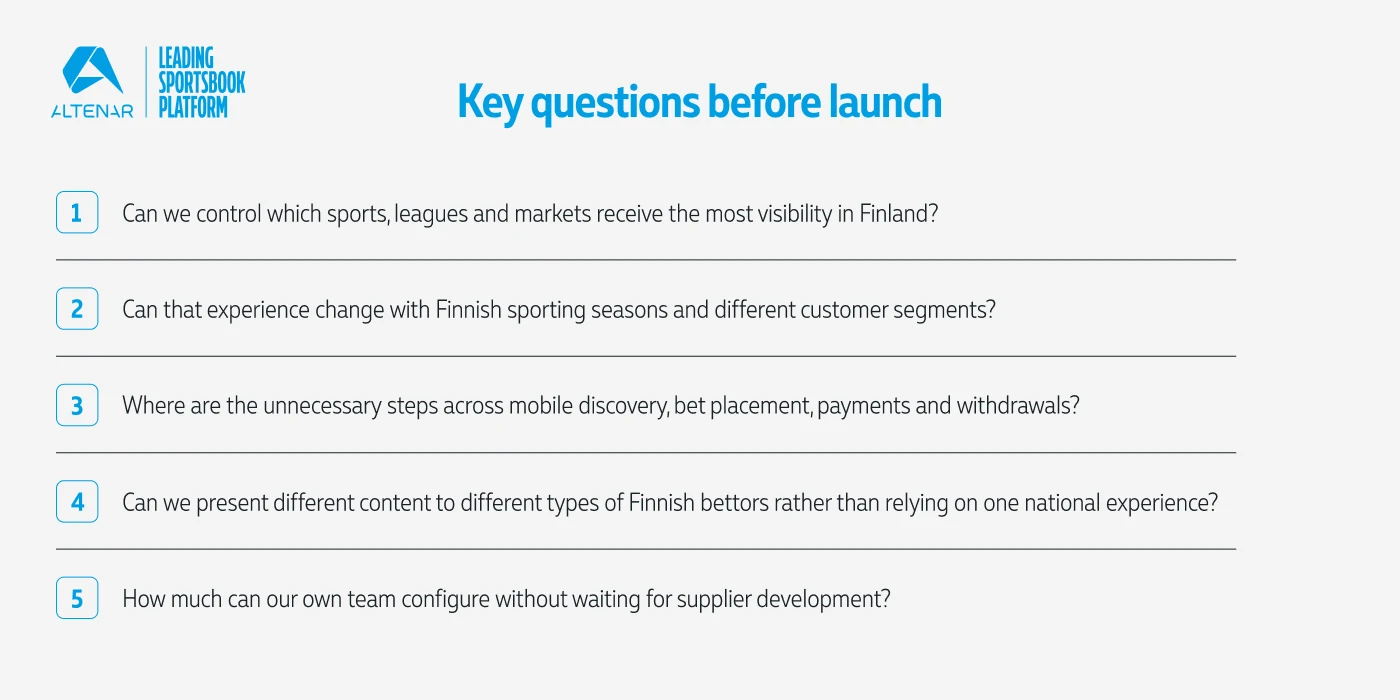
These questions ultimately come down to how much control an operator has over its sportsbook as the Finnish market evolves.
This brings the discussion back to the technology operators choose for the Finnish market. Altenar’s sportsbook combines Finnish-language and localized content with configurable features, live betting, mobile options, and the personalization capabilities discussed earlier. Significantly, these capabilities give operators ways to adapt the experience as sporting interests, customer behavior, and commercial priorities change.
A Finnish license creates the opportunity to compete. But the sportsbook still has to give players a reason to choose yours.
Do you want to see what building specifically for Finnish players could look like? Book a software demonstration with Altenar now to explore the tools available for localization, personalization, live betting, and ongoing sportsbook configuration.