

Key takeaway
-
Higher Tax Pressure: Malta’s sports betting tax rose from 5% to 10% on 1 October 2026, increasing pressure on operator profit margins.
-
Taxable Revenue Accuracy: The 10% tax applies to qualifying gaming revenue, not total betting turnover or automatically all international revenue.
-
Reliable Data Management: Accurate player-location, betting, and revenue-adjustment data supports correct tax calculations and regulatory compliance.
-
Operational Automation: Automated data collection and integrated systems reduce manual work, reporting effort, and operational costs.
-
Smarter Sportsbook Management: Real-time analytics and automated risk controls improve trading efficiency and help manage betting volumes.
Malta’s 10% Sports Betting Tax: Compete Smarter With Better Technology
As most readers of this article already know, running a sportsbook involves many costs that operators can plan for, from technology and staffing to compliance and day-to-day operations. But some costs are simply outside the operator’s control, and when they change, there is little choice but to adapt.
Malta provides a recent example of this. On 1 October 2026, the country increased its sports betting tax from 5% to 10%. For affected operators, that means a larger share of qualifying gaming revenue now goes towards tax, putting additional pressure on margins that may already be tight.
Of course, operators cannot do much about the tax rate, but they can influence how efficiently they run their sportsbooks, including how they manage data, meet reporting requirements and reduce unnecessary operational costs.
And that raises a question worth exploring. When every additional cost matters, how much money could operators be losing through the way their sportsbooks are run?
What Has Changed with Malta's Sports Betting Tax?
Malta's revised gaming tax framework came into effect on 1 October 2026, introducing new rates for different types of gambling activities. Under the previous system, qualifying gaming revenue was generally taxed at 5%. That has now changed.
Under the new rules, the rates are:
-
10% for Type 2 gaming, which includes fixed-odds sports betting.
-
10% for Type 3 and Type 4 gaming, including certain peer-to-peer betting and controlled skill games.
-
15% for Type 1 gaming, which includes casino games.
Significantly, the 10% sports betting tax applies to qualifying gaming revenue, not the total value of bets placed. Nor does it automatically apply to all international revenue generated by an MGA-licensed sportsbook. The tax concerns qualifying gaming activity involving players in Malta.
The changes, introduced through Legal Notice 84 of 2026, form part of a wider reform of Malta's gaming tax and VAT frameworks, as explained by the Malta Gaming Authority in its Enhancements to Malta’s VAT and Gaming Tax Frameworks for the Gaming Sector page. For affected sportsbook operators, however, the immediate concern is what the higher rate means for their existing operating costs.
What Does the Higher Tax Mean for Sportsbook Operators?
Additional tax costs can be substantial, even when the sportsbook's betting activity and revenue remain unchanged. And, of course, tax is only one of the costs involved in running a sportsbook. Operators must also pay for technology, trading, payment processing, marketing, staffing, regulatory compliance and more. All of these expenses affect how much revenue eventually becomes profit.
For operators already working with tight margins, absorbing another cost may leave relatively little room to manoeuvre. And while increasing revenue or cutting expenses might seem like obvious responses, neither is necessarily straightforward.
The tax rate itself is beyond an operator's control. But many of the costs involved in running a sportsbook are not. Finding ways to manage those costs more efficiently becomes increasingly important, starting with something as fundamental as knowing exactly which revenue is taxable.
Why Accurate Sportsbook Data Matters More Than Ever
Before operators can calculate what they owe under Malta's new tax rules, they need to know which betting activity counts. And that depends on having accurate, reliable data. Operators cannot simply apply the new 10% rate to their total betting turnover. They need accurate information about several aspects of their operations. These includes:
Player location
Operators must distinguish between customers whose activity falls within Malta's tax framework and those based elsewhere. An MGA licence does not automatically make all international betting revenue taxable in Malta.
Betting activity
Reliable records of stakes, winnings and settled bets help operators calculate gaming revenue correctly, rather than confusing the total amount wagered with the revenue retained by the sportsbook.
Revenue adjustments
Bonuses, refunds, voided bets and other adjustments need to be recorded and treated correctly under the applicable rules, so that tax calculations reflect the relevant qualifying revenue.
Data consistency
When customer information, betting records and financial data are kept in separate systems, operators may spend considerable time reconciling figures, investigating discrepancies and preparing accurate regulatory returns.
The MGA's revised reporting arrangements provide a timely example of why this matters. But accurate data has value beyond tax compliance. It also gives operators a clearer picture of sportsbook performance. The next task is making sure that information can be collected, processed and reported without creating unnecessary additional work.
How Sportsbook Technology Can Reduce the Operational Burden
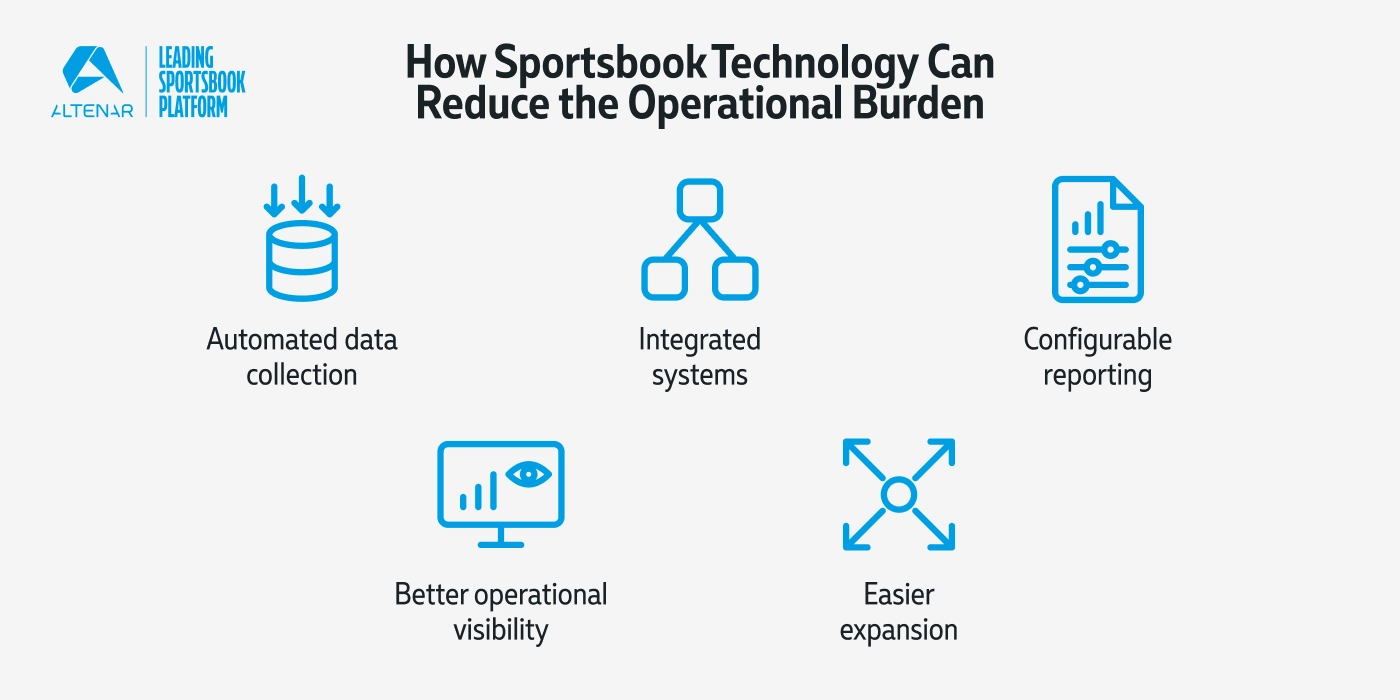
Of course, having accurate data doesn't necessarily mean it's easy to manage. When operators rely on manual processes to verify figures and prepare regulatory reports, even routine tasks can consume valuable time. This is where sportsbook technology can make a practical difference. Rather than relying on staff to gather information from different systems and reconcile it manually, operators can automate much of the process. For example:
-
Automated data collection: Betting transactions, customer activity and revenue information can be captured and organised as they happen, reducing the need for manual data entry.
-
Integrated systems: Connecting betting records, player accounts and financial reporting helps maintain consistent information across the business, making discrepancies easier to identify and resolve.
-
Configurable reporting: When regulators change their requirements, adaptable reporting tools can help operators produce the necessary information without rebuilding existing processes or relying on manual methods.
-
Better operational visibility: Automated data processing gives operators more immediate access to betting activity, revenue and performance information, helping them identify problems and make decisions without waiting for manual reports.
-
Easier expansion: As betting volumes increase or operators enter new markets, automated systems can handle additional transactions and reporting requirements without requiring a proportional increase in administrative staff.
The benefit is not simply getting routine tasks done faster. It is freeing up staff to concentrate on work that requires their attention, rather than spending time collecting information, checking figures and preparing reports.
Technology cannot change Malta's 10% tax rate, but it can help operators reduce the cost of meeting their obligations. The question, then, is whether their existing sportsbook platform gives them the flexibility and control to achieve those efficiencies.
What Should Operators Expect from Their Sportsbook Technology Providers?
Not every sportsbook platform makes these efficiencies equally easy to achieve. Some give operators greater control over their systems, while others require more involvement from the technology provider whenever something needs to change.
That difference is particularly important when regulations change or a sportsbook expands into another market. So, what should operators expect from the technology they rely on?
Here are some of the areas where a technology provider can make a real difference:
Adapting to regulatory changes:
Operators should be able to accommodate new tax rules, reporting requirements and market-specific controls without commissioning extensive platform redevelopment every time regulations change.
A clearer view of sportsbook performance:
Reporting and analytics should go beyond producing regulatory returns. Operators need to understand betting activity, trading performance, liabilities and where operational costs or inefficiencies may be affecting the business.
More efficient trading and risk management:
Automated monitoring, liability controls and real-time information can help trading teams manage greater betting volumes without having to review every transaction or risk exposure manually.
Connected systems and reliable data:
Betting transactions, player accounts, payments and reporting should work together, reducing the need to reconcile information across multiple platforms or maintain separate processes for each market.
Greater control over day-to-day operations:
Operators should also be able to adjust relevant settings, access reports and manage routine operational requirements themselves, rather than depending on their technology provider for every change.
Altenar's sportsbook technology brings together capabilities such as trading, risk management, analytics and reporting in a configurable platform, helping operators manage both day-to-day operations and evolving requirements.
And as Malta's higher tax rate demonstrates, the value of these capabilities becomes particularly relevant when operators need to protect profitability without compromising the quality of their sportsbook offering.
You can't control every cost of running a sportsbook, but you can control how efficiently it operates. Book an Altenar demonstration now and discover what's possible.