
Key takeaways
-
Traditional Drivers Limit Advantage: Features like bonuses and odds coverage are easily copied. Sustainable competitive advantage requires moving beyond purely transactional relationships.
-
Social Features Drive Engagement: Features like leaderboards, bet sharing, and tipster groups keep users connected to the platform even when they are not actively placing wagers.
-
Organic Customer Acquisition: Private leagues, shared slips, and prediction challenges encourage users to invite friends, creating organic, lower-cost acquisition channels.
-
Amplified Gamification Power: Gamification becomes far more impactful with an audience; competing against friends and sharing achievements makes rewards and rivalries more meaningful.
-
Community Delivers High Loyalty: When users invest time in friend groups and rankings, switching platforms means leaving a community behind, creating a strong barrier to churn.
-
Responsible Design Is Essential: Social betting must balance engagement with responsible gambling, privacy, moderation, scalability, and healthy community standards.
How Social Betting Could Transform Sportsbook Loyalty
What if the strongest retention tool available to a betting platform is no longer a bonus, a promotion, or even a product feature? Across the digital economy, many successful platforms have discovered that communities can become powerful competitive assets. Sports betting is beginning to explore the same idea.
This article examines why social betting is attracting growing interest, how community-led engagement can strengthen loyalty, and why the operators that recognise this opportunity early may just gain an advantage that competitors will find difficult to match.
Why the industry is moving beyond traditional engagement
For much of the history of online betting, growth has been driven by a relatively familiar formula. Operators competed through larger bonuses, market coverage, aggressive acquisition campaigns, and continuous product improvements. Those factors remain important today, but their ability to create lasting competitive advantage is becoming increasingly limited.
As regulated markets mature, many operators face a similar challenge. Acquiring players remains expensive, promotional offers are quickly matched by competitors, and product innovations that were once distinctive can become standard expectations within a relatively short period of time.
None of this means that traditional acquisition and retention strategies have stopped working. Far from it. Promotions, CRM activity, personalisation, and user experience continue to play an important role in sportsbook growth. The challenge is that these approaches are becoming easier to replicate across the industry.
That reality is encouraging operators to rethink engagement. Instead of focusing exclusively on betting transactions, many are beginning to explore ways to increase the value users derive from spending time on the platform. The objective is no longer simply encouraging another bet. It is about creating experiences that keep users returning even when they are not actively wagering.
It is within this context that social betting features are attracting increasing attention from operators. Shared experiences, competition between friends, community participation, and recognition within a platform introduce forms of engagement that extend beyond odds and promotions. In an increasingly competitive market, those interactions may prove as valuable in the long term as raw betting activity.
Common social betting features
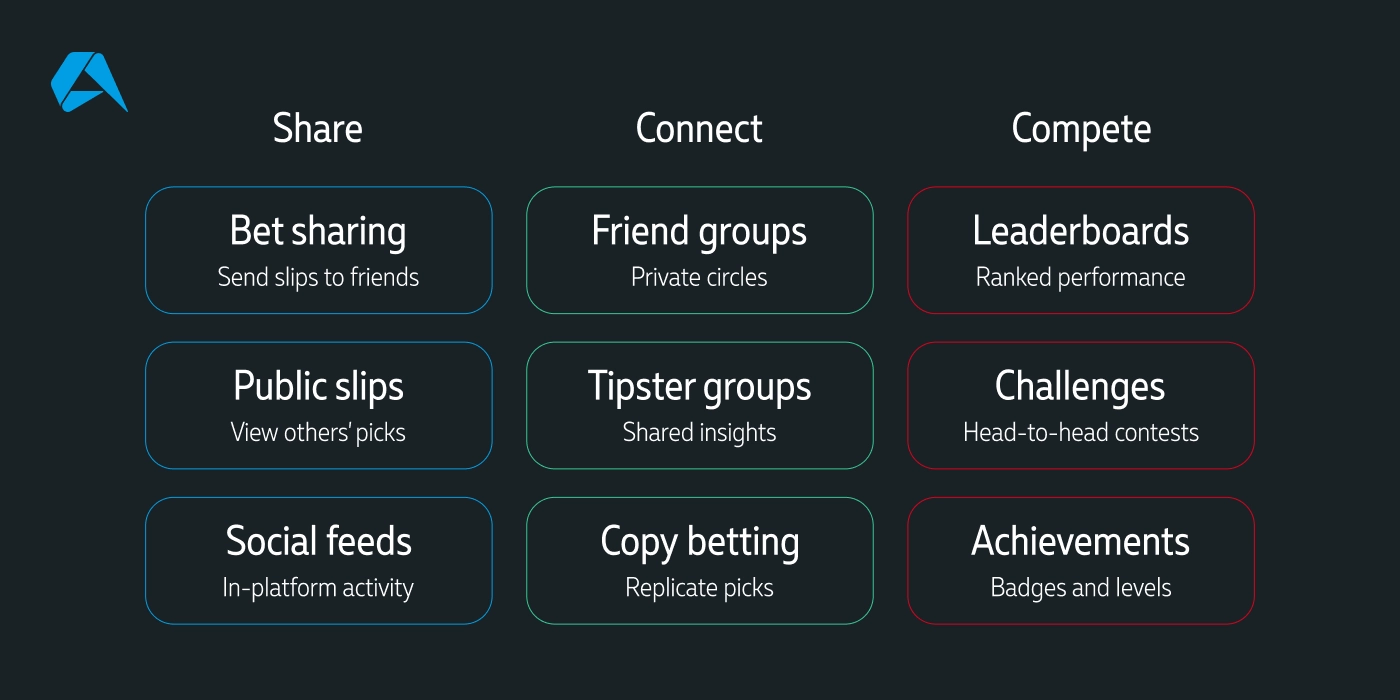
While implementations vary between platforms, social betting features usually include tools that allow users to share, compare, discuss, and compete around betting. Examples include:
-
Bet Sharing
Allows users to share selections and betting slips with friends or wider communities.
-
Public Betting Slips
Enables players to view, discuss, and follow the picks of other bettors.
-
Leaderboards
Rank users based on performance, profitability, prediction accuracy, or competition results.
-
Challenges
Create friendly competitions between players around specific events, tournaments, or betting objectives.
-
Friend Groups
Allow users to build private communities and compare betting activity with trusted connections.
-
Tipster Communities
Bring together users who share insights, predictions, and betting strategies around sporting events.
-
Social Feeds
Display betting activity, achievements, discussions, and community interactions within the platform.
-
Copy Betting
Allows users to replicate selections made by experienced or successful bettors.
-
Achievement Systems
Reward participation, milestones, streaks, and performance through badges, levels, or recognition features.
Why Social features matter for next-generation sportsbooks
The growing interest in social betting is not simply about adding new functionality. For operators, the appeal lies in the ability to encourage deeper, more frequent interactions between users and the platform. While individual features may differ between sportsbooks, the underlying objectives are often the same: to increase participation, encourage repeat engagement, and create experiences that go beyond the outcome of a single wager.
Engagement beyond match day
Traditional sportsbook engagement typically follows a predictable pattern. Players place wagers, follow the event, collect their winnings or absorb their losses, and then wait for the next betting opportunity. But social features introduce additional reasons to return.
A user may revisit the platform to check a leaderboard, compare predictions with friends, discuss an upcoming fixture, and so on. These activities keep users connected to the platform even when they are not actively betting. Over time, this can help transform the sportsbook from a destination used only during sporting events into a platform that remains relevant between them.
Community becoming a customer acquisition channel
Many successful digital products benefit from a simple principle: people naturally invite others into experiences they enjoy. Social betting features create opportunities for this behaviour to emerge within the sportsbook environment.
Friendly competitions, shared betting slips, private leagues, and prediction challenges all create reasons for users to bring friends and colleagues onto the platform. Unlike traditional acquisition campaigns, these interactions originate from existing user relationships rather than marketing activity. While social features are unlikely to replace paid acquisition strategies, they can contribute to a more organic form of growth that becomes increasingly valuable as acquisition costs continue to rise.
Gamification becoming more meaningful
Gamification is hardly a new concept in online betting. Leaderboards, achievements, badges, and reward systems have existed for years. Yet their impact is often limited when participation remains largely individual.
Recognition becomes more valuable when there is an audience to recognise it. A leaderboard carries greater significance when users are competing against friends. Achievements feel more rewarding when they can be shared. Prediction contests become more interesting when they create ongoing rivalries and conversations between participants.
In this sense, social features do not replace gamification. They amplify it. The result is a more engaging experience that encourages participation through competition, recognition, and shared achievement rather than relying solely on financial incentives.
Why community is becoming a competitive advantage
The benefits of social betting extend beyond engagement, acquisition, and gamification. Over time, community participation has the potential to influence something even more valuable. Long-term competitive advantage. Sportsbooks have been competing with the same tools for many years now. Better odds, wider market coverage, and larger promotional budgets have all contributed to attracting and retaining players. These factors remain influential, of course, but they share one common characteristic. Competitors can often replicate them.
A successful promotion may be matched. A new feature can be copied. Even product innovations that initially feel unique and different often become standard expectations across the market over time.
Communities, on the other hand, operate differently. When players become invested in friend groups, prediction competitions, rankings, achievements, and shared experiences, the value they derive from the platform goes beyond betting. They are no longer interacting solely with the sportsbook. They are interacting with other users, building relationships, and participating in experiences that become exclusive to that particular community.
Fundamentally, THIS changes the nature of the relationship. Traditionally, sportsbook loyalty has been built around a direct connection between the player and the platform. Social experiences introduce a third dimension, creating a relationship that increasingly resembles: Player to Community to Sportsbook.
That distinction may appear subtle, but its commercial implications can be significant. A player considering a competing sportsbook is no longer simply comparing odds, promotions, or product features. They may also be weighing the loss of a prediction league, a leaderboard position, a group of friends, or a reputation built over time within a community. At that point, players may be leaving more than a platform. They may be leaving a community they have invested time in.
This, by the way, is not a new concept. Many of the world's most successful digital products have discovered that communities can become powerful competitive assets. The product remains important, but the relationships, interactions, and sense of participation surrounding it often become equally valuable.
For sportsbook operators searching for sustainable differentiation, this may be one of the most important aspects of social betting. While competitors can replicate features, communities are considerably harder to reproduce. They are sometimes unique and develop gradually through participation, interaction, and shared experiences. Once established, they can become an advantage that continues to deliver value beyond individual promotions, product updates, or acquisition initiatives.
Lessons from other digital industries
Sports betting is not the first industry to explore the commercial value of community. In fact, many of the world's most successful digital products have spent years building experiences that encourage user interaction rather than exclusive focus on product.
Fantasy sports platforms have long relied on private leagues, rivalries, and shared competitions to keep participants engaged throughout an entire season. Fitness applications increasingly use leaderboards, challenges, and social accountability to encourage users. Trading platforms have created communities where users exchange ideas, discuss opportunities, and follow the activity of more experienced investors.
Perhaps the most widely recognised example comes from gaming. What began as individual entertainment experiences has gradually become social environments where friendships, communities, and shared experiences are just as important as the gameplay. Platforms such as Discord further accelerated this trend by providing dedicated spaces for users to interact around common interests.
Despite serving very different audiences, these products share a common principle. People typically return not just because they value the product, but because they value the relationships and sense of belonging that develop around it.
Sportsbooks are, in many ways, beginning to explore the same opportunity. Betting will always remain the core product (as the game is to gamers). However, as operators look for new ways to strengthen engagement and loyalty, community-led experiences may become an increasingly important part of the overall value proposition.
The challenges of building social betting features
Though the potential benefits of social betting may be significant, creating successful social experiences is not simply a matter of adding leaderboards and chat functions. As sportsbooks become more interactive, they also inherit many of the challenges faced by social networks, gaming communities, and other user-driven digital products. The objective is not simply creating more interaction. It is creating an environment that remains safe, sustainable, and enjoyable for users over the long term.
Some of the most significant challenges include:
Moderation
User-generated content creates opportunities for engagement, but it also introduces risk. Discussions, comments, tipster communities, and social feeds all require appropriate oversight to prevent abuse, misinformation, harassment, or harmful behaviour.
Responsible Gambling
Social experiences should encourage participation without creating unhealthy pressure to bet. Competition, rankings, and public visibility can be highly engaging, but they must be designed carefully to align with responsible gambling objectives. Operators must therefore strike a balance between creating enjoyable social experiences and avoiding features that could encourage excessive or impulsive behaviour.
Privacy and User Choice
Not every player wants their activity shared publicly. Some users enjoy competition and visibility, while others prefer a more private betting experience. Successful social betting environments typically provide clear controls that allow users to decide what information they share, who can view it, and how they participate within the wider community.
Technical Scalability
Traditional sportsbooks are primarily designed to process bets, manage accounts, and deliver odds efficiently. Social features introduce an entirely different mix of activities, including user interactions, notifications, rankings, content sharing, and real-time community engagement. Supporting these experiences at scale may require additional infrastructure, monitoring, and expertise.
Community Standards and Platform Reputation
Communities often develop their own culture over time. While this can become a significant strength, it also requires clear standards and ongoing management. Healthy communities encourage participation, discussion, and competition. Poorly managed communities can quickly undermine trust and damage the broader user experience.
Will the future sportsbook look different?
The sportsbook of the future may look very different from the ones operators are launching today. Betting will always remain at the centre of the experience, but the platforms surrounding the activity are likely to become increasingly interactive and community-driven.
In many ways, sportsbooks are beginning to borrow ideas from other digital environments that have successfully combined content, competition, and community. The result may be a new generation of platforms that function not only as betting destinations but also as entertainment hubs where users return to connect, compete, share opinions, and participate in experiences that extend beyond individual wagers.
This presents both an opportunity and a challenge for industry operators. Building these experiences requires technology that can evolve alongside changing player expectations while maintaining performance, compliance, and scalability.
At Altenar, we help operators build sportsbook experiences that encourage deeper player connections and create opportunities for long-term loyalty. As the industry continues to explore new ways of strengthening engagement, loyalty, and community participation, having the right technology foundation becomes increasingly important. The operators that move beyond purely transactional relationships and create lasting player connections may be the ones that stand out in an increasingly competitive market.
Arrange a personalised demonstration and explore how Altenar helps operators prepare for the next generation sportsbook experiences that create meaningful opportunities for engagement and retention.