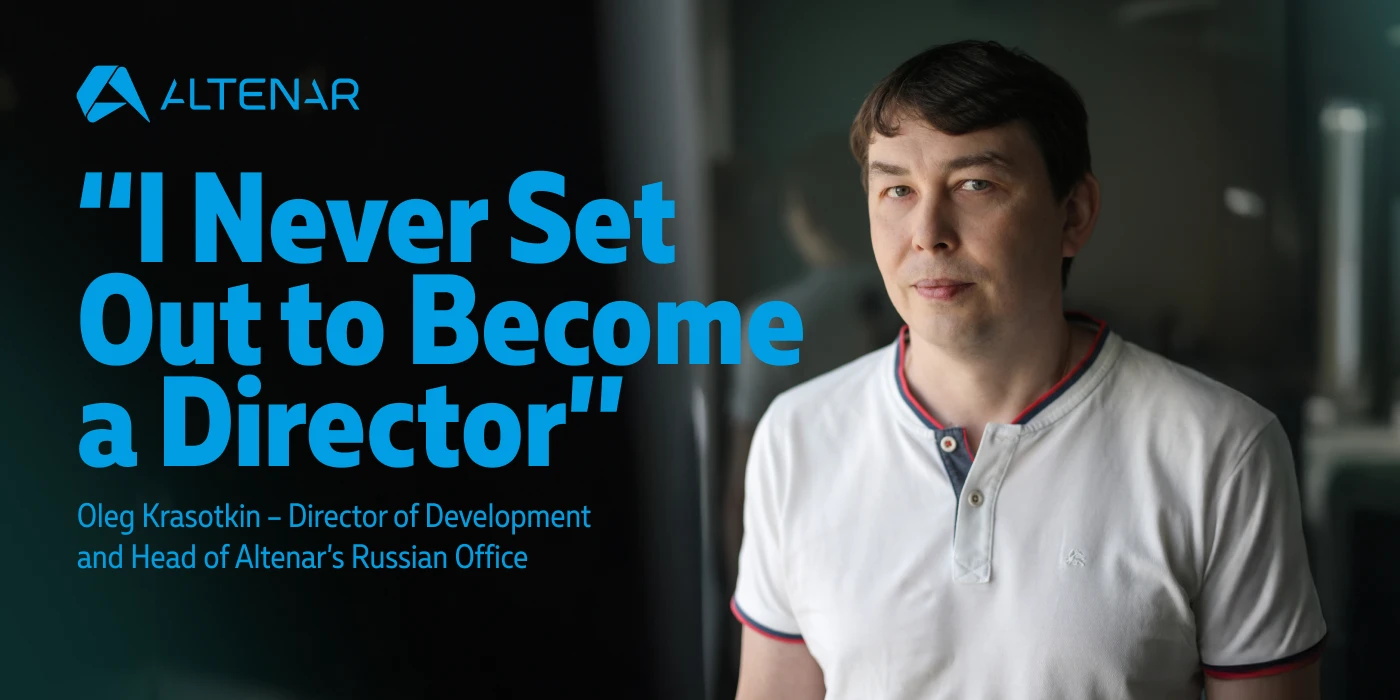
Oleg Krasotkin, Director of Software Development - Sportsbook and head of Altenar’s Russian office, on building a sportsbook from the ground up, leading without a private office and recognising that not every form of progress comes with a promotion.
In Altenar’s Vladimir office, the director sits in the open-plan workspace.
For new employees, this can be mildly confusing. The person working alongside everyone else, available for a quick question and surrounded by the ordinary movement of the office, is Oleg Krasotkin, Director of Development and Head of the company’s Russian operation.
The title arrived before the office. The office, as it turned out, never arrived at all.
Krasotkin joined the project that would eventually become Altenar in the early 2010s, when it was still a small start-up involving a handful of developers in Vladimir and a team in Malta. Today, Altenar employs more than 800 people internationally, while its Russian office has grown to more than 300 employees.
Krasotkin has led that office since 2014. He has also remained closely involved in the technology behind the Altenar sportsbook, continuing to work on development and architecture long after his responsibilities expanded beyond code.
We spoke to him about the early years of the company, the limits of individual brilliance, why responsibility matters more than hierarchy and the one project he expects never to finish.
Before the company
- How did your career begin?
I joined a company in Vladimir as a junior developer while I was finishing university. One of my lecturers recommended me for the position.
At the time, remote work was not really an established option. If you wanted to make serious progress professionally, the obvious path was usually to move to Moscow. I was considering it and had already started attending interviews.
Then an interesting project appeared.
Valery Sandler, who later became one of Altenar’s owners, suggested that we develop a product for a team based in Malta. Stanislav Silin was the project manager on the client side.
The first clients began to appear, and a team gradually formed around the work. I became something like a team lead, although the position did not formally exist at that point.
As the number of tasks grew, we needed to hire more people in Russia. By around 2014, somebody had to take responsibility for the office.
I was told, essentially, “All right, you will be the director in Russia.”
- Was that the direction you had imagined for yourself?
Not at all.
I had never set out to become a director. I wanted to develop as an engineer and continue growing technically.
Even after taking on the management role, I still did a great deal myself. I wrote code, worked on the architecture and remained involved in establishing the product’s technical foundations.
- So your career at Altenar began before Altenar existed as a company?
Yes. Initially, it was simply a project.
Then, gradually, we began building what would eventually become the Altenar sportsbook.
At the beginning, I never imagined that the Russian office would one day employ more than 300 people.
- You did not expect the company to grow on that scale?
No. Naturally, I expected some growth, but I did not even imagine that we would reach 100 employees.
Growth rarely unfolds according to the neat curve people later place in a presentation. At the time, we were concentrating on the work in front of us.
The problem with success stories
- Why do you think the company succeeded?
One factor was that I was completely absorbed in what we were doing. I found the work genuinely interesting.
There is a significant difference between arriving at work thinking, “I am here, I will sit through the day, and eventually it will end,” and arriving because you are eager to continue something.
When the work matters to you, you hurry to get there. You lose track of time. There are never enough hours because you want to do a million different things.
Of course, I would not describe my own involvement as the principal reason for Altenar’s success. Success consists of many things: the commitment of numerous people, the decisions made along the way and, to some extent, luck.
It is tempting to look back and turn the entire process into a simple formula. In reality, there was no single formula.
- What do you consider the company’s greatest achievement?
From the product perspective, the central achievement is the sportsbook itself and everything involved in developing it.
But the organisational side is equally important: building departments, establishing processes and bringing together the right people.
Many employees have developed substantially within Altenar. Some joined as junior specialists and later progressed into highly senior roles.
Creating a company in which that kind of growth is possible is an achievement in its own right.
Initiative has a price
- Many people who joined Altenar in its early years are still with the company. Why do they stay?
I would not claim that Altenar is equally comfortable for everyone.
It is particularly well suited to people who are prepared to take initiative. The company encourages that. At the same time, initiative inevitably comes with responsibility.
You cannot ask for freedom, make decisions and then distance yourself from the consequences.
We want people to understand what they are doing, why it matters and what value they personally contribute. We try to create an environment that supports that degree of ownership.
- Why should a specialist choose Altenar?
The work is interesting, and the people are strong.
The company has also almost never remained on a plateau. It continues to develop - not only in headcount, but in the number of clients, projects, responsibilities and the scale of the business.
The wider world can be unpredictable, but the company continues to move forward. That gives employees room to move forward with it.
As the business grows, new positions and responsibilities appear. When that happens, we first look at people already working inside Altenar.
Whenever possible, we prefer to promote internally rather than immediately recruit somebody from outside. In most cases, that is better for the company and better for the employee.
The office that never happened
- New employees are sometimes surprised to find the director sitting in the open-plan workspace. Why have you never moved into a private office?
I have never tried to position myself above other people.
Naturally, when you are responsible for an office, you cannot be on precisely the same level as everyone else. The role itself creates a degree of separation. But I have never wanted to increase that separation unnecessarily.
I have always remained closely involved in our projects. Sitting with everyone else makes many things easier. A person can walk over, ask a question and resolve an issue quickly.
Initially, there was also a less philosophical explanation: we simply did not have enough space.
Later, when the office expanded, I considered turning one of the glass meeting rooms into my own office. I was having a large number of calls, and sometimes every meeting room was occupied.
It would have been convenient.
But I was not going to enter the room and say, “I am the director, so everyone else has to leave”. I want the same rules to apply to everyone. I do not want to be the person who creates the rule and then grants himself an exemption.
The office was eventually refurbished. I did not move into the room immediately, and somehow I still have not.
Managing managers
- How would you describe your leadership style?
Respectful, I hope.
Other people matter to me, and I try to make decisions in a way that reflects that.
There is also a major difference between managing a team directly and managing other managers.
When you work closely with a team, you can see how people have understood a task, what they are doing and how the work is progressing.
Once there is a team lead between you and the team, communication becomes less direct. At that point, trust becomes essential.
I do not think I always handle this perfectly. Sometimes I still want to go deeply into the details and speak directly with the team.
The challenge is to remain informed without replacing the managers or weakening their authority. If you intervene carelessly, you may solve one immediate issue while creating a larger management problem.
I also want decisions to be fair and reasoned. I want to understand why we are doing something and what result we expect.
Fairness should not depend on a person’s position. That is another reason I do not want special privileges for myself.
Making it safe to ask
Y- ou have considerable experience onboarding employees. What helps people settle into a team more quickly?
The basic principles are straightforward: the team should be open, and information should be accessible.
From the beginning, people need to understand that there is nothing embarrassing about asking a question. There should always be somebody willing to answer.
That is an important part of the culture. People should not be afraid of revealing that they do not yet know something.
Documentation matters for the same reason. A new employee should be able to find information independently rather than depend entirely on whoever happens to be available.
Regular one-to-one meetings are also useful. They create dedicated time for questions, concerns and feedback that may not emerge during daily work.
The main shortcut, however, is to hire good specialists.
Strong people arrive, ask the right questions, absorb the essential information and begin contributing. The process can then appear almost effortless.
But “almost” is important. Even an excellent specialist needs support, context and somebody they can approach.
Why brilliance is no longer enough
- What makes someone an ideal candidate for Altenar?
Responsibility and initiative are fundamental.
The ability to communicate has also become increasingly important.
When the company was small, we could hire an individualist and assign that person a clearly defined area. They might have only two or three lines of communication, and the arrangement could work perfectly well.
Today, very few projects operate in isolation. There are constant dependencies and interactions between people, teams and departments.
A technically brilliant person who cannot communicate may therefore create difficulties far beyond their own area.
Collaboration is no longer an additional advantage. It is part of the work itself.
Development without forcing ambition
- How do you help employees continue developing?
Regular communication and useful feedback are the foundation.
First, a manager needs to understand what motivates the person. You also need to help them recognise their strengths and weaknesses.
Sometimes a weakness should be developed until it becomes a strength. In other cases, it is more effective to concentrate on an area in which the person already performs particularly well.
There are also different forms of progression. One employee may want to move into management. Another may want to remain on a technical path and deepen their expertise.
Both are valid.
Once the direction is clear, you can establish goals, review them regularly and track progress. The important thing is to understand where the person is now and where they genuinely want to go.
At the same time, not everybody wants to pursue rapid development at every stage of life. That is normal.
We sometimes treat ambition as though it must always be switched on. In reality, people have different priorities at different times.
The practical question is whether the person’s current contribution still meets the needs of the team. When the expectations of the employee and the company no longer align, it may be more honest to discuss alternative roles or paths.
After work
- What does an ordinary day look like for you?
My wife and I have three children: two school-age daughters and a young son.
In the morning, I walk the girls to school. Their bags are heavy, so I help carry them. It also gives me an opportunity to walk before the working day begins.
Then I return home and go to the office.
When I need to collect one of my daughters from an after-school activity, I leave at around six. Otherwise, I may stay at work until eight.
At home, I help with homework. There are certain assignments the girls will do only with me. They deliberately wait for their father to come home.
Then we put the youngest child to bed. After that, the house becomes quiet, and not long afterwards it is time to sleep.
There is nothing particularly extraordinary about it. It is an ordinary family day.
Weekends are entirely for the family.
- Do you still have time for hobbies?
Free time is difficult.
There is work, and there is family. Somewhere in that arrangement, there is supposed to be time for me as well. I probably do not have enough of it.
What I enjoy most is travelling with the whole family. For me, rest means going somewhere together - all five of us.
I occasionally play chess online. I also follow mixed martial arts, particularly the UFC. I watch replays, pause the footage and examine individual moments. I know the leading fighters and follow what is happening in the sport.
I used to watch more football, but less so now.
As for practising sport myself, that belongs more to my youth.
The project without a deadline
- What is your favourite project of everything you have worked on?
My children.
My wife and I invest a great deal in raising them, and it is a very, very long process.
I cannot say that they are perfectly obedient. But you can see them growing, developing and changing.
In software, people usually expect a project to have milestones, deliverables and some definition of completion. Children are less accommodating.
- Looking back, what would you do differently?
That is difficult to answer. I cannot identify one particular fatal mistake.
I try to hurt the people close to me less, both at work and at home.
The important thing is not merely to apologise after something has happened. It is to understand what happened, learn from it and avoid repeating it.