
Key Takeaways
-
Fully Regulated Market: Brazil now has a federal framework for sports betting and online gaming, creating clear licensing requirements and greater legal certainty for operators.
-
Strict Licensing & Compliance: Operators must meet SPA requirements covering licensing, AML/KYC, technical standards, financial controls, player verification and responsible gambling.
-
Strong Local Requirements:Market entry involves significant licensing costs and corporate obligations, making local structure, financial planning and regulatory preparation essential.
-
Payments & Localisation Matter: Operators must follow payment controls while adapting platforms to Brazilian users through Pix, Portuguese support, local sports content and responsible gambling tools.
-
Major Market Opportunity: Brazil’s 200M+ population, football culture, high mobile usage and growing online betting demand make it one of Latin America’s most attractive iGaming markets.
-
Continuous Regulatory Monitoring: Operators must track evolving rules on advertising, payments, licensing, technology and compliance to maintain market access and operate successfully over the long term.
Brazil Gambling Laws 2026: Licensing, Compliance & Market Rules
New regulations introduced at the end of 2023 marked a momentous change in Brazil’s approach to gambling, emerging from the shadow of an outright ban in 1946 to the establishment of a fully regulated market.
Online sports betting and casino games are now legal in one of the world’s largest economies. With around 215 million inhabitants profoundly interested in sports, this is a big deal for iGaming operators and service providers.
This article explores Brazil's current gambling regulatory framework, examining opportunities, identifying challenges, and providing valuable insights for operators, suppliers, and investors seeking to understand one of the world's newest regulated gambling markets.
This information is provided for informational purposes only and should not be considered legal advice. Regulations and licensing requirements for gambling operators in Brazil are still being developed and may change.
History of Gambling in Brazil - Past and Present
Unlike many other jurisdictions worldwide, the legal situation for gambling in Brazil over the last decade has been unambiguous. Before 1941, gambling was considered an exciting form of entertainment, and the country enjoyed a lively casino culture.
The landscape changed dramatically, however, with the introduction of the Criminal Contravention Act of 1941, which prohibited all games of chance. President Eurico Gaspar Dutra consolidated this policy in 1946, decreeing an outright ban on all forms of gambling. This move, driven by prevailing moral and social concerns, led to the revocation of casino permits and the closure of the country’s gambling venues.
This situation remained for decades. Poker was the only legal game because it was, and still is, considered a game of skill rather than chance. Despite the ban, there remained an underlying appetite for gambling among the general populace. A move towards greater liberalisation began in 1971 with the legalisation of a state-owned lottery (Loteria Federal), followed by support for non-commercial bingo and horse racing in subsequent years.
The advent of online gambling in the mid-eighties continued the ongoing pressure on the government to legalise gambling. It was argued that the restrictions applied only to gambling operators within the country and did not prevent licensed offshore operators from enjoying rising profits in a nation with a strong interest in sports.
Gambling in Brazil remained largely unregulated for almost eight decades. This situation changed in 2023 when the Chamber of Deputies approved legislation to regulate fixed-odds betting and online gaming. On December 30, 2023, Law No. 14.790 established Brazil's modern federal regulatory framework for fixed-odds betting and online casino games, paving the way for the launch of the regulated market in January 2025.
Since the launch of the regulated market in January 2025, Brazil has completed its transition from a largely unregulated gambling environment to one operating under a comprehensive federal licensing and regulatory framework. While some land-based gambling activities remain prohibited, licensed operators can now legally offer fixed-odds sports betting and online casino games nationwide.
This transformation represents one of the most significant changes in Brazil's gambling history and has created a regulated environment that offers greater legal certainty for operators while strengthening consumer protection and regulatory oversight.
Historical Timeline of Events in Brazil’s Gambling Sector
Brazil's gambling history has been strongly influenced by periods of prohibition, regulation and reform. Below is a timeline of the major legislative and regulatory milestones that have shaped Brazil's gambling market through to 2026.
Early Developments and Prohibition
1941: The Criminal Contravention Act bans all games of chance.
1946: President Dutra enforces a nationwide gambling ban.
1971: State-run lottery (Loteria Federal) is legalised.
1993: Bingo is legalised and grows rapidly across Brazil.
2004: Bingo is outlawed again due to corruption concerns.
Gradual Legalisation and Expansion
2018: Law No. 13.756/2018 legalises fixed-odds sports betting.
2021: Federal government begins drafting sports betting regulations.
2022: Election of a new government delays full gambling regulation.
Major Regulatory Reforms
2023: Law No. 14.790 establishes a legal framework for gambling.
2024: Fixed-odds betting and online casinos become fully regulated.
2024: Secretariat of Prizes and Bets is formed to oversee licensing.
2025: Brazil launches a regulated federal fixed-odds betting market.
2026: Advertising, payments and enforcement regulations are strengthened.
Our team of experts have detailed knowledge of the legal landscape in Brazil to ensure operators have the correct licences, certifications, procedures and strategies in place to meet all legal requirements.
Regulatory Bodies and Responsibilities
Caixa Econômica Federal regulated Brazil’s gambling market for many years during prohibition. In 2018, this responsibility was transferred to SEFEL (the Secretariat of Tax, Energy, and Lottery), which subsequently became SECAP (Secretariat of Evaluation, Planning, Energy, and Lottery).
With the new laws now in force, Brazil's Ministry of Finance (Ministério da Fazenda) plays a leading role in overseeing the country's regulated gambling market through the Secretariat of Prizes and Bets (SPA), developing regulations, supervising licensed operators and enforcing compliance. Its primary responsibilities (as it relates to gambling) include the following:
Policy Development: Advising and implementing policies and strategies.
Regulatory Oversight: Ensuring operations are fair and transparent.
Taxation: Setting tax rates and tax collection on gambling activities.
Licensing: Reviewing applications and issuing licences.
Consumer Protection: Safeguarding consumers from unfair practices.
AML Compliance: Prevention of money laundering and terrorist financing.
Economic Impact: Assessing financial risks and benefits to the country.
Here are the principal regulatory bodies responsible for overseeing Brazil's regulated gambling market in 2026. Together, they help ensure legal compliance, consumer protection and the integrity of licensed gambling operations.
The Secretariat of Prizes and Bets (SPA)
Created under Law No. 14.790/2023, the Secretariat of Prizes and Bets (SPA) is Brazil’s central authority for gambling regulation. Since the launch of the regulated federal betting market in January 2025, the SPA has overseen licensing, technical standards, operational compliance and enforcement across Brazil's fixed-odds betting and online gaming sector.
The SPA’s influence extends across daily operations, from licensing and tax oversight to enforcing anti-money laundering (AML) measures. Operators must adhere to strict technical and security standards, including the mandatory use of .bet.br domains. Beyond compliance, SPA wields significant enforcement powers, including blocking financial transactions, issuing fines and suspensions, and revoking licences for non-compliance.
GTI-Bets (Grupo de Trabajo Intersecretarial de Apuestas – Tax Compliance and Enforcement Unit)
GTI-Bets was established in January 2025 through Joint Ordinance No. 3/2025 as a specialised enforcement unit within the Secretariat of Prizes and Bets (SPA). Its primary role is to monitor tax compliance among licensed fixed-odds betting operators, ensuring they meet all financial obligations and contribute appropriately to state revenues.
With the authority to investigate tax discrepancies, flag irregularities, and recommend penalties for non-compliance, GTI-Bets plays a key role in maintaining transparency. By submitting bi-monthly reports to federal authorities, it actively shapes tax policies, reinforcing financial integrity across Brazil’s regulated gambling sector.
National Consumer Secretariat (SENACON)
The National Consumer Secretariat, part of the Ministry of Justice, plays a central role in safeguarding players’ rights in Brazil’s expanding gambling market. With online betting on the rise, SENACON ensures operators provide responsible gambling tools, protect vulnerable players, and maintain fair advertising standards.
Armed with investigative powers, SENACON can probe consumer complaints, penalise deceptive marketing, and impose fines on non-compliant operators. As Brazil's regulated market matures, its focus includes responsible gambling, consumer protection, fair advertising and ensuring operators comply with their statutory obligations towards players.
State Regulatory Authorities (LOTERJ and Others)
Although Brazil now operates under a national regulatory framework, state governments still retain the power to issue local gambling licences for operators serving players within their respective territories. The State Lottery of Rio de Janeiro (LOTERJ) has been at the centre of legal disputes over state licensing authority, testing the balance between state and federal oversight.
A January 2025 Supreme Court ruling reinforced the requirement that state-licensed operators restrict their services to players within their issuing state, limiting cross-border operations.
Although the federal licensing regime now forms the foundation of Brazil's regulated gambling market, operators should continue monitoring state-level developments, as individual states may introduce additional licensing and regulatory requirements within their own jurisdictions.
Compliance Requirements and Responsibilities for Operators
Obtaining a Brazilian iGaming licence can be challenging, and operators should expect to go through a process designed to ensure compliance with current legal and regulatory standards.
Background checks for owners and key personnel, along with business plans, financial projections, and operational details, are required for application submission. Applicants must also provide a range of financial statements and documents demonstrating proof of compliance with anti-money laundering (AML) and know-your-customer (KYC) protocols.
When a gambling licence application is received, the regulating authority evaluates the applicant's suitability under well-defined technical standards for fairness and security. If the application succeeds, the operator must pay a licensing fee of R$30 million for an authorisation valid for five years, covering up to three commercial brands.
In 2026, operators retain 87% of adjusted gross gambling revenue, while 13% is allocated to statutory beneficiaries and social security. The operator’s retained share falls to 86% in 2027 and 85% from 2028, effectively increasing the statutory allocation to 14% and 15%, respectively. Licensed operators must also pay monthly inspection fees calculated according to adjusted revenue.
Under the new regulations, operators that want to offer fixed-odds betting must be incorporated under Brazilian law, with headquarters and administration in Brazil, and have a Brazilian shareholder holding at least 20% of the company’s share capital.
Maintaining a gambling licence in Brazil also requires adherence to several compliance and responsible gambling practices.
Operators must:
Advertise in a socially responsible way by protecting vulnerable groups from the dangers of excessive and irresponsible gambling.
Verify every bettor’s identity, age and registered details, including through facial recognition with proof of life, before allowing them to place bets.
Provide operator-specific and centralised self-exclusion options for determined or indefinite periods, together with mandatory responsible-gambling limits. The centralised system prevents an excluded player from accessing any federally authorised betting platform.
Implement Know Your Customer (KYC), Anti-Money Laundering (AML), and anti-terrorist checks on customers.
Accept deposits only through authorised payment methods and accounts registered in the bettor’s own name. Cash, payment slips, cheques, crypto-assets, third-party transfers and credit cards are prohibited.
Create a local customer service centre that provides 24/7 service in Portuguese via free electronic and telephone channels.
NOTE
This information is provided for informational purposes only and should not be considered legal advice. Regulations and licensing requirements for gambling operators in Brazil are still being developed and may change.
Key Considerations for Market Entry
Even though Brazil's regulated gambling market is now fully operational, operators should carefully consider the following regulatory and commercial factors before entering the market:
Federal and State Licensing
Although Brazil now operates under a federal licensing framework, state-level licensing continues to evolve. Operators should ensure they understand the distinction between federal and state authorisations, particularly where state licences are restricted to players located within that jurisdiction.
Technical and Compliance Requirements
Licensed operators must comply with comprehensive technical, security, reporting and certification requirements. These include certified betting systems, ongoing reporting through the SPA's SIGAP platform, technical audits and compliance with Brazil's operational standards throughout the licence period.
Advertising Restrictions
Brazil has introduced increasingly detailed advertising requirements. Licensed operators must comply with strict rules governing responsible marketing, mandatory consumer warnings and restrictions designed to protect children and vulnerable individuals from gambling-related harm.
Operators must implement payment systems that comply with Brazil's strict financial controls. Deposits made in cash, by credit card, in crypto-assets, via payment slips, or from third-party accounts are prohibited, requiring operators to work closely with authorised payment providers.
Responsible Gambling and Consumer Protection
Maintaining compliance extends beyond licensing. Operators are expected to implement strong responsible gambling measures, including customer verification, self-exclusion, behavioural monitoring and ongoing consumer protection procedures.
Regulatory Challenges, Pitfalls and Strategies for Success
Brazil’s gambling market is now fully regulated, but a common pitfall for gambling operators is underestimating the complexity of regulatory frameworks. While obtaining a licence is an important milestone, maintaining ongoing compliance has become equally important as the market matures. Operators must continue to meet demanding technical, financial, operational and responsible gambling requirements throughout the licence period.
The licensing process involves strict financial assessments, high technical standards, and adherence to anti-money laundering (AML) measures. Licensed operators must also comply with operational requirements covering .bet.br domains, certified betting systems, secure payment processes, customer protection and ongoing reporting to the Secretariat of Prizes and Bets (SPA). Furthermore, state-level licensing has introduced additional complexity, with regional regulatory frameworks sometimes conflicting with national requirements.
Regulatory compliance now extends well beyond taxation. Operators must navigate evolving requirements across responsible gambling, advertising, payment controls, technical certification, and customer verification. Regulatory authorities have also strengthened enforcement against unlicensed operators through financial transaction blocking, website restrictions and increased regulatory oversight, reinforcing the importance of maintaining full compliance at all times.
To succeed in Brazil, operators must stay ahead of evolving regulations, proactively engage with authorities, and implement robust compliance strategies. Partnering with local legal and financial experts can help businesses navigate changing rules and avoid penalties. Maintaining robust governance, monitoring regulatory developments and embedding compliance into day-to-day operations will be key to sustaining a competitive and compliant presence in Brazil's regulated gambling market.
Although Brazil's regulatory framework is now firmly established, it continues to evolve. Failure to stay updated can lead to non-compliance, risking penalties or licence revocation.
At Altenar, we understand these challenges intimately. Our iGaming software is designed to adapt to regulatory changes, providing a stable foundation for your compliance needs and success in Brazil.
Adopting a proactive, informed, and responsible approach allows your business to meet regulatory requirements and enjoy sustainable growth in this new and exciting market.
7 Top Tips for Success in 2026
1. Dedicate resources to compliance
A comprehensive understanding of the Brazilian regulatory framework is essential. To ensure operations align with Brazilian legal standards and requirements, we advise establishing a capable compliance team or partnering with local legal experts.
2. Engage proactively with regulatory bodies
Be proactive rather than reactive. Engaging with local and national authorities can provide insights into upcoming regulatory changes and opportunities, allowing your business to adapt swiftly.
3. Implement Secure Payment Processing Solutions
Brazil's payment framework imposes strict controls on how betting accounts can be funded. Operators should ensure their payment systems comply with local regulations, including restrictions on cash, credit cards, crypto-assets, third-party payments, and other prohibited payment methods, while continuing to deliver secure and efficient transactions for players.
4. Adopt .bet.br Domains Promptly
New regulations require all licensed operators to use .bet.br domains. A transition period allows ".com.br" domains to remain active for a limited time. Companies that fail to transition risk losing access to the market, as financial institutions block transactions to unauthorised websites.
5. Monitor regulatory developments
Brazil's gambling framework continues to evolve through new ordinances, technical standards and regulatory guidance. Operators should regularly monitor official updates to ensure their policies, systems and procedures remain fully compliant.
6. Invest in responsible gaming initiatives
Brazil, like other leading gambling markets, takes social responsibility seriously. Integrating features that promote safer gambling, such as self-exclusion, deposit controls, and player protection tools, demonstrates a commitment to responsible gambling while helping operators meet regulatory requirements.
7. Cultivate strong local partnerships
Forging local alliances with businesses and community leaders can provide invaluable insights into Brazilian culture and consumer behaviour. It will help your company tailor services to resonate with Brazilian players. Furthermore, community involvement and investment will demonstrate a commitment to the local economy and bolster your company's reputation.
Opportunities and Future Outlook
Brazil’s gambling industry is stepping onto the global stage, with 2026 marking the beginning of an era that operators can’t afford to ignore. With Law 14.790/2023 setting the legal groundwork, the country is no longer just a sleeping giant in the betting world. It’s waking up fast. The nation now offers significant opportunities, especially for early investors who can overcome the prevailing volatility and uncertainty regarding the legal framework.
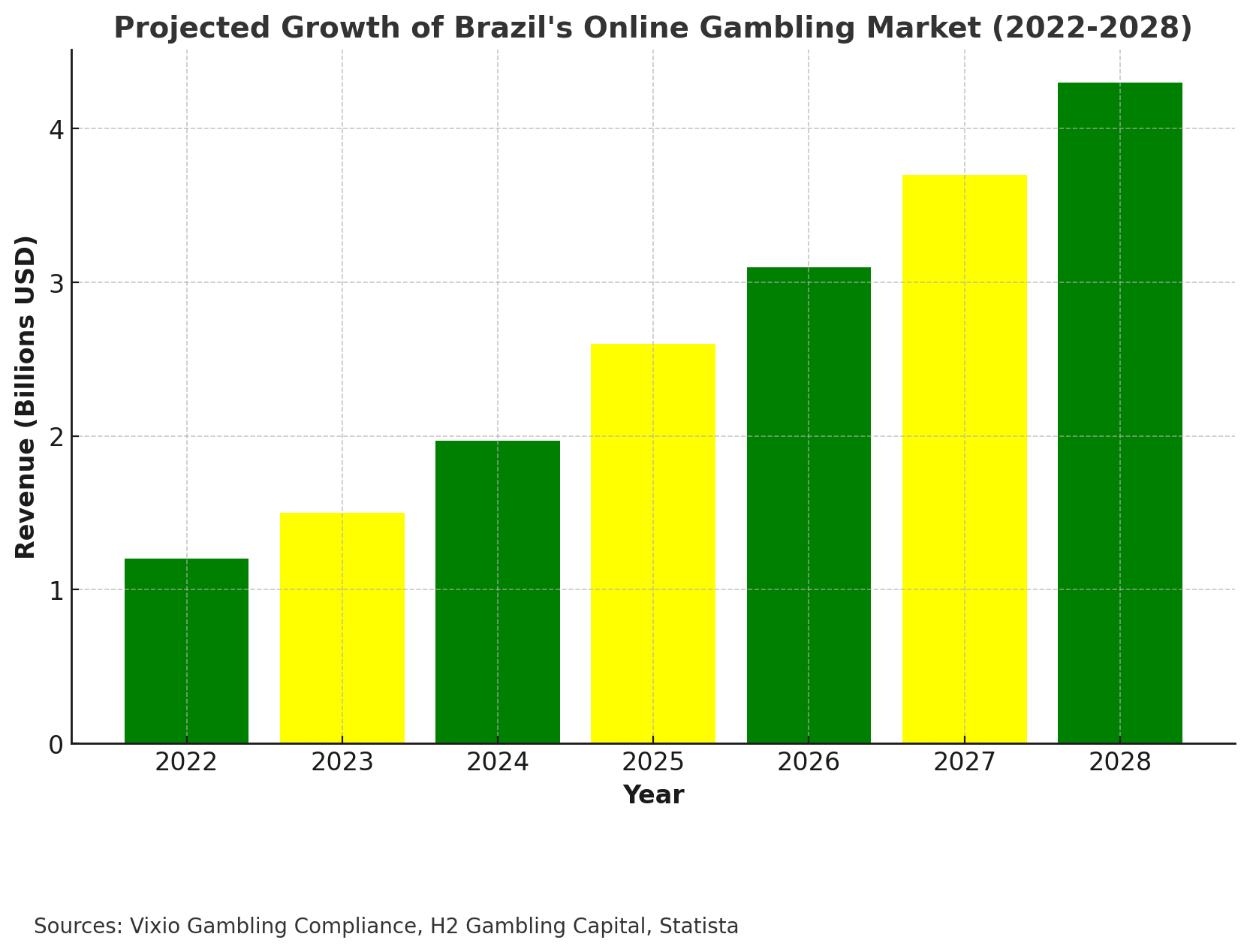
The market's potential is undeniable, and the numbers speak for themselves. With a population of around 215 million, an unwavering passion for football and sports, and an online gambling market projected to hit over $4 billion by 2028 (15.39% annual growth rate until 2029), Brazil isn’t just another market. These numbers alone underline the size and scope of its vast potential and indicate a sector poised for expansion in 2026 and beyond.
January 2025 ushered in a fully regulated fixed-odds betting market, clearing years of uncertainty. Since then, the Secretariat of Prizes and Bets (SPA) has continued to expand the regulatory framework through additional licensing requirements, technical requirements, responsible gambling requirements, and consumer protection requirements, providing operators with greater regulatory clarity.
The tax environment, however, will be challenging but will also bring rewards. Brazil's tax framework continues to evolve, and operators should remain aware of ongoing legislative and regulatory developments that may affect future operating costs.
Innovation will be the difference between success and stagnation in this market. With Pix dominating payments, mobile-first gaming, localised content, and savvy marketing will be essential. Meanwhile, regional licensing is evolving, with states like Ceará exploring their own frameworks, opening new pathways for expansion.
The bottom line? The time to enter Brazil is now. Those who establish a strong foothold today will reap the rewards for years to come.
Market Advantages and Disadvantages at a Glance
Brazil offers one of the world's most attractive newly regulated gambling markets, but market entry also brings important regulatory, financial and operational considerations. The table below summarises the principal advantages and disadvantages operators should evaluate before entering the market.
Market Advantages
Expansive Player Base: With a population of around 215 million, Brazil offers one of the largest gambling markets globally.
Explosive Market Growth: Online gambling revenue is expected to surpass $4.3 billion by 2029, reflecting.
Favourable Player Engagement: Over 75% of Brazilian sports fans bet, with football dominating betting activity.
Evolving Regulatory Stability: The newly structured market offers legal clarity and long-term security.
High Mobile Penetration: More than 84% of Brazilians have access to smartphones, supporting widespread mobile betting opportunities.
Market Disadvantages
High Licensing Costs: A full gambling licence requires a BRL 30 million (approx. €5.0 / $5.25 million) fee, making entry into the market expensive.
Regional Licensing Barriers: Supreme Court rulings now limit state-licensed operators to their respective states, restricting market reach.
Complex Advertising Rules: Gambling advertising is subject to detailed regulations designed to protect consumers, requiring operators to carefully review marketing campaigns before publication.
Licence Application in Brazil
With the implementation of Brazil’s regulated online gambling framework, operators must obtain a licence from the Secretariat of Prizes and Bets (SPA) to offer betting services legally.
There are two primary types of licences available in Brazil:
-
Federal Licence: Grants operators the authority to provide fixed-odds betting and online gaming services nationwide and is valid for 5 years.
-
State-Issued Licences: Some states, such as Rio de Janeiro, issue local gaming licences that allow operators to provide betting services within state borders. However, these cannot be used for nationwide operations.
Applying for a Federal Gambling Licence
To obtain a national gambling licence, operators must apply via SIGAP (Sistema de Gestão de Apostas), the official platform managed by the SPA. All submissions should be in Brazilian Portuguese.
The application process involves:
Submission of Application: Operators must submit a comprehensive application to the SPA detailing their business structure, financial health, and compliance measures.
Technical Certification: Applicants must provide technical certificates for their betting systems, including the sportsbook or remote game server and integration processes.
Compliance Documentation: Operators must present documents demonstrating their adherence to anti-fraud and anti-money laundering protocols, as well as responsible gambling initiatives.
Domain Requirements: Authorised operators must operate under the ".bet.br" domain in accordance with SPA requirements.
Financial Obligations: A licensing fee of 30 million reais is payable upon approval.
Financial Obligations: A BRL 30 million licensing fee is payable upon approval and authorises the operator to offer up to three brands for a five-year period.
Are you looking for a fully compliant sportsbook solution for Brazil? Altenar’s platform is optimised for nationwide expansion in line with federal regulations. Request a demo today to unlock efficient operations with our advanced technology.
NOTE
This information is provided for informational purposes only and should not be considered legal advice. For detailed guidance on applying for a federal licence in Brazil, please visit the SPA’s official website or the official SIGAP portal managed by the SPA.