

Key takeaways
- Growth increases compliance demands: Entering new markets, adding products or payment methods can introduce new regulations, controls and reporting requirements that increase compliance costs.
-
The type of growth matters: Two growth opportunities with similar revenue potential can create very different compliance costs depending on the markets, products and requirements involved.
-
Assess change before expansion: Identify how growth will affect markets, products, payments, players, suppliers, technology and internal operations before committing to an expansion plan.
-
Technology affects compliance costs: The same regulatory requirement can cost very different amounts depending on whether systems are adaptable, automated and able to support changing compliance needs.
-
Build for adaptability: Configurable controls, structured data, automation, clear ownership and documented processes can reduce the amount of work required when new requirements arise.
-
Compliance readiness supports growth: An adaptable sportsbook platform can help operators respond faster to new opportunities by reducing the need for costly bespoke development and operational changes.
The Cost of Growth Most Business Plans Forget to Include
Most businesses have a pretty good idea of what they will need to spend in order to grow. New people, technology, marketing and product development can all go into the plan. But those are largely the costs of making growth happen. What about the costs that growth creates in return?
In iGaming, compliance can be one of those costs. A new market might introduce entirely different requirements, while processes that worked at a smaller scale may need to be redesigned, documented or automated.
So growth doesn't just mean doing more of the same compliance work. It can change the work itself, and with it, the cost. The real challenge is understanding what success will change before you have to start paying for those changes.
Growth Adds to Compliance Demands
Growth does not typically replace one set of compliance requirements with another. More often, it adds to what the business already manages.
Enter a new market, for instance, and your existing market requirements do not disappear. You add another regulatory framework, potentially with different rules around player protection, reporting, payments, marketing, tax or data.
The same principle applies in other areas. Add another payment method, and there may be new checks and processes to manage. Launch a different product and another set of rules may apply, and so on.
That is why compliance costs don't necessarily increase at the same rate as revenue. A 20% increase in revenue does not automatically mean 20% more compliance work. One new market could require very little change. Another could require new systems, processes and people.
The Type of Growth Can Matter More Than Its Size
This creates another consideration when comparing growth opportunities. Two opportunities with similar revenue potential may place very different demands on the business.
Expanding an existing product in a market you already serve may require relatively little change. Entering a new jurisdiction, on the other hand, with different player-protection rules, reporting requirements, and payment methods could require considerably more, even if the expected revenue is lower.
So the point is, revenue alone tells you very little about the compliance cost of growth. A more useful question is how much the opportunity differs from what the business already knows how to support. For example, does it introduce another regulator? New reporting? Different player controls? A payment method the business has never handled? Requirements that the existing platform cannot accommodate without development?
The more answers that involve something new, the more expensive that growth may be to support. This, in itself, does not make the opportunity unattractive. But it does change the calculation. The value of growth depends not only on the revenue it can generate, but also on how much the business has to change to support it.
What Will This Growth Actually Change?
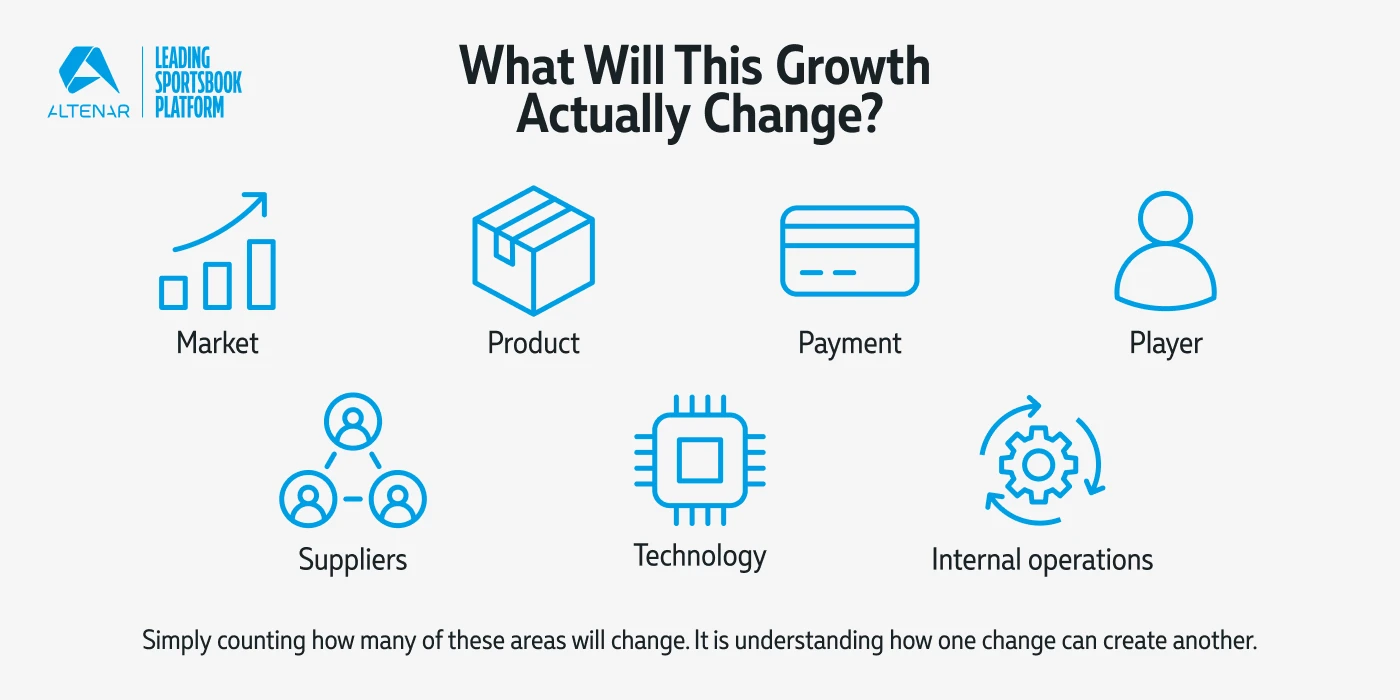
Before committing to a growth opportunity, it can help to look beyond expected revenue and ask a more practical question, like ‘what will we have to do that we do not already do today?’
The answer can provide an early indication of where additional compliance costs are likely to appear.
-
Market: Will you face a new regulator, licence conditions, reporting obligations, tax rules, advertising restrictions or player-protection requirements?
-
Product: Does the product introduce different regulations, technical standards, certifications or controls?
-
Payments: Will new payment methods or providers require different verification, transaction monitoring, reconciliation or reporting processes?
-
Players: Will you need to change how you handle KYC, age verification, responsible gambling or other player controls?
-
Suppliers: Do additional suppliers require due diligence, regulatory approval, new contracts or ongoing monitoring?
-
Technology: Can your existing platform support the requirements, or will you need new integrations, reporting capabilities or development work?
-
Internal operations: Who will own the additional work, and will they need new procedures, documentation, training or specialist support?
The important part is not simply counting how many of these areas will change. It is understanding how one change can create another.
A new market, for example, might require different player controls. Those controls could require platform development, which then needs testing and documentation and changes what operational teams need to monitor.
That is where the compliance cost of an apparently straightforward growth opportunity can start to increase much faster than expected.
Not Every Compliance Cost Is Created by Regulation
Let’s be realistic. Some compliance costs are unavoidable. If a regulator requires a particular control, report or verification process, the operator has to provide it. There is no getting around that.
But the regulation itself does not determine how expensive that requirement will be to meet. Imagine, for instance, two operators facing the same new reporting requirement. One already collects the necessary data and can configure its systems to produce the report. The other has to retrieve information from several systems, reconcile it manually and involve developers every time the reporting format changes. The requirement is the same. The cost of meeting it is not.
This matters because some compliance costs associated with growth come from how difficult the business is to adapt. Manual processes, duplicated data, bespoke integrations and controls built specifically for one market can all become more expensive as additional requirements are added.
So when compliance changes, there are really two questions to ask. What does the regulation require, and how much work will our existing operation need to meet it?
The first may be outside your control. The second usually isn't.
Build Once, Adapt When You Need To
The obvious response is not to try to predict every compliance requirement the business will face in the future. That would be unrealistic. Instead, aim to ensure every new requirement doesn't become another major project.
Take player controls, for example. If limits, verification rules or responsible-gambling measures can be configured for individual markets, entering another jurisdiction may involve adapting what already exists. If every variation requires bespoke development, each new market creates another technology project.
The same principle can apply to many other areas of operation. Wherever possible, build around capabilities that can be adjusted, reused or extended rather than recreated.
That could mean:
-
Keeping compliance data structured and accessible rather than spread across different systems.
-
Automating recurring reporting and monitoring where practical.
-
Assigning clear ownership so new requirements have a home.
-
Documenting processes so they can be adapted without first having to rediscover how they work.
-
Choosing technology that lets you configure rules and controls for different markets.
None of this removes the cost of compliance, but it does change how much additional work the next requirement creates.
The Payoff Is Being Ready When the Opportunity Arrives
There is another reason to think about compliance before growth happens. An attractive opportunity does not necessarily arrive when the business is ready for it.
Imagine an operator identifies an attractive new market. The commercial case works, the timing is right, and the business wants to move forward. If its existing systems and processes can accommodate most of the requirements, attention can focus on what is genuinely different about that market.
If they cannot, the starting point changes. Before pursuing the opportunity, the operator may need to develop new controls, reorganise data, replace manual processes, or change the underlying platform.
That makes compliance readiness more than a way to control costs. It will also influence how quickly the business can act when a commercial opportunity appears.
Compliance may therefore be one of the costs created by growth, but preparing for it can also make the next stage of growth easier.
Growth Gets Expensive When the Platform Can't Adapt
This is where most operators start to see the value of a more adaptable platform. Growth will always introduce some requirements that an operator cannot control. The platform can influence how much work those requirements create.
If adding a market means commissioning bespoke development for every new player control, reporting requirement or operational difference, the technology itself starts adding to the cost of expansion. The same applies when data is difficult to access, or integrations are hard to change.
With a more adaptable platform, expansion does not have to create the same level of additional work. Requirements that can be handled through configuration, existing integrations or reusable capabilities do not have to become separate development projects every time the business expands.
This is one reason Altenar has built its sportsbook technology around the needs of operators working across different regulated markets. The objective is not to remove the compliance work that comes with growth, but to make the technology easier to adapt as those requirements change.
Because the real test of a sportsbook platform is not only whether it supports the business you have today. It is how much you have to rebuild to support the business you want next.
Planning your next stage of sportsbook growth? Book an Altenar demonstration to see how configurable technology can help your operation adapt as markets and requirements change.