
Key takeaways
-
Sportsbook Convergence: Betting platforms are increasingly combining sportsbooks, prediction markets, casino products, and location-based experiences into unified platforms.
-
Conversational AI: AI is making it easier for bettors to find markets, research statistics, and build parlays using natural-language conversations instead of complex menus.
-
Interactive Live Betting: Live broadcasts are becoming integrated with betting markets, statistics, and visualizations, allowing users to watch and bet without switching platforms.
-
Rise of Microbetting: Microbetting enables wagers on individual plays and moments, creating faster and more immediate live betting experiences powered by real-time data.
-
Real-Time Sports Data: Advanced tracking and machine learning can process live sports data to automatically create, price, and update betting markets as events unfold.
-
Flexible Sportsbook Technology: Operators need scalable platforms, APIs, and integrations that can quickly adopt new technologies, markets, and personalized experiences as the industry evolves.
8 Sports Betting Technologies Transforming the U.S. Market
Forget the usual predictions about AI transforming everything. We went looking for the sports betting technologies already emerging in the U.S. that could genuinely change the experience in 2027.
What we found is far more interesting than just another list of buzzwords. Sportsbooks you can talk to. Betting markets lasting only seconds. Live broadcasts that double as betting interfaces. Even platforms that change what they offer depending on where a player is located.
These aren't distant concepts. Many are already being tested, launched, or expanded. Here are eight developments in sports betting technology that could make 2027 particularly interesting for U.S. operators.
The Top 8 Technologies Moving from Experiment to Reality Right Now
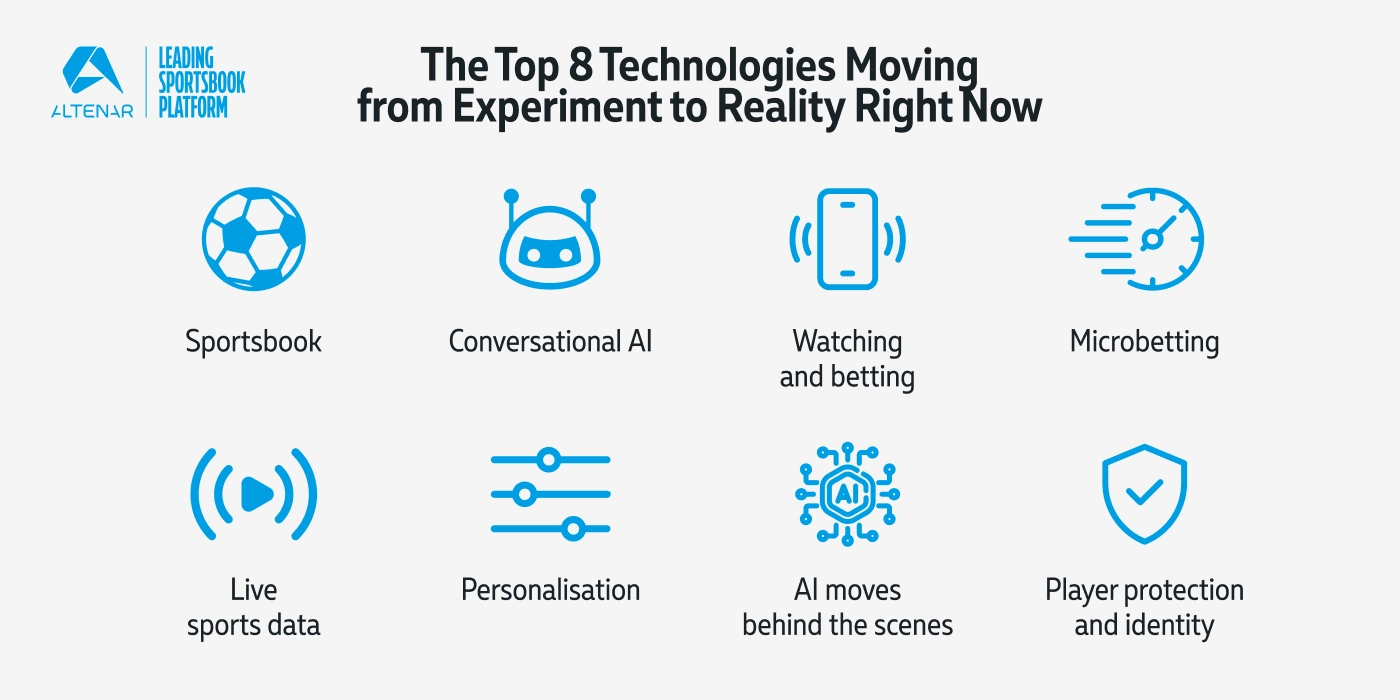
To be clear, we are not predicting science fiction here. Each of these technologies has already given us a reason to believe 2027 could be its breakthrough year. Look closely at what's launching today, and the future becomes a little less speculative.
Here are the top eight developments in particular that caught our attention.
1. Sportsbooks and prediction markets begin to converge
One of the biggest changes in 2027 could be to what we actually mean by a U.S. sportsbook. Instead of opening different platforms for different products, bettors are starting to encounter apps that decide what they can access based on where they are.
DraftKings is already doing it. Its unified app brings sportsbook betting and prediction-market trading together, showing sportsbook products and/or sports event contracts based on a customer's location. Fanatics has gone further, combining sportsbook, casino, and prediction markets in a single app with one account and a shared rewards balance.
For operators, that points toward an intriguing new requirement for sports betting software. The platform may increasingly need to support different products, regulatory models, and customer journeys without creating completely separate experiences for each.
However, one major caveat endures. Sports event contracts remain at the center of a fierce dispute between federal and state authorities over who has the right to regulate them.
So convergence is not guaranteed. But the technology is already here, and 2027 could tell us whether the jurisdiction-aware betting platform becomes a much bigger part of the U.S. market.
2. Conversational AI changes how bettors find bets
Finding a specific bet can still mean working through sports, leagues, events, and increasingly long lists of markets. Conversational AI offers a very different route. Just tell the sportsbook what you want.
FanDuel's AceAI shows what that could look like. Bettors can ask questions about teams and players, research statistics, explore available markets, and build or refine a parlay through natural conversation. The assistant remembers the discussion, allowing the bettor to follow one question with another before adding selections to the betslip.
Now things get interesting. FanDuel is already exploring whether AceAI could eventually become the sportsbook's primary interface rather than simply another feature within it.
If that idea develops in 2027, AI could begin changing sportsbook navigation itself. So, instead of searching through hundreds of markets, bettors could simply describe what interests them and let the online sportsbook software find the relevant options.
For operators, that makes conversational AI much more than an engagement tool. Done well, it could minimize the journey from curiosity to relevant information to bet placement and make increasingly complex sportsbooks considerably easier to use.
3. Watching and betting move onto the same screen
What if the live stream itself became part of the sportsbook? Well, you may be surprised to learn that this is already happening. Genius Sports' BetVision combines low-latency live video with betting markets, statistics, and interactive visualizations, allowing bettors to watch the action and explore wagering opportunities without constantly switching between the game and the sportsbook.
The NFL makes this particularly relevant to the U.S. BetVision uses the league's official data and Next Gen Stats to add information and graphical overlays to the live broadcast. Bettors can personalize what they see, follow player statistics, and access relevant betting markets while the action unfolds.
The next step could be even more interesting. As live data becomes faster and more detailed, the gap between watching an event and betting on it fades. A statistic or event appearing on screen could lead directly to the relevant live market, while more granular markets create additional opportunities to interact with the game as it happens.
For operators, that means the live betting experience may no longer be influenced entirely by the number of markets offered. Streaming quality, latency, data, visualization, and the ease of moving from what a bettor sees to what they can bet on could become equally important parts of sportsbook technology.
4. Microbetting makes live betting more immediate
How small can a betting market become? In 2027, the answer is increasingly a single moment of a game. Microbetting takes in-play betting down to individual plays, possessions, and other outcomes that can be priced and settled almost immediately.
The concept isn't new, but the technology behind it is getting much more capable. DraftKings acquired microbetting specialist Simplebet in 2024, bringing its machine-learning pricing technology in-house, and continues to develop new ways to wager on individual moments of live sports.
The difficult part happens behind the screen. A market that might be relevant for only seconds requires reliable live data, automated pricing, extremely low latency, and rapid settlement before the next opportunity appears. Multiply that across thousands of events and markets, and the demands on a sportsbook solution increase considerably.
For bettors, the result is a live experience that can respond almost continuously to what is happening in the game. For operators, it creates more opportunities for engagement, but also very little tolerance for slow data or technology. And the boundaries continue expanding. Micro-markets are already moving beyond familiar NFL and MLB examples into sports including golf and UFC.
5. Live sports data starts creating markets
Here's where sports data starts to get really interesting. It no longer just tells us what happened in a game. Increasingly, technology can understand what is happening as the action unfolds and use that information to create new betting opportunities.
Take, for instance, an NFL game. Its tracking technology follows the location, speed, and movement of players throughout a game, generating more than 200 additional data points on every play. Machine learning can then automatically make sense of all that information.
Now connect that capability to a sportsbook. Real-time data can feed automated models that price and update betting markets, making specific live bets practical without relying on someone to manage every change manually.
We are already seeing the foundations. MLB has used low-latency data to support new betting markets and automate live-betting processes. So, by 2027, having more data may not be the real advantage. The exciting part will be how quickly sports betting technology can understand it, price it, and turn what is happening on the field into something bettors can wager on.
6. Personalization starts changing the nature of the sportsbook
Sports betting personalization has traditionally focused on promotions. Bet regularly on basketball, for instance, and you might receive a basketball offer. But in 2027, the sportsbook itself could become increasingly personalized.
Imagine two players opening the same app and seeing noticeably different experiences. The sports and events given priority, betting suggestions, Bet Builders, promotions, and even navigation could predominantly reflect what each player is interested in.
We are already seeing steps in this direction. Altenar's Player Tags allow operators to group players and connect those groups with Bet Cards and Boosted Odds, automatically showing more relevant betting content and promotions to different audiences. Its Intelligence Services can also automatically populate selected promotional content, reducing the manual work involved.
Take that idea further, and the traditional one-size-fits-all sportsbook starts to disappear. For operators, the real opportunity is to make a huge betting catalog easier for each customer to move around.
7. AI moves behind the scenes to automate sportsbook operations
In 2027, some of the most important uses of AI may be the ones bettors never notice. Behind the sportsbook, AI and machine learning can increasingly support pricing, trading, risk management, customer segmentation, recommendations, and content. The attraction is easy to understand. A modern sportsbook may offer thousands of markets while responding continuously to changing odds, live events, and individual player behavior. Not every decision needs to start with a human.
DraftKings, for example, is expanding its use of AI across trading, risk, customer experience, and internal operations as it seeks greater automation and efficiency. But that doesn't mean handing over the sportsbook to an algorithm. The more interesting model will likely combine automation with human expertise. Machines handle repetitive decisions and enormous volumes of data, while experienced teams retain oversight of decisions that require judgment.
That changes the question operators should be asking. It is no longer the question ‘Should we use AI?’ It is where automation can make sportsbook software faster and more scalable without losing the human control that still matters.
8. Player protection and identity become continuous
The ability to pass an identity check the moment you open an account may be just around the corner. New technology can combine location, device, and behavioral information to continuously verify that players are who they say they are and flag suspicious activity as it happens. Hard Rock Bet, for example, already uses technology that brings identity verification, geolocation, and real-time fraud signals together throughout the player journey.
The same principle is appearing in responsible gambling. FanDuel's Real-Time Check-In uses machine learning to understand a customer's usual deposit behavior and prompts them when a deposit falls outside that pattern. For industry operators, the direction is clear to see. Player protection is moving away from checks at specific moments toward technology that can respond to changing behavior in real time, potentially catching fraud or signs of risk earlier.
What Should U.S. Sportsbooks Prepare for Now?
It is one thing to know what is on the horizon, but nobody knows which of these technologies will matter most by the end of 2027.
Conversational AI could transform navigation. Microbetting could spread into more sports. Prediction markets could impact the U.S. product ecosystem. Or something we're barely discussing today could move faster than all three.
So, for operators, predicting every winner may be less important than making sure the sportsbook can respond when one emerges.
That means looking beneath individual features. Can new data feeds and third-party technologies be integrated easily? Can the front end adapt without rebuilding the platform behind it? Can new markets, products, and player experiences be introduced efficiently? And can the technology also scale as automation and real-time betting increase the amount of data and activity it has to process?
This is the point where the choice of sportsbook software provider becomes particularly significant. A sportsbook solution built around APIs, configurable technology, and flexible integrations gives operators more freedom to adopt new capabilities as the market develops.
Altenar's approach is built around that level of flexibility, combining configurable sportsbook technology, APIs, and integrations with trading and operational expertise.
You can't always predict the very technology that will take off next, but you can prepare for it. Book a software demonstration with Altenar and see what a future-ready sportsbook looks like.