

Key Takeaways
-
Standardised Gross Limit: From 30 September 2026, UK operators must enforce gross deposit caps under the official title "deposit limit," standardising financial controls across all sportsbooks.
-
Embedded Player Journeys: Financial limit prompts now integrate directly into signup, cashiers, and routine account checks, moving spend management from background menus directly into everyday UI.
-
Product-Led User Retention: When deposit volume drops due to player caps, retention relies on product quality—leveraging smooth sportsbook navigation, faster payouts, and seamless live betting tools.
-
Value-Oriented Customisation: Personalizing feeds around preferred sports and live events boosts user relevance and engagement without pushing players toward higher deposits or risky gambling behaviors.
-
Agile Compliance Technology: Flexible platform architecture is essential to support complex limit rules, mandatory cooling-off periods, and ongoing regulatory changes without compromising site speed.
-
Focusing on Value Over Volume: As spending boundaries harden across the UK market, long-term operator success shifts away from aggressive monetisation toward delivering exceptional platform utility.
How the UK’s New Deposit Limits Could Reshape Sportsbook Retention
A deposit limit might sound like a relatively simple sportsbook feature. A player decides how much they are prepared to deposit, the operator applies the limit, and the sportsbook prevents them from going beyond it. What could be easier?
From 30 September 2026, however, UK operators will have much less freedom over how they define and present that feature. New Gambling Commission rules require them to offer gross deposit limits, use the term ‘deposit limit’ only for limits based on gross deposits and give them at least equal prominence to other financial limits. The rules form part of wider changes designed to make financial controls easier for players to find, understand and use.
For operators, that puts deposit limits more firmly into the everyday player experience. And as players encounter financial limits more often throughout their sportsbook experience, there is a wider commercial question to consider. How do you keep players engaged while respecting the boundaries they have chosen?
That question turns what looks like a relatively modest regulatory change into a wider issue about player engagement and retention. What then gives a player a reason to keep choosing your sportsbook when depositing more is no longer an option?
What has changed with UK deposit limits?
Before looking at what the rules could mean for player retention, it helps to understand exactly what is changing.
From 30 September 2026, UK-licensed operators must now offer customers a gross deposit limit. Put simply, this limits the total amount a player can pay into their account during a defined period, regardless of how much they may withdraw during the same period. Under the new rules, only a limit that works this way can be called a ‘deposit limit.’ Operators offering other types of financial limits must give the gross deposit option at least equal prominence. The Gambling Commission states in its definition of deposit limits for remote gambling page that a deposit limit means the same thing regardless of which sportsbook a player uses.
Operators must allow players to set gross deposit limits covering at least three periods: 24 hours, seven days and one month. If several limits apply at once, the most restrictive takes precedence. Once a player reaches a limit, operators must block further deposits until that period restarts. Players can request an increase, but it cannot take effect until the standard 24-hour cooling-off period has passed and the player confirms the change.
That does not mean every other type of financial control disappears. Operators can still offer stake limits, loss limits and net deposit limits, which take withdrawals into account. The key difference is that these cannot be presented as deposit limits under the new definition.
The changes were originally due to take effect on 30 June 2026. After industry feedback on the technical work required, the Commission extended implementation by three months, bringing the deadline to 30 September.
What do sportsbook operators actually need to do?
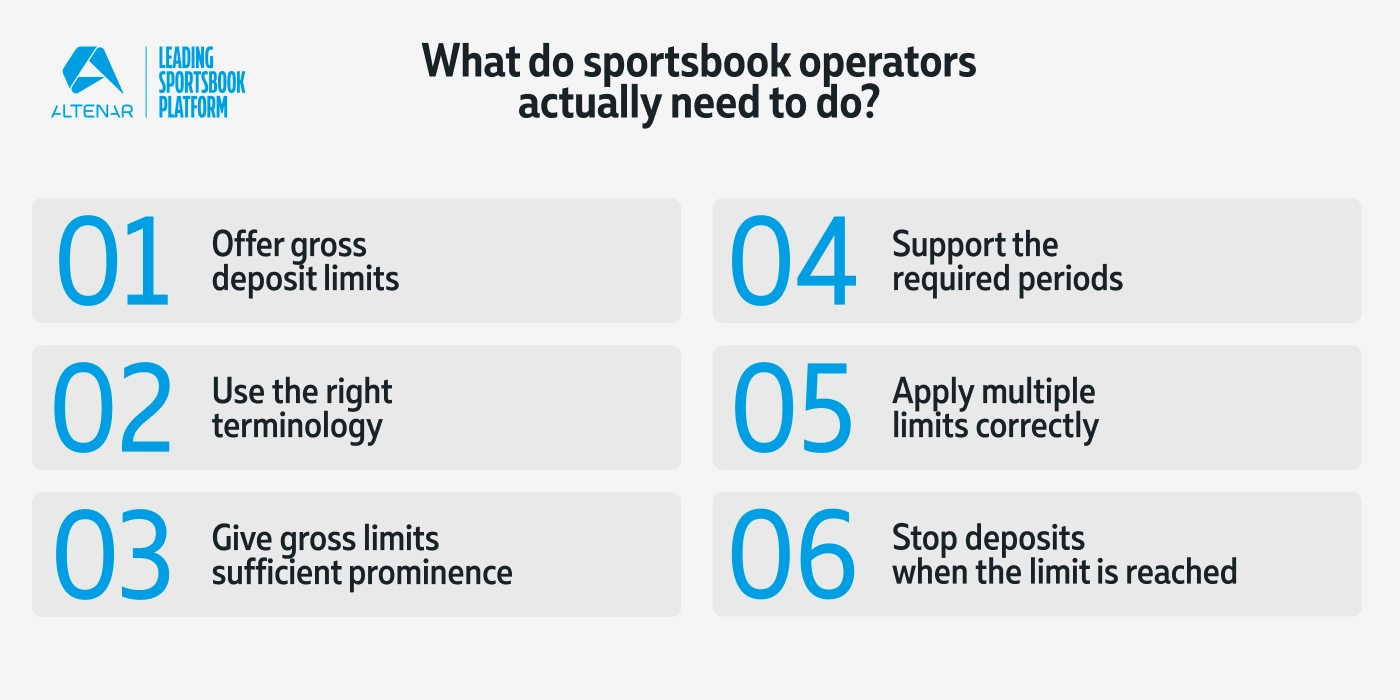
That three-month extension also tells us something about the change. Defining a deposit limit may sound simple on paper, but applying it consistently across an existing sportsbook requires changes to how limits are named, displayed, and enforced.
At the most practical level, operators need to make sure their systems can do the following:
| Requirement | What it means in practice |
|---|---|
| Offer gross deposit limits | Players must be able to limit the total amount they deposit, without withdrawals being deducted from that figure. |
| Use the right terminology | Only a gross deposit limit can be called a ‘deposit limit.’ Other financial limits must be clearly differentiated. |
| Give gross limits sufficient prominence | If other financial limits are offered, the gross deposit limit must receive at least equal prominence. |
| Support the required periods | Players must be able to set limits covering at least 24 hours, seven days and one month. |
| Apply multiple limits correctly | Where more than one period applies, the limit that prevents the player from depositing first takes precedence. |
| Stop deposits when the limit is reached | The operator must prevent further deposits once the applicable limit has been exhausted. |
These requirements affect more than the responsible-gambling section of a website. Operators need the account, cashier and underlying wallet or limit-management systems to recognise which limits apply, calculate deposits against the correct periods and stop another payment when the relevant threshold has been reached. The customer-facing language and presentation must also match what happens behind the scenes. The Gambling Commission sets out these requirements in its revised Remote Gambling and Software Technical Standards (RTS 12).
There is also an important point for existing customers. Operators do not have to move players who already use another type of financial limit onto a gross deposit limit. They can retain those existing arrangements, provided customers are also given access to the new gross deposit-limit option. The Commission specifically addressed this point when assessing the effect on existing customers.
So ultimately, 30 September is not a deadline for replacing every financial limit already in use. It is a deadline for making sure the required gross deposit limit is available, clearly presented and correctly supported by the systems around it.
Deposit limits are becoming part of the player journey
The requirements, however, do not stop with the technology behind the limits. Players also need to see and interact with financial limits, and this process actually began well before the latest rules took effect.
Since 31 October 2025, operators have been required to prompt new customers to set a financial limit before making their first deposit. Setting a limit must be presented as the default choice, while customers who decide not to do so have to confirm that decision. The amount itself is left to the player rather than being suggested by the operator. The Gambling Commission requires operators to provide a free-text facility to avoid suggestions that could influence how high or low a limit is set.
The dialogue does not end at registration. Financial-limit facilities must be easily accessible through direct links on both the homepage and deposit pages. Active customers who already have limits must also be prompted at least every six months to review their account and transaction information, while those without a limit must be prompted to consider setting one at least every 12 months.
This means limit-setting follows the player through several stages of their sportsbook experience, including registration, the first deposit, future deposits, and account management.
A player may therefore encounter financial limits before depositing for the first time, see them again when returning to the cashier and periodically be asked to reconsider whether their existing choices remain suitable.
That ultimately changes the context in which operators think about player retention. Financial limits are not sitting separately from the sportsbook experience. They are being integrated into it, which means the limit defines how much the player is prepared to deposit. But the sportsbook still has to give them a reason to keep coming back within that limit.
So, what does this mean for sportsbook retention?
It is important to be clear about what the new rules do and do not change. The Gambling Commission is not setting a universal maximum that every player must follow. Customers choose their own limits, with RTS 12 requiring operators to provide the facilities that allow them to establish and maintain a gambling budget appropriate to their circumstances. The revised RTS 12 requirements set out how these customer-led controls must work.
Nor does setting a limit mean that operators stop trying to retain that customer. What changes is the context. Once the player has established a financial boundary, there is more reason to think about the value they receive from the sportsbook.
Bonuses and promotions can still form part of that relationship, subject to the UK's rules around incentives. But retention can also come from much more fundamental parts of the product:
-
UX and navigation: A player should not have to search through a crowded sportsbook to find what interests them. Clear navigation, useful search and sensible event presentation make every visit easier and give players fewer reasons to look elsewhere.
-
Personalisation: Relevance can make a large sportsbook feel considerably smaller. Emphasising the sports, competitions, teams and markets a player actually follows can reduce unnecessary searching and make the product more useful each time they return.
-
Live betting: The relationship does not have to end once an event starts. Strong in-play coverage gives players reasons to remain engaged with the sportsbook as the action develops and new markets become relevant.
-
Market variety: Different customers follow different sports and bet in different ways. A broad but well-organised market offering gives them more opportunity to find relevant choices without simply presenting more content for the sake of volume.
-
Payments: The experience around the bet matters too. Reliable deposits, straightforward withdrawals and clear transaction information reduce avoidable problems in moments when players simply expect the sportsbook to work.
-
Product performance: None of those features matters much if the sportsbook struggles when demand increases. Speed, stability, and reliable bet placement become especially important during major events, when large numbers of customers may be using the platform at the same time.
None of these are new ideas created by deposit limits. They have always contributed to the quality of a sportsbook. What the changing regulatory environment does is make their role in retention harder to overlook.
Personalisation should work with, not against, player limits
Of all those areas highlighted above, personalisation makes it especially apparent how retention can work differently. Player data can encourage more activity, but it can also do something much more straightforward, which is to make the sportsbook more relevant to the person using it.
A player who regularly follows Premier League football does not need to search through the full sportsbook every time they log in. Relevant fixtures, teams and markets can be easier to find. Someone primarily interested in tennis might see upcoming tournaments or live matches sooner, rather than being presented with the same football-led experience as everyone else.
The difference is worth acknowledging. Personalisation does not have to mean finding new ways to persuade a player to spend more. It can mean understanding what they actually use and reducing the effort it takes to find it.
Player data can also support safer gambling. The Gambling Commission requires operators to monitor customer activity for indicators of gambling harm and take timely action when these are identified. Personalisation and player protection therefore do not need to pull in opposite directions.
For retention, the opportunity is to make the sportsbook more useful while respecting the financial choices the player has already made. The objective becomes greater relevance, not simply greater spend.
Increasingly, regulation becomes a technology question
Adapting to new regulation while maintaining the player experience ultimately depends on the technology underneath the sportsbook. The new UK deposit-limit rules illustrate why.
Operators need to support a new definition of a deposit limit, specific time periods, cooling-off requirements and rules around how different limits are named and presented. Those changes then have to work across registration, account management, and payments without making the overall sportsbook harder to use.
And the next regulatory change may require something different. Requirements vary between markets and keep changing after an operator launches. A platform built around fixed processes can therefore turn what seems like a relatively contained regulatory update into a much larger development project.
This makes adaptability increasingly important. Operators must be able to change individual parts of the player journey without unnecessarily rebuilding everything around them. At the same time, those changes cannot come at the expense of personalisation, product performance, or anything else that gives players a reason to return, for that matter.
For operators, regulatory flexibility and player experience are therefore becoming harder to separate. A sportsbook needs to adapt to new requirements while continuing to work well for the people using it.
That is where the underlying platform can make a considerable difference. Altenar gives operators the flexibility to adapt their sportsbook to different markets and requirements while continuing to develop the player experience.
If adaptability is becoming as important as functionality, the technology underneath your sportsbook matters more than ever. Book a software demonstration today and explore the platform in action.