
Key takeaways
-
Licensing & Credibility: A UKGC licence gives your brand elite market credibility, but the regulator will intensely scrutinize your corporate structure, criminality, and financial stability to get it.
-
Taxation & Market Value: The market provides massive commercial value with a £16.8B GGY, but operators are hit hard by a steep 40% standard Remote Gaming Duty tax rate implemented in 2026.
-
Regulatory & Legal Updates: The new White Paper reforms give operators a highly predictable legal roadmap, but they enforce rigid, unyielding caps on online slot stakes and customer deposit limits.
-
Consumer Protection Operations: Advanced safety tools protect vulnerable players to secure long-term business, but they force platforms into heavy, continuous behavioral monitoring and strict compliance reporting.
-
Market Outlook & Competition: Steady player engagement across sports guarantees highly predictable revenues, but you face low-cost entry barriers and fierce acquisition warfare against heavily funded brands.
DISCLAIMER
This information is not intended to be legal advice and is solely extracted from open sources. It should not be relied upon as a substitute for professional legal advice, and Altenar does not accept any liability for its use.
UK Gambling Laws 2026: Regulation, Licensing, and Legal Framework Explained
Gambling laws in the United Kingdom are stringent, which is why iGaming platforms that hold a UKGC licence are considered among the most trusted options in the industry. The market combines one of the world's most established regulatory frameworks with a large, mature player base, making it an attractive opportunity for operators prepared to meet its high compliance standards. However, depending on the games and products offered, alongside long-term business objectives, a UKGC licence may not always be the most commercially suitable option for every business.
This article provides insight into UK gambling law and compliance, explaining how the regulatory framework operates, the licensing requirements operators must meet, the responsibilities that come with holding a UKGC licence, and the advantages and challenges of entering one of the world's most competitive regulated gambling markets.
Whether you are launching a new brand or expanding into the United Kingdom, understanding these requirements is essential for building a compliant and sustainable gaming operation in 2026.
The Evolution of Gambling Law in the United Kingdom
Gambling has been a popular activity among the general population and nobles since the 17th century, when horse racing became the sport of kings, referring to Prince Charles II’s enduring passion for racing and gambling. Frost fairs would occur on the icy River Thames, where wagers were placed on tables by the general public, and dice games, card games, and primitive lotteries were common in city streets. By the turn of the century, Harry Ogden was credited with being the first person to offer odds on horses, setting the stage for the modern bookmaking system in 1790.
The 18th and 19th centuries, however, saw an increased drive to regulate gambling and address its social repercussions, primarily relating to debt and poverty. Initial legislative attempts were made in 1845 and 1853 when acts were passed to make all gambling contracts unenforceable by law. While this was effective among high society, the acts had a limited effect on the working class. The Street Betting Act of 1906 aimed to address this issue by making betting a criminal offence, yet demand persisted, leading to the spread of illicit betting shops and underground rings throughout the country.
The government’s response, notably the Betting and Lotteries Act of 1934 and the Betting and Gaming Act of 1960, acknowledged this enduring appetite for gambling by legalising off-course betting, betting shops, casinos and bingo halls, albeit under strict regulation. The creation of the National Lottery in 1994 was another major milestone, marking the start of full liberalisation and regulation, with the lottery enjoying widespread public participation and acceptance.
This movement continued into the early 21st century with the creation of the United Kingdom Gambling Commission in 2005, which aimed to regulate and modernise the entire industry. By 2014, gambling operators in the UK needed a UKGC gambling licence to offer gambling products and services to residents in the UK, regardless of location. Since then, the regulatory framework has continued to evolve in response to the growth of online gambling, with greater emphasis placed on consumer protection, responsible gambling, financial safeguards, and stronger compliance requirements for licensed operators.
Timeline of Key Events and Milestones
Here’s a timeline that illustrates the steps taken by UK authorities to regulate gambling, from restrictive policies to a more liberalised, regulated approach.
1845 and 1853: Gaming Acts to curb and control gambling.
1906: Creation of the Street Betting Act.
1934: Betting and Lotteries Act legalised betting activities.
1960: The Betting and Gaming Act legalised gambling venues.
1968: Gaming Act imposing stricter licensing requirements.
2005: Creation of the United Kingdom Gambling Commission.
2014: Remote Gambling Act regulating online operators.
2020: Credit card gambling ban introduced.
2021: Mandatory customer identity verification strengthened.
2023: Gambling Act Review White Paper published.
2024: Online game design reforms introduced.
2025: Online slot stake limits implemented.
2025: Customer-led deposit limits introduced.
2025–2026: Financial vulnerability checks strengthened.
Current Legal Landscape in 2026
Today, gambling is widely accepted as a mainstream leisure activity in the UK, with a wealth of options ranging from online betting to traditional race tracks, bingo halls and casinos. The public appetite for gambling is protected by a mature regulatory framework designed to support fair play, prevent crime, protect consumers, and reduce gambling-related harm through firm licensing, compliance and enforcement measures.
The current legal framework is anchored by the Gambling Act 2005 and governed by the UK Gambling Commission (UKGC). The Commission continues to implement reforms introduced following the Gambling Act Review, strengthening consumer protection while ensuring regulation keeps pace with the growth of online gambling and advances in technology. This framework ensures that gambling operations are conducted fairly and transparently while emphasising responsible gambling practices. Online operators must implement strong customer verification processes and tools that allow for self-exclusion, customer-led financial limits, and other safer gambling measures designed to identify and support customers at risk of harm. Operators must also comply with the UKGC's Licence Conditions and Codes of Practice (LCCP), anti-money laundering requirements, and the Remote Gambling and Software Technical Standards (RTS), which govern areas such as game integrity, security and system controls.
Furthermore, advertising regulations require gambling marketing to be socially responsible and must not target children, young people or vulnerable individuals, or mislead consumers about the nature or risks of gambling. In short, the UK's approach to gambling legislation is comprehensive, aiming to balance economic benefits with the welfare of society as a whole. This mature environment requires operators to maintain high standards of integrity, consumer protection, and responsibility.
Gambling Act Review and White Paper Reforms
In April 2023, the UK Government published High Stakes: Gambling Reform for the Digital Age, marking the most significant review of gambling regulation since the introduction of the Gambling Act 2005. The White Paper set out a programme of reforms to modernise the regulatory framework, strengthen consumer protection, and ensure that gambling legislation remains fit for today's increasingly digital gambling environment.
Together, these reforms represent a move towards more proactive regulation that emphasises preventing gambling-related harm while preserving consumer choice.
Responsible Gambling Reforms
Safer gambling has become a central priority of UK gambling regulation. Recent reforms have expanded operators' responsibilities beyond providing responsible gambling tools to actively identifying and supporting customers who may be experiencing gambling-related harm.
Licensed operators are now expected to monitor customer behaviour, intervene where appropriate, offer self-exclusion and financial limit tools, and comply with the strengthened customer interaction requirements in the Licence Conditions and Codes of Practice (LCCP).
Additional measures, including statutory financial contributions towards gambling research, prevention and treatment, demonstrate the continued direction of travel towards greater consumer protection and regulatory accountability.
For operators, responsible gambling is no longer viewed solely as a compliance obligation. It has become an integral part of customer protection, operational governance and long-term business sustainability.
Regulations and Compliance for Online Gaming Operators
In the UK, iGaming operators must comply with strict regulatory requirements set by the Gambling Commission to offer gambling products and services legally. The principal requirements are as follows:
Licensing: Obtain an operating licence from the UK Gambling Commission (UKGC). This requires meeting criteria relating to corporate integrity, customer fund protection, fair gaming, financial stability, anti-money laundering (AML), and ongoing compliance with the Licence Conditions and Codes of Practice (LCCP).
Protection: Provide age and identity verification processes to prevent underage gambling. Player checks must be conducted before customers can deposit funds or engage in real-money gambling. Operators must also implement appropriate customer due diligence and consumer protection measures to help identify and support customers at risk of gambling-related harm.
Responsibility: Implement measures promoting responsible gambling. This includes providing self-exclusion tools, customer-led financial limits, reality checks, and ensuring that information on responsible gambling practices is easily accessible to players. Operators are expected to monitor customer behaviour and take appropriate action where indicators of harm are identified.
Advertising: Ensure marketing materials comply with the Advertising Standards Authority (ASA) and the CAP and BCAP Codes. Advertisements must not target children or vulnerable people or mislead consumers about the nature, benefits or risks of gambling.
Financial: Adhere to anti-money laundering (AML) laws and counter-terrorist financing requirements, report suspicious betting patterns and suspicious financial activity where appropriate, and maintain transparent financial controls. Regular audits and regulatory reporting are mandatory.
Technical Standards: Ensure that gambling software and systems comply with the UKGC's Remote Gambling and Software Technical Standards (RTS), including requirements for game fairness, security, testing, system integrity, and customer protection.
Criteria for Obtaining a UKGC Gambling Licence
To obtain a gambling licence from the UK Gambling Commission (UKGC), an iGaming operator must meet stringent criteria designed to ensure compliance with the UK's legal, technical and consumer protection requirements. Applicants are assessed on their suitability to offer gambling services fairly, safely and responsibly. Only those operators who meet the following criteria will be granted permission to provide licensed gambling services to customers in Great Britain.
1. Identity and Ownership - Operators must provide clear and transparent information about their identity, including who owns and manages the company.
2. Business Location - Operators must provide details of their corporate structure, principal place of business and the jurisdictions from which gambling services will be provided. Depending on the licence sought, additional location and regulatory requirements may apply.
3. Criminality Checks - Thorough checks are conducted to ensure the company and key personnel do not have criminal backgrounds.
4. Financial Stability - Operators must demonstrate their financial stability, integrity, and ability to cover player winnings. The UKGC may also assess the financial resources available to the business, including funding arrangements and financial projections, where appropriate, to ensure that licensed activities are conducted in compliance with and in a sustainable manner.
5. AML Compliance - Operators must demonstrate robust anti-money laundering (AML) and counter-terrorist financing procedures, including risk assessments, customer due diligence, source-of-funds and source-of-wealth checks where appropriate, and systems for reporting suspicious activity.
6. Customer Fund Protection - Operators must have measures in place to protect customer funds in case of insolvency.
7. Integrity and Competence - The integrity and competence of management are assessed to ensure no previous gambling violations.
8. Software and Game Fairness - Operators must demonstrate that their gaming software is fair and transparent through third-party testing and certification.
9. Technical Standards - Operators must demonstrate compliance with the UKGC's Remote Gambling and Software Technical Standards (RTS), including requirements relating to system security, technical integrity, game fairness, customer account protection and operational resilience.
10. Responsible Gambling Measures - Operators must have robust safer gambling policies and procedures, including customer interaction processes, self-exclusion facilities, customer-led financial limits, staff training, and measures to identify and support customers who may be experiencing gambling-related harm.
11. Advertising and Marketing - Operators must ensure advertisements and promotional offers are clear, truthful, socially responsible, and not misleading, while complying with the CAP and BCAP Codes and UK advertising legislation.
Licensing Fees and Taxes
To obtain and maintain a gambling licence, operators must pay application and annual licence fees, as well as any applicable gambling duties and business taxes. The exact costs depend on the type of licence held, the gambling activities offered, and the operator's Gross Gambling Yield (GGY).
Licence Application Fees
All operators must pay an application fee when submitting a licence application to the UK Gambling Commission. Application fees vary by licence category and expected GGY, with separate fee structures for remote operators, land-based operators, and gambling software providers.
As licence fees are reviewed periodically, applicants should refer to the UK Gambling Commission's current fee schedule and fee calculator before submitting an application.
Annual Licence Fees
Once a licence has been granted, operators must pay an annual fee to maintain it. These fees contribute towards the Gambling Commission's licensing, compliance, monitoring and enforcement activities.
Like application fees, annual fees vary depending on the licence type and GGY and are reviewed by the Commission from time to time.
Licensed operators must also register with HM Revenue & Customs (HMRC) and pay the appropriate gambling duties where applicable. The principal gambling taxes include:
-
General Betting Duty (GBD) – applies to most fixed-odds betting activities.
-
Pool Betting Duty (PBD) – applies to qualifying pool betting activities.
-
Remote Gaming Duty (RGD) – applies to remote gaming activities such as online casino games. From 1 April 2026, the standard rate increased to 40%.
The gambling duty payable depends on the type of gambling activity being offered, and operators should ensure they understand their obligations before commencing trading.
Other Tax Considerations
In addition to gambling duties, operators may also be liable for Corporation Tax and other standard business taxes where applicable. Most gambling activities remain exempt from VAT under UK tax legislation.
Players do not generally pay tax on gambling winnings in the UK. Instead, gambling taxation is levied on licensed operators through the relevant gambling duties.
DISCLAIMER
This information is not intended to be legal advice and is solely extracted from open sources. It should not be relied upon as a substitute for professional legal advice, and Altenar does not accept any liability for its use.
Regulatory Bodies for Online Gambling
Several bodies are responsible for creating and regulating gambling laws and regulations in the UK. iGaming operators will likely only deal with a few of them on a national level. Land-based gambling establishments, such as betting shops and casinos, may also need to comply with local councils and licensing boards regarding the issuance of licences. Together, these organisations oversee licensing, advertising, financial crime prevention, taxation, consumer protection and data privacy across the gambling sector.
United Kingdom Gambling Commission (UKGC)
Established under the Gambling Act 2005, the UK Gambling Commission is the primary regulatory body for gambling and supervisory authority over gaming law in the UK. The Commission plays a central role in regulating the online gambling sector. It oversees the issuance of operator licences, ensuring that iGaming operators comply with fair play, consumer protection, and anti-money laundering (AML) standards. It rigorously enforces compliance through continuous oversight and has the authority to impose sanctions, fines, or revoke licences for non-compliance.
It also develops and enforces the Licence Conditions and Codes of Practice (LCCP), oversees the implementation of gambling reforms, and has the authority to impose sanctions, financial penalties, or revoke licences where operators fail to meet regulatory requirements.
Advertising Standards Authority (ASA)
The ASA is responsible for regulating advertising standards across the UK, including gambling advertisements. It ensures that advertising is fair, transparent, and non-misleading, protecting vulnerable groups and under-18s from harm relating to gambling activities. The ASA administers the CAP and BCAP Codes, which require gambling advertising to be socially responsible and prohibit advertisements that exploit vulnerability, encourage irresponsible gambling or appeal strongly to children and young people.
Furthermore, the ASA actively monitors compliance and can issue penalties, demand retractions where necessary, and enforce amendments to non-compliant adverts.
Financial Conduct Authority (FCA)
While not directly involved in regulating gambling activities, the FCA regulates financial and payment services used by gambling operators, ensuring secure and lawful transactions. The FCA mandates that operators have reliable systems and controls in place to prevent financial crimes, conduct due diligence, and report suspicious activities. For iGaming operators, adherence to FCA regulations is required for legal compliance and to maintain operational integrity and stakeholder and customer trust. Compliance further mitigates the risk of substantial penalties and reputational damage.
Information Commissioner's Office (ICO)
The Information Commissioner's Office (ICO) is the UK's independent authority for data protection and privacy. Gambling operators processing customers' personal information must comply with the UK General Data Protection Regulation (UK GDPR) and the Data Protection Act 2018. The ICO also regulates aspects of electronic marketing and the lawful use of customer data for promotional purposes.
Opportunities and Outlook
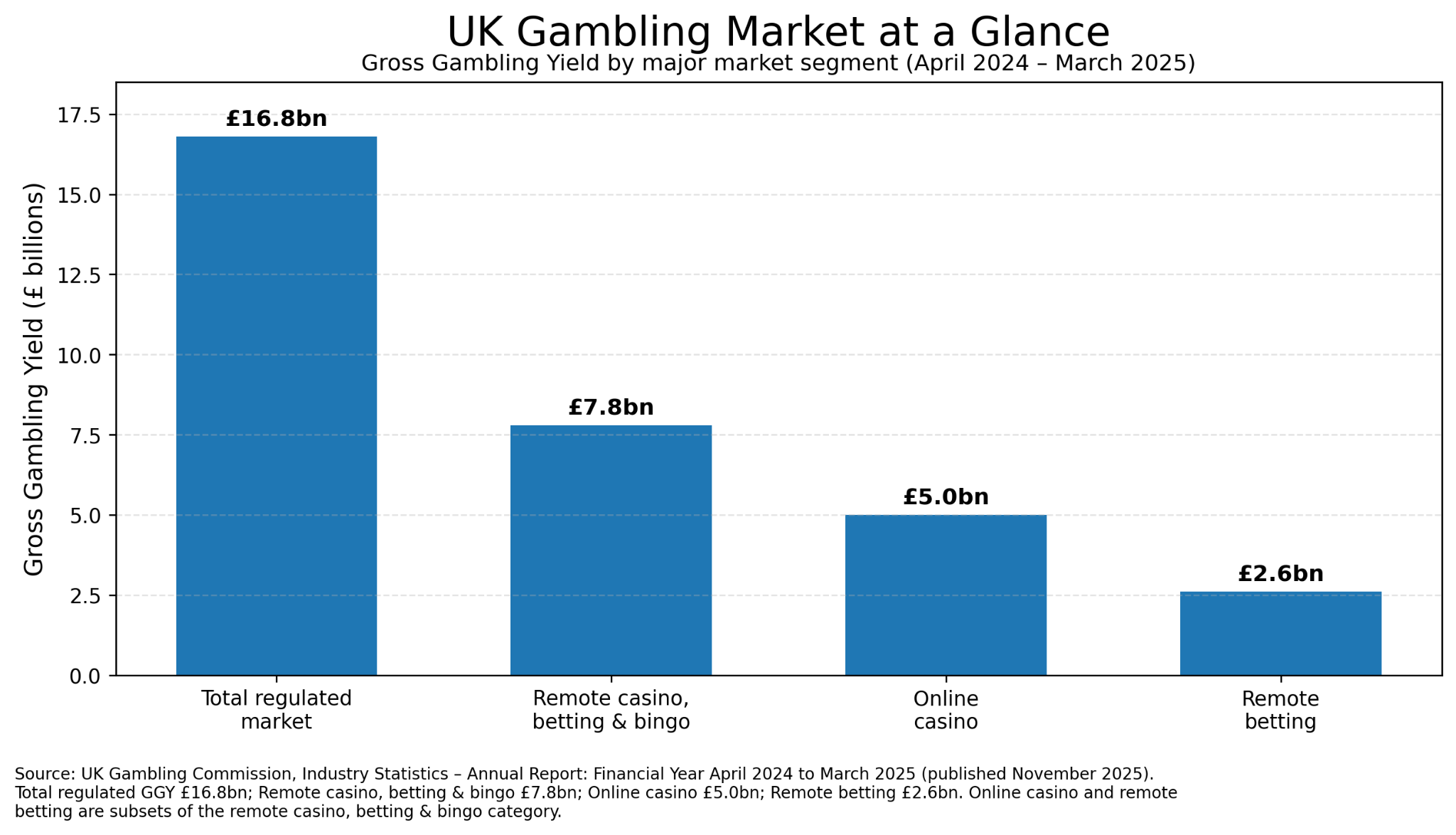
The United Kingdom remains one of the world's most mature and commercially significant regulated gambling markets. However, unlike many emerging jurisdictions where growth is driven by market liberalisation, the UK's development is increasingly influenced by innovation, operational efficiency and regulatory refinement. Consumer participation remains strong across online betting, casino gaming and traditional retail channels, while widespread smartphone adoption and digital payment technologies continue to support long-term online growth. According to the UK Gambling Commission, the regulated gambling industry generated £16.8 billion in Gross Gambling Yield (GGY) during the 2024/25 financial year, with remote casino, betting and bingo contributing £7.8 billion, highlighting the continued importance of digital gambling within the wider market.
As this is happening, the regulatory environment has continued to evolve. Rather than expanding the range of gambling products, recent reforms have focused on strengthening consumer protection and improving the industry's long-term sustainability. Measures introduced following the Gambling Act Review have enhanced customer interaction requirements, introduced online slot stake limits, strengthened financial protections and updated technical and licensing standards for operators. While these changes have inevitably increased compliance obligations, they have also reinforced the UK's reputation as one of the world's most trusted and closely regulated gambling jurisdictions.
For operators, this creates a different competitive landscape. Success is no longer determined simply by securing market access but by the ability to operate efficiently within an increasingly sophisticated regulatory framework. Investment in compliance, responsible gambling technology, behavioural monitoring and operational capability has become part of doing business rather than a competitive advantage. At the same time, many of these investments help build greater consumer confidence, reduce regulatory risk and support more sustainable long-term growth.
Competition across sports betting and online casino remains intense, particularly among established brands with significant marketing budgets. Nevertheless, opportunities continue to exist for operators to differentiate themselves through product innovation, localised content, customer experience, and technology. Importantly, while compliance costs have increased, the UK's regulatory direction has remained clear and predictable. For many operators, that level of certainty is preferable to that offered by developed regulatory systems, where future policy can be difficult to anticipate.
Ultimately, the UK market is unlikely to experience explosive growth in the coming years. Instead, its appeal lies in its stability, depth and predictability. For well-capitalised operators with a long-term outlook, the UK's greatest strength ultimately lies in the combination of market maturity and player engagement. Football, horse racing, and other major sporting events continue to generate consistent betting activity throughout the year, providing operators with stable, predictable revenue supported by one of the world's most respected regulatory systems.
Market Pros and Cons for Operators
For operators evaluating entry into the UK market, the regulatory framework offers significant commercial opportunities, but also imposes higher compliance obligations that influence long-term operating costs.
Advantages
✔ One of the world's largest regulated gambling markets
✔ Highly respected UKGC licensing regime
✔ Strong consumer confidence and market credibility
✔ Mature online and mobile betting culture
✔ Stable and predictable regulatory framework
✔ Access to leading suppliers and technology partners
Drawbacks
✘ High licensing, taxation and compliance costs
✘ Increasing consumer protection obligations
✘ Highly competitive customer acquisition environment
✘ Extensive reporting and ongoing regulatory oversight
✘ Marketing and advertising restrictions
✘ Limited opportunities for low-cost market entry
How to Apply for a UKGC Gambling Licence
iGaming operators must navigate a detailed application process to obtain a gambling licence in the UK, ensuring compliance with high regulatory standards. Here is a step-by-step guide:
The application process
Step 1: Ensure the business meets all identity, ownership, and integrity requirements. This includes criminal record checks, financial stability assessments, and proof of anti-money laundering protocols. Individuals occupying certain management roles may also require a Personal Management Licence (PML).
Step 2: Submit the application to the UKGC, providing all necessary documentation and details on business operations, the types of games offered, and measures to protect players. Applicants must demonstrate how they intend to comply with the Licence Conditions and Codes of Practice (LCCP)
Step 3: Calculate and pay the licensing application fee, due upon application submission. Fees vary depending on the type and scope of the proposed gambling activities. The UK Gambling Commission provides an online fee calculator to help applicants determine the applicable fee.
Step 4: Demonstrate that gambling software and systems comply with the UKGC's Remote Gambling and Software Technical Standards (RTS). Independent testing by a UKGC-approved test house may be required before products are made available to customers.
Step 5: Wait for the decision. The UKGC reviews and scrutinises documents to ensure applications comply with gambling laws and regulations. During this process, operators may receive additional requests for information. If satisfied that all licensing requirements have been met, the Commission will grant the relevant operating licence.
Post-Licensing Commitments
Obtaining a UK Gambling Commission (UKGC) licence is only the beginning of an operator's regulatory obligations. Once licensed, operators are expected to demonstrate ongoing compliance with the Commission's requirements throughout the lifetime of the licence. Failure to do so can result in regulatory action, including financial penalties, licence suspension or revocation.
Ongoing Compliance
Licensed operators must comply with the Licence Conditions and Codes of Practice (LCCP), which set the standards for consumer protection, anti-money laundering, fair gaming, responsible gambling, and operational conduct. Operators are expected to maintain effective governance, risk management, and internal controls while fully cooperating with UKGC investigations and compliance assessments.
Customer Protection and Safer Gambling
Operators must continually monitor customer behaviour to identify indicators of gambling-related harm and take appropriate action where necessary. This includes providing self-exclusion tools, customer-led financial limits, customer interaction processes and other safer gambling measures designed to protect vulnerable individuals. Recent reforms have further strengthened customer interaction requirements, making ongoing monitoring and intervention increasingly important for regulatory compliance.
Reporting and Technical Compliance
Licensed businesses must submit regulatory returns to the UK Gambling Commission, maintain accurate operational records and notify the regulator of significant changes affecting the business. Operators must also ensure continued compliance with the Remote Gambling and Software Technical Standards (RTS), including maintaining system security, game integrity and technical controls. Independent testing and regulatory audits may be required where appropriate.
Financial Crime and Customer Funds
Operators remain responsible for maintaining effective anti-money laundering (AML) and counter-terrorist financing controls throughout their operations. This includes conducting customer due diligence, monitoring higher-risk transactions and reporting suspicious activity where required. Operators must also clearly disclose the level of protection afforded to customer funds in the event of insolvency and keep these disclosures accurate and up to date.
Advertising and Marketing
All marketing activities must continue to comply with the CAP and BCAP Codes and the UKGC's licensing requirements. Advertising should be socially responsible, transparent and must not target children, young people or vulnerable individuals, or mislead consumers about the risks or nature of gambling products.
Further Notes
1. A UKGC gambling licence does not have a specific expiry date and remains valid unless revoked, suspended, or surrendered.
2. Operators must register at least 31 days before starting the business unless based in the UK, EU, Gibraltar, the Isle of Man, Norway, the Faroes, Iceland, New Zealand or South Africa. For these countries, you should register at least 14 days before.
3. The UK Gambling Commission advises applicants to allow up to 16 weeks for most operating licence applications. However, processing times may vary depending on the complexity of the application and whether additional information is requested.
Ready to succeed in one of the world's most demanding regulated gambling markets? Schedule a personalised demonstration with Altenar to see how our sportsbook platform helps operators deliver compliance, efficiency and long-term commercial growth.
DISCLAIMER
This information is not intended to be legal advice and is solely extracted from open sources. It should not be relied upon as a substitute for professional legal advice, and Altenar does not accept any liability for its use.