
Quick article overview - 2 min read
The Democratic Republic of the Congo (DRC) is now a top target for betting companies. It has a huge population and a massive love for football. However, you cannot just launch a website and start taking bets. The legal system is a mix of old colonial rules and modern state-run monopolies. To succeed, you must know which government offices hold the keys to the market.
The regulatory spine: partnerships and power
Unlike many African nations with independent gambling boards, the DRC operates under a state monopoly model. The sector is governed by a handful of key institutions that manage everything from technical safety to tax collection:
-
SONAL (Société Nationale de Loterie): The state-owned gatekeeper. Private operators do not usually act alone; they enter the market via partnership agreements with SONAL.
-
Ministry of Finance: The ultimate authority. They issue the actual licences (authorisations) and oversee the fiscal health of the industry.
-
OCC (Office Congolais de Contrôle): The technical watchdog. They must inspect and certify all gaming machines and electronic systems before they go live.
-
Ministry of Sports and Leisure: While their influence has waned in favour of the Ministry of Finance, their historical orders still dictate how physical gambling halls are organised.
Market entry: the compliance checklist
To go live in the DRC, operators must follow a specific administrative sequence. It begins with local incorporation—you cannot operate without a registered Congolese legal entity. Once established, the dossier moves through the Ministry of Finance for approval, often in tandem with negotiating terms with SONAL.
"Private operators typically enter the market through partnership arrangements with SONAL while operating under authorisations issued by the Ministry of Finance."
Key Action Steps for Operators:
-
Register a local company in the DRC.
-
Submit a formal licence application to the Ministry of Finance.
-
Finalise a partnership deal with SONAL.
-
Certify all hardware and software through the OCC.
-
Align with Law No. 20/017 regarding ICT and data protection.
The money: taxes and big gaps
The DRC has a strange market. It is full of activity, but the rules are still catching up. Experts guess that online gambling makes $1.6 billion to $1.7 billion every year. Even so, the government admits it only collects a small part of this in taxes.
If you run a regulated business there, you must plan for these costs:
-
Pay a 20% tax on your Gross Gaming Revenue (GGR).
-
Withhold 10% from all player winnings.
The future of betting
The DRC is currently in a state of transition. With 34.7 million internet users and a booming mobile payment network, the infrastructure for a digital betting explosion is already in place. While the licensing process is not very clear. Parliament is still reviewing new laws from 2025 to create a dedicated gambling regulator. This means the "first-mover" advantage is huge. If you can handle the state partnership model now, you will own the keys to one of Africa’s biggest remaining iGaming markets.
Looking to scale your operations in emerging African markets? Read the full report below for a deep dive into Congolese tax law, technical certification, and strategic partnership advice.
As Africa’s betting industry continues to expand into new markets, the Democratic Republic of the Congo is increasingly drawing the attention of international operators. With one of the largest populations on the continent, growing internet access, and strong enthusiasm for football betting, the country offers considerable long-term potential for operators able to adapt to its developing environment.
The Congolese gambling market differs from many other jurisdictions. State partnerships, evolving legal frameworks, and emerging fiscal oversight mean that entering the market requires a clear grasp of how licensing rules, regulatory oversight, and commercial participation align.
For operators exploring new growth opportunities in Africa, this guide provides a detailed overview of the laws, market conditions, and opportunities driving the DRC’s gambling landscape today.
DISCLAIMER
This information is not intended to be legal advice and is solely extracted from open sources. It should not be relied upon as a substitute for professional legal advice, and Altenar does not accept any liability for its use.
Gambling in the Two Congos
To avoid confusion, it is worth noting that there are two separate countries that share the name Congo. This article focuses on the Democratic Republic of the Congo (DRC), whose capital is Kinshasa. The neighbouring Republic of the Congo, with its capital in Brazzaville, operates under a different legal and regulatory structure.
While gambling is permitted in both countries, the regulatory environments differ significantly. In the Democratic Republic of the Congo, betting and casino operations fall under the oversight of the Ministry of Finance in coordination with the state lottery operator SONAL, which supervises licensing and sector oversight. The Republic of the Congo has a much smaller, less formally structured gambling sector, where activities are typically authorised through broader administrative approvals rather than through a dedicated gambling authority. For industry stakeholders assessing Central African markets, the DRC’s population size, growing betting activity, and identifiable regulator make it the jurisdiction most favoured by operators.
History of Gambling in the Democratic Republic of the Congo
Gambling in the Democratic Republic of the Congo has developed through a combination of colonial legal traditions, state-controlled gaming models, and more recent attempts to modernise oversight of a rapidly expanding betting market. The legal foundations of the sector stretch back to the early twentieth century, when colonial authorities introduced formal rules governing lotteries and games of chance. Legal measures such as the Order of the Governor General of 1901 on Games of Chance and the 1927 decree on lotteries established some of the earliest legal restrictions and controls on gambling activity in the territory.
Gambling remained tightly restricted following independence in 1960, and for a number of decades the sector was essentially limited to small-scale lottery operations and occasional casino-style entertainment in major urban centres. A significant transition occurred in the 1980s with the creation of the Société Nationale de Loterie (SONAL), the state-owned lottery operator tasked with organising and supervising lottery activities on behalf of the government. This move effectively consolidated the state’s role in the sector and laid the foundation for the monopoly model that continues to shape gambling regulation in the country today.
As sports betting and gaming machines gained popularity across parts of Africa during the 2000s, the Congolese government gradually introduced administrative rules governing gaming establishments and activities. Ministerial orders issued in the 2010s defined categories of gambling venues and clarified operational standards for casinos, betting shops, and automatic gaming halls.
More recent reforms have aimed to bring greater organisation and oversight to the market. Ministerial Order No. CAB/MIN/FINANCES/2021/020, adopted in December 2021, confirmed the state monopoly over gambling while allowing private operators to participate through partnerships with SONAL under the supervision of the Ministry of Finance. Additional amendments introduced in the early 2020s have focused on strengthening fiscal oversight and improving monitoring of gambling activity as the sector continues to expand.
Timeline of Key Milestones
The evolution of gambling in the Democratic Republic of the Congo reflects a gradual movement from colonial restrictions and state monopolies toward a more open market where private operators participate through partnerships and regulatory oversight:
1901: Colonial authorities introduce the Order of the Governor General on Games of Chance, establishing early legal controls over gambling activities in the territory.
1927: A decree governing lotteries formalises state oversight of lottery operations and reinforces restrictions on unregulated games of chance.
1951: Ordinance Law 11-141 prohibits sports prediction competitions and other betting formats.
1960: Following independence, gambling activity remains limited and largely informal, with only small-scale lottery initiatives and occasional casino-style entertainment in major cities.
1984: The government establishes the Société Nationale de Loterie (SONAL), creating a state-owned lottery operator.
1990s: Casino venues and gaming machines begin appearing in major urban centres such as Kinshasa and Lubumbashi as tourism and entertainment industries expand.
2000s: Sports betting gains popularity across Central Africa.
2011: Ministerial orders introduce formal rules governing casinos, gaming halls, and other venues offering games of chance.
2019: Inter-ministerial fiscal measures introduce clearer taxation rules for gambling activities, including mechanisms for taxing player winnings and bets conducted through digital technologies.
2021: Ministerial Order No. CAB/MIN/FINANCES/2021/020 establishes a modern administrative framework for gambling activities and confirms the state monopoly exercised through SONAL.
2022: Amendments to the 2021 framework clarify definitions of gambling activities and reinforce the partnership model allowing private operators to work with the state lottery.
2023: The Ministry of Finance introduces measures aimed at strengthening monitoring of gambling activity, including oversight to improve transparency and fiscal reporting.
2025: Draft legislation proposing a comprehensive gambling law and the creation of a dedicated regulatory authority is introduced in parliament.
The Current Landscape for Gambling in the DRC
Today, gambling is legal in the Democratic Republic of the Congo across several verticals, including casinos, sports betting, gaming machines, and lottery products, with market participation structured around the state’s partnership-based regulatory framework.
The nation's gambling sector is currently structured around a monopoly model centred on the Société Nationale de Loterie (SONAL), the state-owned lottery company responsible for organising and supervising most forms of gambling in the country. In practice, this model allows private companies to participate in the market through partnership arrangements with SONAL and authorisations issued under the Ministry of Finance's supervision.
Several gambling verticals are permitted under the current system. Land-based casinos operate primarily in major cities such as Kinshasa and Lubumbashi, while gaming machines are offered in authorised gaming halls and entertainment venues. Sports betting has become one of the most visible segments of the market, with betting shops appearing in urban areas as football wagering gains popularity among younger demographics. Lottery products remain a core component of the sector and continue to operate under the state monopoly.
Online gambling is not regulated through a dedicated digital gambling statute. However, existing ministerial orders governing games of chance, betting competitions, and lottery activities are interpreted broadly enough to cover betting conducted through electronic and communication technologies. As a result, some operators offer digital betting services in partnership with SONAL while maintaining a physical presence through betting outlets.
For bettors, gambling is legally permitted through licensed venues and authorised operators, with fiscal rules applying to the sector. Recent measures introduced by the government have strengthened tax collection and monitoring obligations for operators, reflecting a broader effort to increase transparency and improve fiscal returns from gambling activity.
Looking ahead, the Congolese government has communicated its intention to introduce more comprehensive legislation governing gambling. Proposed reforms include the possible creation of a dedicated regulatory authority and clearer rules for licensing, supervision, and enforcement. If implemented, these changes could move the sector toward a more conventional regulatory model while preserving the state’s central role in the industry.
Gambling Regulators
Gambling activity in the Democratic Republic of the Congo is directed by a handful of public institutions that oversee licensing, financial supervision, operational partnerships, and technical compliance. Together, these bodies form the administrative spine that supervises the country’s regulated betting and gaming market:
Société Nationale de Loterie (SONAL)
The Société Nationale de Loterie plays a central role in the Congolese gambling sector as the state-owned company responsible for organising and managing lottery activities and overseeing the state monopoly on gambling. In working practice, SONAL acts as the gateway through which private gambling operators access the market. Companies seeking to offer sports betting, casino games, or other wagering activities typically do so through partnership arrangements with SONAL, supported by authorisations issued through the Ministry of Finance.
On a day-to-day basis, SONAL works with partner operators to structure agreements, review technical proposals, and ensure that the games offered in the market align with the government's regulatory framework. The organisation also coordinates with public authorities on reporting, compliance monitoring, and fiscal obligations tied to gambling operations.
Through this partnership-based model, SONAL effectively bridges the gap between the state’s monopoly over gambling and the commercial participation of private operators. Its position at the centre of the licensing and partnership process means that it continues to influence how the market evolves as betting demand grows across the country.
Ministère des Finances
The Ministry of Finance plays an unusually prominent role in supervising the gambling sector in the DRC. Unlike many jurisdictions where a dedicated gambling regulator operates independently, responsibility for licensing oversight, fiscal supervision, and regulatory policy largely resides within the Ministry itself. As a result, the Ministry of Finance functions as the central governmental authority responsible for approving gambling authorisations, issuing ministerial orders, and overseeing taxation and financial regulation of licensed gambling activities across the country.
At an operational level, the ministry’s work involves reviewing licence applications, evaluating financial and corporate documentation submitted by operators, and determining whether proposed gambling projects comply with national laws and fiscal requirements. It also oversees the taxation of gambling activities, including the collection of duties, authorisation taxes, and other financial obligations applied to licensed operators.
The Ministry of Finance works closely with SONAL, which manages the state lottery monopoly and partnerships with private operators. While SONAL coordinates operational partnerships, the ministry provides the legal authority behind authorisations and regulatory rules. Through this combination of policy-making, licensing oversight, and economic supervision, the Ministry of Finance remains a significant institution directing the development and regulation of the Congolese gambling market.
Office Congolais de Contrôle (OCC)
The Office Congolais de Contrôle (OCC) plays a technical and compliance-oriented role within the DRC’s gambling framework. As the national inspection and certification authority responsible for quality control across multiple sectors, the OCC is tasked with verifying that equipment used in gambling operations meets applicable technical and safety standards. This includes the inspection and certification of gaming machines, electronic systems, and other specialised devices used by licensed operators.
In practice, operators introducing gaming equipment into the Congolese market must ensure that machines and related technology are inspected or approved by the OCC before deployment in casinos, gaming halls, or betting venues. The organisation therefore supports oversight of gaming by helping maintain technical integrity and consumer protection in the market.
Ministère des Sports et Loisirs
Historically, gambling activities in the DRC were treated as part of the broader category of leisure and entertainment, which placed casinos, gaming halls, and similar venues under the ministry’s administrative oversight. Ministerial orders issued during this period introduced operational rules for gambling establishments.
While responsibility for licensing and economic supervision has since been transferred, predominantly to the Ministry of Finance, the legal instruments introduced by the Ministry of Sports and Leisure continue to influence how gambling venues are organised and operated. As a result, the ministry’s original regulatory foundations still form part of the broader regulatory environment affecting casinos and gaming establishments today.
Compliance Requirements for Entering the Online Gambling Market in the Democratic Republic of the Congo
Operators planning to enter the online gambling market in the Democratic Republic of the Congo must, like in any other gambling jurisdiction, comply with its regulatory framework. While it continues to evolve, several legal statutes and regulatory practices already define the basic compliance route for market entry.
The first requirement for market participation is the establishment of a locally registered legal entity. Businesses seeking to operate gambling activities are expected to incorporate a company within the DRC that can represent the operator before national authorities, register with tax institutions, and carry out administrative procedures related to licensing and regulatory compliance.
Once a legal entity is established, operators must obtain authorisation from the Ministry of Finance, which acts as the primary governmental authority overseeing gambling licences. Companies wishing to offer betting, casino games, or other wagering products must submit licence applications supported by corporate documentation, financial records, and operational plans demonstrating compliance with national regulatory requirements.
The licensing system itself derives from several legal measures governing gambling activities, including the Interministerial Orders No. 001/CAB/MIN/SL/2019 and No. CAB/MIN/FINANCES/2019/133, which define the taxation structure and regulatory conditions applicable to gambling operations in the country.
A distinctive feature of the Congolese market is the state monopoly held by the Société Nationale de Loterie (SONAL). Established under Ordinance No. 84-156 of 4 July 1984, SONAL was granted control over lottery activities and games of chance within the country. Private operators typically enter the market through partnership arrangements with SONAL while operating under authorisations issued by the Ministry of Finance.
Beyond licensing and partnership requirements, operators must also comply with financial and fiscal obligations, including taxation on gambling revenues and duties imposed by national authorities. In practice, sports betting operators have been subject to taxes calculated on gross gaming revenue, as well as additional financial contributions collected by the Ministry of Finance.
Compliance obligations extend to areas such as anti-money laundering controls and digital regulation, particularly where online gambling platforms process payments or handle player data. Telecommunications and digital legislation, including Law No. 20/017 on telecommunications and ICTs, contribute to the broader legal framework governing online operations and the protection of personal data in digital services.
Actions to Take for Market Entry
-
Register a local company in the DRC.
-
Prepare the licence application documentation dossier.
-
Submit an authorisation request to the Ministry of Finance.
-
Establish a partnership agreement with SONAL.
-
Comply with gambling taxation and duties.
-
Obtain technical certification for gaming equipment (OCC).
-
Meet telecommunications and digital compliance rules.
DISCLAIMER
This information is not intended to be legal advice and is solely extracted from open sources. It should not be relied upon as a substitute for professional legal advice, and Altenar does not accept any liability for its use.
License Costs and Taxes
Costs associated with entering the Congolese gambling market primarily arise from licensing authorisations and taxation applied to betting activities. Unlike in some African jurisdictions, however, detailed cost information in the DRC is not readily available from public sources.
Licences
Public legal texts governing gambling in the Democratic Republic of the Congo confirm that operators must obtain ministerial authorisation to organise games of chance, but licence fees and costs are not fully transparent or standardised in the available legislation. The legal basis for authorisation procedures is defined in Ministerial Order No. CAB/MIN/FINANCES/2021/020 (14 December 2021), which outlines the practical conditions for granting gambling approvals. In practice, operators typically seek further details on licence conditions directly from the Ministry of Finance or through partnership discussions with the state lottery operator SONAL.
Taxes and Ongoing Obligations
Operators should expect multiple levels of taxation when entering the Congolese gambling market. Industry analyses indicate that sports betting operators may face taxes of around 20% on gross gaming revenue (GGR), while a 10% withholding tax on player winnings has also been introduced in the betting sector. These taxes sit alongside additional duties and royalties defined under Interministerial Orders No. 001/CAB/MIN/SL/2019 and CAB/MIN/FINANCES/2019/133, which establish the broader economic framework for gambling activities. Further measures governing the collection of gambling-related revenues were introduced through a ministerial order of February 2024.
Opportunities and Future Outlook
The Democratic Republic of the Congo is increasingly drawing the attention of the international betting and gaming community as one of Africa’s most underdeveloped yet potentially lucrative iGaming markets. Some industry estimates suggest that online gambling activity in the nation may already be generating around $1.6-$1.7 billion in annual revenue, although reliable official market statistics remain limited.
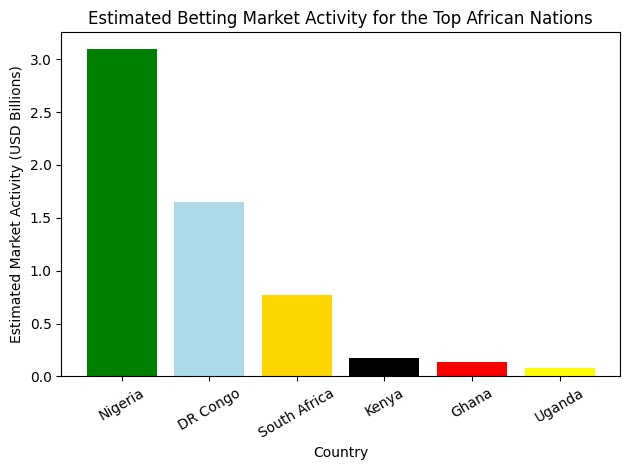
Sources: PwC Global Entertainment & Media Outlook, Focus Gaming News, Statista Market Insights, industry analysis reports on African betting markets.
Footnote: Figures represent the most recent available industry estimates and may refer to different revenue measures across markets. In the case of the Democratic Republic of the Congo, the estimate reflects overall gambling activity rather than regulated sports-betting revenue, as official market statistics remain limited.
The figure points to one of the most notable features of the Congolese gambling industry, which is the scale of betting activity already taking place. The betting market has grown faster than the controls put in place to oversee it. Government officials have acknowledged that only a small fraction of the sector’s revenue currently flows into public finances, highlighting the gap between market activity and formal regulatory oversight.
From a commercial perspective, the underlying drivers of this growth are familiar across the African gambling landscape. The Democratic Republic of the Congo has seen a steady expansion in mobile connectivity, with more than 64 million active mobile connections and around 34.7 million internet users, representing approximately 30 per cent of the population. This level of digital access is already sufficient enough to support large-scale mobile betting activity, particularly in urban areas such as Kinshasa and Lubumbashi, where sports betting has become a mainstream form of entertainment.
Sports betting remains the dominant segment of the gambling market, reflecting the widespread popularity of football nationwide and the growing availability of mobile payment solutions. Participation levels, however, are still relatively low compared with more mature African betting markets, suggesting that long-term growth potential remains significant as internet penetration and digital payments expand.
For operators considering market entry, the outstanding opportunity lies in the combination of strong consumer demand and a still-developing regulatory framework. Government initiatives announced in recent years indicate that authorities are seeking to modernise oversight and capture more tax revenue from the industry through updated legislation and public-private partnerships.
With that said, the same regulatory evolution also presents challenges. Licensing procedures remain poorly defined and unclear, and the market continues to operate through a mixture of formal partnerships and informal activity.
Operators that succeed in the DRC have been observed to be those that enter early, secure strong local partnerships, and align closely with the country’s regulatory institutions. Mobile-first betting platforms, reliable payment integrations, and scalable infrastructure are essential, especially in environments where internet connectivity is not always consistent.
Market Pros and Cons for Operators
For operators evaluating expansion into Central Africa, the Democratic Republic of the Congo presents a mix of promising growth potential and operational challenges:
Market Advantages
-
Large population with rising digital adoption.
-
Rapid growth in mobile betting usage.
-
Strong national interest in football betting.
-
Limited competition from major international brands.
-
Significant untapped market potential.
-
Expanding mobile payments network.
Market Challenges
-
Licensing procedures not fully transparent.
-
The regulatory framework is still evolving.
-
Infrastructure reliability varies across regions.
How to Apply for a Gambling Licence
Operators interested in launching gambling operations in the Democratic Republic of the Congo typically begin the licensing process by engaging directly with the Ministry of Finance, which oversees authorisations for gambling activities. Unlike some jurisdictions that provide a dedicated online licensing portal, the DRC generally handles applications through formal administrative submissions and in-person engagement with government authorities.
Ministry of Finance – DRC (Head Office)
Centre Financier de Kinshasa
1 Zongotolo, Gombe
Kinshasa
Democratic Republic of the Congo
Email: [email protected]
Telephone: +243 242 814524
In practice, operators typically prepare a regulatory application dossier outlining their corporate structure, proposed gambling activities, technical infrastructure, and financial capacity. This documentation is submitted to the Ministry of Finance, which reviews applications and determines whether the proposed operation meets the conditions defined in Ministerial Order No. CAB/MIN/FINANCES/2021/020.
Because gambling activities operate under a state monopoly model, operators commonly establish working relationships with the Société Nationale de Loterie (SONAL) during the application process. Early engagement with these institutions often helps clarify licensing expectations before formal approval procedures begin.
As the African betting sector continues to expand, operators are recognising the importance of partnering with technology providers equipped for emerging markets. Book a demonstration today to see how Altenar’s flexible and scalable sportsbook platform supports expansion in the DRC and beyond.
DISCLAIMER
This information is not intended to be legal advice and is solely extracted from open sources. It should not be relied upon as a substitute for professional legal advice, and Altenar does not accept any liability for its use.