
DISCLAIMER
This information is not intended to be legal advice and is solely extracted from open sources. It should not be relied upon as a substitute for professional legal advice, and Altenar does not accept any liability for its use.
Quick article overview - 3-minute read
Uganda is no longer a peripheral market. While it lacks the sheer size of Nigeria, it has achieved something rare in emerging economies: predictability. Between 2021 and 2025, total wagers in the country exploded from UGX 500 billion to nearly UGX 8 trillion. This 16-fold increase signals a massive shift in consumer behavior, moving away from local betting shops and toward a mobile-first future.
Digital channels now dominate the landscape, accounting for over 70% of all bets. For the strategic operator, this isn't just growth—it is a transition into a professionalized, event-driven market where football remains the ultimate king.
Navigate the Regulatory Triple-Threat
To operate successfully, you must satisfy three distinct regulatory bodies that oversee daily operations:
-
The NLGRB: The National Lotteries and Gaming Regulatory Board is your primary contact. They issue licenses, conduct inspections, and enforce the strict 2025 Responsible Gaming Directives.
-
The FIA: The Financial Intelligence Authority handles AML (Anti-Money Laundering) oversight. You must appoint a money laundering control officer and report suspicious transactions within two business days.
-
The UCC: The Uganda Communications Commission controls your brand's voice. They ban inducements and require mandatory addiction warnings on every advertisement.
The Financial Barrier to Entry
Uganda uses a tiered fee structure that rewards regional investment. Foreign online sportsbook operators should budget UGX 100 million (approx. $27,000) for initial fees, while East African nationals pay half.
The real challenge lies in capital and taxation:
-
Minimum Capital: You must prove UGX 250 million in paid-up capital through bank statements.
-
Weekly Taxes: Operators pay 20% on betting and 30% on gaming (calculated as stakes minus winnings).
-
Player Tax: You must deduct a 15% withholding tax from all player winnings.
Your Market Entry Checklist
The licensing process is strictly document-driven. You must follow these steps to secure approval:
-
Register a local entity: Incorporate a company eligible for licensing.
-
Submit technical certification: Provide proof that your software meets NLGRB standards.
-
Implement safeguards: Install self-exclusion systems and deposit limits before launch.
-
Register with NITA-U: You must sign up as a formal data collector.
-
Renew annually: All licenses expire on December 31. Submit your renewal paperwork by October to avoid service gaps.
Why Uganda is a Strategic Win
While the tax burden is high and the annual renewal cycle is compressed, the market offers a "stability premium." Unlike neighboring regions where tax laws shift overnight, Uganda’s framework is well-defined and increasingly enforced.
As the regulator cracks down on unlicensed operators, legitimate players gain a safer, more profitable environment. With industry revenue projected to hit $55 million by 2030, the current window offers the perfect entry point for operators who value structure over speculation. If you can handle the documentation, the player demand is already waiting.
At first glance, Uganda looks modest compared to Africa’s headline betting markets. Then you might notice that stake volumes have been multiplying over the last few years, mobile usage has overtaken retail, and regulators are moving toward tighter monitoring rather than greater restrictions. Then suddenly, a very different market comes into view.
Yes - Uganda is growing, but it’s not automatically profitable. Performance depends on understanding how the market actually behaves week after week, from margins and taxation to player habits and regulatory pressures. This guide examines those realities to help operators assess whether Uganda fits their strategy and what needs to be right for it to work.
Brief History of Gambling in Uganda
For much of the country’s post-independence history, betting and gaming activity existed in loosely organized forms, driven by social habits. Small-scale wagering, card games, and community lotteries were common long before access to major sporting events was common, and before any formal regulatory framework emerged.
The first real attempt to bring structure to the sector came as Uganda’s economy liberalized in the 1990s and early 2000s. As private enterprise expanded and foreign investment increased, gambling moved from informal settings into visible commercial spaces. Casinos began operating in hotels, betting shops appeared in towns and cities, and lottery-style products became popular and widely accessible. At this time, regulation was inconsistent, with oversight split across older statutes that were never designed for a modern, commercial gambling market.
That changed decisively in 2016 with the introduction of the Lotteries and Gaming Act. The law created a single, unified framework for gambling in Uganda. It established the National Lotteries and Gaming Regulatory Board (NLGRB) as the central authority responsible for licensing, supervision, and enforcement. Significantly, the Act did not limit itself to traditional, land-based gambling. It anticipated online betting, gaming machines, intermediaries, and supplier activity, laying the groundwork for a regulated multi-channel market.
Subsequent years saw the framework refined and expanded upon. Amendments in 2018 clarified licensing categories and strengthened regulatory powers, while detailed regulations followed, covering betting operations, gaming machines, licensing procedures, and minimum capital requirements. As online and mobile betting grew rapidly, primarily driven by smartphone adoption and a young, sports-focused audience, the regulator shifted its attention from market entry to operational discipline.
By the early 2020s, policy started to move beyond basic market oversight. Tax reforms, stronger enforcement against illegal gambling, and the rollout of centralized monitoring systems reflected a state increasingly concerned with transparency and consumer protection. The publication of formal Responsible Gaming Directives in 2025 marked another turning point, signaling that Uganda’s approach had matured beyond basic licensing into a more hands-on regulatory model.
Today’s framework is the product of that gradual evolution, which progressed from informal beginnings to rapid commercial growth, and a regulatory response that has steadily adapted to the realities of a modern gambling market.
Timeline of Key Milestones
Uganda’s gambling framework gradually evolved from post-independence informality to regulation and, later, consolidation under a central authority. The key milestones include:
1962: Informal betting continues without laws after independence.
1968: Public lotteries begin appearing under ad-hoc oversight.
1990s: Private betting shops emerge as football interest grows.
2000: Early attempts to tax betting activity through revenue laws.
2016: Lotteries and Gaming Act establishes Uganda’s modern legal framework. The National Lotteries and Gaming Regulatory Board is formally created as the central regulator.
2017: Licensing regulations clarify casino, betting, and gaming machine rules.
2018: Amendment Act strengthens enforcement and licensing powers.
2023: Withholding tax on gaming winnings officially removed.
2023: ITHUBA awarded a 10-year national lottery monopoly license.
2024: Updated Fees Regulations restructure license/renewal costs.
2025: Responsible Gaming Directives published.
Current Framework for Gambling Operations
Gambling in Uganda operates under a comprehensive regulatory framework grounded in the Lotteries and Gaming Act, 2016, which brought all wagering, gaming, and lottery activities into a single legal structure. This law, supported by a number of regulations developed since 2017 and updated license fee rules in 2024, established the legal basis for both land-based and remote (online) gambling, giving greater transparency on operator obligations and market expectations.
At the heart of Uganda’s gambling regime is the National Lotteries and Gaming Regulatory Board (NLGRB), the authority empowered to license, supervise, and enforce compliance across the sector. The NLGRB’s mandate covers sports betting, casinos, lotteries, bingo, gaming machines, and related supplier licenses, with supervision over both physical venues and online platforms.
Sports betting, including fixed-odds markets and live betting, is explicitly regulated and permitted, provided operators hold an appropriate license from the NLGRB. The law recognizes licensed sports betting operators both in retail shops and on online/mobile platforms, with licensing requirements applying equally across channels.
Online gambling (remote sports betting, online casinos, digital lotteries) is also regulated. Operators must secure the relevant license from the NLGRB, and compliance includes implementing responsible gambling tools, AML/KYC policies, and player-protection measures before launch.
Offline, players can access a range of betting shops and casinos that hold NLGRB licenses. At the same time, modern consumers increasingly use mobile apps and online portals to place bets, driven by widespread smartphone usage and the adoption of mobile money payments.
Gambling Regulators in Uganda
Understanding Uganda’s market requires knowledge of the regulators involved, as licensing, financial controls, and advertising practices are handled by separate institutions working in parallel, each interacting with operators at different stages of day-to-day operations.
National Lotteries and Gaming Regulatory Board
The NLGRB is the central authority responsible for licensing and supervising all gambling activity in Uganda. Its powers are derived primarily from the Lotteries and Gaming Act 2016 and related regulations. The Board issues operating licenses across betting, casinos, lotteries, gaming machines, intermediaries, and online gambling software, and maintains a public register of authorized operators.
Licensed operators interact with the Board during applications, annual renewals, inspections, reporting submissions, and responsible gambling compliance checks. It has the authority to suspend or revoke licenses, issue compliance notices, and impose administrative penalties. Both retail premises and online platforms are subject to oversight, including approval of systems, location suitability, and enforcement of the Responsible Gaming Directives of 2025.
Financial Intelligence Authority
The Financial Intelligence Authority (FIA) serves as Uganda’s anti-money laundering and counter-terrorism financing regulator. Under the Anti-Money Laundering Act 2013, gambling operators are classified as accountable persons, placing them under direct AML supervision.
The FIA requires operators to implement customer due diligence procedures, verify identity using reliable documentation, monitor transactions, maintain detailed records for up to 10 years, and report suspicious activity within statutory time frames. It also enforces reporting thresholds for large cash transactions. Operators must appoint a designated money laundering control officer and maintain internal AML systems capable of scrutiny. In day-to-day operations, this translates into structured KYC workflows, transaction monitoring, and periodic regulatory engagement, particularly where unusual activity is detected.
Uganda Communications Commission
The Uganda Communications Commission (UCC) oversees gambling advertising, sponsorship, and promotional communications across broadcast, digital, and outdoor channels. Its authority stems from the Uganda Communications Act 2013 and the Uganda Communications Commission’s Advertising Standards.
For operators, the UCC shapes how gambling brands appear in public. Marketing content must not mislead, target minors, or portray gambling as a financial solution. Specific warning messages are mandatory, including the prescribed addiction statement. The Commission monitors advertising placements, sponsorship arrangements, and promotional language and has the power to impose sanctions. Online campaigns, affiliate messaging, and broadcast interviews all fall within its remit, making advertising compliance a continuous operational consideration.
Operational Compliance Requirements in Uganda
While the legal framework appears straightforward compared to some other jurisdictions in the region, Uganda’s gambling system includes a number of operational nuances that require careful planning and consideration.
To start with, licenses in Uganda run only until December 31 of the year in which they are issued. This creates a compressed renewal cycle regardless of the approval month. Applications for renewal must be filed at least two months before expiration, so timing and internal compliance calendars matter from day one.
It is important to note that Uganda distinguishes between foreign applicants and Ugandan/East African nationals in its fee structure under the Lotteries and Gaming (Fees) Regulations 2024. Application and license fees differ materially depending on ownership classification. Capital thresholds are further governed by the Lotteries and Betting (Minimum Capital) Regulations 2017, which are scrutinized at the application stage.
AML obligations in Uganda are also extensive. Under the Anti-Money Laundering Act 2013, operators are ‘accountable persons’. Customer due diligence is mandatory before establishing business relationships, suspicious transactions must be reported within two business days, and records must be retained for 10 years.
Responsible gambling is now a central pillar of compliance. The Responsible Gaming Directives, 2025 require self-exclusion systems, deposit and time limits, prescribed website disclosures, and annual employee training. Non-compliance constitutes a breach of license conditions.
Further to this, advertising is tightly controlled. The Uganda Communications Commission prohibits inducements designed to encourage betting and mandates specific warnings. Marketing strategy must therefore be designed around regulatory restraint rather than promotional intensity.
DISCLAIMER
This information is not intended to be legal advice and is solely extracted from open sources. It should not be relied upon as a substitute for professional legal advice, and Altenar does not accept any liability for its use.
Step-by-Step Guide to Applying for a Gambling License
Before applying for a gambling license in Uganda, operators should understand that the process is formal, document-driven, and strictly governed by statute. The steps below outline the core legal and compliance requirements that must be satisfied before license approval is granted.
1) Identify the Correct License Category
Determine the precise license required between general betting, pool betting, casino, intermediary, gaming machine, or gambling software, before preparing documentation.
2) Incorporate a Legal Entity Eligible to Hold a License
Register as a legal entity capable of being approved and licensed by the National Lotteries and Gaming Regulatory Board.
3) Confirm Compliance with Minimum Capital Requirements
Verify that paid-up capital meets thresholds prescribed for betting operators under applicable capital regulations before submission.
4) Prepare Application Documentation in Prescribed Form
Compile required corporate, ownership, operational, and technical information in accordance with licensing regulations for the selected license category.
5) Pay the Prescribed Application Fee
Submit the statutory application fee corresponding to the license type and nationality classification of the applicant.
6) Submit Application to the NLGRB for Review
File the completed application with the Board, which assesses suitability, documentation completeness, and regulatory compliance readiness.
7) Obtain Approval of Premises (Where Applicable)
For land-based operations, secure regulatory approval confirming the suitability of proposed gambling premises before operations begin.
8) Submit Technical Certification for Machines or Software
Provide testing results confirming compliance of gaming machines or betting software with standards determined by the Board.
9) Establish Customer Due Diligence Procedures
Implement identity verification and risk-based AML controls before establishing customer relationships or processing qualifying transactions.
10) Implement Suspicious Transaction Reporting Systems
Create internal processes to detect and report suspicious transactions to the Financial Intelligence Authority within statutory time frames.
11) Install Responsible Gambling Controls Before Launch
Integrate self-exclusion systems, deposit and time limits, mandatory disclosures, and employee training in line with Board directives.
12) Apply for Renewal Before December 31 Expiration
Licenses expire annually on December 31. Renewal applications must be submitted at least two months prior to expiration.
The Cost of Market Entry, Licenses and Taxes
Under the Lotteries and Gaming (Fees) Regulations 2024, the cost of an online general betting operating license varies depending on the applicant's classification. A foreign applicant must pay a UGX 50 million application fee and UGX 50 million license fee, while Ugandan and East African nationals pay a UGX 25 million application fee and UGX 25 million license fee.
This means a foreign online sportsbook operator should budget at least UGX 100 million (approx. $27,000) before operational costs. Licenses issued under the Lotteries and Gaming Act 2016 expire on December 31 of the year in which they were issued, and renewal applications must be submitted two months before expiration.
Equally important is capital adequacy. The NLGRB requires proof of a minimum capital of UGX 250 million for a general betting license in Uganda, evidenced through bank statements and accompanied by written consent allowing the regulator to verify funds directly with the bank. Applicants must also submit notarized incorporation documents, shareholder and director identification, police and Interpol clearance certificates, proof of beneficial ownership, a URA tax clearance certificate, a detailed business plan (Board template), AML and Responsible Gaming training program, software provider details, and registration as a data collector with NITA-U. This documentation requirement often proves more demanding than the fee itself and influences market-entry preparation timelines.
Ongoing Operational Costs
Beyond the initial costs of obtaining a betting license, operators must also bear the cost of ongoing system audits, AML/KYC tools, responsible gaming solutions, software updates, payment integrations, staff training programs, and periodic regulator inspections, all of which contribute to yearly operating budgets. Retail operators will also incur additional fees for premises inspections and approvals, and gaming machine operators are subject to registration fees per machine.
Taxation
In addition to the above requirements, taxation is a significant cost consideration. According to the Uganda Revenue Authority, the weekly betting tax is set at 20% of the total amount staked less winnings paid out, while the gaming tax is 30% on the same basis. A 15% withholding tax applies to betting winnings, deducted by operators before payouts. These rates influence margin modeling and cash-flow planning, particularly in high-volume retail or mobile betting environments.
Opportunities and Future Outlook
Uganda does not present itself as a big-ticket gambling market. It is not Kenya in a peak expansion phase, nor is it Nigeria in terms of scale. But for operators willing to look beyond market size alone, it offers something arguably more valuable to some - structure, predictability, and steady yet increasing betting demand.
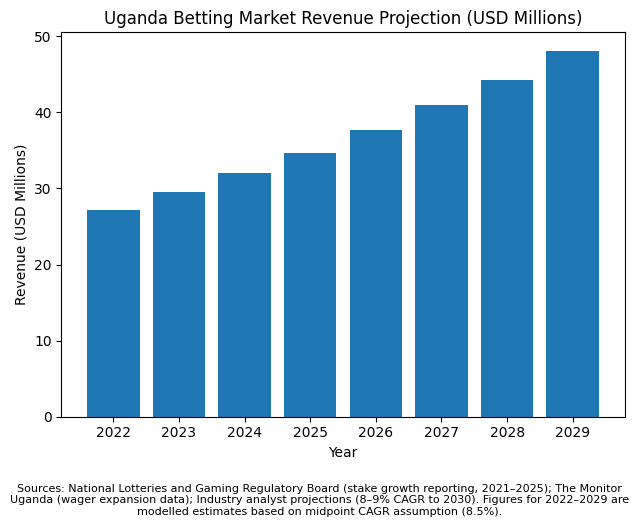
Uganda’s betting market has expanded dramatically in recent years. Total wagers climbed from around UGX 500 billion in 2021/22 to nearly UGX 8 trillion in 2024/25, according to the National Lotteries and Gaming Regulatory Board, highlighting an almost 16-fold increase in stake volume in just a few years. Online and mobile channels now account for over 70% of bets, underscoring a move away from traditional retail. Analysts project industry revenue reaching USD 35-40 million by 2025 and more than USD 55 million by 2030, on an 8–9% growth trajectory, driven by smartphone adoption and digital access.
Economically, Uganda remains one of East Africa’s fastest-growing economies, supported by a young population and increasing urbanization. Disposable income levels are modest, but mobile penetration continues to have a greater influence on consumer behavior. Betting activity is heavily football-led, with the English Premier League driving consistent weekly engagement. That creates a recurring, event-driven betting cycle rather than irregular tournament moments. For operators, this allows revenue forecasting to be grounded in predictable seasonal patterns rather than speculative assumptions.
Yet, there are challenges. Capital requirements and documentation thresholds are demanding by regional standards. Enforcement against unlicensed operators is becoming more visible, which increases opportunities and margins for legitimate operators. Such initiatives will be significant going forward, with taxation already accounting for a meaningful share of revenue.
Uganda’s betting and withholding tax structures are by no means low, but they are well defined and stable, compared to neighboring jurisdictions where tax systems can change quickly. Compliance expectations are rising, particularly around responsible gambling and monitoring systems, but the direction of travel is toward tighter oversight rather than structural uncertainty.
For disciplined operators with realistic margin modeling and strong local partnerships, Uganda ultimately delivers something increasingly rare in emerging markets - and that’s stability.
Market Pros and Cons for Operators
For operators weighing market entry, the gambling landscape in Uganda offers some clear commercial benefits alongside defined cost and compliance considerations that influence long-term profitability.
Advantages
✔ Clearly defined licensing framework under the 2016 Act.
✔ Stable and transparent tax structure.
✔ Strong football-driven betting culture.
✔ Growing mobile and digital penetration.
✔ Increasing enforcement against unlicensed operators.
✔ The hybrid retail and online model supports diversification.
Drawbacks
X High tax burden reduces operator margins
X Annual license renewals increase recurring costs
X Extensive documentation and compliance thresholds
X Future growth is likely incremental rather than explosive
How to Apply for a Gambling License
Operators seeking a gambling license in Uganda must submit their applications through the NLGRB’s official e-licensing portal. All license applications must be made online and must use the prescribed forms and documentation required under the Lotteries and Gaming Act 2016 and the Lotteries and Gaming (Licensing) Regulations 2017.
To begin, an applicant must create an account on the NLGRB’s E-Licensing system, select the relevant license category, and upload all supporting documents, including company incorporation records, proof of capital, and technical information.
The National Lotteries and Gaming Regulatory Board then examines the submission, assesses suitability, and notifies the applicant of approval or rejection within the statutory time frame.
Applicants can contact the regulator at Grand Luthuli House, Plot 15 Luthuli Avenue, Kampala or by telephone at +256 326 333 020 for additional guidance.
Market entry decisions start with the right technical foundation. Schedule a live demonstration today to explore how Altenar supports local integrations and scalable, compliant growth in Uganda and across regulated African betting markets.
DISCLAIMER
This information is not intended to be legal advice and is solely extracted from open sources. It should not be relied upon as a substitute for professional legal advice, and Altenar does not accept any liability for its use.