

Football bettors often favor the “Over” market, drawn by the prospect of an exciting, high-scoring game. One of the common selections is Over 2.5 goals , which requires at least three goals to be scored. This preference may reflect more than expectations about the final score.
How much does this emotional appeal influence betting decisions, and what makes “Over 2.5” such an attractive market for players?
Expert view:
-
I think that around 65-80% of bettors generally prefer the “Over” market. And “over 2.5” is one of the more popular markets, and I think there are two main reasons for this, - commented Anestis Grazdanis, Football Monitoring Manager at Altenar.
- People choose the Over 2.5 market because it appeals to them both psychologically and from an entertainment perspective. Basically it comes by default from being human: you’d like to see something engaging, want to have fun, and you keep hoping until the end that something will happen.
From a trading perspective, however, a strong pattern of «Under» betting can be an indication of more professional money, as these bettors tend to approach the market differently from those who are betting primarily for entertainment.”
But what does the data reveal about this preference, and how closely do betting trends match the reality of football results?
Football Betting Data: Key Insights
The review How Rational Is Gambling?, published in the Journal of Economic Surveys, discusses research suggesting that around 81% of bets on football matches were placed on the Over outcome.
The authors cite a study published in 2016, raising a question: to what extent does this historical pattern still hold true today? To explore this, we analyzed more recent data.
Altenar’s data for the 2026 FIFA World Cup final points toward a higher-scoring outcome.
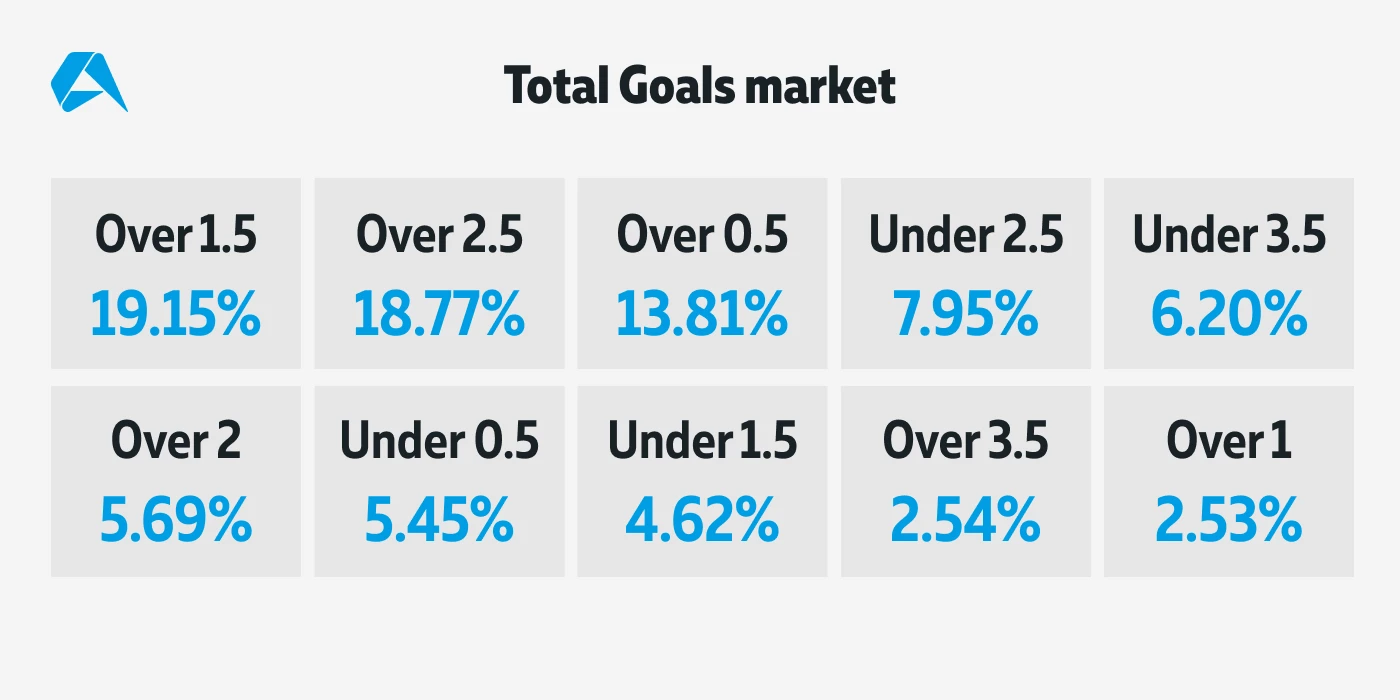
Within the Total Goals market, the most popular selection was “Over 1.5” (two or more goals). “Over 2.5” was the second most popular pick at 18.77%, while “Over 0.5” accounted for a further 13.81%.
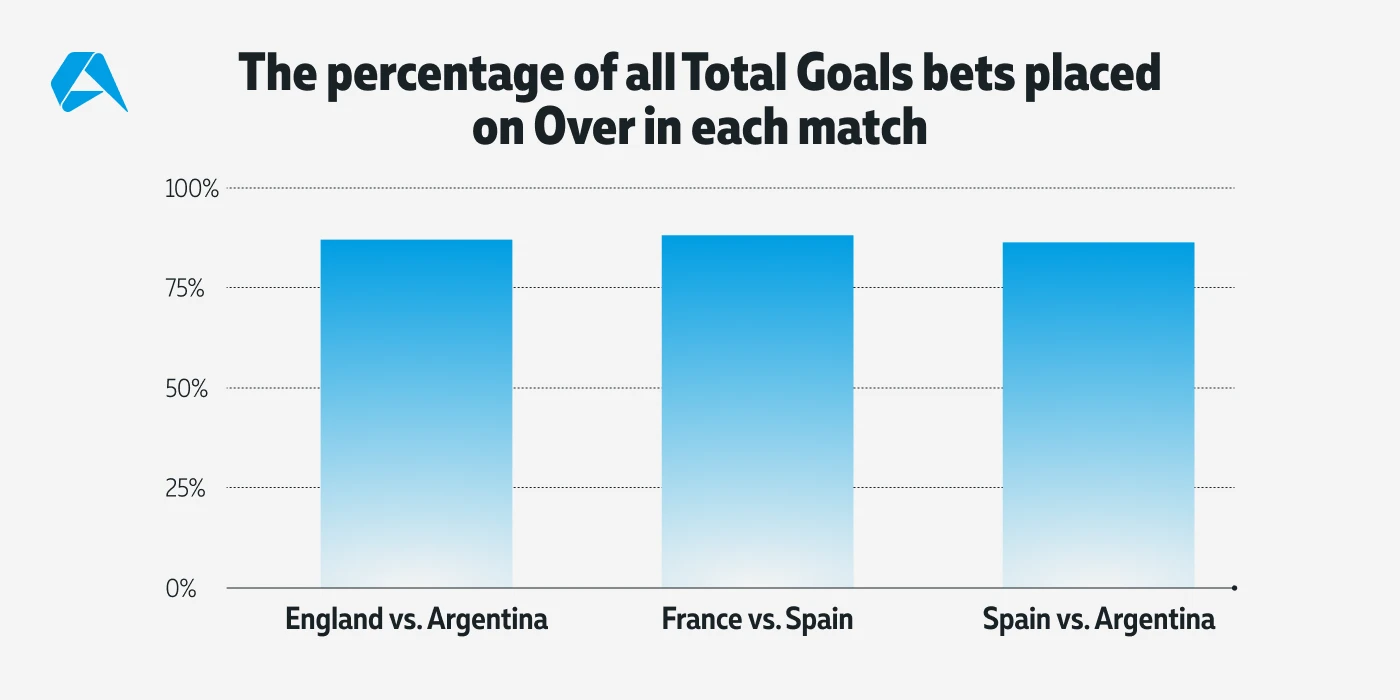
If we also include data from the World Cup semi-final matches, the figures show the following trend: 87% of all bets on total goals markets were placed on Over.
The percentage of all Total Goals bets placed on Over in each match was as follows:
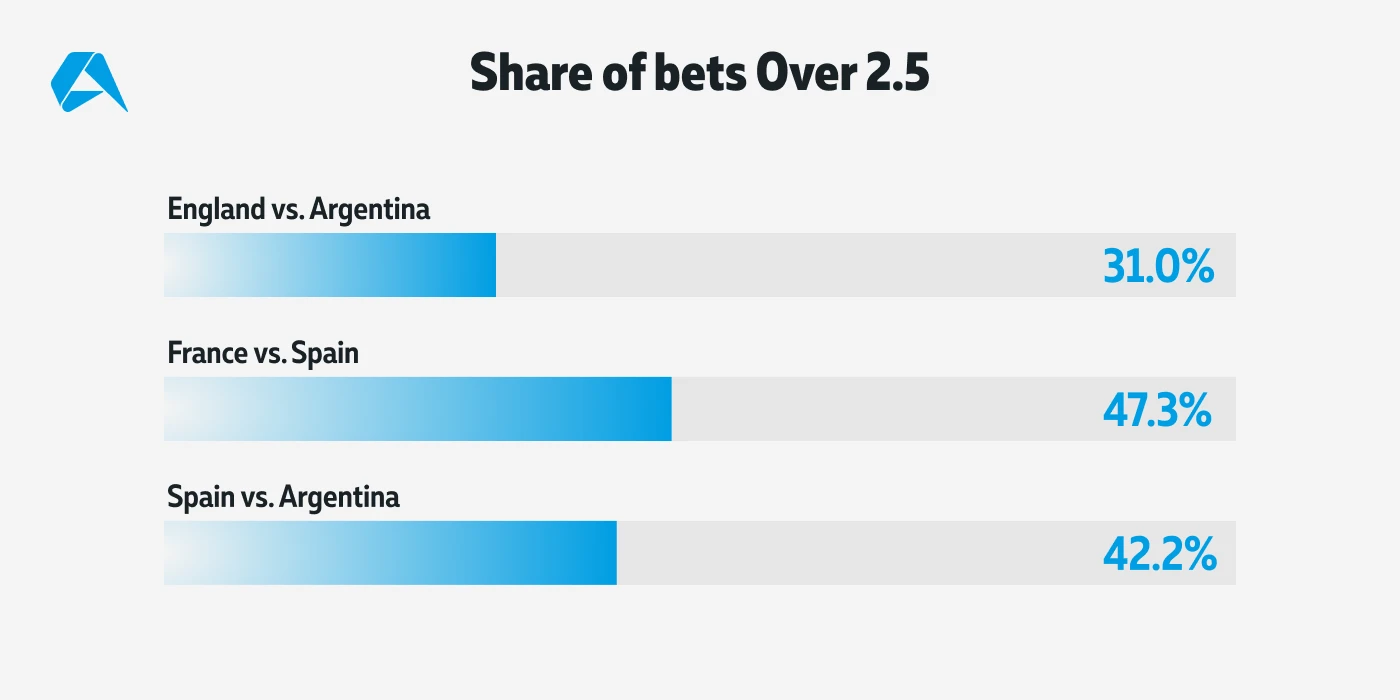
Over 2.5 accounted for 31% of all Total Goals bets in the England vs Argentina match and 47.3% in the France vs Spain match.
Share of bets “over 2.5”
Another interesting tendency – the average stake on "Total Under" is twice as large as the stake on "Total Over."
This may suggest that bettors who choose the “Under” market tend to place larger individual stakes, potentially reflecting a more calculated approach or greater confidence in their predictions. This also supports the expert’s observation that “Under” betting can be associated with more professional money.
When the biggest games follow and do not follow the expectations
The opening match day of the 2026/27 Champions League provides a good example of why “Over 2.5” remains such an attractive market for football bettors. 13 of the 18 matches produced at least three goals, meaning the Over 2.5 line was met in 72.2% of games.
But what about other major tournaments and big finals?
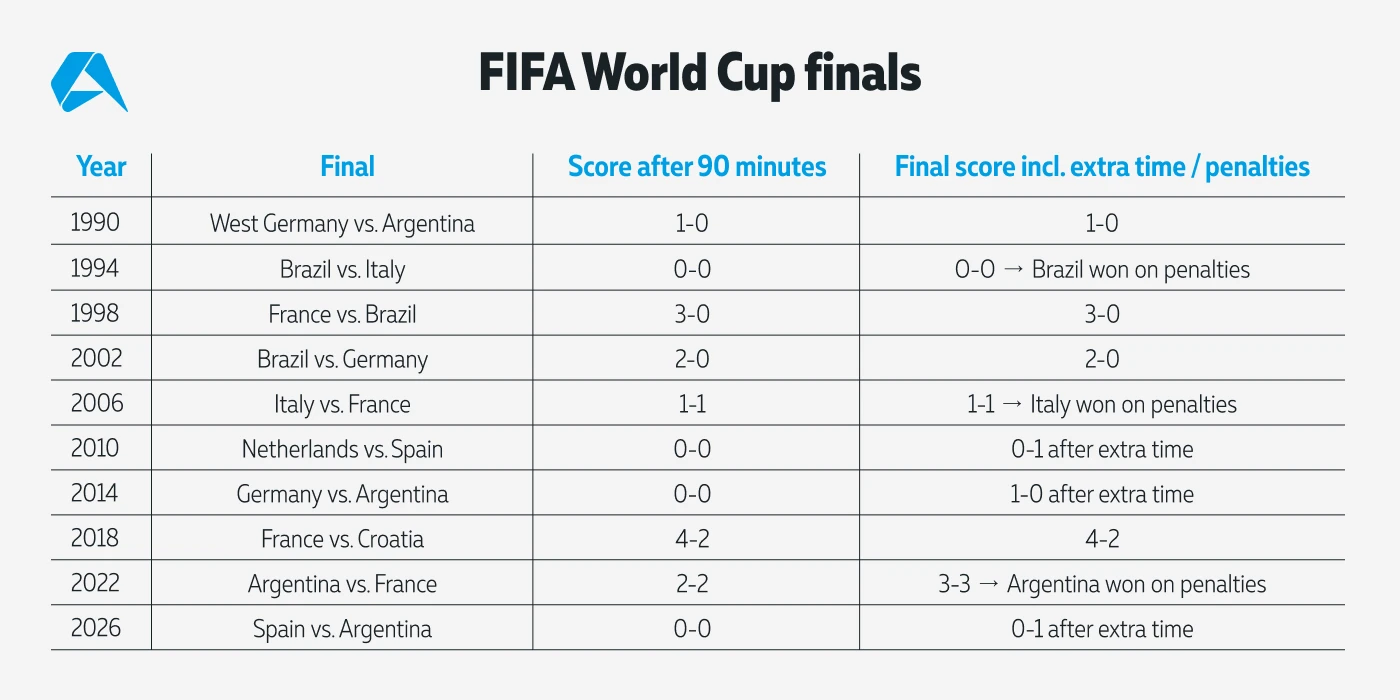
Looking at the 10 most recent FIFA World Cup finals, from 1990 to 2026, the picture is much less goal-heavy. – Only 3 of the 10 last FIFA World Cup finals (30%) finished with “over 2.5”: 3+ goals were scored in 1998, 2018 and 2022.
The same question can be taken to another major international tournament.
Looking at the five most recent EURO finals, from 2008 to 2024, only two reached 3+ goals, 40% of the final matches.
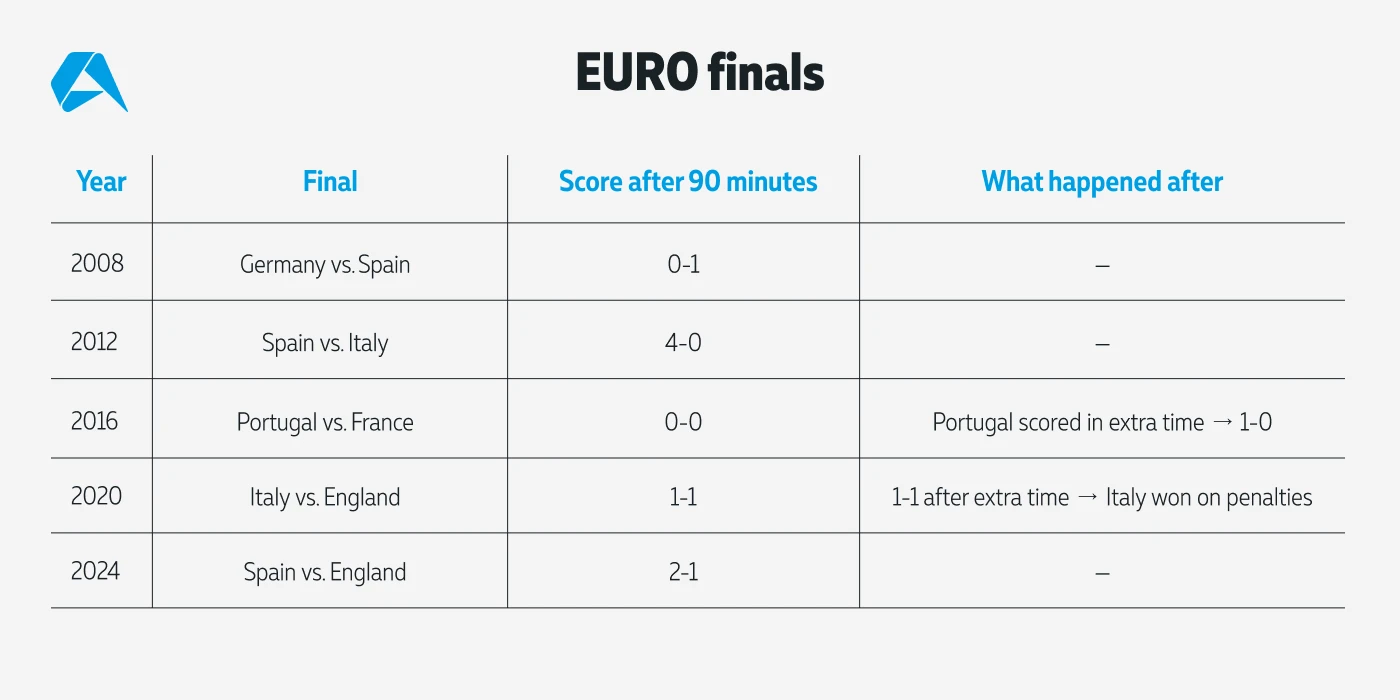
So a major football final may feel like the perfect setting for a high-scoring spectacle, but the actual scoreline can be much more restrained.
Instinct or information?
This is where the difference between an emotional prediction and an informed decision becomes interesting.
Football is full of instinct. A fan may remember a team's last spectacular performance, expect two attacking sides to produce an open game, or simply have a feeling that “there will be goals”.
At the same time, modern sportsbook experiences give players access to considerably more information before making a decision. Recent team results, scoring records and previous performances can provide additional context alongside a fan's own view of the match.
At Altenar, the sportsbook includes Team Performance functionality, allowing users to review how teams have performed in previous matches. Rather than replacing intuition, this type of information gives players another source of context to consider.
That creates an interesting question: can sportsbooks help move football betting from a purely emotional prediction towards a more informed decision?