

What Every Operator Should Know Before Signing a Deal
Launching a sportsbook is one of those ventures that can feel both exciting and overwhelming at the same time. We have the vision of that platform live, providing odds, taking bets, and competing from day one. But the route to get there is not always obvious. Do you build, borrow, or buy?
Among the options, turnkey solutions stand out by offering the quick launch of a competitive, market-ready product, without the heavy groundwork usually required.
But before you decide, it’s worth looking closer at what a turnkey sportsbook really is, and what it can (and can’t) do for your business.
What Is a Turnkey Sportsbook Platform?
If you’re exploring ways to launch a sportsbook, a turnkey solution is often the first model considered. It offers a fast route to market while still delivering a product that looks and feels competitive from day one. But what does that really mean, exactly?
A turnkey sportsbook is an iGaming business model that you can roll out and start running almost immediately.
Instead of piecing together dozens of moving parts, from payments and player accounts to betting markets, risk tools, and compliance systems, everything comes pre-assembled in a single package. Think of it like moving into a fully furnished apartment. The essentials are already in place, but you can still rearrange the furniture or add your own style.
For new operators, this means you don’t need an in-house tech team or months of development before taking bets. Compared to other models, turnkey gives you more control than a white-label brand, but without the heavy costs and complexity of building a platform entirely from scratch.
Competitive Advantages of a Turnkey Setup
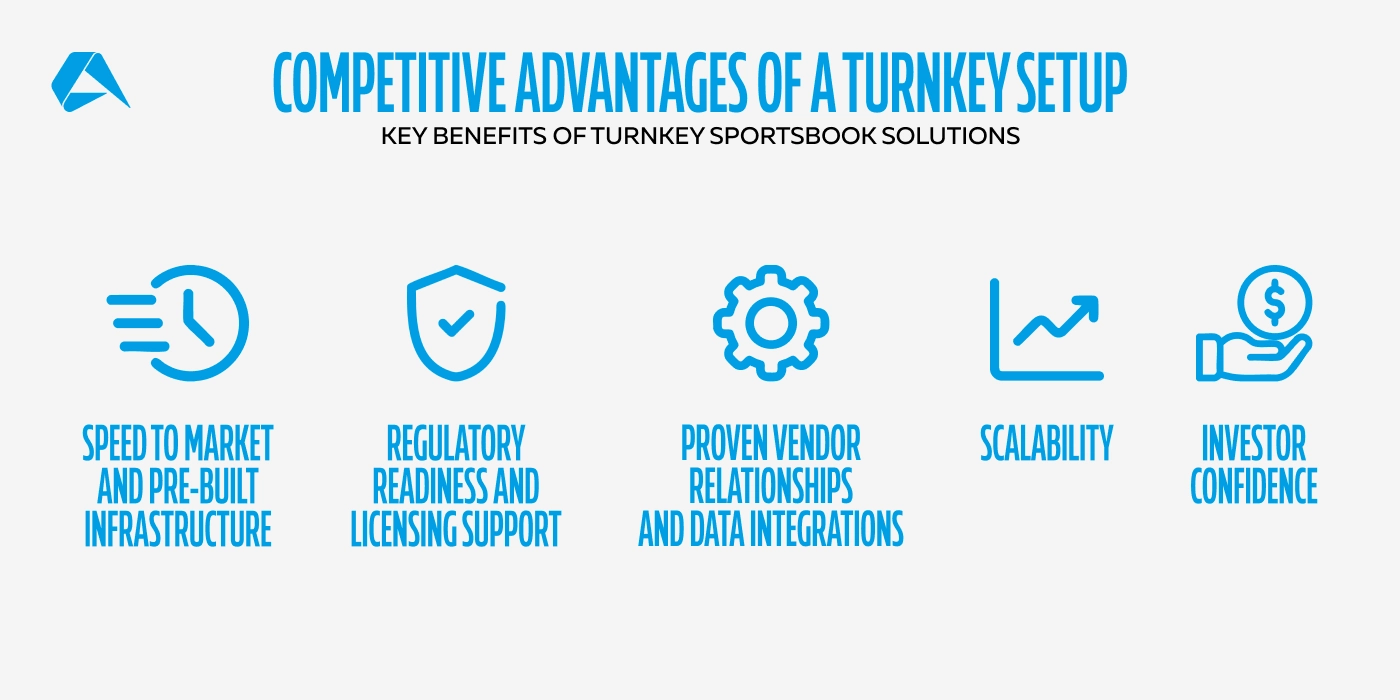
The appeal of turnkey isn’t just speed, though that’s usually what draws operators in first. The real advantage lies in how much heavy lifting is already done for you. Entering a regulated market means grappling with compliance, payments, player security, and reliable data feeds, each a potential pitfall if you try to assemble alone. A turnkey solution brings these elements together in a tried-and-tested model, providing the springboard for trust, reliability and scalable growth.
For new operators, that foundation is the difference between launching quickly and spending months working through technical or legal setbacks. For established brands, turnkey solutions can provide a way to expand into new jurisdictions with reduced overhead and fewer constraints, building on a proven structure that has already demonstrated its effectiveness.
Speed to Market and Pre-Built Infrastructure
With the core technology already integrated - odds feeds, payments, PAM, risk tools, etc - you can launch in weeks instead of months. The platform has already been stress-tested, which avoids the costly trial-and-error stage of building from scratch.
Regulatory Readiness and Licensing Support
Turnkey providers typically operate across multiple jurisdictions, ensuring that compliance modules, reporting tools, and responsible gaming features are already in place. This shortens the path to regulatory approval and reduces the risk of costly delays.
Proven Vendor Relationships and Data Integrations
Official data rights, payment gateways, and casino partnerships don’t have to be negotiated individually. A turnkey setup gives you access to established vendor pipelines, often at better rates and with stronger SLAs than you could secure independently.
Scalability
Because the platform is built on established architecture, you can expand into new markets, add retail channels, or increase betting volumes without needing to rebuild the core system. This avoids the ‘teardown and rebuild’ problem that haunts early-stage operators.
Investor Confidence
From a funding perspective, a turnkey sportsbook demonstrates immediate operational credibility. Investors and partners see a regulated, functioning product, not a long-term development project with uncertain timelines.
Key Benefits of Turnkey Sportsbook Solutions
✔ Rapid launch with pre-built core infrastructure.
✔ Faster entry into regulated markets.
✔ Integrated compliance and responsible gaming tools.
✔ Pre-integrated payment gateways (cards, wallets, crypto).
✔ Access to official data and odds feeds.
✔ Built-in risk and trading management support.
✔ Scalable architecture for new markets or channels.
✔ Centralised back office and reporting tools.
✔ Multi-currency and multi-language capabilities included.
✔ Flexible front-end design and branding options.
✔ Casino and third-party integrations.
✔ Built-in promotional tools (bonuses, boosts).
✔ Channel readiness across online, mobile, and retail.
✔ Tested security frameworks and audit readiness.
✔ Immediate access to player behaviour insights (via PAM/CRM).
✔ Stronger investor and regulator confidence from launch.
✔ 24/7 technical and operational provider support.
The Drawbacks Operators Need to Weigh Up
Turnkey sportsbook platforms solve many early challenges, but they aren’t without their drawbacks. The very features that make them attractive, such as speed, completeness, and pre-built systems, can also create limits over time. Operators weighing up a turnkey solution must look beyond launch day and ask how much flexibility they’ll want in two, five, or 10 years from now.
Ultimately, the main trade-offs tend to fall into three areas, namely product ownership, long-term costs, and dependency on the supplier’s technology and direction of development. None of these are deal-breakers on their own, but together they influence how much strategic control you truly have.
Limited Flexibility
With core architecture already set, certain features, designs, or betting options can only be altered within the boundaries the provider allows. This can restrict how differentiated your brand feels in competitive markets.
Long-Term Costs
Lower upfront costs often come with revenue-share agreements or ongoing licence fees. Over time, these can add up to more than the initial savings, particularly if your brand experiences rapid growth and transaction volumes increase significantly.
Dependence on Vendor Technology and Innovation Cycles
With turnkey solutions, your supplier primarily dictates the pace of innovation. If they prioritise features for other clients or move slowly, you may lag behind competitors who build or integrate new functionality on their own timeline.
Migration and Exit Challenges
Moving away from a turnkey provider is rarely a simple process. Your player data, integrations, and systems may be deeply embedded in proprietary technology, making migration costly, time-consuming, and potentially disruptive to your players.
Key Drawbacks of Turnkey Sportsbook Solutions
X Limited freedom to fully customise product features.
X Ongoing revenue-share or licence costs can mount.
X Reliance on the supplier’s technology and development cycle.
X Slower access to niche or emerging features.
X Migration to another platform can be complex.
X Brand differentiation may be more complex in crowded markets.
X Less direct control over vendor contracts and SLAs.
X In-house expertise may develop more slowly than with self-build.
Other Market Entry Options
Turnkey is a strong route to market, but it’s not the only one. Operators exploring their first sportsbook, or looking to diversify, typically weigh three other approaches. These are white-label setups, sportsbook modules, and self-build platforms. Each comes with a different balance of cost, control, and speed. An understanding of these differences helps clarify why turnkey is often chosen as the middle ground, and whether it is the right direction for your ambition.
White-Label Solutions
The fastest and lowest-cost way to enter sports betting. With a white-label sportsbook, you generally operate under your provider’s licence, using their payments, compliance framework, and trading expertise. This removes most of the operational pressures and allows you to focus almost entirely on marketing and player acquisition. For startups, it’s a straightforward way to test the waters and get started in a regulated market with minimal risk.
The downside is autonomy. Your platform is largely locked to the provider’s design, data, and tech stack, which makes it difficult to carve out a unique brand identity. Transitioning away later is possible but usually disruptive, so white label tends to suit those prioritising speed over long-term profit and independence.
Sportsbook Modules
A middle-ground option for operators who already have a working platform, such as a casino with its own PAM or front end, but want to add sports betting to the mix. Modular sportsbook platforms allow you to plug a sportsbook into your existing stack, providing access to odds, markets, and trading, among other features, without the need to rebuild your current infrastructure.
This approach can be cost-efficient for operators expanding into new verticals, as it leverages what you already have in place. But it’s not a full-stack solution. You’re still responsible for integrations, compliance, and scaling your existing systems to handle the demands of sports betting. Modules provide flexibility, but the complexity of stitching everything together should not be underestimated.
Self-Build Development
| Model | Time to Market | Cost (Broad Estimate) | Control & Customisation | Compliance Readiness | Scalability |
|---|---|---|---|---|---|
| White Label | Fastest 2–6 weeks | Low €25k–€50k setup | Minimal branding and limited features | Fully handled by the provider | Limited Bound to provider licence and systems |
| Turnkey | Fast 6–16 weeks | Medium €100k–€500k+ | High within the provider’s architecture | Pre- integrated for multiple markets | Strong Can add channels, markets, and higher volumes |
| Module | Moderate 3–9 months | Medium to high €250k–€1m+ | Flexible sportsbook bolted to existing stack | The operator must integrate compliance | Moderate Reliant on the core platform |
| Self- Build | Slow 12–24 months | High €1.5m+ plus staffing | Maximumfull ownership and control | Built entirely in-house | Unlimited If resourced. Requires heavy investment |
This is the most ambitious and resource-intensive option. A self-build gives you complete ownership and control, from selecting every vendor and data feed to building compliance systems, payment integrations, and in-house front-end design. For large operators with deep pockets and strong technical teams, it’s a way to create a unique product that reflects their exact vision.
However, this freedom comes at a price. Higher upfront investment, longer timeframes (often a year or more to launch), and the constant demands of maintaining compliance across markets. It also requires large, highly-skilled development and operations teams. For these reasons and more, self-build is the route for established companies aiming for maximum independence, but it’s rarely practical for newcomers.
Key Considerations to Think About Before Choosing a Turnkey Option
Choosing a path to market is not a decision to take lightly. The right choice often depends on far more than speed or cost. It determines how much control you’ll retain, how easily you can scale when expansion is needed, and whether your platform can withstand the pressure of the fast-changing iGaming environment.
Turnkey can be the perfect model for some, but operators who succeed are typically those who go in with a clear understanding of its hidden complexities and long-term implications.
Cost Structures and Hidden Fees
While it is true that turnkey solutions reduce upfront spending, operators would be wise to look beyond the initial headline figures. Pricing often includes setup costs, recurring licence fees, and revenue shares, which can rise sharply as volumes grow. Some providers bundle third-party data feeds or payment gateways into their packages, while others charge additional fees for these integrations.
Similarly, compliance updates, regulatory reporting, or premium risk management can sometimes carry additional surcharges. Over a five to 10-year period, these incremental costs can have a sizable impact on margins.
Key Suggestion: Demand clarity early from your intended supplier, breaking down the ‘all-in’ pricing against projected revenues. Doing so avoids surprises and ensures the turnkey model remains sustainable as the business matures.
Regulatory and Compliance Readiness
Operating in iGaming means working within constantly evolving rules. A turnkey provider may include responsible gaming tools, reporting dashboards, and jurisdictional templates. However, it's the operators themselves who must ensure that these are genuinely aligned with their target markets. What works in Europe, for instance, may not meet the standards of regulators in Latin America or Asia.
Similarly, localised data storage, identity verification processes, and anti-money laundering protocols can all vary widely, and gaps in coverage can delay licensing or expose operators to penalties. Advanced software providers maintain dedicated compliance teams that track multiple regions and update frameworks proactively.
Key Suggestion: Operators should not only interrogate the features available today, but also the provider’s track record in keeping clients ahead of regulatory changes.
Scalability and Exit Strategy
The real test of a turnkey solution often comes years after launch. While most platforms can handle steady growth, ambitious operators quickly discover the importance of flexible scaling. Can the system accommodate multiple brands under one licence? Does it expand easily into retail or cross-border markets?
And just as important is the exit strategy. If you decide to move away from turnkey, will you retain full access to your player data, integrations, and custom work? Some providers make migration difficult, locking operators into proprietary systems that can be challenging to transition from. Others take a partnership approach, ensuring clients can transition to hybrid or self-build models without disruption.
Key Suggestion: Before committing to a turnkey contract, ask the provider tough questions about scale, data ownership, and exit conditions. The answers will reveal whether a provider is truly a partner for long-term growth.
10 Tough Questions Every Operator Should Ask
No two turnkey providers are the same, and the contract you sign will define the limits of your business for years to come. The most astute operators are those who probe beneath the sales pitch, asking questions that reveal the actual costs, flexibility, and long-term viability. Before making any commitment, put these essential questions on the table:
What is the full breakdown of costs, including hidden fees?
How is player data stored, and who owns it?
Which jurisdictions does your compliance framework support?
How often are compliance tools updated to reflect new regulations?
Can the platform scale across multiple brands or licences?
What restrictions exist on customising features or front-end design?
How are third-party integrations (payments, data feeds) managed?
What is your process for migrating data if we leave?
How quickly do you typically deploy new features or updates?
What contractual exit terms and notice periods apply?
Turnkey Solution Backed by Proven Market Success
A good turnkey supplier should combine proven technology, broad regulatory credentials, and the kind of experience that reassures both investors and regulators. It’s not enough to provide software alone. The partner you choose should have a proven track record of operating in diverse markets, adapting to complex compliance requirements, and delivering platforms that remain stable under the pressure of growth.
Altenar’s turnkey sportsbook was built with these standards in mind. The solution provides a fully integrated stack that encompasses sportsbook, PAM, and payments, alongside premium official data feeds and advanced risk management tools. Operators also benefit from Altenar’s casino aggregation network, which offers more than 25,000 games from leading providers, as well as a customisable front end, bonus engine, and flexible content management that allow brands to shape their player experience without losing stability.
But Altenar’s value goes beyond technology. Operators align with a partner that offers 24/7 risk and trading support, continuous compliance monitoring across more than 30 regulated markets, and integrated CRM systems that improve retention and marketing efficiency. The result is a turnkey solution that not only gets you live quickly, but sustains your growth with operational expertise, regulatory confidence, and a product that can scale as far as your ambitions.
Key Strengths of Altenar’s Turnkey Sportsbook
-
Fully integrated sportsbook, PAM, and payment systems
-
Premium official data feeds with global sports coverage
-
25,000+ casino games from leading providers
-
Flexible, widget-based front-end design
-
Advanced bonus engine and promotional tools
-
Built-in CRM integration for smarter retention
-
24/7 trading and risk management support
-
Proven compliance across 30+ regulated markets
-
Scalable architecture for retail, online, and mobile
-
Continuous product innovation without disrupting operations
There’s a moment when planning ends and execution begins, and with the right turnkey partner, that moment can come sooner than you think. Schedule your Altenar turnkey sportsbook demo today to picture your brand live.