

You will rarely see this happen on an average Tuesday. Platforms go down on the nights that matter most. When millions of eyes are on a Champions League knockout, the Grand National is under way, or the Super Bowl is in full swing across the US. The recent January 2025 outage at Bet365 proved the point when cash-out stopped working during a packed European match night, leaving frustrated customers stuck in markets where timing is everything. Social media lit up, headlines followed, and a single technical failure undermined years of brand investment in less than an hour.
The problem isn’t just bad luck. It’s basic math. Peak betting moments can be brutal. At the 2024 Grand National, OpenBet recorded more than 100,000 bets per minute. That’s the difference between testing for ‘average day traffic’ and stress-testing for the busiest half-hour of the year. Systems buckle when caching isn’t pre-warmed, when non-core markets consume excessive processing power, or when load-balancing hasn’t been designed to handle sudden surges.
For industry operators transitioning from white label to turnkey or fully independent operations, this represents an unseen liability. Independence comes with a cost, and the price is proving your infrastructure won’t buckle in the few minutes that matter most.
Key Takeaway: Design for your busiest half-hour, not your average day. Pre-warm caches, throttle non-essential markets, and load-test to the breaking point, because that breaking point will come when you least want it to.
1. The Latency Budget in Live Betting
Sportsbook margins tend to be at their most fragile in live markets. And the reality of that is that even a one-second delay can be the difference between a trusted experience and a lost customer, particularly in a market where goals, points, and penalties move odds instantly. And let’s be blunt. Players generally don’t care why it happened. They just see that the odds changed before their bet went through.
Under the hood, that delay comes from what engineers call the latency chain. Data leaves the stadium, gets packaged by a feed provider, runs through trading algorithms, passes to the sportsbook platform, and finally reaches the player’s screen. Each step adds a few milliseconds. Add enough steps, or one slow link, and suddenly the whole system feels sluggish.
The challenge is greater now with ‘watch and bet’ products, where live video streams sit beside constantly updating odds. If the video and the odds aren’t in sync, trust evaporates.
Key Takeaway: Measure your end-to-end latency, from stadium to bet slip. Vendor benchmarks mean little if the customer still feels behind the game.
2. Payments That Don’t Lose You the Bet
Sportsbook payments look simple on the surface, yet keeping that flow smooth and dependable is more complicated than it appears. If a deposit fails at the wrong moment, the player walks. If a withdrawal drags, trust is questioned. Immediacy in this area is king, and payment issues are one of the fastest ways to lose lifetime value.
The problem is twofold - reliability and risk. Reliability comes down to having the right connections, multiple PSPs, intelligent routing, and fallback options so a card decline or a network problem doesn’t end the journey. Risk is the other side of the coin. High fraud rates mean operators juggle 3-D security, chargeback controls, and AML rules without significantly impacting conversion rates. It’s a fine balance.
Operators moving beyond white-label setups should understand that payments aren’t just a back-office function, but part of the product. The better they run, the more bets that get placed.
Key Takeaway: Treat payments like part of the front end. Automatic backup routes (failovers), fraud controls, and speed matter as much here as they do in your odds feed.
3. Keeping the Doors Open: Security, Outages, and Third-Party Risk
When a sportsbook experiences an outage, the cause isn’t always a coding error. In many instances, it can just as easily be an outside entity. Distributed denial-of-service (DDoS) attacks are a constant threat in this sector, and they’ve only grown in scale. Some now reach multiple terabits per second, which is enough to swamp global cloud providers. Without proper mitigation, this kind of event can knock your platform offline on the busiest Saturday of the year.
But cyberattacks aren’t the only danger. Third-party outages can be just as damaging. Consider the core suppliers that every operator relies on for essential services, including data feeds, identity verification, payment processors, and cloud hosting for iGaming operators. If one of them fails, the impact ripples straight through to your front end. The 2024 global IT outage, which halted IT services across multiple industries, served as a reminder that stability isn’t just about your own stack, but the partners you choose and how well you’ve prepared for their vulnerable moments.
Operators transitioning from white-label setups to greater independence quickly discover that security and resilience are integral to the product. Because to the frustrated bettor, there’s only one responsible party, and that’s the brand they logged into.
Key Takeaway: Run outage drills the way you’d run fire drills. Assume a provider will fail, and design your systems so players barely notice when it happens.
4. Suspicious Bets Travel Faster Than You Think
It doesn’t take a high-profile match-fixing scandal to impact your brand. A handful of unusual bets landing at the same time on a second-tier market can be just as damaging if your systems miss it. By the time the anomaly is noticed, the money’s out the door, and regulators could be asking questions.
In 2024, the International Betting Integrity Association logged 219 alerts worldwide. Most weren’t glamorous scandals, but relatively small spikes that pointed to manipulation or misuse of insider data. These aren’t problems a human trader can spot in the moment. They happen too fast, and too often.
That’s why the smart operators build integrity into the platform itself. Automated alerts flag suspicious patterns within seconds, and trading tools help teams focus on the few signals that matter to protect your margin, reassure regulators and partners.
Key Takeaway: Treat integrity like your fire alarm. Unnoticed when quiet, invaluable when it saves you from a blaze.
5. Geolocation, Compliance, and Identity at Scale
Super Bowl LVIII wasn’t just a test of the players on the field. In many ways, it was a stress test for the industry’s compliance tech. GeoComply processed 122 million location checks that weekend, peaking at nearly 15,000 per second. That’s what scale looks like in practice, with thousands of logins, deposits, and bets all being verified in real time, with regulators watching closely.
For operators, the risks are twofold. First is geolocation itself. VPN spoofing, cross-border play, and device tampering are constant threats. If your defences aren’t solid, a regulatory breach can put a licence at risk. Second is identity and KYC/AML. Fraudsters now use deepfakes and scripted onboarding attempts to sneak through weak controls. What used to be a document upload and a selfie has become a sophisticated arms race in recent years.
White-label operators often don’t see the moving parts because providers handle them. But once you step up to turnkey, API, or independent setups, the responsibility lands squarely on your platform. That means more than just picking a vendor. It invariably means load-testing compliance systems the same way you load-test your sportsbook. If identity verification slows to a crawl on game day, or if location checks block legitimate players, the effect arrives at once. Fewer wagers are placed, and there is a reduced belief in your brand.
Key Takeaway: Treat compliance controls like part of the front end. If players can’t get through quickly and securely, nothing else in your platform matters.
6. Build to the Standard: GLI-33 as an Operator’s Checklist
Every regulated sportsbook, regardless of the market, ultimately faces the same expectation, and that is to prove that its platform is fair, accurate, and secure. For most regulators, that proof comes back to the GLI-33 standard, a technical blueprint that covers everything from event logging to settlement integrity.
On paper, GLI-33 looks heavy. In practice, however, it can be translated into a straightforward operator’s checklist. Do you have a process that records and approves every code change so nothing slips in unnoticed? Are your settlement processes accurate and auditable down to the last cent? Can your logs show regulators who did what, and when? These are more than compliance checks. They’re the systems that protect you when something goes wrong and you need to show evidence fast.
Operators moving from white-label setups to more independent models quickly find that GLI-33 is more than a document but a system to apply daily. Treat it that way, and you’ll be better prepared when regulators, auditors, or partners come calling.
Key Takeaway: Turn GLI-33 into a living checklist. If your team can’t tick it daily, you’re leaving blind spots that regulators will find first.
The 90-Day Operator Survival Guide
The first few months after stepping away from a white label should be focused less on growth and more on survival. We’re keeping the lights on. Outages, sluggish feeds, broken payments, compliance checks that falter under pressure, and the moment you launch, the risks on paper become real.
The aim of the first 90 days after launching your new platform isn’t to build the perfect system, or even to grow profit. From a technical perspective, it’s about ensuring the foundations are solid enough to withstand the moments that matter. That means pressure-testing what you’ve already got and plugging the most obvious weaknesses in your systems. Ultimately, you need to prove, even if it is just to yourself, that your platform won’t fold the first time traffic spikes.
Think of it as survival work. It’s not glamorous, but essential, and sometimes the difference between an operator that is well positioned to move on to the next stage (growth or otherwise), and one that spends its first quarter apologising to players and regulators. The tasks ahead aren’t complicated, but they are core to a strong technical foundation.
Key Takeaway: Start small but start now—every month without a plan raises the odds the next outage is yours.
The 90-Day General Checklist
-
Run a chaos test
Don’t wait for a live outage to learn how your system reacts. Simulate failure by killing a server, overloading a feed, and observing the consequences. Then fix it.
-
Audit your latency chain
Time how long data takes to travel from a live event to screen. If one link is slowing the odds, trim it. Milliseconds in live betting are worth more than hours in planning meetings.
-
Put a PSP fallback plan in place
One payment provider going down shouldn’t stall deposits. Map out your backup routes so the money keeps moving even when a processor falters.
-
Tabletop a DDoS attack
Walk through what happens if a flood of traffic hits your platform. Who calls whom, which system kicks in, and how do you tell players? Rehearse it before it’s real.
-
Do a GLI-33 gap check
Use the standard as a mirror. Are your logs complete? Are changes tracked? Is settlement airtight? Tick what you can, flag what you can’t, and close the gaps fast.
GLI-33 Gap Check Form For Operators
Expanding on the above, this GLI-33 gap check form turns complex standards into a simple daily tool, helping operators spot weaknesses before regulators or outages do.
Section 1: Change Control
All code changes logged and approved before deployment
Emergency changes documented and reviewed within 24 hours
Version control system in place and accessible to auditors
Section 2: Logging & Monitoring
All priority events (logins, wagers, settlements) logged with timestamps
Logs stored securely and tamper-proof
Regular log reviews carried out and documented
Section 3: Settlement Integrity
Settlement rules consistent with published odds
Manual overrides flagged and reviewed
Random checks confirm settlement accuracy
Section 4: Security & Access
Role-based access controls implemented
Admin activity tracked and auditable
Password and credential policies enforced
Section 5: System Availability
Backup and disaster recovery procedures tested (last 6 months)
Redundancy documented for all essential services
Incident response plan reviewed with staff
Section 6: Compliance Evidence
Audit trail available for last 12 months
Key documents (policies, procedures) up to date
Training records for staff maintained and accessible
From White Label to Independence: How Altenar Supports the Journey
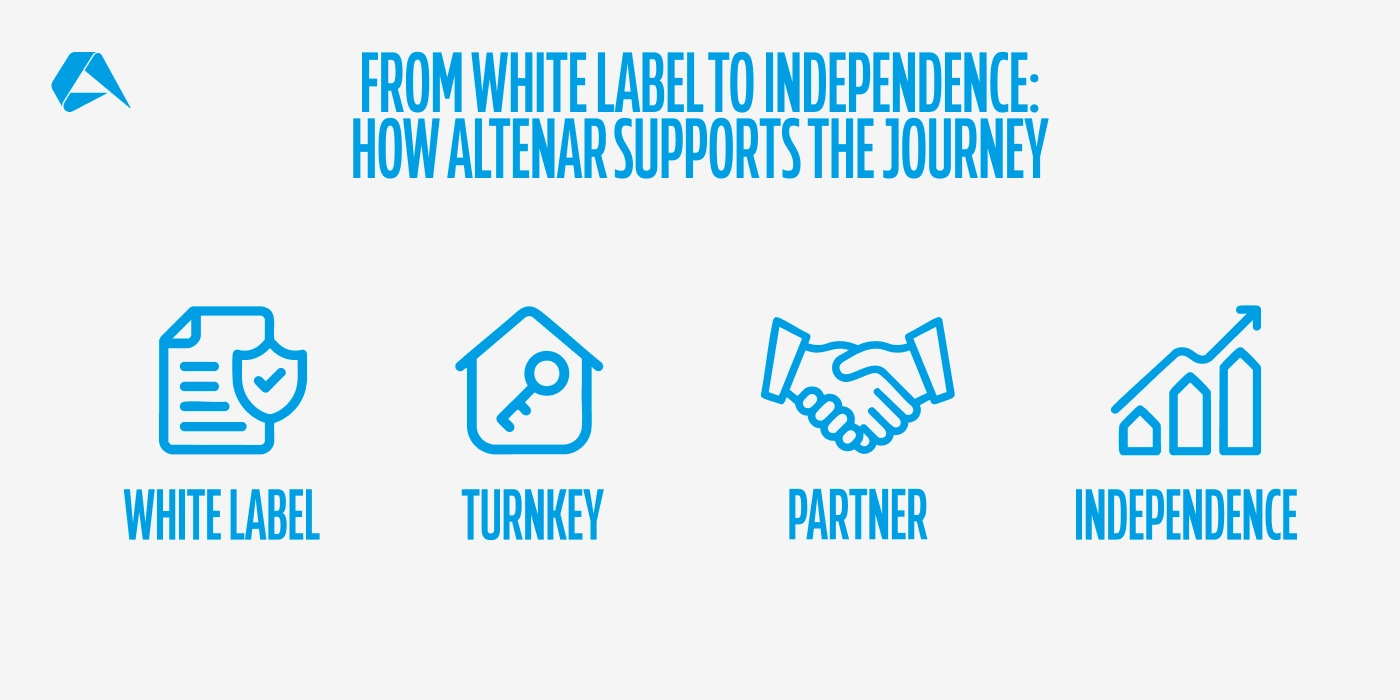
For industry operators, the transition from white label to turnkey or complete independence often marks the point at which technical challenges become a reality. Payments, latency, compliance, and platform stability are no longer abstract risks. They’re part of the daily business of running a sportsbook. The difference between the success and failure of such a move usually comes down to preparation, and often, choosing a partner that’s been there before.
At Altenar, we’ve built our reputation on guiding operators through that exact journey. Many start with our white-label solution, gaining a safe foundation for growth, before transitioning to turnkey, modular, or API-driven setups. Each step is supported by our experience in helping operators stress-test infrastructure, streamline payments, and harden compliance systems against real-world pressure. Our GLI-33 certification underlines that we meet the most demanding technical and regulatory standards, and we continue to invest in ensuring our platforms remain reliable under demanding conditions.
Operators don’t have to take on these challenges alone. With the right partner, the path from white label to independence can be managed, not feared.
Scaling a sportsbook should never be about guesswork. Schedule a call with Altenar’s experts today and explore how we support operators through every stage of your journey, from white label beginnings to fully independent operations.