
Sportsbooks used to win on margins, bonuses, and brand alone. And that still matters. But where these elements would once (when done well) put you in the premier league of sportsbooks, the playing field has changed in recent years. Today, the user experience (UX) is where operators will rise or fall.
The New UX Battleground in Sports Betting
The above statement sounds dramatic, but let’s look at the facts. We know from statistics that a bettor who can’t find the market they want in two taps simply won’t hang around anymore. Someone who experiences lag on a live bet will take their money elsewhere. At the same time, platforms that feel intuitive and, above all, personalised, create a stickiness that even the best odds can’t buy.
So what does this all mean? It means that the industry is moving beyond functional design. UX is no longer a final coat of paint but the foundation on which engagement and retention are built. And the competition is heating up. Currently, sportsbook brands are starting to integrate live betting flows, modular front ends, and personalised feeds, aiming to do so faster than their rivals.
That’s why this moment feels like a battleground. What once felt like fine-tuning is becoming an expectation. The ultimate challenge for industry operators is not only keeping pace with what bettors expect today but acknowledging current trends that will define the sportsbook experience tomorrow.
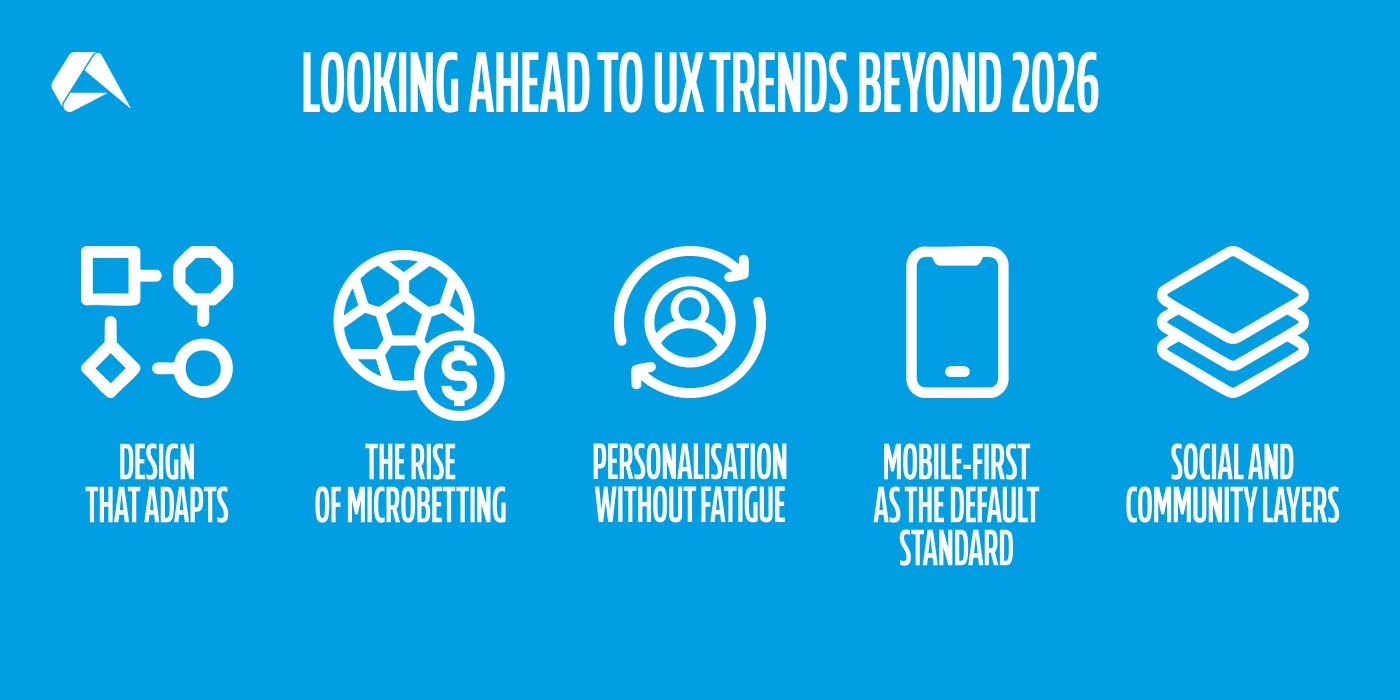
Here are the current UX trends that operators should watch moving into 2026:
Design That Adapts
Sportsbook design has outgrown the idea of ‘making things look sleek’. The measure now is whether a platform adapts across markets, devices, and moments of play.
Modular and Market-Specific Layouts
In 2025, operators are thinking beyond rigid sportsbook templates, even if they are regionally adapted, in favour of modular front ends that can alter depending on who’s logging in and where. A bettor in Brazil, for example, might see a football-first homepage with quick links to local leagues, while a bettor in Japan is guided straight into baseball and esports. The architecture behind these layouts is what really matters; APIs and widgets that can be swapped in and out without rebuilding the whole system. It’s the kind of flexibility that localises the experience and future-proofs the platform.
Micro-Interactions and Visual Cues
The minor details of sportsbook design now have greater influence. This can be seen in odds that animate when markets change. Bet slips that provide instant feedback upon tapping. Subtle transitions that reassure users their wagers have been placed in real time. These micro-interactions keep bettors informed without overwhelming them. And in the growing environment of live betting, visual cues become the signals bettors rely on in high-pressure moments.
The bigger picture is that sportsbook design is no longer generic. It is built around the bettor rather than expecting the bettor to adapt to the platform.
The Rise of Microbetting
Microbetting has moved from a nice-to-have to the mainstream, and in doing so, it is reshaping how sportsbooks are built. The speed and frequency of in-play wagers mean the user experience must work under pressure.
Designing for Speed and Latency
In a microbetting environment, seconds matter. Bettors expect odds to update instantly and wagers to be confirmed without delay. Anything else risks player frustration and bet abandonment. For these reasons, interfaces are being stripped back to allow one-tap bet placement, with bet slips and payment flows integrated into the live screen.
Microbetting as a UX Stress Test
Stress testing in a microbetting environment exposes weak design choices. Offering too many markets at once overwhelms the user, while poorly structured layouts make it hard to find the right option in time. Current trends prioritise clarity, bringing the most relevant bets to the forefront quickly and presenting them in a way that allows bettors to act without hesitation.
Personalisation Without Fatigue
While it is generally true that today’s bettors want platforms that recognise their interests and bring to the forefront preferred markets, we should also acknowledge that they are quick to switch off when the experience feels intrusive or repetitive.
AI as a Subtle UX Layer
From suggested markets to notifications timed around bettor activity, machine learning now drives tailored recommendations. The best AI/CRM systems serve content that feels highly relevant to the bettor, and work at their best when they blend into the experience rather than dominate it.
The Fine Line Between Relevance and Noise
Furthermore, overuse of targeted offers risks damaging trust because too many prompts can feel more like spam than service. Recent trends show operators focusing on restraint, using data to identify when to push information and when to hold back. The emphasis is on reducing clutter while maintaining relevance.
The key takeaway is this. Personalisation should simplify the betting journey, not add extra layers of distraction.
Mobile-First as the Default Standard
It’s no secret that mobile phones have overtaken desktops as the main entry point for placing bets and playing casino games worldwide, particularly for live real-time betting action. So it should come as no surprise that modern platforms are now built for speed, one-handed use, and straightforward navigation on smaller screens.
Is Desktop the Add-On Now?
In practice, mobile-first means features are designed for swipes and taps, not clicks. Interfaces that still prioritise desktop behaviours are in danger of frustrating the majority of bettors who expect an intuitive experience from their phones. For sportsbooks, the challenge now is not to remove desktop entirely, but to ensure it supports the mobile experience rather than the other way around.
Designing for Low-Bandwidth Realities
However, not all users enjoy perfect connectivity. Indeed, in many regions, 4G or unstable Wi-Fi connections are still the norm. Current solutions focus on lightweight builds that load quickly and can run reliably in lower bandwidth environments. Operators are also exploring offline caching and simplified versions of key features to retain the attention of bettors when connections drop.
Social and Community Layers
Sports betting has not always been social. For much of its history, sports wagers were typically placed in private and only acknowledged in moments of triumph. That’s to say, when a big win occurred. But in 2025, current trends suggest sports betting is no longer always a solitary activity.
In response to this, many platforms are experimenting with features that add a sense of community, competition, and shared experience. These elements can increase retention, but they must be applied carefully to avoid crossing the line into distraction or overuse.
Gamification Done Right
Leaderboards, challenges, and reward systems are now common additions, yet not all implementations succeed. The most effective versions motivate without overwhelming, aiming to provide small, purposeful nudges that create a sense of progress. Poorly designed gamification, on the other hand, can feel juvenile or manipulative, undermining credibility instead of building it.
Social Betting and Shared Experiences
Going beyond the social layer, some operators are testing group betting pools, live chats, and features that display what friends or fellow bettors are wagering on. These additions create energy and a sense of belonging, particularly in markets such as Latin America, where social play resonates strongly. Still, such initiatives must respect boundaries. Transparency about wagers and outcomes is valuable, but users also expect privacy and control over what they share.
The broader trend is apparent. Social and gamified features are being worked into sportsbooks to create stickier experiences. To succeed in this area, operators must strike a balance between community and control, offering interaction without pressure.
Looking Ahead to UX Trends Beyond 2026
The features discussed above that are shaping today’s sportsbooks reflect immediate expectations. Beyond this, a new wave of technology is emerging that could redefine how bettors interact with platforms within the next decade. Many tools are still developing, but their direction and impact are already clear to see:
5G/6G and Latency-Free Experiences
The ongoing rollout of 5G has already raised expectations for speed and reliability, and its impact on live betting will be of considerable benefit for user experiences in iGaming. Clearly, faster connections enable richer live streams and instant market updates, all without lag disrupting the moment.
Looking further ahead, the promise of 6G is even more ambitious. Concepts such as the ‘tactile internet’ could open new ground, enabling interactions that feel immediate and physical. For sportsbooks, that could mean interfaces where odds update in near real time and bet confirmations feel instantaneous. These days, the conversation is less about whether these networks arrive but more about how operators adapt their platforms to take advantage of them without leaving behind users still on weaker connections.
Voice and Agentic AI Interfaces
Voice command is becoming a serious consideration for sportsbook design. The ability to place a wager by saying, ‘Bet €10 on the under,’ turns what used to be a multi-step process into a single action. Combined with agentic AI, these systems are evolving from simple assistants into tools that act on intent, confirm transactions, and even anticipate user needs.
Significantly, this technology is not only about speed. It also has potential for responsible play, with AI capable of issuing real-time nudges if behaviour suggests risk, or those such as chasing losses. Such innovation will give bettors more control with less effort while providing operators with an easier path to the management of compliance obligations.
Community and Creator-Driven Systems
The next stage of social betting is expected to evolve from group pools and leaderboards to betting systems led by communities and content creators. For instance, shared microbet pools tied to fan groups, creator-led commentary, and influencer-driven markets are already starting to appear. Ultimately, this trend extends the reach of sportsbooks into areas once considered niche. Women’s sports, esports communities, and smaller competitions are gaining visibility, fuelled by creators who bring their audiences with them.
Looking ahead, these models could redefine loyalty by tying betting experiences more closely to the communities where fans already spend their time. For operators, the challenge may soon be about how to nurture such initiatives authentically through the use of tools that enhance rather than exploit fan engagement.
Blockchain as Invisible Trust
Blockchain technology is often discussed in the context of payments, but its value for user experience may lie in the transparency it brings rather than just currency. Tamper-proof bet slips, auditable transactions, and automated payouts are all features that can reinforce trust without adding complexity for the bettor. The strongest applications are those that work in the background, delivering reassurance without forcing users to engage directly with the technology.
The result is a platform where fairness and reliability are not just promised but verifiable, strengthening both bettor confidence and regulatory compliance.
VR and AR Experiences
Much has been said about virtual and augmented reality in industry channels. Progress feels slow, and you would be forgiven for thinking this might never happen. But the prospect of virtual lounges where bettors interact with markets as though they were part of a live venue, and AR overlays with the potential to enhance live viewing by placing odds and prop bets directly onto the screen, explains why the conversation continues. Because even if adoption is gradual, the upside for engagement and retention is hard to ignore.
When infrastructure and devices catch up, these tools are expected to find their place in sportsbooks, but only if they are expertly applied. The risk, however, is that poorly executed VR or AR features come across as gimmicks, adding complexity without real value. For operators, the focus should be on adding these technologies on arrival as enhancements that support betting behaviour rather than complicating it.
Preparing for What’s Next
Every new wave of technology promises transformation, but history shows that not all innovations endure. The real test for operators is to distinguish progress from gimmick. Bettors will reward platforms that use emerging tools to strengthen trust and clarity, and most likely ignore those that complicate a journey that should remain straightforward. After all, the experience belongs to bettors, not tech providers.
Emerging technologies promise transformation, but only careful application creates real value. Altenar transforms complex tools into straightforward user experiences that keep bettors engaged and operators one step ahead.
Schedule your demonstration now and see how our platform delivers the kind of sportsbook experience bettors will remember for the right reasons.