
Key takeaways
-
The market features strong liquidity, supported by a mature mobile money economy that reached GH¢3.01 trillion across 8.1 billion transactions in 2024.
-
Driven by football-led demand, Ghana has high betting participation, with future growth expected from turnover expansion within its already active user base.
-
Split Regulatory Authority: The Gaming Commission regulates sports betting and casinos under the Gaming Act 2006, while the National Lottery Authority holds a strict state monopoly over all lotto games.
-
Local Ownership & Presence: Applicants must have partial or full Ghanaian ownership (often a 10% minority share), maintain a physical local office, and appoint at least one resident director.
-
High Financial Barriers: Online sports betting requires a $500,000 upfront fee, a $60,000 annual renewal fee, and a minimum paid-up capital requirement of $2 million.
-
Taxation Framework: Operators must pay a 20% tax on Gross Gaming Revenue (GGR). Conversely, the 10% withholding tax on player winnings was formally abolished in March 2025.
-
Multi-Agency Compliance: Operators must follow Bank of Ghana rules for mobile money flows and cooperate with the Financial Intelligence Centre for anti-money laundering and KYC tracking.
DISCLAIMER
This information is not intended to be legal advice and is solely extracted from open sources. It should not be relied upon as a substitute for professional legal advice, and Altenar does not accept any liability for its use.
Ghana’s gambling market is often described as stable, but this description doesn’t do justice to what is really happening on the ground. Sports betting in Ghana generates real, recurring revenue and betting liquidity is supported by one of Africa’s most mature mobile money systems. Yes, market entry is expensive, and weak operations tend to get exposed early, but this is exactly why the market continues to reward highly disciplined operators.
This article is written for decision-makers who want more than surface-level summaries. It breaks down how Ghana’s gambling framework actually works in practice, where market pressure can be found, and why it behaves differently from its regional counterparts in West and East Africa.
A Brief History of Gambling in Ghana
Like in many other African markets, gambling in Ghana evolved from everyday social behaviour, with informal betting preceding regulation. Number games, street-level pools, and community betting were already familiar parts of urban and semi-urban life well before any national framework existed. These activities were not commonly regarded as illicit behaviour but were closer to routine entertainment, often informal and closely tied to local culture.
That social normality is important. When Ghana eventually moved to regulate gambling, it was not reacting to an explosion of activity, but to something that already existed but needed structure and boundaries. The Gaming Act of 2006 formalised that approach, establishing the Gaming Commission of Ghana and bringing casinos, betting, and gaming machines into a single licensing system. The objective was control and visibility, not prohibition. Operators were expected to register and be subject to oversight, while unlicensed activity was eased out of mainstream activity.
At the same time, Ghana made a deliberate policy choice to keep lottery activity separate. The National Lottery Authority retained exclusive rights over lotto-style games, reflecting the state’s view that mass-participation number draws occupied a different social and economic space from commercial betting. That divide has remained intact and continues to influence how products are categorised and taxed today.
But the most significant influence on Ghana’s gambling market was not new legislation. It was technology. Mobile money adoption and widespread smartphone use transformed the nation’s betting behaviour, especially around football. Wagers moved easily between retail shops and mobile platforms. Regulators responded pragmatically, licensing online betting in practice despite the original legislation not anticipating digital delivery in detail.
In recent years, Ghana's gambling policy has been influenced as much by economic pressures as by regulation. Tax reforms, including the removal of the controversial withholding tax on winnings, reflected concerns about compliance and revenue sustainability rather than morality. Over time, Ghana’s stance has remained steady, treating gambling as a legitimate economic activity, albeit one that is closely monitored and regulated.
Timeline of Key Events
Ghana’s gambling framework developed through formal legislation, state control of lotteries, and later commercial expansion across betting and casinos. Key milestones include:
1965: State-run lotto schemes created to centralise informal number betting.
1996: National Lottery Authority established.
2006: National Lotto Act passed, confirming lottery monopoly.
2006: Gaming Act created Ghana’s first unified gambling framework.
2007: The Gaming Commission of Ghana established as regulator.
2010: First licensed commercial casinos open under the new regime.
Mid-2010s: Retail sports betting expands through shop-based networks.
Late 2010s: Online sports betting licensed despite limited statutory references.
2020: Anti-Money Laundering Act extends AML duties to gambling operators.
2023: 20% GGR tax introduced for betting and interactive gaming.
2025: 10% withholding tax on player winnings formally abolished.
Current Framework for Gambling in Ghana
Gambling in Ghana operates under a clear and tightly structured legal framework, primarily anchored in the Gaming Act 2006 and the National Lotto Act 2006. Together, these laws define which forms of gambling are permitted, who may offer them, and which activities remain off-limits.
Oversight of the gambling sector rests with the Gaming Commission of Ghana, which licenses and supervises most commercial gambling activity. The Commission issues local licences for retail and online sports betting, interactive games of chance, casinos, gaming machines, and bingo. In practice, this means operators can lawfully offer fixed-odds sports betting, both online and through physical shops, alongside approved online casino-style games where the appropriate licence is held.
Sport betting in Ghana is by far the most prominent vertical. Football dominates betting volume, supported by a dense retail network and widespread mobile usage. Online betting is fully permitted, even though it is not expressly detailed in the original Gaming Act. The regulator has filled this unaddressed area through licensing requirements and operational guidelines, making online betting an established part of the market rather than a legal grey area.
Physical casinos and gaming machines are also legal, though more tightly controlled. Land-based casinos must meet minimum capital thresholds and ownership conditions, including partial or full Ghanaian ownership. Gaming machines may be operated by licensed casinos or licensed venue operators outside casinos.
Lottery games remain entirely outside this framework. All lotto-style products fall under a state monopoly, overseen by the National Lottery Authority. Private operators cannot run competing lotteries or secondary lottery schemes. Only licensed lotto marketing companies may distribute official National Lottery products, and these entities must be wholly Ghanaian-owned.
Certain activities remain unregulated or prohibited. Emerging products such as fantasy sports, sweepstakes, loot boxes, and social casino games are not explicitly regulated, leaving their legal treatment uncertain. Cryptocurrency payments are also unregulated within gambling law, though not expressly banned. Overall, Ghana’s framework for gambling permits commercial gambling across most mainstream verticals, but it does so with clear boundaries, firm licensing controls, and a deliberate separation between private betting activity and state-controlled lottery operations.
Gambling Regulators in Ghana
Operating legally in Ghana requires engagement with multiple regulators, each overseeing specific aspects of gambling activity. Knowing how these authorities engage helps operators plan market entry, structure operations correctly, and maintain compliance.
Gaming Commission of Ghana
The Gaming Commission of Ghana is the primary authority responsible for licensing, supervising, and enforcing gambling activity across the country. For operators, this is the regulator that matters most on a day-to-day basis. It issues licences for online and retail sports betting, interactive games, casinos, gaming machines, and bingo, and approves advertising and promotional activity.
For licensed operators, Interaction with the Commission is ongoing. Licensed operators should expect routine reporting, compliance audits, and renewal reviews, alongside scrutiny of trading controls, payments, and player protection measures. The Commission also plays an active enforcement role, with powers to impose fines, suspend licences, or revoke approvals where conditions and requirements are not fully met.
In practice, the regulator prioritises operational visibility and order. Operators that maintain clear reporting, disciplined risk controls, and transparent payment flows generally find engagement to be predictable, structured, and non-adversarial.
National Lottery Authority (NLA)
The National Lottery Authority of Ghana is outside the commercial gambling licensing framework and plays a very different role from the Gaming Commission. Ultimately, it operates as the exclusive authority for lottery games in Ghana, holding a statutory monopoly under the National Lotto Act. This means private operators cannot offer competing lottery or lottery-style products, whether online or retail.
For operators, the NLA becomes relevant in two specific ways. First, any activity that resembles number draws, pooled prize schemes, or secondary lotteries is strictly prohibited unless it forms part of the NLA’s authorised offerings. Second, the NLA licenses lotto marketing companies, which are permitted to distribute and sell official National Lottery products under tightly controlled conditions.
These marketing licences are limited to wholly Ghanaian-owned entities, with strict rules around ownership, distribution, and conduct. For betting and iGaming operators, the key takeaway is separation of activities. Sportsbook and casino activity comes firmly under the authority of the Gaming Commission, while anything lottery-related remains exclusively within the NLA’s domain.
Bank of Ghana
The Bank of Ghana does not license gambling directly, but it exerts significant influence over how gambling businesses operate in practice. As the central bank, it oversees banks, mobile money operators, and payment service providers that gambling operators rely on for deposits and withdrawals. Its rules highly influence wallet integrations, transaction monitoring, settlement timelines, and PSP approvals. In a mobile-first betting market like Ghana, alignment with the Bank of Ghana's expectations is essential to maintaining stable payment flows and avoiding operational disruptions.
Financial Intelligence Centre
The Financial Intelligence Centre (FIC) is responsible for enforcing Ghana’s anti-money laundering framework, including its application to gambling operators. Licensed betting and gaming businesses are classified as accountable institutions, required to conduct KYC, monitor transactions, retain records, and submit suspicious transaction reports. While interaction with the FIC is less visible than with the Gaming Commission, its requirements strongly influence onboarding processes, transaction limits, and internal controls, particularly for operators handling high volumes of digital payments.
Compliance Requirements for Market Entry
Foreign gambling operators entering Ghana must meet not only financial and technical criteria but also local ownership and expectations that reflect the country’s regulatory and commercial priorities.
Under the Requirements for a Gaming Licence issued by the Gaming Commission of Ghana, an applicant must be partly or wholly Ghanaian-owned to qualify for a licence. This requirement ensures that local stakeholders have a direct equity interest in gambling enterprises operating within the jurisdiction.
In practice, this has commonly translated into minority Ghanaian shareholding structures, often around 10%, subject to Commission approval. Beyond ownership, operators must also establish a physical presence in Ghana, including an identifiable local office, and appoint at least one director who is a resident of Ghana.
Regulators also assess corporate presence through documentation of operational structure, management roles, and local staffing in licence applications. Altogether, this reflects a broader expectation that licensed entities maintain meaningful engagement in the Ghanaian market rather than acting purely as offshore entities.
These requirements serve dual purposes. They promote economic participation by Ghanaian citizens and ensure that licensed operators have a real operational grounding in the country. Understanding local ownership, board composition, and expectations is therefore essential for any international operator planning entry into the Ghanaian gambling market.
Step-by-Step Guide to Obtaining a Gaming Licence in Ghana
Here is a practical, regulator-aligned process reflecting the Gaming Commission of Ghana’s official licensing requirements for international operators planning market entry.
-
Incorporate a Ghanaian entity
Incorporate a local company in Ghana, ensuring partial or full Ghanaian ownership in line with statutory licensing eligibility requirements.
-
Establish a physical local office
Secure an identifiable registered office in Ghana, suitable for inspections, correspondence, and ongoing regulatory engagement.
-
Register business name and service mark
Register the company name and service mark logo with the Registrar of Companies as part of formal business identity requirements.
-
Meet minimum capital requirements
Demonstrate minimum stated capital, ranging from US$1.5m to US$2.5m depending on licence category, with supporting financial evidence.
-
Prepare a detailed business proposal
Submit a business proposal outlining locations, directors, management structure, operational model, and market analysis where applicable.
-
Develop betting and game documentation
Provide details on sports offered, odds structures, prize models, game rules, and participant codes of practice for betting and online operations.
-
Submit incorporation and statutory documents
Attach Certificates of Incorporation and Commencement of Business, alongside shareholder agreements and corporate governance records.
-
Provide financial and marketing plans
Submit capital budgets, five-year financial projections, funding assumptions, and a marketing strategy demonstrating operational sustainability.
-
Submit tax registration and clearance certificates
Provide proof of tax registration and valid tax clearance certificates for the company and all directors.
-
Complete PN and AML documentation
Directors and key persons must complete the Personality Note and Anti-Money Laundering forms for regulatory and security vetting.
-
Undergo security and background checks
Participate in background checks conducted by BNI, CID, FIC, and international agencies for foreign directors, as required.
-
Submit software and technical documentation
Provide certified software details, platform illustrations, system architecture, and information on all technical and game content providers.
-
Outline corporate social responsibility plans
Submit details of planned CSR initiatives that reflect expectations for local contributions and responsible market participation.
-
Await fit-and-proper determination
Following due diligence and security reports, the Commission grants or refuses the licence based on fitness, integrity, and compliance readiness.
Licensing Costs and Betting Tax in Ghana
Entering Ghana’s regulated gambling market requires a clear understanding of licence fees, capital thresholds, tax exposure, and the recurring compliance costs that determine medium to long-term profitability.
Licensing Fees and Upfront Costs
For online operators, Ghana is a high-commitment licensing market by regional standards. The online sports betting licence carries an upfront licence fee of USD $500,000, with an annual operational cost of $60,000 and a renewal fee of $60,000. Operators offering remote interactive games or online casino products face lower entry fees of $50,000 for the licence, $15,000 annually, and $25,000 for renewal.
Beyond fees, the Gaming Commission requires minimum paid-up capital of USD $2 million for sports betting and USD $1.5 million for route-style or machine-linked operations, maintained at levels determined by the Commission. Software certification, system disclosures, and approval of technical providers are mandatory before licence issuance.
Taxation of Online Gambling Operations
Online gambling operators are subject to a 20% betting tax in Ghana on gross gaming revenue (GGR) under Section 7A of the Income Tax Act, 2015, as amended in 2023. This applies uniformly to online sports betting and remote interactive gaming, with no difference between verticals.
In March 2025, Ghana abolished the 10% withholding tax on player winnings, significantly improving payout economics and player trust. While this reduced obstacles on the consumer side, it did not alter operator-level GGR taxation, which remains a core cost consideration when budgeting operational costs. Operators must also budget for compliance-driven costs associated with AML reporting, transaction monitoring, audits, and data retention, which are enforced by the Financial Intelligence Centre and Banking oversight.
Ongoing Compliance and Cost Exposure
In the gambling industry, upfront licensing costs are only part of the equation for legal, regulated jurisdictions. Online operators must fund annual audits, licence renewals, key employee approvals, software recertification, and continuous reporting to remain in good standing. In Ghana, penalties for late renewals, misrepresentation, or operational breaches are explicitly defined and enforced.
DISCLAIMER
This information is not intended to be legal advice and is solely extracted from open sources. It should not be relied upon as a substitute for professional legal advice, and Altenar does not accept any liability for its use.
Opportunities and Future Outlook
Ghana’s gambling market currently occupies an interesting middle ground for operators assessing West Africa. It is neither an early-stage experiment nor a saturated market. Instead, it is a regulated, revenue-producing market with proven demand, where the rules are largely established.
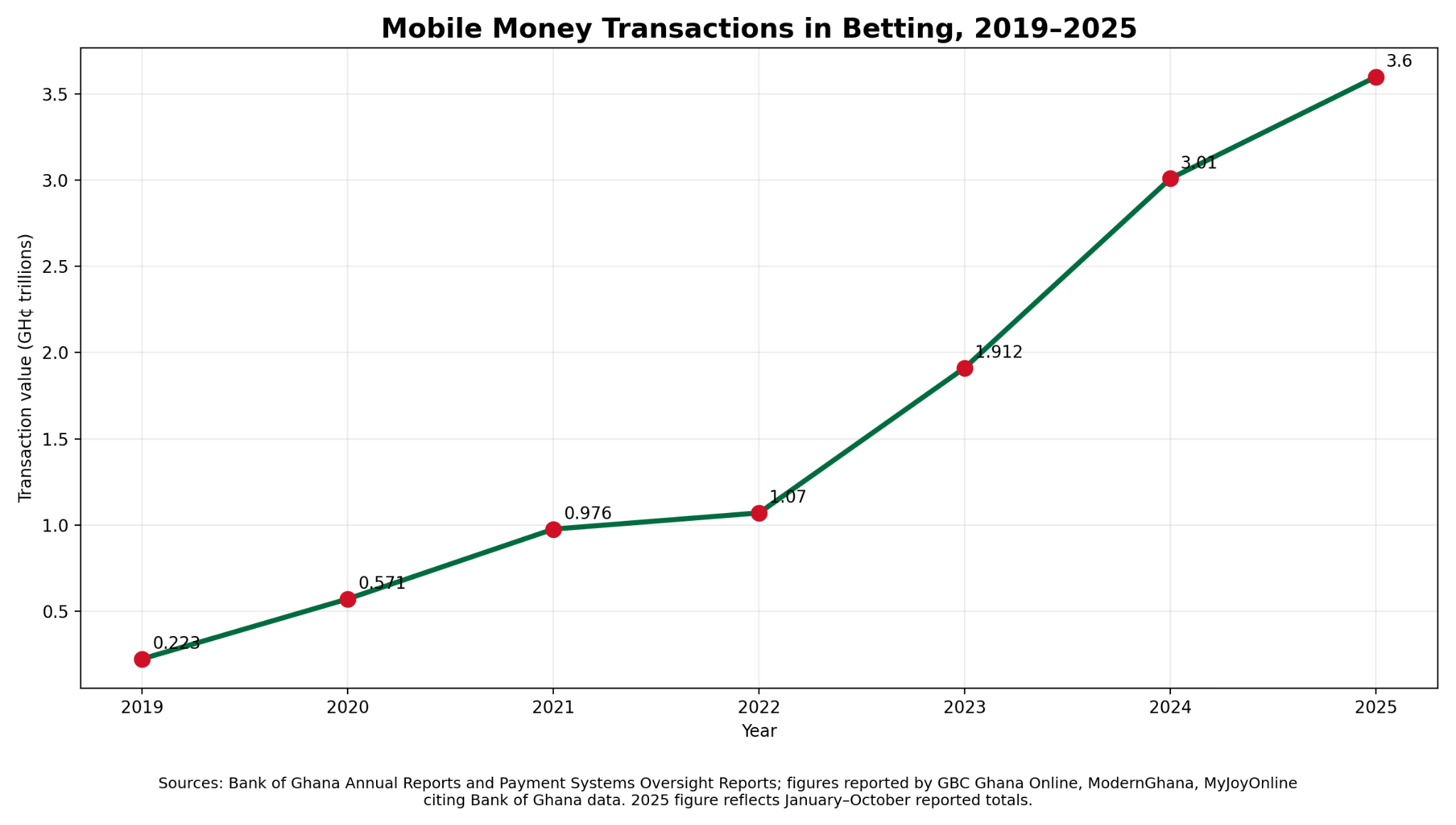
From a pure demand perspective, Ghana continues to perform strongly. Moreover, stronger than it often gets credit for, mainly because it centres a payments economy that already works at scale. With mobile money now the default financial infrastructure, transaction volumes continue to grow year on year. The Bank of Ghana data cited by GBC Ghana Online puts 2024 mobile money value at GH¢3.01 trillion, with 8.1bn transactions (+18.9% YoY). Wagering activity draws directly on this payment infrastructure. For operators, this translates into predictable liquidity, fast settlements, and fewer barriers to repeat wagering than in many neighbouring markets.
Stability is another defining feature. Ghana’s licensing regime is expensive, particularly for online sports betting, but that cost functions as a filter rather than a deterrent. High entry thresholds limit overcrowding and discourage speculative or undercapitalised entrants. As a result, Ghana has largely avoided the extreme promotional volatility and margin compression seen in lower-barrier markets across the region. The removal of withholding tax on player winnings further strengthened the market’s economics, improving payout confidence and reinforcing trust without increasing operator-side tax exposure.
Looking ahead, growth is likely to come less from explosive user acquisition and more from turnover expansion within an already active base. Compared with smaller, more fragmented regional markets, Ghana offers a more bankable medium-term opportunity for well-capitalised operators willing to play a long game.
While the market is highly active, it is not overly competitive. Entry barriers are high in financial terms, particularly for online sports betting, which naturally limits the number of operators that participate in Ghana. This has helped prevent the race-to-the-bottom dynamics seen in some neighbouring jurisdictions with cheaper, looser licensing regimes.
Market Pros and Cons for Operators
For operators weighing market entry, Ghana offers a mix of strengths and commercial trade-offs, best seen in a side-by-side comparison, as shown below:
Market Advantages
-
Regulated and established gambling framework with clear licensing routes.
-
Strong, scalable mobile money infrastructure supporting fast deposits and withdrawals.
-
High betting participation driven by football-led demand.
-
Predictable regulatory engagement once licensed and operational.
-
Ability to operate across online, retail, or hybrid models.
Market Drawbacks
-
High upfront licence fees and minimum capital requirements.
-
20% GGR tax places sustained pressure on margins.
-
Ongoing compliance, reporting, and audit obligations are resource-intensive.
-
The market favours well-capitalised operators, limiting flexibility for smaller entrants.
How to Apply for a Gambling Licence in Ghana
Applying for a gambling licence in Ghana is a structured process that involves preparing detailed documentation and submitting it to the national regulator - the Gaming Commission of Ghana.
There is no dedicated online licensing portal at this time, so operators typically engage the Commission directly to begin the application process.
The first step is to confirm eligibility by reviewing the Commission’s Requirements for a Gaming Licence, which detail criteria such as company incorporation, capital thresholds, Ghanaian ownership, tax clearance, and documentation required for online betting or casino operations.
Applicants must then officially submit their licence application, with all supporting proposals, financial plans, corporate documents, and technical information, either in person at the Commission’s Accra offices or by email to the regulator’s contact address.
For enquiries and submissions, operators can use the regulator’s official contact details on its home page.
Once the application is received, the Commission will review completeness, conduct vetting (including background checks of directors), and assess compliance before granting a licence, a process that may take several months.
If Ghana is on your expansion list, early infrastructure choices matter. Book a tailored demonstration of Altenar’s sportsbook software and see how disciplined trading, reporting, and payments support long-term performance in regulated African markets.
DISCLAIMER
This information is not intended to be legal advice and is solely extracted from open sources. It should not be relied upon as a substitute for professional legal advice, and Altenar does not accept any liability for its use.