
Italy’s gambling rules are changing more than they have in years, and most operators watching the 2026 licensing phase unfold are looking for the same thing - a clear view of what the new rules really mean once you get past the industry chatter. That’s what this report sets out to offer. Not just a list of new regulations and obligations, but a grounded view of the reforms coming into force and how they’ll play out in day-to-day operations.
But before discussing strategy or opportunity, it’s worth taking a moment to examine the reforms themselves, because everything else builds on that foundation.
New Reforms and Rules for 2026
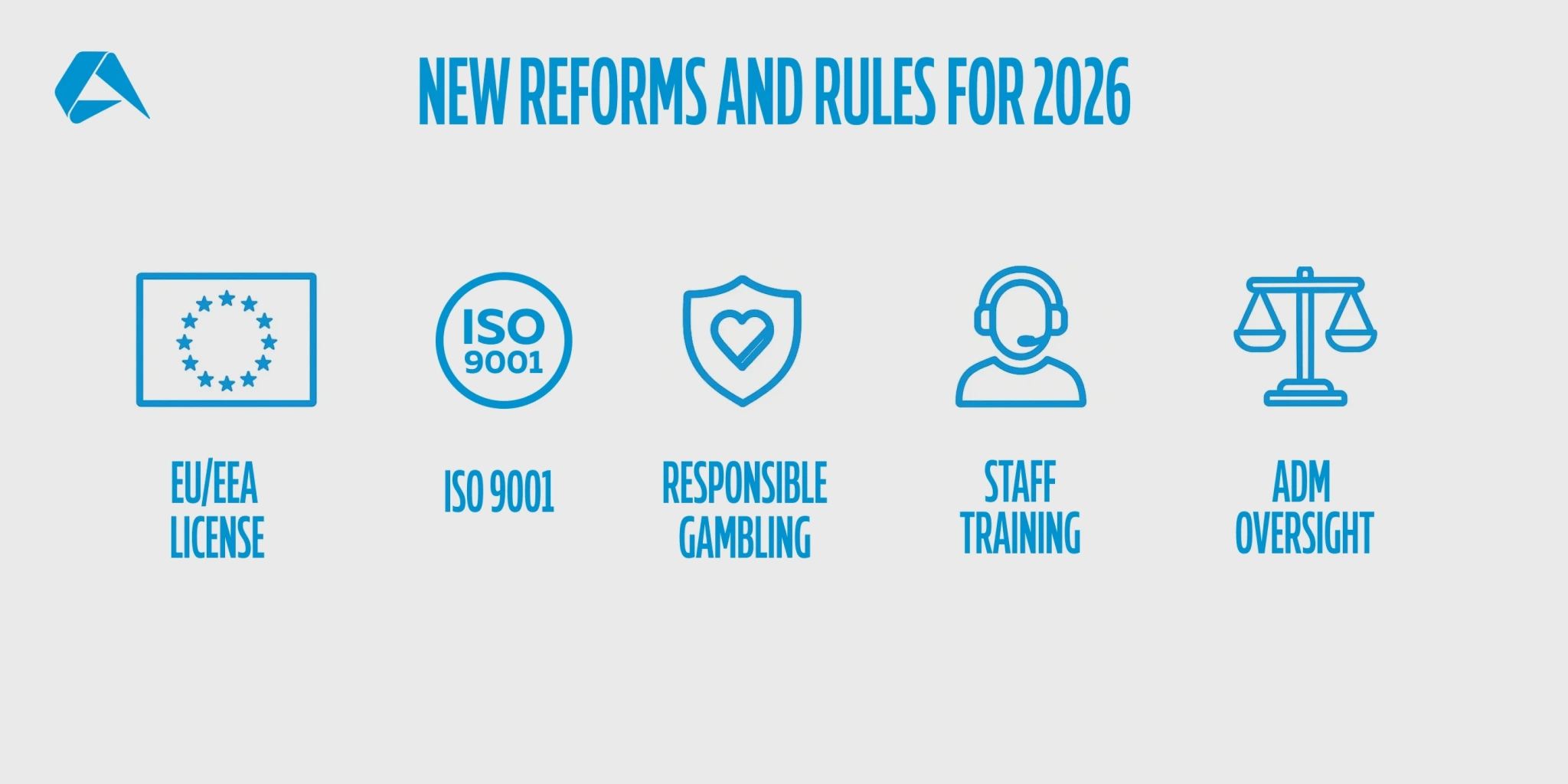
Here are the key areas of reform that will take effect in 2026, each with new obligations and rules that operators must comply with and adapt to in the Italian market to secure and maintain a legal presence:
The Reorganisation of Gambling Decree (Decree 41/2024)
When Italy began drafting Decree 41/2024, the goal was more than minor housekeeping. In essence, it was a structural overhaul. The online gambling market had been running on frameworks written more than a decade earlier, and the government wanted a system capable of supporting a larger, more regulated digital industry. This decree, approved in March 2024, served as the foundation for all subsequent developments, from the 2025 tender to the technical rules that will take effect in 2026.
At its core, the decree redefines what a licensed operator looks like. Any company seeking a concession must now be incorporated within the EU or EEA and, if based outside Italy, maintain a registered office inside the country for tax purposes. Operators must also adhere to recognised international standards, including ISO 9001 for quality management, ISO 26000 for social responsibility, and ISO 27001 for data security. These requirements are now embedded directly into the concession agreements that the ADM issues.
The reform also promotes responsible gambling and consumer protection more deeply into daily operations. It introduces deposit and time limits that adjust according to player behaviour and age, requires pop-up reminders during play about session length and spending, and expands the self-exclusion system so players can restrict access by product or duration. Furthermore, front-line support teams must receive formal training in identifying harmful gaming activities.
In addition to these new rules, Decree 41/2024 strengthens ADM’s ability to supervise. Operators are required to provide real-time access to account and transaction data, retain key records for inspection, and maintain technical infrastructure that meets strict availability standards.
Key New Rules for Operators (Decree 41/2024)
-
Local Presence: The company must maintain a registered office or branch within Italy.
-
ISO Standards: Mandatory ISO 9001, 26000 and 27001 certifications.
-
Nine-Year Term: A fixed concession duration, providing longer operational stability.
-
Responsible Limits: Deposit and time caps tied to player behaviour.
-
Player Alerts: Mandatory pop-ups showing time and spend during play.
-
Self-Exclusion: Centralised RUA system covering all licensed operators.
-
Staff Training: Required responsible-gaming training for customer-facing teams.
-
Data Access: ADM granted real-time oversight of player and transaction data.
-
Server Location: Infrastructure must be hosted in Italy or within the EEA.
-
Record Retention: Player and accounting data stored up to seven years.
-
Enhanced Audits: ADM may perform on-demand compliance and security checks.
The 2025 Online Gambling Tender and Licence Model
The 2025 tender marks the practical rollout of Italy’s new licensing system. It brought the abstract rules of Decree 41/2024 into reality, replacing dozens of expiring concessions with a smaller, more controlled network of licensees. In September 2025, the Agenzia delle Dogane e dei Monopoli (ADM) confirmed that 52 concessions had been awarded to 46 operators, which represents a sharp reduction from the 93 applications submitted in the previous round.
The most discussed element is cost. Each concession now carries a €7 million fee, payable in two instalments; €4 million upon award and €3 million upon launch. That figure alone has affected the market, forcing smaller operators to withdraw or merge with larger groups. Yet for those still able to commit, the prize is a nine-year licence offering stability in one of Europe’s most lucrative gambling markets.
There are also other financial obligations operators need to pay attention to. Licensees must pay an annual fee equal to 3% of net gaming revenue, plus maintain a security bond that combines a fixed €500,000 with variable components based on prior-year tax and gaming balances. Each operator must also provide anti-mafia declarations and proof of corporate suitability as part of the application process.
The tender also introduces structural change. The long-standing multi-brand ‘skin’ model has been abolished, requiring operators to focus on a single brand per licence. This rule encourages a more transparent market identity, and brand diversification is no longer an option.
Key New Rules to the Tender & Licence Model
-
Licence Fee: €7 million per concession, paid in two instalments.
-
Nine-Year Term: A fixed duration that provides long-term regulatory certainty.
-
Limited Concessions: 52 licences awarded to 46 approved operators.
-
Annual Fee: 3% of net gaming revenue payable twice yearly.
-
Security Bond: €500k fixed plus variable amount tied to prior-year activity.
-
Single Brand Rule: Multi-brand ‘skin’ model abolished. One brand only permitted per licence.
-
Corporate Eligibility: EEA incorporation is required, along with a secondary office in Italy.
-
Anti-Mafia Declaration: Mandatory suitability and conviction-free documentation required.
-
Application Timeline: Two-stage tender with an operational start in November 2025.
DISCLAIMER
This information is not intended to be legal advice and is solely extracted from open sources. It should not be relied upon as a substitute for professional legal advice, and Altenar does not accept any liability for its use.
Technical and Operational Protocols (2025 Releases)
Alongside the new concessions, 2025 has brought a wave of technical updates that influence how operators connect with Italy’s regulatory systems. The ADM released a complete refresh of the communication protocols that govern everything from player account registration to data reporting, and these standards are now mandatory for all new licence holders.
The most notable change is the rollout of Sports Betting Protocol 5.0, which will become the standard from March 2026. It modernises how betting data is exchanged between operators and the ADM, tightening control over odds, event lists, and wager validation. It also strengthens live-data integrity requirements, meaning that systems must confirm each bet’s registration and settlement with greater accuracy and speed than before. For many operators, that translates into new integrations, certification testing, and migration work well before launch.
Further updates include Player Account Registry Protocol v3.0, which standardises the communication flow for KYC data and account events. ADM has also introduced new guidelines for communication between gaming platforms and verification bodies, ensuring that every certified product, from sportsbook to poker, uses traceable and compliant messaging formats.
Infrastructure standards have evolved, too. Operators may now host servers within the EEA using cloud solutions, but they must guarantee ADM’s real-time access to all required data. Audit logs, security keys, and data backups must be maintained and available within Italian jurisdiction upon request.
Key Technical and Operational Changes for Operators (2025 Protocol Releases)
-
Sports Betting 5.0: New mandatory protocol for all sportsbook data exchange.
-
Account Registry 3.0: Updated player registration and KYC data communication format.
-
Real-Time Validation: Every wager must be confirmed and logged instantly with ADM.
-
Certified Integration: All platforms must pass approved ADM verification testing.
-
Data Traceability: Every transaction requires timestamped, auditable reporting records.
-
Cloud Hosting Rules: Servers allowed in EEA if ADM access remains guaranteed.
-
Audit Readiness: Logs and security records must be available to ADM on demand.
-
Product Communication: New unified protocol for transmitting gaming product data.
-
Verification Guidelines: Testing bodies must follow ADM’s new certification procedures.
-
Encryption Standards: Updated requirements for secure data transmission between systems.
-
Migration Timeline: Operators must adopt new protocols before the March 2026 launch
Responsible Gambling and Player Protection Framework
Among all the recent reforms, few touch operators more directly than the responsible gambling framework introduced under Decree 41/2024 and strengthened through the 2025 concession model. The focus has moved from optional protections to enforceable obligations built into the licence itself, with the ADM now treating player protection as a measurable part of compliance.
The most visible change is the introduction of behaviour-based deposit and time limits. Operators must allow players to set personal spending caps. However, the system also automatically adjusts recommended limits based on age and betting patterns. Where warning signs appear, automated messages must remind users of the length of their activity and spending in real time, offering direct links to cool-off or self-exclusion tools.
Italy’s Registro Unico delle Autoesclusioni (RUA) has been expanded to cover every licensed site. A player who self-excludes is blocked across all operators instantly, removing the common practice of opening new accounts elsewhere. Operators must integrate their platforms with the RUA database and honour requests immediately.
The reforms also require training for customer-facing staff. Call-centre and support teams must receive ADM-approved instruction on identifying risky gaming activity and guiding players to support services. In addition to these new requirements, operators must now allocate 0.2% of annual GGR, capped at €1 million, to responsible-gambling initiatives, alongside transparent reporting on prevention measures.
Key Responsible Gambling and Player Protection Rules (2024–2025 Reforms)
-
Behaviour-Based Limits: Deposit and time caps adjust automatically by player age and activity.
-
Mandatory Pop-Ups: Real-time alerts display session duration and spending levels during play.
-
Central Exclusion Register: Expanded RUA blocks excluded players across all licensed operators.
-
Fast Integration: Operators must sync systems with the RUA database for instant enforcement.
-
Staff Training: Customer-facing staff require ADM-approved responsible gaming instruction.
-
Financial Contribution: 0.2% of annual GGR, capped at €1 million, funds RG initiatives.
-
Product-Level Exclusion: Players can self-exclude by specific game type or duration.
-
Behaviour Monitoring: Operators must automatically detect and flag high-risk play patterns.
-
Mandatory Age Checks: All new accounts verified using SPID or recognised digital ID.
-
Transparent Interfaces: Platforms must display balance, playtime, and winnings at all times.
Advertising and Brand Regulations
Some areas of Italy’s gambling reform are commercially restrictive, and advertising is one such area. Since the Decreto Dignità came into force in 2018, gambling promotion has been banned mainly across television, radio, and digital channels, leaving operators to compete with limited visibility. Under the 2026 reform package, that framework remains in place for now, but signs of a potential rethink are emerging.
The government has acknowledged that total prohibition has not eliminated illegal marketing or offshore traffic. Discussions within ADM and the Ministry of Economy suggest that a controlled advertising model may be introduced in 2026 or 2027, focusing on certified operators, responsible messaging, and transparent brand visibility. While no timeline is confirmed, this is one area where future easing could significantly reshape player acquisition strategies.
What has already changed is the elimination of the multi-brand model. Each concession is now tied to a single consumer-facing brand, bringing to an end a decade-long practice of operating multiple ‘skins’ under one licence. Operators must now channel all marketing, product development, and player engagement through a united identity. The change in direction encourages stronger brand consistency, but it also removes the flexibility to segment the market through secondary brands.
Affiliate and sponsorship activity also faces tighter control. ADM has made operators responsible for ensuring partners comply with national advertising laws, meaning any affiliate breach could jeopardise the concession itself.
Key Advertising and Brand Regulation Changes (2024–2026 Framework)
-
Advertising Ban: The national ban on gambling advertisements, as outlined in Decreto Dignità, remains active.
-
Future Reform Talks: The Government is reviewing options for the return of controlled advertising.
-
Affiliate Oversight: Operators are fully responsible for ensuring the compliance of ad rules by their affiliate partners.
-
Sponsorship Ban: Gambling sponsorships in sport and media remain prohibited.
-
Responsible Messaging: Any approved ads must include clear harm-reduction messages.
-
Transparency Focus: Operators must clearly display brand ownership and licence details.
-
Digital Monitoring: ADM to expand web surveillance for unlicensed or illegal ads.
-
Sanction Risk: Breaches may result in fines of up to 20% of the campaign value.
-
Public Awareness: Only licensed brands may appear in potential future ad channels.
Taxation and Compliance Alignment
The tax and compliance alignment phase, formalised through Decree Law 96/2025 and the 2025 Budget Law, sets out new fiscal rates, payment obligations, and transparency standards aimed at bringing online and retail gambling into closer parity.
For operators, the most significant change is the adjustment of gross gaming revenue (GGR) tax rates. Online sports betting now carries a 24.5% GGR tax, while casino games sit at 25.5%. Retail betting falls slightly lower at 20.5%, reflecting land-based operational costs.
ADM’s compliance reforms are equally detailed. Operators are now required to maintain complete data archives for a minimum of six months active and five years stored, available on demand. AML and KYC controls have been expanded to include tighter thresholds for transaction monitoring and mandatory reporting to the Financial Intelligence Unit (UIF) for any suspicious betting activity.
ADM and the Bank of Italy jointly oversee financial transparency, particularly in relation to payment processing and the use of crypto-assets. Licensed platforms must provide traceable transaction records, and payment providers may only service approved licensees.
Key Taxation and Compliance Changes (2025–2026 Framework)
-
Updated GGR Tax: 24.5% for online betting, 25.5% for casino, 20.5% retail.
-
Data Retention: Six months live data plus five years archived and accessible.
-
AML Expansion: Stricter reporting thresholds and enhanced transaction monitoring.
-
UIF Reporting: Mandatory filings of suspicious activity to the Financial Intelligence Unit.
-
Bank Oversight: Bank of Italy co-monitors gambling payment flows with ADM.
-
Crypto Restrictions: Digital assets are only allowed through approved, traceable channels.
-
Payment Traceability: All transactions must link to identifiable player accounts.
-
Audit Frequency: More regular ADM audits across financial and operational records.
-
Tax Uniformity: Aligns retail and online taxation for greater fiscal consistency.
-
Supplier Accountability: Platform and payment partners share responsibility for compliance.
DISCLAIMER
This information is not intended to be legal advice and is solely extracted from open sources. It should not be relied upon as a substitute for professional legal advice, and Altenar does not accept any liability for its use.
What These Changes Mean for Operators and Players
Italy’s gambling overhaul has transformed the country into a more demanding and efficient gaming market, but not necessarily a smaller one. The new structure rewards scale and financial strength. Licence costs and compliance standards have pushed out casual entrants, leaving a core of well-capitalised operators who now share a far more predictable, nine-year cycle. For those already in, the shake-up is essentially a reset.
Such consolidation is reshaping competition. With just 46 operators moving forward, they will hold more of both the market and the public’s confidence. Licensed brands will find it easier to prove legitimacy in a country where unregulated sites still attract attention. Yet, the price of that credibility is high. Each operator must now run tighter operations, manage ongoing audits, and budget for responsible-gaming contributions, certification renewals, and technical integrations.
Players, meanwhile, will experience a market that feels more controlled and, it is fair to assume, safer. The new deposit limits, automated alerts, and national self-exclusion register mean gambling behaviour will face closer scrutiny than ever before. That could frustrate high-spending players in the short term, but over time, it will likely strengthen trust in regulated operators and draw more activity away from the grey market.
Marketing remains the most significant pain point. With the advertising ban still in force, growth will depend on retention, brand experience, and mobile usability rather than visibility. For players, this translates into more reliable brands, fewer questionable sites to navigate, and prompt payouts of winnings. For operators, it’s a call to invest in data-driven personalisation, responsible play features, and partnerships that build organic reach.
Post-Reform Market Opportunities and Limitations for Operators
Below is a snapshot of what operators stand to gain and the additional limitations they may face as the new 2026 framework takes effect.
Opportunities
Revenue Certainty: Nine-year licences enable stable forecasting and justify heavier investments in technology or marketing.
Higher Market Share: Fewer licensees mean less competition and a larger share of player volume for each operator.
Exit of Grey Operators: Stricter enforcement diverts players toward regulated platforms, increasing revenue potential.
Pricing Control: Reduced competition supports healthier margins and greater leverage in supplier negotiations.
Operational Efficiency: Standardised protocols simplify reporting, testing, and compliance workflows across departments.
Cross-Sector Synergy: Future alignment between retail and online betting opens shared wallet and loyalty programme models.
Partnership Upside: Joint ventures with larger brands or suppliers can spread costs while preserving market access.
Player Retention Edge: Responsible-gaming and transparency tools reinforce player trust and reduce churn.
Advertising Reform Potential: Should restrictions ease, early licensees will hold the advantage in brand reach.
Restrictions and Limitations
High Entry Cost: €7 million licence fee limits accessibility to well-capitalised operators only.
Operational Overheads: Continuous audits, certifications, and RG contributions add recurring expenses.
Restricted Marketing: Ongoing ad ban suppresses acquisition, forcing reliance on organic growth.
Single-Brand Constraint: No scope for portfolio diversification or sub-brand experimentation.
Technical Complexity: New ADM protocols require re-certification and integration investment.
Compliance Burden: Heavier AML and reporting standards demand stronger internal governance.
Slower Market Entry: Multi-stage approval process and testing can delay launch timelines.
Limited Flexibility: Concessions are non-transferable.
Narrow Margins: Tax, annual fees, and RG levies compress profit potential despite its larger scale.
Preparing for Licence Renewal or Market Entry
Operators entering Italy’s new framework should ask one fundamental question. How ready are we? The strongest applicants will be those who treat preparation as a strategy and align every detail before the tender process even begins.
Pre-Tender Audit of Corporate Structure and Compliance Readiness
Before the next ADM window opens, conduct a thorough review of your corporate structure and documentation. Even slight irregularities, like outdated AML procedures or missing ISO updates, for instance, can derail an application. Think of the pre-tender audit as insurance. The operators who walk in ready invariably save months of delays.
Budgeting for Licence Cost + Bond + Annual Fees + Testing / RG
Many underestimate the real cost of entry. The €7 million licence is just for starters. Add the bond, ADM’s annual 3% fee, technical testing, and responsible-gaming contributions, and the numbers add up. Build a financial buffer that comfortably covers these expenses while keeping capital free for marketing, product development, and player acquisition post-launch.
Align Infrastructure with Sports Betting Protocol 5.0 Requirements
ADM’s 2025 Sports Betting Protocol has become the technical gatekeeper. It demands faster data exchange, tighter reporting, and full integration with national systems. Reconfiguring compliance later will cost more than building it in now. Align your early efforts, especially in trading, reporting, and account management infrastructure, to ensure certification passes smoothly and your launch timeline remains on course.
Leverage Local Partnerships to Offset Operational Costs
Partnerships in Italy aren’t just about convenience. Local legal counsel, payment processors, and tax representatives can significantly reduce setup time and operational barriers. Whether through joint ventures or platform alliances, an EEA presence backed by local expertise shows commitment to ADM and builds credibility with both players and institutions.
Importance of AI-Based CRM and Personalisation
The new system prioritises retention over acquisition. AI-driven CRM systems let operators recognise behavioural patterns, tailor offers responsibly, and build loyalty without breaching marketing restrictions. Done right, this translates into long-term profitability, built on understanding when to engage and when to back off.
Consider Phased Entry or Collaboration with Existing Licensees
Going solo isn’t always the best move. Phased market entry, or partnering with a licensed operator, can reduce upfront exposure and give your team time to adapt to ADM’s firm oversight. It’s a pragmatic approach to scaling by testing your product, refining operations, and understanding the regulatory environment before making a full commitment.
Looking Ahead to 2026 and Beyond
When the dust settles on the new licensing cycle in 2026, the Italian iGaming market is all set to become more efficient and profitable. With fewer operators, the fight for market share switches from marketing spend to brand performance, with increased focus on product innovation and player experience. And that’s the part worth paying particular attention to. That means the companies that are most likely to benefit the most will be those with agile tech stacks, compliance, and a genuine local presence.
Players will also notice the upgrade, with bigger platforms, stronger protections and a greater sense that the one they choose is trustworthy. At the same time, technological change is accelerating. Live-betting, mobile-first interfaces, artificial intelligence-driven personalisation and even potential ad reforms point to new ways for brands to engage.
From an operator’s perspective, the more extended nine-year licences mean you’re in it for the long run. And while entry costs are high, the reward is a market with fewer competitors. Italy may not be the easiest market to operate in, but for those who align with the current regulatory direction, the next few years appear to be a rare opportunity to establish a significant betting business in Italy.
If your focus is stability, compliance, and growth under Italy’s new framework, speak with our Italian team and book a demonstration to see how Altenar’s sportsbook can support your licensing efforts.
DISCLAIMER
This information is not intended to be legal advice and is solely extracted from open sources. It should not be relied upon as a substitute for professional legal advice, and Altenar does not accept any liability for its use.