
Overview Saint Kitts and Nevis Gambling Licence: A Complete Guide for iGaming Operators
The Saint Kitts and Nevis gambling licence provides a strategic entry point for iGaming startups and crypto-first platforms seeking a legal offshore base. Backed by the Gaming Control Act 2021, this Caribbean jurisdiction offers significantly more regulatory clarity than unregulated alternatives while ensuring a straightforward application process.
Operators can legally target international players across diverse verticals, including online casinos, sportsbooks, and poker, benefiting from much lower entry costs and fewer bureaucratic hurdles than Tier 1 regions. Although it may encounter challenges with traditional financial infrastructure, its rapid speed to market—approximately 8–12 weeks—and operational flexibility make it a formidable alternative to Curaçao or Kahnawake.
The regime successfully balances critical compliance requirements, such as AML/CFT policies and fit-and-proper assessments, with a low-maintenance oversight model for offshore activities. Ultimately, for forward-thinking businesses prioritising affordability and solid legal grounding, Saint Kitts and Nevis represents an ideal middle ground for achieving sustainable global growth.
Read the blog below to discover why Saint Kitts and Nevis could be the right choice for your global iGaming expansion.
You’ve likely heard it said many times, but it is worth repeating. When it comes to launching an online gambling platform, choosing the right licence is one of the biggest decisions you’ll make. While names like Malta and the UK tend to dominate the conversation, not every operator is aiming for Tier 1 markets right out of the gate.
And that’s where licensing jurisdictions like Saint Kitts and Nevis come in.
This lesser-known Caribbean nation offers a fully legal route to market, with a relatively simple application process, low upfront costs, and the ability to operate internationally. But with fewer headlines comes less clarity, and more room for confusion.
In this guide, we’ll walk you through everything you need to know to help you decide if this licence fits your platform’s goals.
DISCLAIMER
This information is not intended to be legal advice and is solely extracted from open sources. It should not be relied upon as a substitute for professional legal advice, and Altenar does not accept any liability for its use.
Understanding the Saint Kitts and Nevis Gambling Licence
So what does a gambling licence from a two-island Caribbean nation offer today’s iGaming startups? Well, perhaps more than you might think, especially if you’re looking for flexibility without a thick layer of red tape.
For a growing number of globally focused gambling startups, particularly those working with crypto or looking to test new B2C concepts, this Caribbean licence has steadily become a viable contender. It’s a lesser-known option, for sure, yet it offers something many operators are looking for - a legal, affordable, and relatively straightforward route to market.
The Saint Kitts and Nevis gambling licence allows companies to operate online gambling businesses within the jurisdiction while targeting international players. It covers key verticals such as sports betting, online casinos, poker, and lotteries, and is designed specifically with offshore activity in mind. Local gambling is highly restricted, so this isn’t a domestic licence in the traditional sense, but rather a gateway for building a business abroad.
The licence offers a few significant characteristics that differentiate it from others in the same tier. To begin with, it’s more structured and legally defined than some other offshore options. It’s backed by national legislation, overseen by a formal Gaming Board, and issued to companies that meet a defined set of criteria. In essence, you’ll still find light-touch regulation compared to the likes of the UK or Malta, but it’s not a paper licence either.
This is where it earns its niche. If you’re a new operator focused on markets where no local licence is required, or you're launching a crypto-first platform and need a base to operate legally, this licence offers an accessible and cost-efficient starting point. It won’t open doors to European banking or regulated markets, but it doesn’t pretend to. What it offers instead is clarity, speed to market, and operational freedom.
What This Licence Offers
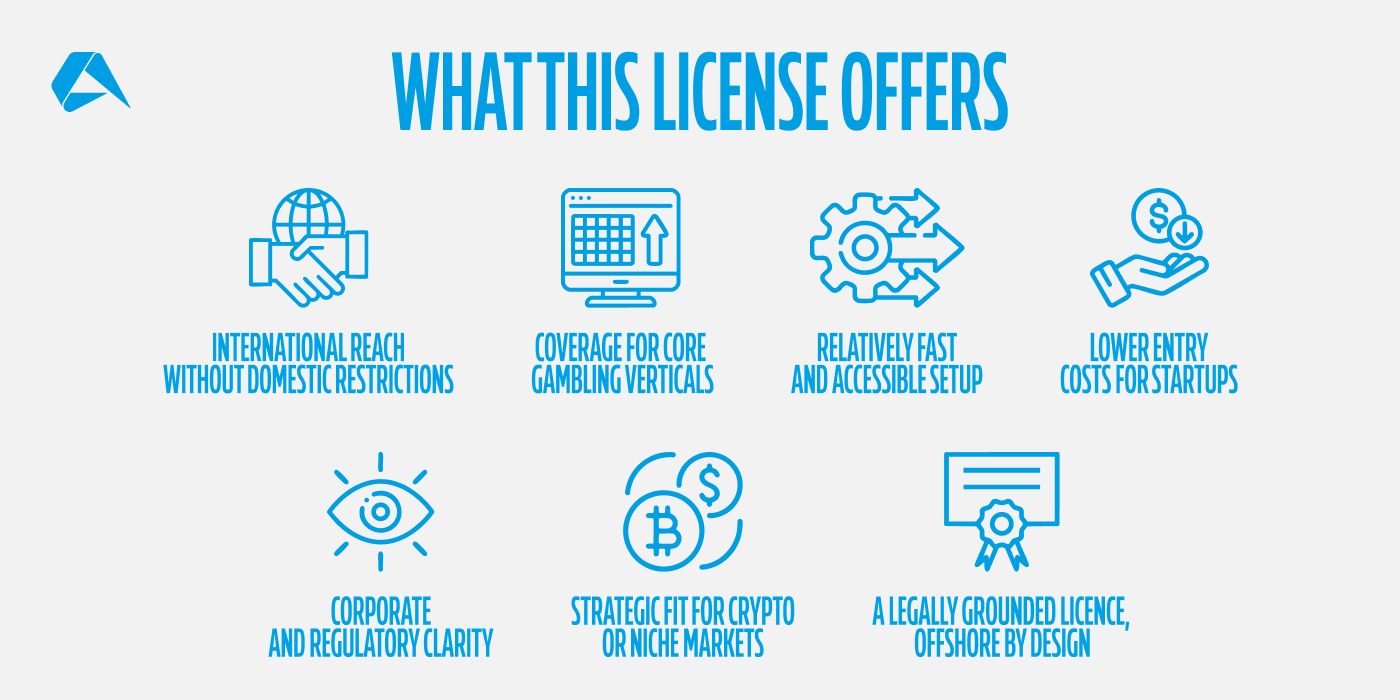
So, what does the Saint Kitts and Nevis licence actually offer? Beyond its legal framework, it’s the combination of global reach, cost efficiency, and regulatory clarity that makes it appealing. Here’s a closer look at the key features operators can expect from this jurisdiction.
International Reach Without Domestic Restrictions
Operators licensed in Saint Kitts and Nevis are authorised to target players outside the jurisdiction, offering a legal base for global operations. Local gambling is restricted, so this is strictly an offshore-facing licence by design.
Coverage for Core Gambling Verticals
The licence can cover online casinos, sportsbooks, poker, and lottery operations, depending on the scope of the application. This makes it suitable for a wide range of B2C business models, including single-vertical and mixed-platform operations.
Relatively Fast and Accessible Setup
Compared to Tier 1 jurisdictions, the application process is more straightforward and can be completed in weeks. The required documentation is limited, and costs are significantly lower than those of other, more established regulators.
Lower Entry Costs for Startups
Initial and annual licensing fees are modest, and operators are not required to establish costly local infrastructure. This makes the licence especially attractive to startups or small teams looking to launch without significant capital outlay.
Corporate and Regulatory Clarity
Unlike some offshore alternatives, this licence is issued under formal legislation by a defined regulator. That structure lends credibility over loosely registered regimes and may offer a smoother path when working with compliance-conscious partners.
Strategic Fit for Crypto or Niche Markets
Operators focusing on crypto betting, non-restricted jurisdictions, or niche international audiences often use this licence as a legal anchor. It supports models that don’t require access to regulated markets or Tier 1 financial infrastructure.
A Legally Grounded Licence, Offshore by Design
The Saint Kitts and Nevis licence is issued under the Gaming Control Act of 2021, backed by national law and regulated by the Financial Services Regulatory Commission (FSRC). It’s a credible offshore licence, designed for operators targeting international markets, not players within the Federation.
Licence Costs and Timeframes
Saint Kitts and Nevis offers several types of licences as defined by the Fourth Schedule of the Gaming Control Act (2021). Each licence is issued on an annual basis, valid until December 31, with renewals due by January 31.
Below is a breakdown of representative licence fees:
| Licence Type | Application Fee (USD) | Annual Fee (USD) |
|---|---|---|
| Casino | $10,000 | $100,000 |
| Internet Gaming | $5,000 | $50,000 |
| Sports Betting | $1,000 | $10,000 |
| Lottery | $5,000 | $50,000 |
| Slot Parlour | $2,000 | $20,000 |
| Racetrack | $1,000 | $10,000 |
Source: Gaming Control Act 2021, Fourth Schedule
Typical Application Timeline
Although the Act doesn’t specify deadlines, industry feedback estimates that the total process, including application, background checks, and final sign-off, takes around 8–12 weeks, assuming complete and transparent documentation.
Ongoing Costs and Considerations
As with all gaming licences, beyond the initial licence and renewal fees, operators should plan for ongoing operational expenses. These may include compliance audits, AML and data security systems, technical certification, and responsible gambling tools. While these costs vary depending on the business model and scale, they are essential for maintaining a good standing with the regulator and ensuring smooth operations under the licence throughout the year.
Staying Up to Date
Licensing costs are subject to change by order of the FSRC or through legislative updates. For the most accurate and up-to-date fee schedules, applicants should consult the official FSRC Law Library Gaming section.
The Licensing Process
Applying for a gambling licence in Saint Kitts and Nevis is relatively streamlined, but not to say that it’s without structure. The process is overseen by the Saint Christopher and Nevis Gaming Board, which reviews applications and makes formal recommendations to the Financial Services Regulatory Commission (FSRC), the authority that ultimately issues the licence under the Gaming Control Act of 2021.
Applicants must submit a full suite of documentation, including a business plan, financial statements, AML/CFT policies, platform descriptions, and internal control procedures. Fit-and-proper assessments are mandatory for all directors, shareholders, and key personnel, and applicants are required to cover the costs of all background checks and due diligence. This stage can be rigorous and is a defining feature of the jurisdiction’s risk-based approach.
Furthermore, incorporation of a local entity is typically required, and most operators do this through an International Business Company (IBC) or Limited Liability Company (LLC) structure under Nevis or federal law. A registered agent must be appointed locally to manage compliance and filings, though a physical office is not required.
Neither is there a requirement to maintain a local bank account, and operators are generally free to use offshore or international banking partners. However, proof of financial adequacy, including source of funds and access to operational capital, must be submitted during the application process.
How to Apply for a Saint Kitts and Nevis Gaming Licence
Applications for a gambling licence in Saint Kitts and Nevis must be submitted through a licensed local registered agent, since direct applications from operators are not accepted.
While the FSRC provides downloadable forms, there is no dedicated online portal for digital-only submission.
Instead, the process allows for either physical delivery or electronic transmission of documents, depending on how the registered agent chooses to handle the filing. The Gaming Board reviews completed applications, and if approved, they are forwarded to the FSRC for formal issue.
Compliance and Regulatory Obligations
One of the main draws of the Saint Kitts and Nevis licence, particularly for startups and emerging brands, is its balanced approach to compliance. Compared to Tier 1 jurisdictions, regulatory obligations here are less intensive:
Internal Controls and AML/CFT Requirements
Operators must implement internal policies addressing anti-money laundering, counter-terrorist financing, and fraud prevention. These systems are legally required under the Gaming Control Act and are reviewed during the application process.
Fit-and-Proper Person Requirements
Shareholders, directors, and key staff undergo mandatory vetting during the application phase. Criminal records, financial history, and business integrity are assessed, which are similar to those in higher-tier jurisdictions, although ongoing checks are less intensive.
Responsible Gambling and Player Protection
Licensees must include responsible gambling policies and published terms and conditions, which should consist of self-exclusion tools and age verification procedures. However, these requirements are lighter than those in EU-based regions and are generally not actively monitored unless issues arise.
Geo-Blocking of Local Players
Operators must not accept players located in Saint Kitts and Nevis. Compliance requires geo-blocking and jurisdictional exclusions, and operators must include a clause in their user terms that clearly states access is prohibited for local players. Failure to implement this can result in suspension.
Reporting and Audits
The FSRC has the authority to audit licensed operators, but oversight tends to be reactive rather than ongoing. There are no routine monthly or quarterly reporting requirements, making this a low-maintenance licence from a regulatory standpoint.
Limitations and Payment Considerations
While the Saint Kitts and Nevis licence has its advantages, it’s nonetheless important to approach it with a clear view of its limitations, especially if you're planning to scale or connect with mainstream financial infrastructure.
The first thing to note is that, although the licence is legally grounded and government-regulated, it’s still considered a Tier 3 licence by much of the industry. That means it may not carry the same weight with banks, payment service providers (PSPs), or platform partners, particularly those with strict risk and compliance protocols. Some PSPs may reject onboarding entirely unless you also hold a licence from a higher-tier jurisdiction.
Operators also need to be aware that this licence is not a gateway to regulated markets, such as the UK or most of the EU. For this reason, geo-blocking and responsible targeting are essential, and attempts to enter restricted markets without local approval could result in reputational damage and/or legal challenges.
In terms of payments, there's no legal requirement to open a local bank account, which offers a fair degree of flexibility. However, because of the jurisdiction's offshore status, access to fiat PSPs may be limited, and crypto-friendly solutions are often preferred, particularly for sportsbooks or casinos serving global audiences outside Tier 1 frameworks.
Ultimately, Saint Kitts and Nevis can serve as a strategic entry point, but it’s best suited to operators with realistic expectations, alternative payment strategies, and business models that don’t rely on Tier 1 financial integrations.
How It Compares to Other Tier 3 Licences
Saint Kitts and Nevis sits among a competitive group of offshore licensing jurisdictions. The comparisons below provide a general overview of how it performs compared to other popular Tier 3 licensing jurisdictions.
Tier 3 Gambling Licence Comparison Table
Criteria Saint Kitts & Nevis Curaçao (New Regime) Anjouan (Comoras) Kahnawake (Canada) Costa Rica Application Time 8–12 weeks 8–12 weeks 2–4 weeks 6–10 weeks 1–2 weeks Licence Cost (est. for sports betting) $10K $25K+ $12K–$18K $20K–$25K $2K–$5K Scope Casino, Sports, Lottery, Poker Casino, Sports, B2B/B2C Casino, Sports, Crypto Casino, Sports, Poker No licence; registration Pros Legal structure, crypto-ready, low entry cost Modernised, supports B2B, good reputation Fast setup, low cost, flexible North America-friendly, stable Very low cost, fast setup Cons Offshore only, PSP hurdles Costlier, stricter reporting Lower recognition, fewer PSPs Limited reach, mostly regional No formal licensing, PSP issues
Saint Kitts and Nevis vs Costa Rica
Saint Kitts and Nevis offers a far more structured regime than Costa Rica, which only allows for company registration without a formal gaming licence. While Costa Rica remains inexpensive and discreet, it lacks regulatory oversight, which invariably poses challenges when working with PSPs or banks. In contrast, Saint Kitts and Nevis issues licences under a defined law, with clear renewal terms and regulatory backing. Operators prioritising credibility and compliance will generally favour Nevis over Costa Rica’s unregulated model.
Saint Kitts and Nevis vs Curacao
Curacao is undergoing major reform, shifting away from its legacy master licensee system toward a more centralised regulator. While this promises stronger oversight, the process is still unfolding. Saint Kitts and Nevis, meanwhile, already offers legal clarity under its 2021 Act, including standalone licences for key verticals. Fees are comparable (when spread across all licence types), but the application process in Nevis is often faster and more predictable. For operators looking to avoid transitional uncertainty, Nevis currently offers a more stable offshore option.
Saint Kitts and Nevis vs Anjouan (Comoros)
Anjouan is one of the lowest-cost offshore licences available, often appealing to startups and crypto platforms. However, it is known for operating with limited transparency and varying application standards. By contrast, Saint Kitts and Nevis combines affordability with a solid legal foundation, backed by a national regulatory body and codified gaming laws. While both are offshore-focused, Nevis offers stronger long-term credibility for operators seeking to establish B2B business relationships or expand beyond grey market exposure.
Saint Kitts and Nevis vs Kahnawake
Kahnawake has long been seen as a reputable offshore option, particularly in North America. Its licence is respected by PSPs and offers strong player protection standards. However, the process can be lengthy, and costs are generally higher than in Saint Kitts and Nevis. Nevis presents a more accessible entry point with faster setup and a broader international focus. While Kahnawake may suit operators targeting Canada or seeking a mature regulatory framework, Nevis wins on speed, cost, and licensing flexibility.
Conclusion
Among offshore Tier 3 gambling licences, Saint Kitts and Nevis occupies a strategic middle ground. That’s to say, more structured than Anjouan or Costa Rica, yet less established than the newly reformed Curacao regime or Kahnawake. What sets it apart is the legal clarity offered through the Gaming Control Act of 2021, paired with comparatively moderate costs for sports betting licences and moderate processing timelines.
While not as bank-friendly as Kahnawake or as widely recognised as Curacao, the Nevis licence does much to avoid the ‘regulatory grey’ label still attached to Costa Rica. It may not suit operators seeking entry into regulated markets, but for crypto-first businesses, underserved or lightly regulated regions, or those prioritising speed and simplicity within a legal framework, it offers an attractive balance.
For startups and niche operators, this licence punches above its weight, and may prove more future-resilient than some other legacy options.
Is the Saint Kitts and Nevis Licence Right for Your Business?
The licence isn’t a one-size-fits-all solution, but for many operators, it strikes a smart balance between credibility, cost, and control. If you're a startup seeking a structured yet accessible offshore entry point, or a crypto-first business looking for a legally defined framework with fewer barriers, this jurisdiction deserves serious consideration.
It doesn’t offer market access to major regulated regions, nor the global name recognition of places like Malta or Curaçao. However, what it does offer is clarity in terms of cost, process, and legal status, without the high fees or bureaucratic burdens associated with the more established jurisdictions.
For operators focused on underserved markets, decentralised models, or fast launch timelines, Nevis delivers a compelling middle path. It’s a licence that doesn’t overreach, but also doesn’t cut corners, and that balance may be precisely what your business needs.
A licence is just the start, but success takes more. Book a platform demo with Altenar and see how our flexible sportsbook solution aligns with Saint Kitts and Nevis and other offshore Tier 3 licensing environments.
DISCLAIMER
This information is not intended to be legal advice and is solely extracted from open sources. It should not be relied upon as a substitute for professional legal advice, and Altenar does not accept any liability for its use.