
Key Takeaways
-
Slow Down. Stay Longer: Slowing intense play can create healthier, more consistent engagement, helping operators turn short-term activity into long-term player value.
-
Big Spenders Aren’t Always Your Best Players: Sustainable LTV comes from players who return consistently, not those who spend heavily today and disappear tomorrow.
-
The Right Moment Makes All the Difference: Smart RG interventions work best when they respond to changing behaviour before it becomes a bigger problem.
-
One Rule Can’t Fit Every Player: Behaviour-led personalisation helps operators deliver the right controls at the right time without unnecessary disruption.
-
Connect RG to CRM & Product: Moving responsible gaming out of compliance silos builds stronger, longer-lasting player relationships.
-
The Real Strategy? Make Engagement Last: Regulating activity builds predictable retention and higher LTV across the entire player journey without simply pushing for immediate spend
Rethinking LTV: Why Responsible Gaming Measures Can Improve Long-Term Value
Responsible gaming is typically regarded as a regulatory requirement and constraint on revenue growth.
This article challenges that view. When applied correctly with strategic intent, these tools can shape player behaviour, extend engagement, and increase lifetime value.
This article explores how operators can turn RG controls into a long-term growth strategy.
In most iGaming operations, player value is still judged by how much a player spends and how quickly they spend it. High activity, frequent deposits, longer sessions. All of these are primary identifiers that look like growth, but could this be painting a picture of short-term gain rather than long-term value?
Look past the headline numbers, and you may see a different pattern. Some of the most active players are also the least consistent. Their behaviour is irregular, their spending grows quickly, and their engagement can drop off just as fast. Apparent strong performance in the short term tends to evaporate within days or weeks without warning.
These patterns are familiar to most operators. A spike in activity followed by silence. A player who moves from high engagement to complete inactivity. In some cases, that fall in participation might be tied to an intervention. In others, it’s simply the result of fatigue or loss of interest after an intense period of play.
The result is a form of value that is difficult to sustain. It creates short bursts of revenue, but little in the way of long-term contribution, AKA player lifetime value (LTV).
Ultimately, this raises a more important question. If short-term spend doesn’t define value, what does?
What Actually Drives Lifetime Value
To understand lifetime value properly, it’s important to look beyond moments of high activity. LTV is built over time, through patterns that repeat and persist.
The players who contribute the most are not typically the high spenders who deposit the most in a single session. They are the ones who return consistently, engage at a steady pace, and remain active over longer periods. In other words, their behaviour is less volatile, which makes their value more durable.
Consistency matters because it extends the player lifecycle. A player who deposits smaller amounts across multiple sessions over several months will often generate more value than one who spends heavily in a few short bursts and disappears. The difference is not just in total spend, but also in how that spend is distributed across a player's playing history.
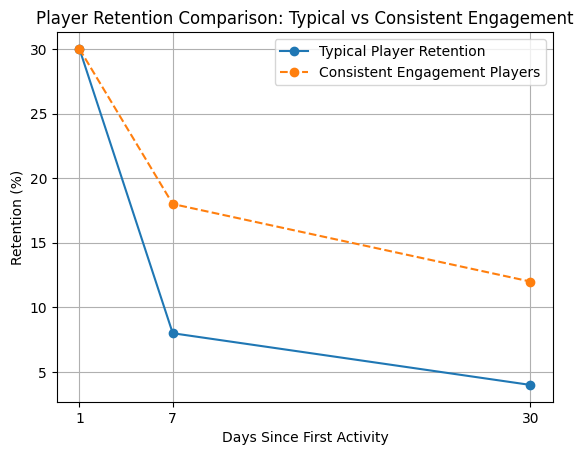
Illustrative comparison showing typical player retention patterns versus more consistent engagement behaviour. Based on industry retention benchmarks (Quago).
Predictability plays an equally important role. When player behaviour follows a more stable pattern, operators can manage it more effectively. It becomes easier to align offers, adjust engagement strategies, and anticipate future activity. Revenue is less tied to short-term fluctuations and more tied to ongoing participation.
This is where strategies built around immediate performance tend to fall short. Focusing too heavily on the here and now can obscure underlying instability. High activity can look like growth, but without consistency, it doesn’t translate into lasting value.
The primary focus for experienced operators is not on immediate spend, but on maintaining sustainable engagement levels. The goal is not to push players harder, but to keep them active for longer.
The key takeaway is this. If value correlates to behaviour over time, then influencing that behaviour becomes a central part of long-term growth.
Controlling Player Behaviour Through Responsible Gaming
Responsible gaming is a set of limits. Deposit caps, session reminders, and cooling-off periods, etc. Necessary tools, but only applied when player risk appears. In practice, however, its role is much broader.
At its core, responsible gaming influences how players behave over time. It affects pacing and tempo, how long sessions last, and how often players return. When applied well, it reduces extremes without disrupting engagement, creating a more balanced pattern of play.
This matters because player behaviour is not always stable on its own. Left unchecked, activity can accelerate quickly. Sessions become longer, deposits increase, and engagement intensifies in a short period. At face value, this can look like strong performance. But these patterns are often difficult to sustain and are often followed by early disengagement.
Responsible gaming acts as a counterbalance. It applies measured constraints at key moments in player activity, slowing down behaviour before it becomes unsustainable. A well-timed reminder, a suggested limit, or a brief pause in activity can move players away from short bursts of activity toward longer-term participation.
‘This is where responsible gaming begins to contribute directly to player value.’
The goal is not to reduce activity, but to regulate it. Players remain active, but at a pace that is more likely to be sustainable over time. This is where responsible gaming begins to contribute directly to player value. It extends the lifecycle by preventing the kind of behaviour that leads to early churn.
Fundamentally, this is not about applying the same rules to every player. Behaviour varies, and so should the response. The most effective approaches are those that adapt to individual patterns, using data to identify when intervention supports engagement rather than interrupts it.
Seen this way, responsible gaming is not a constraint on growth. It is part of how sustainable growth is built.
But this creates a tension that operators are very familiar with. Do we maximise what this player can generate now, or do we protect their ability to generate value over time?
Turning Responsible Gaming into a Practical Advantage
In modern-day iGaming platforms, responsible gaming tools are already widely available. The tools are not the issue. The real question is whether or not they are used to strengthen long-term player relationships.
In many cases, interventions are triggered by fixed thresholds rather than behavioural context. A player reaches a deposit limit, a message appears, or a restriction is applied. The action is technically correct, but it often comes at the wrong moment. Too early, and it disrupts engagement unnecessarily. Too late, and the behaviour has already become difficult to reverse.
In many cases, timing is where the process falls short. Player behaviour does not unfold in predictable stages. It evolves. A gradual increase in session length or deposit frequency can signal a change long before any predefined limit is reached. The point is that when systems rely solely on static rules, they tend to react after the pattern has already formed.
A generic application creates a similar problem. Not all players behave the same way, yet many responsible gaming models treat them as if they do. A limit that is appropriate for one player may feel restrictive to another, or irrelevant to a third. Without recognising individual patterns, interventions risk becoming either intrusive or ineffective.
There is also a structural issue. Responsible gaming is often separated from product and CRM strategy, handled as a compliance function rather than part of player lifecycle management. This disconnect makes it harder to align interventions with the broader goal of sustaining engagement over time.
The result is a separation between intention and outcome. The tools are there, but they do not always support the behaviour they are meant to guide.
The difference is not in what is used, but in how it is applied. Which leads to a more important question: what does effective implementation actually look like?
What This Means in Practice
Use responsible gaming to stabilise engagement
The goal is not to restrict activity, but to shape it into something sustainable over time.
Move beyond fixed thresholds
Static limits react too late. Focus on identifying gradual behavioural changes instead of waiting for hard triggers.
Prioritise timing over action
The effectiveness of an intervention depends more on when it happens than what it is.
Segment behaviour, not just players
Apply controls based on activity patterns, not broad player categories.
Integrate responsible gaming into CRM and product workflows
Treat it as part of lifecycle management, not a standalone compliance function.
From Disruption to Sustainability: Getting Responsible Gaming Right
The conclusion, then, is not as complicated as it may seem. Responsible gaming does not reduce player value. Poor implementation does. The implication being that in many cases, the issue is not what is used, but how it is applied. Interventions triggered too late tend to follow behaviour rather than influence it. Applied too early, they unnecessarily interrupt engagement. In both cases, the result is the same: disruption without direction.
Generic limits, as previously mentioned, create a similar effect. Instead of guiding behaviour, they introduce unnecessary resistance. Over time, that can lead to reduced engagement or early disengagement. The impact is not always immediate, but it is cumulative. Disjointed interventions, poorly timed messaging, and inconsistent signals can erode trust. Players remain active, but engagement becomes harder to sustain.
The alternative is not to remove controls, but to apply them with intent.
| Common Approach | More Effective Approach |
|---|---|
| Fixed thresholds trigger interventions | Behavioural patterns guide timing |
| Uniform limits applied across all players | Controls adapted to individual behaviour |
| Responsible gaming handled as compliance | Integrated into CRM and product strategy |
| Reactive interventions after escalation | Early patterns used to guide behaviour |
| Focus on immediate activity control | Focus on sustaining engagement over time |
In practice, this means moving from reactive control to behavioural guidance. Interventions should align with how player activity evolves, not just where it crosses predefined limits. A gradual increase in deposit frequency, for example, is often more meaningful than a single large transaction.
Personalisation plays a key role. When controls reflect individual patterns, they are more likely to be accepted and less likely to disrupt the experience. This creates a more balanced form of engagement, where activity continues at a pace that can be sustained.
Alignment across teams is equally important. Responsible gaming cannot sit apart from CRM and product decisions. When incentives, messaging, and controls work toward the same objective, behaviour becomes more predictable and easier to manage.
The outcome is not just improved compliance. It is a more stable player base, longer lifecycles, and revenue that is less dependent on short-term fluctuations.
That is where responsible gaming moves beyond obligation and becomes part of a long-term growth strategy.
What This Looks Like in Practice - The Platform of Tomorrow
Understanding the theory of how Responsible Gambling can increase lifetime player Value (LTV) is one thing. Applying it in a live environment is where the real difference is made.
For most operators, the difference is not in capability, but in execution. The tools are already in place. The challenge is knowing how to apply them in a way that supports long-term player value without disrupting engagement. In practice, this often comes down to small but meaningful adjustments.
The difference may not always be obvious at first, but over time, it strongly impacts how your player base engages, how long they stay, and how predictable that value becomes.
| Scenario | Standard Approach | More Effective Approach | Commercial Impact |
|---|---|---|---|
| Loss-chasing behaviour | React after large losses occur | Identify repeated deposits following losses and intervene early | Reduces escalation and extends player lifespan |
| Rapid re-deposits | Trigger limits after thresholds are hit. | Detect multiple deposits in short intervals and introduce earlier prompts | Prevents short-term surges and reduces early disengagement |
| Deposit escalation | Act on single high deposits | Monitor gradual increases in deposit frequency and value | Improves timing and stabilises behaviour |
| Session duration | Notify after extended sessions | Identify increasing session length across sessions and act earlier | Maintains engagement without abrupt disruption |
| Intervention timing | Trigger actions at fixed thresholds | Use behavioural indicators to guide the timing of interventions | Aligns actions with real player behaviour |
| Player limits | Apply the same limits across all players | Adapt limits based on individual behaviour patterns | Reduces issues and improves acceptance |
| Bonus response | Push bonuses to increase activity | Adjust bonus timing based on recent behaviour patterns | Prevents artificial peaks followed by disengagement |
| Messaging tone | Compliance- driven, restrictive messaging | Use guidance-based, context-aware communication | Maintains trust and improves response to interventions |
| Cross-channel behaviour (casino + sportsbook) | Monitor behaviour within a single vertical | Track combined activity across products | Reduces unseen patterns and improves accuracy |
| Withdrawal reversals | Allow repeated cancellations without context | Treat repeated reversals as a behavioural signal | Identifies early risk and supports more stable engagement |
| Reactivation strategy | Send generic offers to inactive players | Tailor reactivation based on prior behaviour and intensity | Improves retention quality and avoids repeated patterns |
| New player onboarding | Push strong bonuses early | Gradually introduce engagement to avoid early over-intensity | Improves retention and reduces early churn |
| Session- to-session changes | Evaluate sessions individually | Track behavioural changes across sessions and adjust messaging | Captures changes earlier and improves intervention timing |
| Time-of-day intensity | Treat all sessions equally | Identify high-intensity late sessions and introduce earlier controls | Reduces fatigue-driven behaviour and improves session quality |
| VIP / high-value players | Reduce controls to protect revenue | Apply tailored controls based on behaviour, not player tier | Protects long-term value and reduces sudden churn |
The Next Step for Operators
In today’s betting environment, responsible gaming should not be handled as just a compliance requirement. When applied with strategic intent, it becomes part of how player value is built and sustained.
For operators looking to move beyond reactive controls and toward a more structured, behaviour-led approach, the next step is understanding how these principles translate into real platform decisions.
If you’re reviewing your current setup or planning ahead, book a product demonstration with Altenar today to explore how responsible gaming can be aligned with long-term player value and growth.