
For much of the past decade, Missouri’s absence from the regulated sports betting scene has been notable. Not because online gambling was unfamiliar to locals, but because progress repeatedly stalled at the legislative level, even as neighbouring states moved ahead. The result was a market defined by delay rather than direction.
That changed in December 2025. With voter approval replacing the legislative deadlock, Missouri formally introduced regulated retail and mobile sports betting. For the first time, industry operators now have a market with a settled legal framework.
But market entry to Missouri is not an open invitation. The environment for online sports betting is purposefully limited in scope. Licensing is tightly capped, and market access is structured to restrict the number of sportsbook brands operating statewide. For independent operators, the implications are clear.
This article examines Missouri’s gambling laws and sports betting regulations as they stand today, explaining how the state arrived at this point, how access is controlled, where opportunities realistically exist, and why positioning, patience, and regulatory awareness matter.
DISCLAIMER
This information is not intended to be legal advice and is solely extracted from open sources. It should not be relied upon as a substitute for professional legal advice, and Altenar does not accept any liability for its use.
A Brief Historical Context of Gambling in Missouri
For much of the 20th century, gambling activity in the US state of Missouri was limited to a small number of explicitly authorised forms and anchored in retail casino gaming, with lawmakers and voters repeatedly opting for curtailment over expansion and experimentation.
The first major milestone towards legalised gaming activity arrived in 1986, when voters approved the creation of the Missouri Lottery. Designed as a state-run monopoly, the lottery was positioned from the start as a public revenue tool rather than a commercial gambling market, with proceeds directed toward education and general state funding. Its establishment reflected a broader pattern that gambling would be permitted, but only where the state retained a clear supervisory role.
A more transformative move followed in 1992, when voters approved a constitutional amendment legalising riverboat gambling. This transition allowed gambling boats to operate on the Mississippi and Missouri Rivers, marking the state’s entry into commercial casino gaming. The model was deliberately restrictive. Casino licences were capped, locations tightly controlled, and gambling confined to river-based venues, even after later reforms allowed permanently moored facilities. Oversight was centralised under the Missouri Gaming Commission, which was tasked with licensing, enforcement, and regulatory compliance.
Throughout the 1990s and 2000s, Missouri’s casino market matured without any major change. Slot machines, table games, and poker were permitted within licensed casinos, while standalone cardrooms remained prohibited. Charitable gaming, including bingo and raffles, was authorised under separate constitutional provisions, and pari-mutuel wagering on horse racing was legalised by ballot initiative in 1984, although the state no longer hosts active racetracks.
What stands out in Missouri’s history is not what expanded, but what did not. Unlike many other states, Missouri resisted repeated efforts to introduce sports betting following the 2018 repeal of PASPA. Legislative proposals stalled year after year, often collapsing over disputes about licensing models, integrity fees, and the role of video lottery terminals (VLTs). The consistent failure of these bills shows the limits of statutory reform in a cautious US state.
That limitation was finally broken in November 2024, when voters narrowly approved a ballot initiative to legalise land-based and mobile sports betting. By placing sports wagering directly into the constitutional framework, the initiative bypassed legislative barriers and set a firm deadline for market launch. As a result, sports betting joined Missouri’s list of authorised gambling activities for the first time, marking the most significant change in the state’s gambling environment in more than three decades.
This slow, voter-driven evolution explains much of Missouri’s current regulatory posture, which is stable, tightly defined, and resistant to rapid expansion, even as new forms of wagering gradually enter the market.
Timeline of Historical Events
Over more than four decades, Missouri’s gambling regulations have evolved through voter initiatives and tightly controlled reforms, resulting in a cautious yet enduring regulatory model that shapes the market today.
-
1984: Missouri voters approve pari-mutuel wagering on horse racing, establishing a regulated betting framework despite the absence of long-term racetrack operations.
-
1986: The Missouri Lottery is created as a state-run monopoly, positioning gambling primarily as a public revenue generator rather than a competitive commercial market.
-
1992: Voters approve a constitutional amendment legalising riverboat gambling, opening the door to commercial casinos operating on the Mississippi and Missouri Rivers.
-
1994: Missouri’s first riverboat casinos open, introducing the state’s formal entry into regulated casino gaming under strict licensing controls.
-
1997: The Missouri Gaming Commission is formally established, consolidating regulatory oversight, licensing, and enforcement.
-
2008: Legislative reforms allow permanently moored casinos, modernising the riverboat model while retaining constitutional limits on locations and licence numbers.
-
2018: The US Supreme Court overturns PASPA, triggering nationwide sports betting expansion while Missouri lawmakers fail to pass favourable legislation.
-
2019–2023: Multiple sports betting bills were introduced in the Missouri legislature, but repeatedly stalled with disagreements over market structure and video lottery terminals.
-
November 2024: Missouri voters narrowly approve a ballot initiative legalising retail and mobile sports betting through a constitutional amendment.
-
May 2025: The Missouri Gaming Commission opens the sports wagering application period and publishes initial licensing and regulatory materials.
-
July–September 2025: Sports betting regulations are finalised and licence applications reviewed.
-
1 December 2025: Retail and mobile sports betting officially launch statewide, marking Missouri’s most significant gambling expansion in over 30 years.
The Current Landscape for State Gambling
Missouri’s gambling market today is defined by a stable land-based foundation and the recent addition of regulated sports wagering, which brings a modern betting dimension to an otherwise tightly regulated framework. For both operators and residents, the state now offers a clear, if deliberately limited, set of legal options across retail and digital channels.
At the core of the market are Missouri’s 13 licensed riverboat casinos, all regulated by the Missouri Gaming Commission. These properties remain the primary venues for casino gaming and retail wagering, offering slot machines, table games, poker, and in-person sports betting under a capped licensing system. Casino expansion is constrained by constitutional and local approval requirements, reinforcing Missouri’s long-standing preference for controlled growth over open-market entry.
Sports betting now sits alongside this established casino base. Residents may place wagers both in-person and through approved mobile platforms, extending access beyond physical venues while keeping sports wagering structurally distinct from online casino gaming. Mobile betting has been introduced, creating a path for digital gaming without opening the door to broader iGaming products. For operators, this positions sports betting as Missouri’s primary online opportunity.
Horse racing occupies a more peripheral position. Pari-mutuel wagering is legal under Missouri law and regulated at the state level, even though the state does not currently host active racetracks. While racing no longer drives meaningful wagering volume, its continued legal recognition reflects the state’s incremental approach to gambling.
Outside sports and racing, the market remains conservative. The Missouri Lottery, operated as a state monopoly, continues to offer draw games, instant tickets, and Keno, including online sales, but remains clearly separated from casino-style wagering. Fantasy sports contests and charitable gaming are permitted under specific licences, while online casino games and online poker remain unauthorised. Overall, Missouri’s gambling landscape is now anchored by regulated sports betting built on top of a mature retail casino market.
Influential State Gaming Regulators
Together, the following institutions form the regulatory core of Missouri’s gambling market, shaping how licensed operators enter, operate, market, and report across casino gaming and sports wagering within the state:
Missouri Gaming Commission (MGC)
The Missouri Gaming Commission is the primary regulator for casino gaming and sports wagering in the state. Established in the mid-1990s following the legalisation of riverboat casinos, the Commission oversees licensing, compliance, enforcement, and technical standards across regulated gambling activities. For online sports betting operators, the MGC controls market entry, approves internal controls and technology systems, monitors integrity and advertising conduct, and enforces ongoing compliance through audits and financial penalties.
Its role is both centralised and highly operational, giving it decisive influence over how sportsbooks operate in the US state of Missouri, while enforcing operational standards covering internal controls, technical systems, wagering integrity, advertising conduct, and responsible gambling measures. It also conducts background investigations, monitors live operations, and issues disciplinary actions where breaches occur. In essence, the Commission acts as both rule-maker and enforcer, giving it significant day-to-day influence over how online sportsbooks structure their platforms, manage risk, and interact with Missouri customers.
Missouri Lottery
The Missouri Lottery operates as a state-run monopoly and plays an indirect, but important role in the state's wider gambling environment. Established in 1986, it offers draw games, instant tickets, Keno, and approved digital lottery sales, with revenues directed toward public funding priorities.
While the Lottery does not regulate sports betting or casino gaming, its protected status helps define the boundaries of what’s permissible regarding online gambling activity in Missouri. For operators, its influence is structural rather than operational, reinforcing the separation between lottery products and regulated wagering activities overseen by the Gaming Commission.
Office of the Missouri Attorney General
The Office of the Missouri Attorney General plays a key enforcement role in the state’s gambling framework, particularly in areas affecting consumer protection and market conduct. While it does not issue gambling licences, the office has the authority to investigate misleading advertising, unfair promotional practices, data protection breaches, and unlawful or unlicensed gambling activity.
For sportsbook and casino operators, this means that marketing communications, bonus offers, and customer-facing terms must comply with state consumer protection laws, alongside Gaming Commission regulations. The Attorney General’s oversight adds an additional layer of accountability beyond licensing compliance.
Missouri Department of Revenue
The Missouri Department of Revenue manages the assessment, collection, and auditing of gambling-related taxes, including those generated by casino gaming and sports wagering. Although it plays no role in licensing or regulatory approval, its influence on day-to-day operations is subsequently significant.
Licensed operators are required to comply with state tax reporting obligations, remittance schedules, and financial record-keeping standards once live. Accurate revenue reporting and timely payments are essential to maintaining good standing, as failures can trigger audits, penalties, or enforcement action independent of the Gaming Commission.
Sports Betting Regulation in Missouri - What Changed and What It Means for Operators
Missouri’s move into regulated sports wagering did not start with a typical state statute. It began with a constitutional change approved by voters in November 2024, adding Article III, Section 39(g) to the Missouri Constitution. That matters because it hardwires sports betting into the state’s legal foundation, most notably the existence of two direct mobile (untethered) licences that are separate from the casino and venue-linked licensing paths.
Those direct mobile licences are commercially significant because they are the only route that doesn’t require a pre-existing relationship with a Missouri gambling host. In other words, for operators without casino ties, they were the only realistic option for market access. The state’s application calendar made that explicit. The Missouri Gaming Commission opened the application window on 15 May 2025, set 15 July 2025 as the deadline for direct mobile submissions, scheduled applicant appearances for 13 August, and targeted firm selections for 15 August 2025.
Operationally, the move from legal on paper to the live market was subject to the Commission’s rules and controls, as set forth in Missouri’s sports wagering regulations, published by the Secretary of State. The Commission also published licensing forms and requirements for retail/mobile applicants.
Missouri set a clear statewide start date of 1 December 2025, and the Commission publicly confirmed wagering availability from that date. Compared with neighbours, Missouri’s model is unusually scarcity-led. Kansas is statute-based (see SB 84) and regulation-driven through the Kansas Lottery/KRGC structure. Illinois is also statute-led under the Sports Wagering Act (230 ILCS 45).
For operators evaluating Missouri today, the message is simple. The legal change may have created a live, regulated market, but it also concentrated the best entry paths into a very small number of licences and approvals.
A Market Access Reality Check
On the surface, Missouri’s sports betting market looks open, but in practice, it is one of the most tightly constrained market-access models introduced by a newly-regulated US state. The distinction matters, particularly for operators assessing whether Missouri remains realistically accessible today.
Following voter approval in November 2024, retail and mobile sports betting may be offered through existing casino venues or approved relationships, while the constitution also permits no more than two direct mobile sports wagering licences issued by the Missouri Gaming Commission. These direct mobile licences allow an operator to offer statewide mobile wagering without a casino tether, which is a rare feature in US markets.
However, the critical limitation lies in how those licences function. Under the constitutional language and subsequent regulations, each sports wagering licence authorises only a single operator brand. In other words, a direct mobile licensee cannot host multiple third-party sportsbook brands or offer sub-licensing arrangements. There is no skin model comparable to states such as Pennsylvania or New Jersey. Once the two direct mobile licences are issued, that route is effectively closed.
The same principle applies to casino-linked market access. While casinos and approved venues may partner with sportsbook operators, the operating licence itself is brand-specific and subject to full regulatory approval. These arrangements do not create an open marketplace for downstream operators. In every respect, they simply provide a defined entry point for a limited number of approved brands.
For suppliers, platform providers, and service partners, Missouri still offers limited opportunities through licensing and registration requirements that support approved operators. But for sportsbook brands seeking independent market entry, the window is effectively closed, narrow, and highly competitive. In August 2025, DraftKings and Circa Sports were selected by the Missouri Gaming Commission as the recipients of Missouri’s two constitutionally permitted direct mobile sports wagering licences. Those awards exhausted the standalone mobile pathway created by the voter-approved framework, leaving no remaining capacity for additional independent mobile operators to enter the market without a casino or venue affiliation.
As a result, Missouri is no longer a market where new sportsbook brands can realistically plan for autonomous entry. Any remaining opportunities are limited to a small number of tightly controlled partnerships with existing licensees and are subject to full regulatory approval. For operators that secured licences during the initial rollout, Missouri offers regulatory certainty and statewide reach. For those that did not, the structure now in place leaves little room for late-stage access, reinforcing Missouri’s position as a deliberately capped and highly selective sports betting market.
Where Opportunities Still Exist for Independent Operators
Missouri’s sports betting framework may have been designed to limit the number of consumer-facing sportsbook brands. However, that does not mean the market is closed to independent gambling operators altogether. The opportunity has simply shifted toward structural, product-level, and strategic participation.
One of the most tangible entry points lies in non-sports betting verticals that remain regulated but less commercially saturated. Missouri continues to license and regulate fantasy sports contests, charitable gaming services, and casino-adjacent products under the oversight of the Missouri Gaming Commission. Fantasy sports, in particular, remains accessible to qualified operators through a standalone licensing regime, without the constitutional caps that apply to sports wagering.
Another area of opportunity exists in future-facing wagering formats that are not yet comprehensively addressed in Missouri law. While esports wagering, peer-to-peer betting opportunities, and certain social or hybrid gaming products remain unregulated or undefined, observers note that Missouri has historically preferred incremental expansion through regulatory clarification rather than outright prohibition. For operators willing to engage early with regulators, this creates scope for first-mover positioning if additional formats are formally authorised in the future.
Independent operators may also find value in strategic acquisition or replacement scenarios. Casino licence holders may change sportsbook partners, subject to regulatory approval. While such events are rare, they do occur in response to underperformance, technology failures, or changes in national strategy. These moments represent the only realistic pathway for a new sportsbook brand to enter Missouri’s betting market today.
Finally, Missouri’s emphasis on integrity, controls, and regulatory transparency has created sustained demand for specialist operators and hybrid models that sit just outside traditional sportsbook definitions. Operators offering pricing engines, niche market expertise, trading-as-a-service, or risk-sharing models - essentially B2B suppliers of such services to sportsbook operators - may access the market indirectly while remaining independent at the corporate level.
Opportunities and Future Outlook
With the legal sports betting market now settled, the conversation is beginning to shift from whether sports betting will work to how the market will evolve from here. Early indicators point clearly towards mobile-led growth. Like most newly regulated US markets, Missouri is expected to lean heavily toward online wagering rather than retail traffic, driven by statewide access, familiar national brands, and a customer base already accustomed to mobile-first entertainment.
While the number of operators is capped, the audience is not. Missouri’s population of just over six million residents, combined with strong sports engagement across the state, places it firmly in the mid-tier of US betting markets by potential handle. Smaller than Illinois, but comparable to states such as Kansas and Indiana on a per-capita basis.
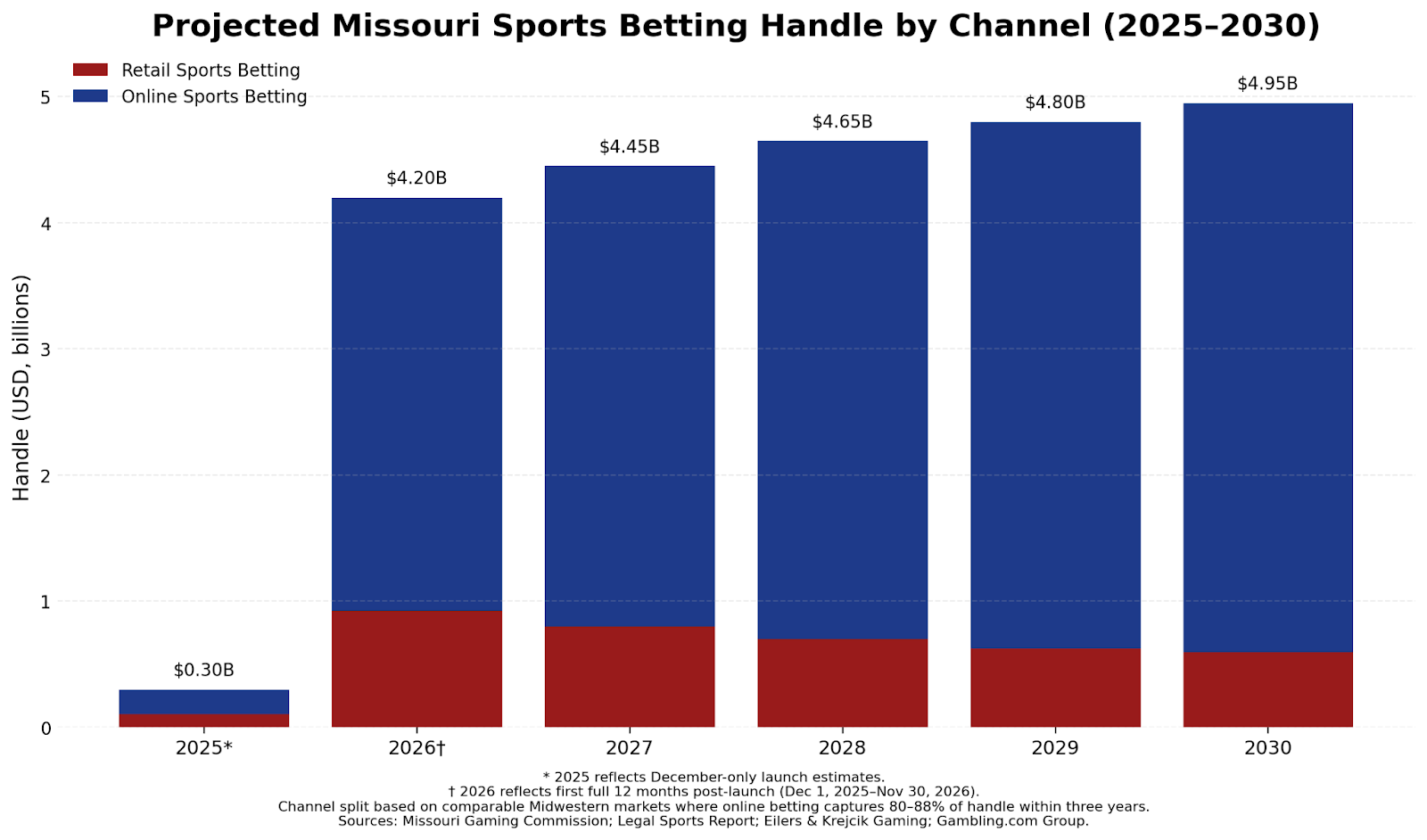
That concentration creates an unusual dynamic. A minimal number of licensed sportsbooks (two) are competing for a relatively broad pool of players, which tends to favour product quality, pricing discipline, and retention strategy over pure promotional spend. For the operators inside the market, namely DraftKings and Circa Sports, this can translate into healthier long-term economics once the initial launch phase settles.
Looking further ahead, there are also some early pressures worth noting. Missouri remains a casino-led gambling state with no regulated online casino or poker offering. As sports betting matures and state revenues become measurable, comparisons with neighbouring jurisdictions, particularly Illinois and Michigan, are likely to appear more frequently in political and financial discussions. Those states derive substantial tax revenue from iGaming, and while Missouri lawmakers have historically shown caution, the presence of a functioning online betting framework lowers the technical and regulatory barriers to future debate.
Cross-border dynamics add another variable into the mix. Missouri sits between multiple regulated markets, and player behaviour does not stop at state lines. Policymakers are already focused on leakage and competitiveness, particularly as mobile wagering normalises consumer expectations. That doesn’t guarantee legislative change, but it does shape the context in which future proposals are evaluated.
For independent operators, Missouri is not an expansion play today, but it is a market worth watching. The regulatory structure rewards stability, and political signals suggest that any future changes would be incremental rather than abrupt. For those prepared to engage early, build relationships, and track how the market performs in practice, Missouri now has a baseline from which the next phase of discussion will inevitably grow.
Market Pros and Cons for Operators
For independent online sportsbook operators assessing Missouri as a new live opportunity, the market’s appeal is inseparable from its constraints, making a balanced evaluation of advantages and disadvantages essential.
Market Advantages
✔ Freshly regulated online market
Early-stage market with no entrenched digital operators.
✔ Statewide mobile betting access
Immediate reach without reliance on physical casino locations.
✔ Strong local sports engagement
Consistent betting demand across professional and college sports.
✔ Clear constitutional mandate
Voter-backed framework reduces short-term legislative risk.
Market Disadvantages
X No iGaming or online poker
Limited cross-sell, retention, and lifetime player value.
X Severely restricted licence availability
Independent market entry effectively closed post-award.
X No realistic sublicensing pathways
Partnership options are tightly controlled.
X High competition for limited partnerships
Existing licensees prioritise established national sportsbook brands.
X Regulatory processes are still untested
Compliance expectations are likely to evolve post-launch.
X Political caution around gambling expansion
Further vertical expansion is unlikely in the near term.
X Cross-border competition remains strong
Illinois and Kansas retain established customer bases.
Building Success in Regulated US Sports Betting Markets
Success in regulated US sports betting markets invariably comes down to how well operators adapt to a tightly controlled, state-by-state regulatory environment that rewards operational discipline, compliance maturity, and long-term planning.
Across the US, several common themes consistently define market performance. Licensing frameworks are restrictive, often limiting the number of operators or tying market access to land-based partners. Regulatory oversight is active and enforcement-led, with close scrutiny of internal controls and conduct. At the same time, commercial pressure is intense. Customer acquisition costs remain high, promotional activity is closely monitored, and taxation, revenue-sharing arrangements, and compliance overheads commonly squeeze margins.
In this environment, technology choices matter. Operators need platforms that are flexible enough to meet variable state requirements, while remaining stable, scalable, and efficient under regulatory supervision. Risk management must be precise, adaptable, and transparent. Reporting needs to be accurate, timely, and audit-ready. Perhaps most importantly, compliance cannot be an add-on applied after launch. It must be built into your platform’s core architecture from day one.
This is where experienced technology partners make a measurable difference. Altenar supports operators in regulated US markets by combining configurable sportsbook technology with deep regulatory awareness. From jurisdiction-specific risk controls and reporting to scalable platform deployment and operational support, Altenar helps operators manage complexity without sacrificing performance.
As US sports betting markets continue to mature and consolidate, sustainable success will belong to operators that combine regulatory readiness with operational efficiency and long-term strategic focus. The next step is choosing the right foundation to compete effectively in that environment.
As US sports betting markets mature, execution matters more than ever. Book a private demonstration and discover how Altenar supports operators navigating complexity and margin pressures in regulated US states.
DISCLAIMER
This information is not intended to be legal advice and is solely extracted from open sources. It should not be relied upon as a substitute for professional legal advice, and Altenar does not accept any liability for its use.