
A decade ago, online betting meant a website, a wallet, and the ability to take a bet. Yet from where we are standing today, the next wave of technology feels different. Artificial intelligence is learning to predict behaviour in real time, blockchain is rewriting trust, immersive realities are blurring the line between play and presence, and payments move faster than the games themselves. And more to the point, these forces aren’t necessarily arriving separately. They’re converging.
This guide explores the four major technologies shaping the next generation of iGaming, and what operators must do now to stay ahead of the curve.
1. Artificial Intelligence
The Brain of Next-Gen Betting
In 2025, it is safe to say that artificial intelligence has moved well beyond hype in iGaming. Industry operators are already experimenting with AI to personalise player journeys, predicting churn before it happens, and keeping fraud in check. At its core, AI gives sportsbooks the ability to make smarter and faster decisions at scale. Ultimately, it turns raw data from features like betting slips, live odds, and player behaviour into actions that improve margins and engagement. With benefits on this scale, it’s no surprise that AI is increasingly becoming the brain of the platform.
Key Advancements Emerging from AI
-
Personalised betting recommendations that adapt in real time to player behaviour and preferences, increasing both retention and average session value.
-
Fraud detection systems that can identify suspicious activity across millions of bets, thereby reducing bonus abuse and transaction manipulation.
-
Churn prediction models that alert operators before a player leaves, triggering tailored retention campaigns or incentives.
-
Automated risk management tools that dynamically balance odds to secure sustainable margins even during volatile live betting events.
-
AI-powered chatbots and support agents that can handle routine queries instantly, freeing staff for higher-value player interactions.
Obstacles to Implementation
For all its promise, AI adoption requires careful implementation. Regulators are wary of algorithms that may influence vulnerable players toward harmful betting patterns, forcing operators to prove transparency and fairness. Furthermore, data privacy laws restrict how far personalisation can go, especially in tightly regulated markets.
In practical terms, there’s also the problem of bias. Models trained on incomplete or skewed data can lead to unfair outcomes. Implementation costs can be high, particularly when integrating AI into legacy systems. And without skilled oversight, the general lack of transparency in how models make decisions can create more compliance headaches than it solves.
2. Blockchain
The Ledger of Trust
Blockchain may have been born in finance, but its value to iGaming is fast becoming clear. On a fundamental level, blockchain provides transparency and integrity; two qualities gambling operators can never have enough of. By recording every transaction, bet, or outcome on an unalterable ledger, platforms can build trust with players and regulators alike. It also enables automation in the form of smart contracts that trigger payouts instantly, or loyalty tokens that move across products. Essentially, blockchain is about creating a system where fairness can be proven, and not just promised.
Key Advancements Emerging from Blockchain
-
Provably fair gaming systems that allow players to verify outcomes independently, boosting trust and reducing disputes.
-
Smart contracts that automatically process bets, payouts, and bonuses without human intervention to guarantee speed and accuracy.
-
Tokenised loyalty and rewards programs that enable players to earn, trade, or transfer value across multiple platforms, games, and betting activities.
-
Unalterable audit trails that simplify compliance reporting, offering regulators clear visibility into betting activity.
-
Cross-border crypto payments with lower fees and faster settlement, expanding access for players in multiple jurisdictions.
Obstacles to Implementation
Despite its appeal, blockchain adoption in iGaming faces plenty of real-world challenges. Scalability remains a key problem. Many networks struggle with the transaction volumes required by major sportsbooks. Regulators are also cautious, often viewing cryptocurrencies with suspicion due to volatility and links to money laundering.
For everyday players, blockchain can feel complex, and wallets, keys, and tokens remain barriers to mainstream adoption. On top of this, integrating blockchain systems with existing platforms requires significant investment and technical know-how. Until these hurdles are addressed, blockchain will remain more of a niche technology than a fully mainstream solution.
3. Augmented and Virtual Reality
AR & VR as the User Experience Layer
The idea of placing bets in a virtual world is no longer far-fetched. The technology already exists, even if it’s still in its early stages. After years of speculation, AR and VR are only now beginning to show real potential in shaping how players engage with iGaming platforms. Augmented reality can enrich the experience by overlaying live odds, stats, and prompts directly onto mobile screens or glasses, while virtual reality opens the door to fully immersive casinos, poker tables, and sportsbook lounges. As hardware evolves and adoption gradually expands, these technologies could make online gambling more interactive and community-driven.
Key Advancements Emerging from AR/VR
-
Virtual casinos and sportsbooks where players enter immersive 3D spaces, watch events, and wager in a shared digital space.
-
Augmented reality overlays that project live betting prompts, statistics, or visual enhancements directly into real-world match settings.
-
Social VR environments that let friends meet virtually for poker, slots, or sports betting, replicating the experience of real-world in-person play.
Obstacles to Implementation
Today, AR and VR remain in the early stages for gambling. Headset adoption is limited, hardware remains expensive, and comfort issues restrict use over longer sessions. And as with all emerging technologies, regulators are cautious of the potential threats too, especially with concerns that immersive experiences could heighten addictive behaviours or blur lines around responsible gaming.
The technical obstacles are also significant. Ultra-low latency and strong connectivity are prerequisites, without which the immersive promise falls flat. For these reasons, AR/VR continues to be a developing frontier that operators should watch closely, experiment with lighter AR applications, and prepare for a future where these technologies could move from novelty to mainstream.
4. Advanced Payments
The Lifeblood of iGaming
As all experienced operators understand, the smooth and trouble-free movement of money is as important as the games themselves. Players want and expect near instant deposits and withdrawals with options to suit their preferences, whether that’s fiat, crypto, or hybrid wallets. Suffice to say, payment technology is more than an add-on; it’s a competitive edge. Faster, safer, and more versatile payments increase trust, expand access to new markets, and keep players on side and on board. As global fintech innovation accelerates, iGaming stands to benefit from tools that make money flow as efficiently as gameplay.
Key Advancements Emerging from Payments
-
Instant settlement systems giving players near real-time deposits and withdrawals, and eliminating one of the major pain points in iGaming.
-
Cryptocurrency integration offering low-fee, cross-border payments that bypass local banking restrictions and expand operator reach.
-
Hybrid wallets allowing players to switch between fiat and digital currencies within a single account for greater flexibility.
-
Embedded fintech solutions providing tailored credit, micro-betting support, and responsible spending controls built directly into payment flows.
-
Stronger fraud prevention and AML tools powered by AI, ensuring compliance while protecting both operators and players.
Obstacles to Implementation
Despite the desire for smooth transactions on all sides, advanced payments in gambling face several challenges. Crypto remains volatile, and regulators are divided on how to treat it. Some embrace it, while others restrict or ban its use. Compliance with anti-money laundering (AML) and know-your-customer (KYC) requirements can slow onboarding and frustrate players, presenting an obstacle that’s difficult to overcome.
Payment providers themselves can become part of the problem, with costs, settlement delays, or geographic restrictions limiting choice. On top of this, consumer trust in this area can be fragile. A single failed withdrawal can undermine a brand.
Tech Type Summary
Technology Opportunities Limitations Implication Artificial Intelligence Personalisation, fraud detection, risk management Regulation, privacy, bias, cost Use AI responsibly to enhance margins Blockchain Fair gaming, smart contracts, crypto payments Scalability, regulation, complex UX Build trust with targeted pilot projects AR/VR Immersive play, social betting, live overlays Hardware cost, low adoption, and latency Experiment small, prepare for growth Advanced Payments Instant settlement, hybrid wallets, crypto payments Volatility, AML/KYC, trust issues Diversify payment methods and tech
The Power of Tech Convergence
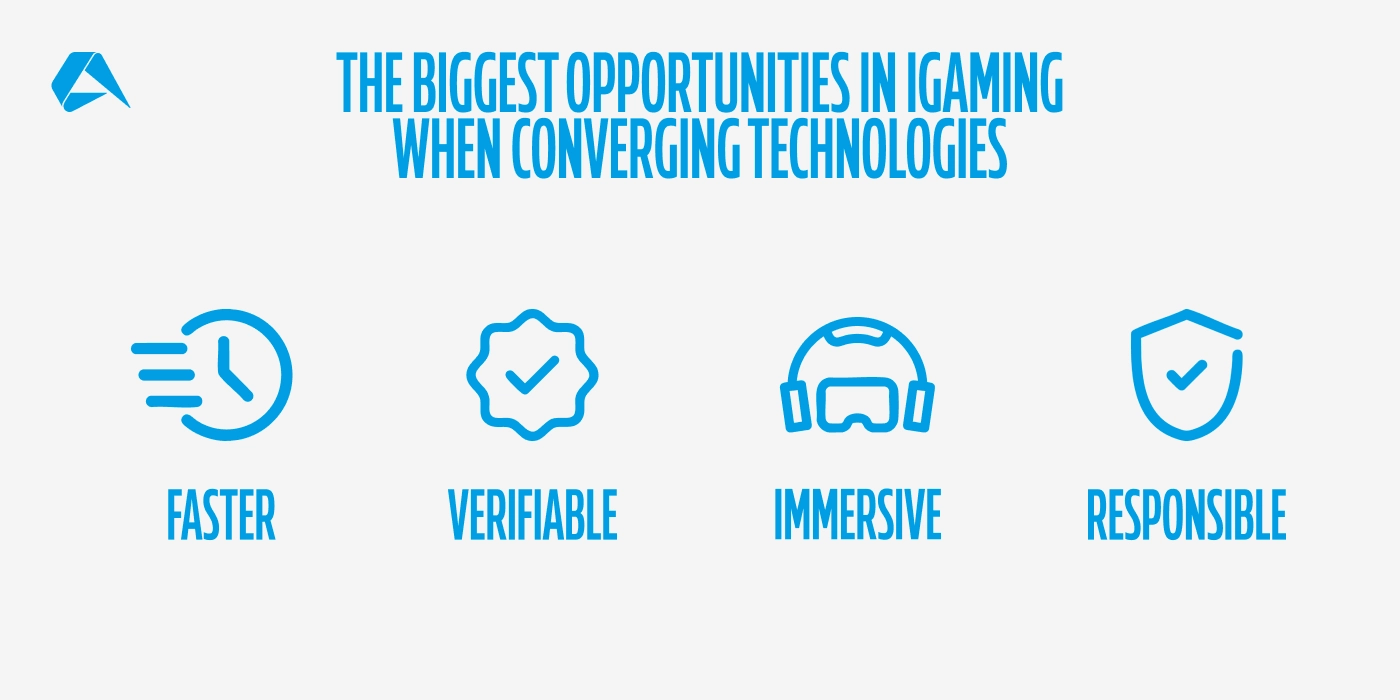
From the above, it’s easy to see that each evolving digital technology has the potential to reshape iGaming. But the real breakthroughs will happen when these technologies overlap. These convergences are where operators will find the most significant opportunities and complex challenges beyond their initial rollout.
Take AI and blockchain, for example. On their own, AI can analyse player behaviour while blockchain secures ledgers (records). Together, they create a system where predictions and outcomes are not only fast but also verifiable. In the future, it is more than feasible that an operator could use AI to detect fraudulent activity and then log every flagged transaction, giving regulators an instantly audited trail and players visible proof of fairness.
Or, let’s consider the potential convergence of AR/VR and payments. Pairing augmented and virtual experiences with instant, integrated fiat and crypto wallets can ensure players never have to step out of the moment. Imagine watching a live match in VR, with stats projected around you, placing a bet via a payment prompt that clears in seconds. The bet then becomes part of the experience, not an interruption.
Yet AI and payments have the potential to form another powerful link. Predictive analytics can identify when players are about to wager beyond their means, and trigger payment-level interventions that support responsible gambling. The same systems can also optimise micro-bets in live scenarios, offering personalised limits and instant settlements tailored to each player’s history.
And then there’s infrastructure. Convergence demands scale in as far as AI needs to compute, VR needs low latency, blockchain needs throughput, and payments need uptime. Without a strong foundational backbone, the convergence of these technologies will falter without foundational stability.
These are just a few instances of many potential applications showing that future success won’t just come from isolated experiments. It will come from connecting technologies so that the whole becomes greater than its parts. Platforms that integrate intelligently across AI, blockchain, AR/VR, and payments will create new features, experiences and standards that’ll reshape the industry.
The Infrastructure Backbone
The next generation of iGaming technology comes with one shared dependency - the infrastructure that makes it work. Without a strong and advanced infrastructure, the promise of AI, blockchain, AR/VR, and advanced payments will not realise its full potential. Latency, downtime, or bottlenecks in processing frustrate players, weaken trust, and kill engagement. Infrastructure is rarely glamorous, but it is the difference between a platform that maintains stability under pressure and one that buckles. To this end:
Cloud infrastructure gives operators the elasticity they need. When a major sporting event drives a sudden surge in live bets, cloud resources can expand instantly to meet demand, keeping systems stable without overinvesting in redundant capacity. It also enables faster product rollouts, smoother integrations, and more resilient disaster recovery.
Edge computing takes this further by moving processing power closer to the player. For live betting, this means lower latency and faster odds updates. For immersive AR/VR environments, it is essential for securing a smooth performance by reducing the lag that can disrupt the experience.
5G connectivity ties it together by delivering the bandwidth and reliability required for mobile-first gaming. Ultra-low latency connections allow players to stream, interact, and bet simultaneously, no matter where they are.
The Competitive Advantage in Tomorrow’s Market
Perhaps the real question operators should be asking in 2025 is not what technology to adopt, but what kind of business they want to become once they do. AI, blockchain, AR/VR, and advanced payments aren’t side projects. Ultimately, these are up-and-coming developments that expose how ready (or unready) a company truly is.
And here’s the hard truth. Every operator will eventually have access to the same tools. Instant settlement, predictive analytics, and provably fair games. None of these are defensible advantages once they go mainstream. The real edge, therefore, comes from how they are applied, and whether they reshape the culture of decision-making behind the platform, because technology doesn’t mask weak strategy -it magnifies it.
There’s also a danger in doing nothing. Players are unforgiving when their expectations change. Once fast and efficient withdrawals are experienced elsewhere, what once felt like a bonus quickly becomes an expectation. At that point, failing to keep pace risks reputational damage, among other things.
Competitive advantage in tomorrow’s market will belong to the operators who treat technology as much more than an upgrade, but as a redefinition of what their platform is built to do, like build trust, deepen engagement, or create entirely new experiences. Treat technology like a bolt-on, and you’ll look like everyone else. Use it to rethink the purpose of your platform, and suddenly, you'll be competing on a level others will struggle to reach.
Technology Providers Shaping the Future
For all the talk of AI, blockchain, immersive experiences, and advanced payments, one truth stands out. Few operators can access all of these technologies alone. The pace of innovation, the scale of investment, and the complexity of compliance require advanced partners who live and breathe technology. iGaming providers are the ones who translate abstract potential into real-world platforms, balancing ambition with stability, and innovating responsibly within regulatory frameworks.
Their role is not just technical. A responsible provider becomes an operator’s performance optimiser, deciding which innovations are viable, how they should be integrated, and when the market is ready.
Few providers understand this balance better than Altenar. The operators we work with expect more than tools and innovation. They expect Altenar to guide, build, and scale at the right time at the right pace, while helping operator partners harness tomorrow’s tech today.
There is no doubt that the digital forces shaping iGaming are converging fast, so the question is simple. Will you be ready to compete on tomorrow’s terms?
Experience the convergence of iGaming technologies through Altenar’s sportsbook platform. Book your demonstration now and unlock the competitive edge that tomorrow’s market will demand.