
The odd thing about the ‘crowded markets’ concern many have is that operators don’t really notice the crowd initially. But what tends to stand out, oddly enough, is how little their sportsbook stands out, with dozens of brands offering the same odds, the same bonuses, the same everything. You can almost predict the flow of a sportsbook journey, which tells you something.
In real terms, this isn’t a battle for space. There’s plenty of room for those who have the resources and vision. It’s a battle against the feeling that every sportsbook could trade places with the next, and nobody would bat an eyelid.
So what’s the problem? The foundations are shared across the industry. Identical feeds, matching props, generic promotions. All good ingredients on their own, of course, but often not enough to stand out when everyone is feeding from the same pantry.
And yet, despite that, some operators still manage to become the ones players remember. Typically, because they commit to identity. A style, a voice, a way of placing the player front and centre that feels different from the rest. Once you see that, the way forward in a saturated market starts looking entirely workable.
Why Standing Out Matters More Than Ever
You can trace most of today’s retention problems back to a basic understanding that players don’t form attachments to sportsbooks in the way they used to. The product became somewhat standardised and predictable, unintentionally teaching bettors that loyalty doesn’t buy them much. So they behave accordingly.
That’s the angle many miss when talking about market saturation. It isn’t the number of operators that’s the issue. It’s the lack of differentiation that rewires behaviour. Acquisition, retention, and even reactivation are effective, but sometimes little in the experience gives players a reason to return.
There’s also another layer to this. Regulators are tightening promos, banning certain incentives, and capping others. So the old method of buying loyalty with sportsbook bonuses is collapsing. Operators now have to build loyalty through product and identity, not giveaways. It’s a more challenging path, for sure, but a more sustainable one.
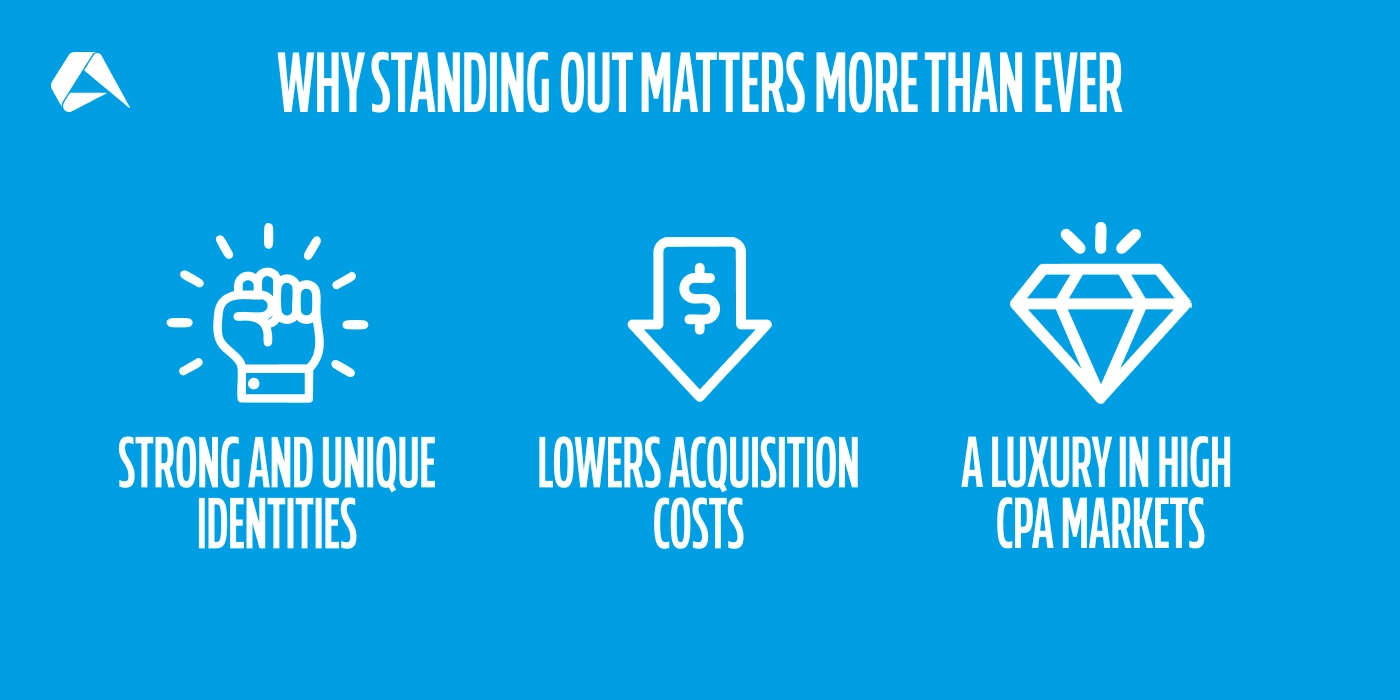
And this is why standing out matters. Markets these days are punishing neutrality. Bettors remember strong and unique identities. When a sportsbook is built for someone, not everyone, the numbers start reflecting the effort you’ve put in.
A few things tend to become clear once you look closely:
-
Players stick with brands that feel different, not just look different.
-
Identity reduces churn far more reliably than promotions.
-
A recognisable product cuts acquisition costs because players remember it.
-
Standout products attract organic traffic because they’re a luxury in high-CPA markets.
Top Tips for Differentiation
So what are the practical steps that operators can take now to differentiate from the crowd? In almost all instances, it usually comes down to a handful of decisions about how a sportsbook feels, behaves, and earns loyalty that turn a sportsbook from forgettable into familiar:
Unique Offerings
Give Players Something They Don’t Get Everywhere Else
Differentiation often starts in the most obvious place - the betslip itself. Evidence strongly suggests that players notice when a sportsbook shows a bit of personality in its pricing or market selection, even if they don’t articulate it. Distinctive pricing on the leagues that players track most often leaves a memorable impression, offering the sense that ‘this is the place I check first’ for this sport.
Exclusive props work in the same way. A market no one else bothers to price, or a twist on a familiar bet type, can give bettors something to talk about. And that matters. Word of mouth still drives a surprising amount of traffic in betting, especially among niche communities.
Niche sports are another avenue plenty of operators still overlook. UFC prelims, lower-league football, and esports micro-markets are pockets of interest where loyalty forms quickly. McBookie is a good example of how powerful this can be. By putting Scottish football above English football on their site, they sent a simple message saying this book is built for Scotland. It is a small design choice, but one that instantly tells bettors where they belong.
Unique offerings usually don’t need to shout for attention, they just need to feel intentional.
Localisation With Intent
The Fastest Way to Build Differentiation
Localisation gets talked about a lot in this industry, though often in a surface-level way, meaning a translated interface here, a regional payment method there, etc. All of which are useful, but rarely enough to make a player feel like the sportsbook was built with them in mind. Real localisation goes deeper than that. It tells the bettor, often subconsciously, that this place understands their sporting environment.
A typical example of this would be prioritising regional leagues. Not buried in menus, but right where local players naturally look. It sounds simple because it is, and it changes behaviour. The same goes for language. A bit of local slang or terminology, or a joke only that audience would get, can also make an impact. Most operators underestimate how quickly players pick up on that.
Push notifications are another option. Aligning them with local match moments creates a flow that mirrors how fans actually follow their teams. It’s a small detail, though it tends to matter.
Partnerships help too - think local clubs, podcasts, fan communities, etc. When a sportsbook shows up locally, it builds trust faster than any promo can achieve.
McBookie proves the point again. Their decision to place Scottish football above English football isn’t complicated. It’s intentional. And bettors immediately recognise that. In a market full of global templates and standards, properly localised products get noticed, and players stick with what feels familiar.
User Experience
Fast, Light, Mobile-First and Built for Real Behaviour
Ask an operator where UX earns its keep, and they’ll usually point to metrics and KPIs. Players answer the question very differently. They remember the bet they tried to place, but couldn’t. That’s where a sportsbook’s real quality shows.
Instant bet placement is usually the first thing players judge. A slight delay can feel like a long time in live play. Stable live odds come next. When risk management in sports betting does its job well in odds management, players barely notice. They just experience markets that behave the way they should.
Then there’s the part operators sometimes forget. Not every player is running a high-end device on super-fast Wi-Fi. A sportsbook that loads smoothly on older phones gains an advantage no amount of marketing can buy. And somewhere underneath it all, the security needs to feel trustworthy without slowing the player down. That balance is more complicated than it looks.
When a product gets these things right, bettors stick around because it feels easy, and ease of use can be one of the strongest forms of differentiation in a crowded market.
Personalisation
Moving Towards Actual Relevance
Personalisation is another feature that typically gets thrown around so casually that it’s almost lost its meaning. Sometimes, players barely notice it, because what they get is just segmentation dressed up as something more innovative.
Real personalisation behaves differently. It is a tailored market that appears at the right time because the player always backs corners, or something like a bet builder that adapts to the combinations they favour. Better is a recommendation shaped by actual bet history. It’s subtle enough that most bettors won’t call it personalisation, they just feel like the sportsbook understands them.
Timing is a big part of it. Behavioural timing tends to work better than generic promotions. A player who usually wagers 10 minutes before kick-off doesn’t need a lunchtime nudge. When an offer arrives at the moment they’re already thinking about it, it feels timely rather than intrusive. Another overlooked factor is decision fatigue. Players don’t need the full catalogue of options every time they open the app. Personalisation narrows the view, keeping the experience focused on what they genuinely bet on.
When done well, personalisation becomes identity. A sportsbook feels familiar in a way others don’t.
Loyalty That Feels Like a Relationship
In many ways, the concept of loyalty in sportsbooks has never quite matched the reality. Operators talk about it, everyone spends money on it, yet few players would describe it as something that keeps them loyal in any real sense. Yes, they see the point ladders and the same monthly challenges dressed up slightly differently. It works, but only in the mechanical sense. That’s to say, players claim the rewards, hit the milestones, and move on.
The programmes that actually create stickiness behave differently. They feel more like a relationship than a rewards system. Real-world perks help a lot, not just free bets, but things that pull players a little closer to the sport itself, like a ticket to a midweek fixture or a VIP experience that becomes a moment they’ll remember. Operators that invest in experiences like this often notice stronger retention.
Gamification helps too, though only when it’s rooted in fan culture and aligns with how fans naturally follow their sports. Completing a derby-day challenge, for example, works better than climbing yet another abstract ladder.
Marketing & Engagement
Look Beyond Ad Spend
Most operators pour money into marketing because it’s measurable, fast, and familiar. Fair enough. But the brands that actually build staying power tend to do something a little different. They create places where players want to spend time, not just places to bet. It’s a subtle distinction, though once you see it, you can’t unsee it.
Influencer micro-communities are a good example. Not the big celebrity deals that drain budgets, but the smaller voices with tight followings, like the podcast host, the match-day vlogger, or the tipster with a loyal Telegram group. These pockets of influence behave more like extended fan circles than advertising channels, and players trust them in ways traditional campaigns can rarely achieve.
In addition, match-day storytelling helps too. Bettors respond to context, especially when it feels like someone’s watching the game with them. The same applies to social betslips, which is a small feature that turns betting into something shareable rather than solitary. And once people start sharing, identity spreads on its own.
Prediction leagues add another dimension. They create routine, a reason to return, a bit of friendly rivalry. It's a community disguised as a feature. Creative social formats do the same, often packaged as quick polls, banter-led posts, and lightweight challenges. None of it feels like marketing, and that’s precisely why it works.
The point is this. When a brand becomes part of the culture around the sport, it becomes something people talk about, and in this industry, that’s hard to buy.
Customer Support
Help That Feels Human, Even Under Pressure
Consider the authentic moments in customer support. We’re talking about the late-night query that gets answered quickly and the support agent who actually understands the issue, rather than reading from a script. These small interactions carry more weight than some operators realise.
Fast withdrawals are a big part of it, too. Players appreciate the books that pay out without fuss, and remember them, especially when the stakes are small and the process should be simple. It’s one of the quickest ways to build trust, and one of the fastest ways to lose it. The same goes for proactive support during big fixtures, even something as simple as alerting users to expected delays matters.
So what’s the takeaway? When players feel looked after, they stay. Quality support is a sign that the sportsbook is reliable under pressure. Trust grows quietly, and once a player trusts you, it’s far harder for a rival to tempt them away.
Innovation
Staying Fresh To Stay Remembered
Innovation in sportsbooks isn’t always the headline-grabbing stuff. Most of the time, it’s the small improvements that make the product feel alive. Live mode switching is a good example. The ability to switch into an in-play view instantly, without the lag or awkward reloads, is a big deal when it’s most needed. The same goes for micro in-play markets. Quick, reactive prices tied to short windows of play give the product a sense of energy, especially for bettors who thrive on fast decisions while betting responsibly.
Personalised dashboards help in a different way. They take all the clutter out and give players a space that feels like their own. And when AI tools for sports betting automatically identify the right markets, the whole product feels more responsive without adding complexity. Integrated feeds add another twist. Instead of jumping to social media for context, players get bite-sized insights, updates, or clips right inside the app.
Faster live bet flows tie it all together. When every step goes smoothly, innovation becomes momentum. And in a market where so many products sit still, the brands that keep moving tend to stay at the forefront in people’s minds.
The Competitive Edge Comes From Identity
If there’s a single thread running through all of this, it’s that the iGaming market has grown too mature for copy-and-paste strategies. Operators aren’t short on features, markets, or promotional tools, especially when they are partnered with high-level B2B iGaming providers. They’re largely short on originality, the kind of individuality and character that players actually notice. That’s what today’s bettors respond to.
The brands that perform well in the long term are those that commit to a target audience and tailor their products to suit them. Localisation done well makes that obvious. A touch of emotional loyalty makes it feel personal. Strong UX turns it into a habit. Innovation keeps it moving. None of these pieces need to be spectacular on their own, but together they give a brand a foundation players recognise instantly, even if they can’t pinpoint why.
And in a market where sameness is still the default, recognition becomes its own competitive edge. Players stay with the sportsbook that aligns with how they follow and bet on sports. For operators willing to build with that in mind, saturation stops looking like a mountain to conquer.
A strong identity wins in crowded markets. Schedule a demonstration with Altenar, and discover sportsbook software solutions built to create relevance, recognition, and experiences players actually remember.