
Overview Gambling Laws and Market Realities in Oregon
Oregon has established a unique state-controlled gambling market that prioritises public oversight over commercial expansion. Since the state lottery was legalised in 1984, Oregon has adopted a "nationalised" approach, with the Oregon Lottery managing traditional games and a vast network of video lottery terminals (VLTs). Currently, online sports betting operates as a monopoly via the Lottery’s exclusive partnership with DraftKings, while land-based casinos and retail sportsbooks remain the exclusive right of federally recognised tribes.
While the market is currently "closed" to private operators with no commercial licences available, demand is high; sports betting handle already exceeds US $800 million annually. Although the framework remains restrictive, recent legislative reviews indicate that policymakers are evaluating current revenue-sharing and operational structures. Oregon remains a stable, tightly regulated environment defined by its commitment to public funding and tribal sovereignty.
Read the blog below for more details on Oregon’s evolving regulatory landscape and market opportunities.
When most operators think of US gaming markets, they often picture open licensing and fierce competition. Oregon’s gambling market, however, tells a different story. Controlled by the state, protected by tribal compacts, and firmly closed to private operators, it’s a market built on exclusion rather than competition.
But that doesn’t mean it should be ignored. Understanding Oregon’s public-first sportsbook model, tribal exclusivity, and slow-moving legislative shifts can offer valuable lessons and perhaps a glimpse of future change. In this report, we explore how gambling works in Oregon today and why it’s still worth watching.
DISCLAIMER
This information is not intended to be legal advice and is solely extracted from open sources. It should not be relied upon as a substitute for professional legal advice, and Altenar does not accept any liability for its use.
The History of Controlled Gambling Growth in Oregon
Few US states have approached gambling as selectively or as strategically as Oregon. Long before the neon glow of state-run Video Lottery Terminals, the 19th and early 20th centuries saw gambling flourish quietly in Portland’s back rooms and public houses. But that all changed when early reformers, driven by moral concerns, moved decisively to exclude it from the state’s regulated economy. Their efforts didn’t just restrict gambling. They effectively erased it from Oregon’s legal market.
That prohibition lasted for much of the 20th century. But like many states, Oregon’s financial realities caught up with its political caution. In 1984, facing economic strain, voters chose to legalise the Oregon State Lottery. The necessity wasn’t entertainment, it was revenue. A new constitutional amendment gave birth to a tightly controlled, state-run gambling model designed to fund schools, parks, and other public programmes.
Initially, the Lottery kept it simple with scratchcards and weekly jackpot draws, such as Megabucks. But the 1990s saw a gradual transformation. In 1992, Oregon introduced Video Lottery Terminals (VLTs) across licensed venues, representing a significant development. These weren’t private slot machines, but rather state-owned assets, operated under public oversight, and marketed as a safer, more controllable answer to illegal poker machines that had prospered for decades. By the early 2000s, VLTs were generating hundreds of millions annually for state coffers.
Yet Oregon State wasn’t the only player expanding its reach. Following the passage of the federal Indian Gaming Regulatory Act (IGRA) in 1988, Oregon’s tribes began negotiating compacts to establish their own casinos. Unlike the Lottery’s monopoly, however, tribal gaming offered classic casino floors with table games, slots, and later, on-site sportsbooks, each operating under sovereign rights and state agreements.
By the time mobile sports betting launched in 2019, controlled exclusively by the Lottery via DraftKings, the pattern was clear. Oregon hadn’t liberalised gambling. It nationalised it.
Timeline of Key Historical Events
Here’s a timeline highlighting some of the most significant moments in Oregon’s gambling legislation and regulatory development.
1984: Voters approve State lottery via a constitutional amendment
1985: Launch of scratchcards and first Megabucks jackpot draw
1988: Oregon joins Multi-State Lottery Association (Lotto America)
1991: Keno introduced across licensed retail locations statewide
1992: Video lottery terminals deployed under state control
1993: First tribal gaming compact signed with Grand Ronde tribe
2001: VLTs exceed $500 million in annual net revenue
2009: State police formally tasked with tribal gaming oversight
2018: Oregon Lottery begins to develop legal online sportsbook
2019: DraftKings selected as exclusive mobile betting operator
2022: Lottery sports betting revenue surpasses $50 million annually
2024: Oregon enacts new consumer data privacy law for operators
How Gambling Works in Oregon Today
In many ways, Oregon’s current gambling framework is a natural extension of its history. Having built its industry around state ownership and tribal agreements, the state has maintained a deliberately controlled market that prioritises public oversight over commercial expansion.
At the heart of this system sits the Oregon Lottery, which continues to dominate gambling activity across the state. Traditional draw games, keno, and an extensive network of state-owned video lottery terminals (VLTs) continue to be the primary sources of revenue. These units, scattered across licensed venues such as bars and restaurants throughout the state, are not privately owned. They’re owned and managed by the state itself, generating around US $1.18 billion in net sales annually. Profits flow directly into public services, with recent years seeing record transfers of nearly US $947 million to state funds.
When it comes to sports betting, the same principle applies. Oregon has resisted the open-licensing approach seen in states like New Jersey or Colorado. Instead, online wagering operates as a monopoly, controlled by the Lottery and delivered exclusively through DraftKings Sportsbook. Bettors aged 21 and over can place mobile bets on professional sports, though restrictions apply and wagering on local college teams remains off-limits via the app.
For land-based sports betting, Oregon’s federally recognised tribes play a key role. Several offer retail sportsbooks within their casino venues, operating under Class III tribal-state compacts. While these facilities offer a broader range of sports markets, they’re confined to in-person betting on tribal lands.
Advance Deposit Wagering (ADW) on horse racing adds a niche but substantial vertical, regulated separately by the Oregon Racing Commission. Despite its lower profile, Oregon processes some of the highest ADW volumes in the nation.
In practical terms, Oregon presents a closed environment for potential operators. With no commercial casino sector and a state-run model dominating both sports betting and VLT gaming, entry points remain tightly controlled. For players, however, the system offers a highly regulated, legally secure betting environment, with winnings above US $600 taxed as standard income.
Understanding Oregon’s State-Controlled Sports Betting Model
Unlike open licensing states where multiple operators compete, Oregon’s model is built around a single authorised provider: DraftKings. This arrangement exists because sports betting falls under the authority of the Oregon Lottery, which has the exclusive right to offer mobile and online wagering under state law.
Originally, the Oregon Lottery operated its own sportsbook platform, called Scoreboard. In 2022, it pivoted to a partnership model, selecting DraftKings as its sole authorised sportsbook provider. DraftKings now powers the state’s only legal mobile betting app, operating not as a licensed independent operator but as a contracted vendor to the Lottery itself.
The implications for private operators are clear. There is no licensing process. No competitive bidding is in place for multiple sportsbooks. Oregon’s sports betting framework treats online wagering as an extension of state lottery operations rather than a competitive commercial market. This model channels all revenue through the Lottery, which in turn returns funds to state programmes.
Unless the state revisits its legal framework, operators seeking access to Oregon’s online betting sector will find the door firmly closed, except perhaps as prospective suppliers to the Lottery itself.
Who Oversees What in Oregon?
A small number of specialised authorities governs Oregon’s gambling sector. Each plays a distinct role in regulating state-run gambling, tribal casinos, pari-mutuel racing, and charitable gaming, working collectively to maintain legal integrity and operational oversight across the industry.
Oregon Lottery Commission
The Oregon Lottery Commission is the central authority responsible for regulating and managing all state-run gambling activities. Its remit covers the operation of draw games, keno, and the widespread network of state-owned video lottery terminals (VLTs), which are deployed across licensed venues throughout the state. Perhaps most significantly, the Commission holds exclusive oversight of Oregon’s state-controlled sports betting market, managing the partnership with DraftKings that powers the state’s only mobile sports betting platform.
Beyond direct operational control, the Commission is tasked with financial oversight, ensuring that lottery proceeds are channelled into public funds supporting education, state parks, veterans’ services, and responsible gambling initiatives. In its broader scope, the Commission sets strategic policy, approves budgets, and acts as the regulatory body for Oregon’s entire state-operated gambling sector.
Oregon State Police Gaming Division
The Oregon State Police Gaming Division enforces regulations and compliance within the state’s tribal gaming sector. Its primary role is to oversee the operation of Class III casino gaming conducted by Oregon’s nine federally recognised tribes, under the provisions of their individual tribal-state compacts. The Division conducts background investigations on vendors and key gaming personnel, reviews the suitability of licensing, and performs compliance checks across tribal gaming facilities.
It also monitors revenue reporting and enforces compact terms, working in coordination with both tribal regulators and the National Indian Gaming Commission. Unlike the Lottery Commission, the Division does not regulate state-run gambling activities. Its focus is exclusively on maintaining integrity and lawful operation within Oregon’s sovereign tribal gaming sector.
Oregon Racing Commission
The Oregon Racing Commission (ORC) was established in 1933 to regulate all pari‑mutuel horse racing and wagering activity in the state. Its five‑member board, appointed by the governor and confirmed by the Senate, issues licences for race meetings, participants (trainers, jockeys, veterinarians), off‑track betting hubs, and Advance Deposit Wagering platforms.
The ORC ensures comprehensive oversight of all wagering operations, race meet licensing, participant compliance, and animal welfare standards across the state’s regulated racing sector. This includes licensing procedures such as fingerprinting and criminal background checks. At the same time, day-to-day enforcement is handled by stewards and investigators, who oversee race conduct, wagering compliance, and safety measures. In essence, the ORC balances public confidence, industry integrity, and the economic health of Oregon’s horse racing sector.
Oregon Department of Justice – Charitable Gaming Division
The Charitable Gaming Division of the Oregon Department of Justice oversees non-profit gambling events, primarily bingo, raffles, and Monte Carlo-style functions, under ORS Chapter 464 and OAR provisions. The Division licenses eligible non-profit organisations and regulates the equipment and venues used for charitable gaming. Its responsibilities include reviewing licence applications, monitoring prize limits, overseeing the distribution of proceeds, and conducting inspections to ensure ongoing compliance.
In addition, the division investigates complaints, can suspend or revoke licences, and takes enforcement action, ensuring events serve genuinely charitable objectives. By maintaining transparent rules and oversight, it helps community organisations raise funds lawfully while safeguarding participants. In doing so, the Division supports both social benefits and integrity within Oregon’s niche charitable gaming sector.
The Role of Tribal Casinos and Compacts
Tribal casinos form the foundation of the physical gambling sector in Oregon. Unlike many US states, where commercial casinos dominate, Oregon’s constitutional ban (Article XV, Section 4(10)) on private casinos has placed federally recognised tribes at the heart of land-based gaming. Today, nine tribes operate casino facilities across the state under Class III compacts negotiated with the state government and governed federally by the Indian Gaming Regulatory Act (IGRA).
The nine federally recognised tribes in Oregon are as follows:
-
Burns Paiute Tribe
-
Confederated Tribes of Coos, Lower Umpqua & Siuslaw Indians
-
Confederated Tribes of the Grand Ronde Community of Oregon
-
Confederated Tribes of Siletz Indians
-
Confederated Tribes of the Umatilla Indian Reservation
-
Confederated Tribes of Warm Springs
-
Coquille Indian Tribe
-
Cow Creek Band of Umpqua Tribe of Indians
-
Klamath Tribes
These compacts allow the operation of casino table games, slot machines, video poker, keno, and in-person sports betting, all within the boundaries of tribal land. In effect, tribes hold exclusive control over Oregon’s retail casino and retail sportsbook sectors. Each compact also establishes operational guidelines, licensing conditions, and revenue-sharing models between individual tribes and state agencies. Oversight responsibilities are shared between tribal gaming commissions and the Oregon State Police Gaming Division, which handles enforcement and conducts vendor suitability checks.
While these tribal venues are not open to private ownership or direct commercial partnerships, they do offer indirect opportunities for certain suppliers. Technology vendors, payment processors, and content providers can engage with tribes as B2B partners, subject to compact permissions and tribal approval processes.
In short, for any operator eyeing Oregon, understanding the sovereignty and exclusivity of tribal gaming is essential. Without reform, these tribal compacts will continue to define Oregon’s retail gambling sector for the foreseeable future.
Future Outlook – Opportunities or a Locked Market?
For private iGaming operators, Oregon represents one of the most closed gambling markets in the United States. Its public-first model, anchored by the state-run Lottery and federally protected tribal casinos, leaves little room for external competition. Dissimilar to liberalised states where commercial licences are available, Oregon maintains control of its gambling sector through direct operation and compact agreements.
Currently, online sports betting remains under a state-controlled monopoly. The Oregon Lottery’s partnership with DraftKings offers bettors a single mobile sportsbook, with no current route for rival platforms to enter the market. Retail sports betting is similarly exclusive. Only tribal casinos can offer in-person wagering, under compacts that continue to protect their operational rights.
For potential entrants, the message is clear: Oregon is currently not open for business.
Yet, the picture isn’t entirely static. In early 2024, state lawmakers began evaluating the revenue-sharing structures between the Oregon Lottery and tribal operators, as well as the Lottery’s broader operational remit. Although no legislation has advanced, this review suggests that policymakers are, at the very least, reconsidering the current balance of control. Whether this leads to meaningful reform is uncertain, but operators would be wise to monitor legislative updates over the next 12 to 24 months.
If Oregon were to liberalise its gambling market, the commercial opportunity could be significant. Based on the performance of the current Lottery and DraftKings, total sports betting handle has already exceeded US $800 million annually despite single-operator restrictions. Opening the market to multiple sportsbooks would likely drive substantial growth, potentially doubling total handle over time, in line with mid-tier US states.
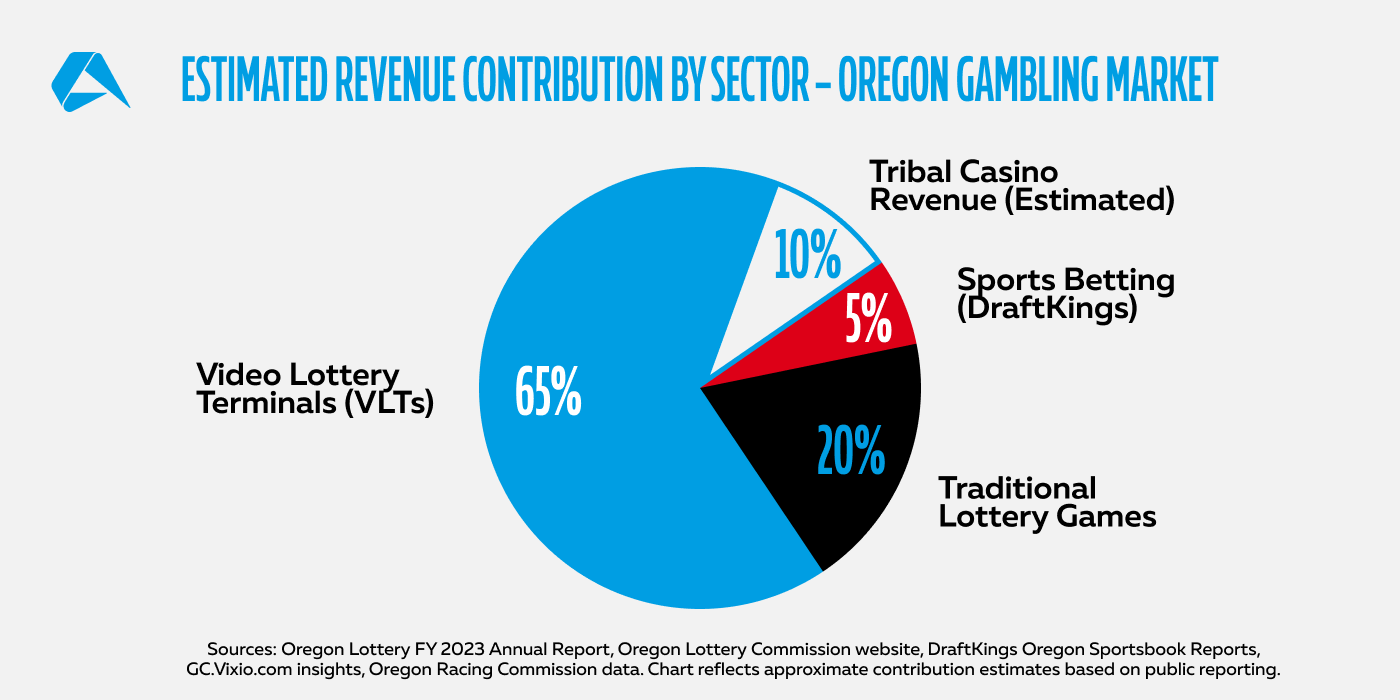
Similarly, the absence of commercial casinos masks underlying demand. With a population of around 4.3 million and a well-established betting culture via VLTs and Lottery products, Oregon could feasibly sustain several commercial operators across both sports and casino verticals if constitutional restrictions were lifted. For now, however, this remains theoretical, and operators should treat Oregon as a future-watch state rather than an actionable target.
Key Advantages and Barriers for Operators
Oregon’s gambling sector offers few practical openings for private operators. Below, we outline the market’s structural strengths and the key restrictions limiting commercial access across all verticals.
Market Advantages
-
Established Betting Culture
State lotteries, VLTs, and tribal casinos generate consistent player engagement.
-
Proven Demand for Sports Betting
DraftKings’ exclusive handle exceeds US $800 million annually in a single-operator market.
-
Regulatory Stability
Long-standing legal frameworks offer predictability and limited regulatory volatility.
-
Strong State Infrastructure
Good internet penetration and mobile betting adoption across the adult population.
Market Disadvantages
-
No Commercial Licences Available
Sports betting and casino verticals are closed to private operators.
-
State-Controlled Monopoly Model
The Oregon Lottery controls online betting, limiting market access.
-
Tribal Exclusivity for Retail Gaming
In-person casino and sportsbook operations are restricted to tribal facilities.
-
Constitutional Ban on Commercial Casinos
Legislative reform would be required to permit commercial gambling.
-
Minimal Competitive Opportunities
Entry paths are limited to supplier/vendor contracts or tribal partnerships.
-
Low Political Appetite for Liberalisation
Recent legislative reviews have focused on revenue allocation, rather than market expansion.
Is Policy Change Coming to Oregon?
While Oregon’s gambling sector remains firmly closed to private operators, subtle developments are unfolding behind the scenes. In 2024, the state legislature initiated a formal study, via House Bill 3154, to examine revenue-sharing structures between the Oregon Lottery and the state’s tribal casino operators. The review aimed to assess whether existing financial arrangements still serve the state’s public interests and whether tribal benefits remain balanced. The report, initially due in September 2024, has yet to be publicly released.
However, related developments emerged in December 2024, when the Oregon Lottery published its Tribal Relations Activity Report, detailing consultation efforts and ongoing dialogues with Oregon’s nine federally recognised tribes. While the report focuses on tribal engagement rather than structural reform, its publication confirms that discussions between state and tribal stakeholders remain active.
For operators, this signals a policy environment that, while outwardly static, is undergoing quiet internal review. Although no formal recommendations or legislative proposals have surfaced, the state’s focus on financial recalibration and operational oversight suggests that its monopoly structure is being reconsidered, at least in principle.
While Oregon remains closed, America isn’t. Book your private software demonstration today and discover how Altenar’s sportsbook platform can power your US expansion.
DISCLAIMER
This information is not intended to be legal advice and is solely extracted from open sources. It should not be relied upon as a substitute for professional legal advice, and Altenar does not accept any liability for its use.