

Overview Do You Need a Licence When Using a White Label Sportsbook or Online Casino?
Launching a successful sportsbook requires navigating complex regulations, as every legitimate platform must hold a valid licence to operate legally. Fortunately for new entrepreneurs, white-label solutions often provide a faster, cost-effective alternative to applying for an independent licence from scratch.
By operating under a provider’s existing regulatory "umbrella," such as Altenar’s international MGA licence, businesses can bypass expensive upfront fees and lengthy application processes to enter many global markets in just weeks.
However, this licensing shortcut is not universal; strict jurisdictions like the UK, Spain, or Sweden still mandate that operators hold their own local approvals regardless of their technology partner. This comprehensive overview explains the nuances of compliance, the trade-offs between shared and independent licensing, and how key certifications like ISO 27001 ensure security and player trust. Whether you need full umbrella coverage or a certified platform to support your own application, understanding these regulatory requirements is vital for long-term business growth.
Read the full blog below to learn how white-label solutions can fast-track your sportsbook launch!
So you’re thinking about starting your own sportsbook or online casino. It’s an exciting idea, offering entrepreneurs the opportunity to enter a fast-growing industry where the right product, brand, and strategy can establish a lasting business. But before you picture your platform going live, there’s one question that every new operator needs answered: Do you need a licence to run it?
There’s much confusion, but the short answer is yes. Every sportsbook needs to operate under a licence of some kind to stay legal in regulated markets.
The more useful answer, however, is that if you choose a white-label solution, the path to being licensed can look very different.
In some markets, you can be covered directly by the provider’s existing licence, letting you launch faster and with far fewer hurdles. In others, you’ll still need to secure your own approval, though a certified provider can make that process much smoother.
This article takes you through how licensing works with white-label platforms, what you need to know about different markets, and where Altenar’s licences and certifications can give you a head start.
How White Label Licensing Works
Every sportsbook, whether it’s built from scratch or launched as a white label, needs to operate under a licence. For new operators, it is essential to understand that this isn’t just paperwork. It’s what allows you to legally accept bets, protect your players, and run a business that regulators will approve of.
Where things get interesting is how that licence is obtained. If you build your own platform, you also need to secure your own licence from the very start. And that process can be long, expensive, and complex, with some jurisdictions taking many months and large sums of money in fees before you can legally go live.
A white-label setup works differently. Here, the provider may already hold licences in specific markets, and as an operator, you can launch directly under their umbrella. That means that you don’t need to apply for your own licence in those jurisdictions, since the provider’s existing approvals essentially cover you. This is one of the primary reasons new operators opt for the white-label route. It can reduce the time to market from a year to just a few weeks.
The Cost Angle
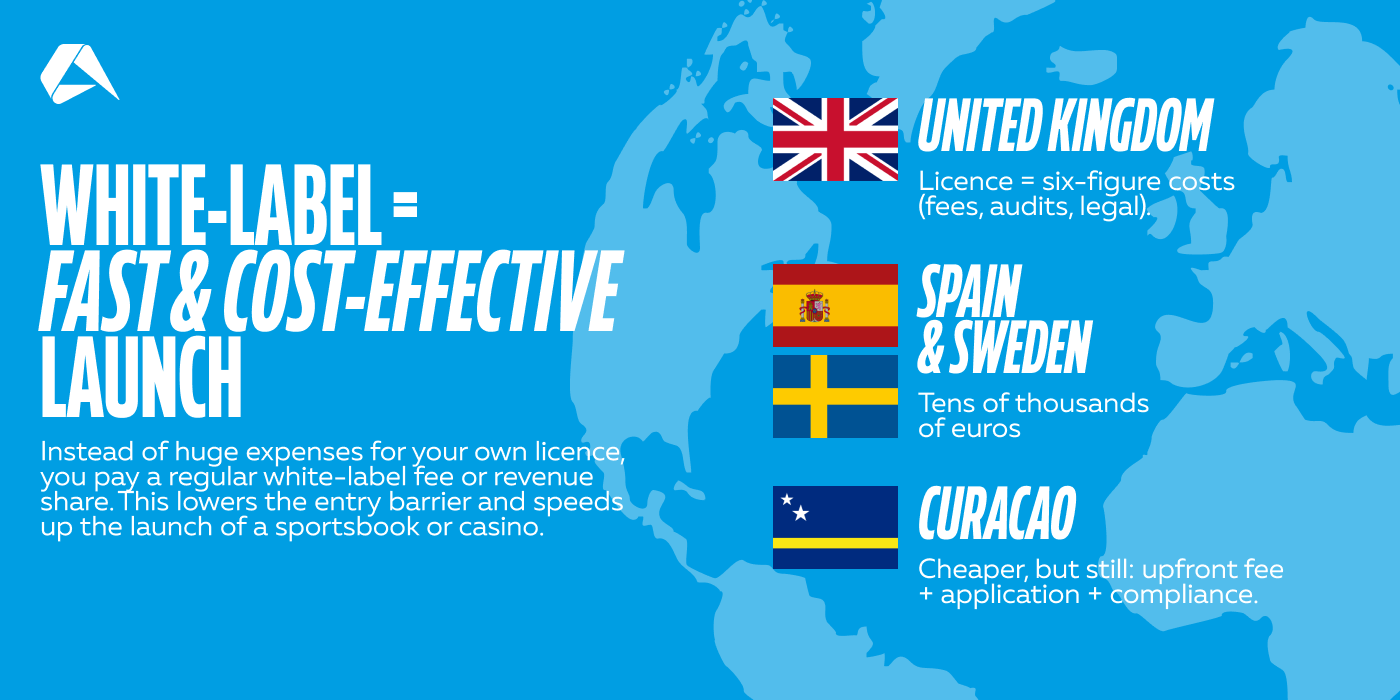
Licensing isn’t just about approvals. It’s also one of the most significant expenses. For example:
-
A UK licence can involve six-figure costs once you add fees, compliance audits, and legal support.
-
In Spain or Sweden, local licences can also run into tens of thousands of euros, with strict ongoing reporting requirements.
-
Even in lower-cost jurisdictions such as Curacao, you’ll face upfront licence fees, application costs, and compliance spend.
By operating under a provider’s licence in jurisdictions where you can avoid most of these initial costs, you’ll instead pay a regular revenue share or fixed white-label fee. For the most part, it doesn’t eliminate licensing altogether, but it shifts the burden from being your sole responsibility to a shared framework that’s already in place.
That’s why the white-label model is often the quickest and most cost-effective way for new entrants to launch a sportsbook or casino.
When You Can Operate Under a Provider’s Licence
One of the biggest attractions of a white-label sportsbook is that you can sometimes operate under the provider’s existing licence. However, this convenience comes with boundaries that every new operator needs to be aware of.
First, you’re limited to the markets where that licence is valid. A provider licensed in Malta (MGA), for example, can give you cover in many international and some grey markets. Still, it won’t open the door to highly regulated territories like the UK, Spain, or Sweden. If your ambitions stretch into those regions, you’ll need to apply for your own local licence regardless of who supplies your platform.
Second, your operation is tied directly to the provider’s compliance framework. That means you’ll inherit their rules, their reporting systems, and their restrictions. While this can simplify things, it also means you don’t have the freedom to adjust the framework to suit your unique business strategy.
Finally, there’s the question of control. Operating under another company’s licence usually involves sharing a brand or having certain limits on how you present and market your sportsbook. For some operators, this is a worthwhile trade-off to get started quickly. For others, especially those aiming to build a standalone brand, it can, over time, feel restrictive.
In short, being covered by a provider’s licence is a powerful shortcut, but it’s not a universal solution. It works best for operators who want to launch quickly in the target markets they aim to operate in, where umbrella licensing is recognised, and for those who are comfortable with the restrictions that come with it.
When You Still Need Your Own Licence
With that said, there are certain cases where operating under a provider’s licence simply isn’t enough. Some jurisdictions require that every operator targeting their players must have a local licence, regardless of which white-label provider they work with.
This is especially true in highly regulated markets, such as the UK, Spain, Sweden, Greece, and most US states. In these regions, regulators want to approve each operator individually. That means you’ll need to go through the application process, pay the required fees, and meet ongoing compliance obligations, even when a highly licensed and qualified technology provider powers your platform.
Another factor to consider is credibility. Investors, payment providers, and even some affiliates may prefer, or even demand, that your business holds its own licence. Having a licence in your company’s name shows you’re committed to a long-term operation and willing to meet the same standards as established brands.
In addition to this, there’s also the question of future flexibility. While starting under a provider’s international licensing umbrella might get you to market quickly, it can limit your options later if you want to expand into stricter jurisdictions. In other words, a provider’s licence can give you a fast start, but if you’re aiming for a presence in top-tier regulated markets, or want full independence and credibility, you will eventually need your own licence.
Fully Compliant Frameworks
Understanding where licences are required is only the first step. The bigger question for many new operators is how to move forward once those rules are clear. This is where the choice of provider makes all the difference. A partner with the right regulatory approvals can remove many of the early barriers, while certifications and compliance expertise ensure that your operation is not only legal on paper but built to withstand scrutiny.
In many international and cross-border markets, Altenar’s licences, for example, allow white-label operators to come under its umbrella, providing them with a faster and more cost-efficient route to launch. In practice, this means that instead of waiting months or incurring significant costs on local licence applications, new operators can enter those markets backed by Altenar’s existing approvals.
But licensing is only one part of the picture. Top solution providers like Altenar reinforce this coverage with a compliance framework that meets the standards of the strictest regulators. Certifications such as ISO 27001 for information security and GLI 33 for technical fairness demonstrate that its platform isn’t only legally approved but also independently tested and trusted. These credentials make a difference. They smooth the path with regulators, reassure payment providers, and show players that your sportsbook is built on a solid foundation.
For operators, the result is more than just access to many markets. Altenar provides the infrastructure, certifications, and expertise that enable you to operate with confidence and remain compliant as you grow.
Altenar’s Licensing Portfolio
Altenar’s regulatory footprint combines an international licence with multiple national approvals. The distinction matters. The MGA licence provides umbrella coverage in many markets, while national licences ensure Altenar can legally supply technology and compliance support to operators who already hold, or are applying for, their own local licences in highly regulated jurisdictions.
| Licence Type | Jurisdiction / Regulator | Benefits for White-Label Operators |
|---|---|---|
| International Licence | Malta Gaming Authority (MGA) B2B Critical Supply Licence (MGA/B2B/582/2018) | ✅ Allows white-label operators to operate directly under Altenar’s licence. ✅ Recognised in many .com and multi-jurisdictional markets across Europe, Latin America, Africa, and parts of Asia. ✅ Provides a cost-efficient, fast-track launch route without applying for a local licence. |
| National Licences | UK (UKGC) Sweden (Spelinspektionen), Greece (HGC), Romania (ONJN), Ontario (AGCO), South Africa (Western Cape) | ❌ Operators must still hold their own local licence in these jurisdictions. ✅ Altenar can legally supply technology and services to licensed operators in these countries. ✅ Demonstrates Altenar’s compliance with some of the world’s strictest regulators. ✅ Ensures the platform already meets local reporting, security, and fairness standards, making it easier for operators to apply for and maintain their own licence. |
Certifications That Strengthen Compliance
While licences determine where you can operate, certifications and accreditations prove that a provider’s technology is secure, fair, and trusted. For operators, they provide two key advantages in the form of smoother regulatory approvals and greater credibility with players, investors, and payment providers. Altenar strengthens its licensing footprint with a series of globally recognised credentials.
| Certification | Scope | Benefits for White-Label Operators |
|---|---|---|
| ISO 27001 - 2022 | International standard for information security management | ✅ Guarantees strong protection of player and operator data. ✅ Demonstrates to regulators and payment providers that Altenar meets global security benchmarks. ✅ Reduces risk during licence applications, where IT security controls are often a focus. |
| GLI 33 | Global standard for sportsbook systems testing and functionality | ✅ Confirms Altenar’s platform has been independently tested for fairness, reliability, and technical compliance. ✅ Speeds up regulator approvals when applying for new markets. ✅ Enhances player trust in the integrity of your sportsbook. |
| Brazil Virtual Sports Certification (2025) | Market-specific approval for Altenar’s Virtual Sports and Remote Gaming Server (RGS) | ✅ Allows Altenar’s certified products to be deployed legally in Brazil. ✅ Provides a head start for operators entering the Brazilian market. ✅ Signals readiness as Brazil’s regulated betting market expands. |
ISO 27001: 2022
Altenar is certified to the international gold standard for information security. This means that your sportsbook operates on a platform with rigorous controls surrounding data protection, thereby reducing risk and reassuring both regulators and players.
GLI 33 Certification
Independently tested by BMM Spain Testlabs, Altenar’s sportsbook platform meets GLI’s widely accepted standards for fairness, functionality, and technical integrity. This certification is a powerful asset when applying for national licences, as it demonstrates compliance with international benchmarks.
Brazil Virtual Sports Certification
In April 2025, Altenar secured certification in Brazil for its virtual sports and Remote Gaming Server (RGS) content. While not a full national licence, it allows Altenar’s virtual products to be deployed legally in Brazil, which is an important advantage as the country’s new betting market takes shape.
Together, these certifications demonstrate that Altenar not only holds licences but also operates to the standards that regulators demand worldwide. For operators, this translates into faster approvals, easier expansion, and a stronger foundation for building trust with customers.
Choosing the Right Provider
For those weighing up white-label options, the decision often comes down to more than just the product. The right partner can shorten launch timelines, smooth regulatory hurdles, and provide the long-term support that keeps a sportsbook competitive.
When evaluating providers, most operators focus on five key areas:
-
Credibility & Licensing Footprint
Proven regulatory coverage is the first test of a serious partner. International licences can provide an umbrella entry into multiple markets, helping operators launch quickly, while national approvals demonstrate that the provider can support growth into more stringent jurisdictions.
-
Compliance Readiness
Beyond licences, certifications and frameworks matter. Independent credentials, such as ISO 27001 and GLI 33, combined with built-in reporting and KYC/AML tools, ensure a smoother licensing process for operators and reduce the risk of regulatory delays.
-
Technical Strength
A sportsbook is only as good as the engine behind it. Scalability, fast and reliable APIs, and real-time risk and odds management are the features that make the difference between surviving and thriving in competitive betting markets.
-
Support & Service
Launching is just the beginning. Operators should also look for onboarding support, clear SLAs, and a partner relationship that continues beyond the first integration. For operators with serious ambitions, look for providers who will stay invested in your success as regulations and markets evolve.
-
Cost Transparency
Hidden fees and unclear revenue shares are red flags. Clear visibility into the upfront and ongoing costs of launching and running an iGaming platform enables operators to make informed, long-term decisions about their business model.
Altenar brings strength across all five areas, combining international licensing with compliance-grade certifications, proven technical reliability, and a reputation for long-term partnerships. For new operators, that translates into a provider that not only gets you live faster but keeps you competitive as you grow.
Planning your next move in iGaming? Launching a sportsbook is complex, but it doesn’t have to be. Altenar’s experts will guide you through licensing options, explain the regulatory steps ahead, and deliver the technical foundation needed to ensure your entry is both swift and fully compliant.