

Overview Common Errors That End Most Sportsbook Startups Before They Begin
The online sports betting industry offers high rewards but operates on thin margins where competition is fierce. Success requires building with intent and avoiding fatal pitfalls like selecting an inadequate technology partner or an inflexible platform model. Startups frequently fail by underestimating the "silent killer": regulatory complexity and the high costs of compliance and taxation.
To thrive, operators must adopt a "mobile-first" approach, ensuring a seamless user experience while managing localised payment systems and robust risk oversight to prevent catastrophic losses. Neglecting player retention and scalability often leads to a "revolving door" of customers, similar to filling a bucket with holes. By prioritising a modular, scalable foundation and partnering with experts who understand regulated markets, founders can transform a risky gamble into a sustainable, global business.
Read the blog below to discover the key mistakes to avoid and the smart moves that lead to long-term success.
Be under no illusion. An online sports betting business isn’t for the timid. It’s a business where margins are thin, competition fierce, and only the strongest thrive. But for ambitious founders, the rewards for success are high, and that’s precisely the appeal.
What separates the winners is not luck. It’s having the courage to build with intent and the knowledge to avoid the pitfalls. Those who get it right have the chance to create something remarkable. Not just a sportsbook, but a business that commands trust, scales globally, and prospers spectacularly.
This journey begins by understanding the most common mistakes made by new sportsbook startups.
The Big Mistakes to Avoid
Every new sportsbook startup begins with the same ambition. To build a platform that attracts players, earns trust, and scales into a significant business. Yet that goal is littered with projects full of promise at launch, only to fall apart shortly after.
The truth is, most failures aren’t caused by bad luck. They’re the result of choices that better foresight would have prevented.
What follows is a list of the most common mistakes that new sportsbooks make. Each one has claimed its share of operators who underestimated the challenge.
1. Selecting the Wrong Technology Partner
Nothing sinks a new sportsbook faster than the wrong tech foundation. Operators often get dazzled by glossy sales decks or quick promises of ‘ready-to-launch’ platforms, only to discover too late that the engine underneath can’t support their ambitions.
A partner with weak regulatory coverage means you’re boxed into fewer markets, or worse, scrambling to plug gaps in compliance. Moreover, an inflexible system leaves you unable to localise offers, bolt on new features, or integrate with third-party tools as your strategy evolves. If the platform struggles with stability, scalability, or live data feeds, your players will feel it immediately, and in this business, they don’t come back after a crash during a prime-time football match.
Founders need to look beyond the demo and ask hard questions: How many regulated markets does this platform actively serve? What’s the track record on uptime during major sporting events? How modular is the tech when you need to adapt? And ultimately, how aligned is the provider with your ambitions?
2. Choosing the Wrong Platform Model
Even with a strong partner, picking the wrong operational model can undermine a sportsbook. White-label setups may look attractive because they’re fast and low cost, but they can limit flexibility and leave you tied to a brand you don’t fully control. Turnkey solutions offer more independence, but they also come with heavier responsibilities, including compliance, payments, and marketing, which are on you. Modular sportsbook systems provide long-term adaptability, but require higher upfront investment and deeper expertise to manage effectively.
The danger is misalignment. A startup that needs to move fast but is anchored into an overbuilt structure will waste resources. Those who choose the easy path may outgrow the platform quickly and face painful migration. Getting this call wrong is less about technology and more about strategy, but the consequences are just as costly.
3. Underestimating Regulatory Complexity
Regulation is often the silent killer of new sportsbooks. Many startups focus on tech and marketing but frequently underestimate the time, money, and expertise required to stay compliant. Licensing processes can stretch for months, reporting requirements are relentless, and every market has its own rules on advertising, payments, and player protection.
Cutting corners here increases the risks, which can lead to heavy fines, reputational damage, or maybe the closure of the business. Even with a secured licence, ongoing obligations such as anti-money laundering checks and responsible gaming safeguards require constant attention. Too many operators treat these as box-ticking exercises, only to discover that regulators don’t see it that way.
4. Misjudging Compliance and Tax Costs
Let’s be practical. The margins in sports betting are tight, yet many new operators underestimate how quickly compliance and taxation eat into profits. Licence fees alone can be significant, but the ongoing costs in terms of regular audits, reporting systems, responsible gaming tools, and the like can add up fast. Then comes taxation, which varies wildly between jurisdictions. Some markets charge modest rates on gross gaming revenue, while others might take a third or more, and that’s before factoring in local levies or mandatory partnerships.
The danger for new startups is building projections on optimistic assumptions, and a business model that looks profitable on paper can collapse once the real costs are applied. Operators that ignore this reality often burn through funding or find themselves cutting corners elsewhere to compensate. Misjudging these expenses can turn a promising sportsbook into a loss-making venture almost overnight.
5. Failing to Keep Up with Tech
Change is rapid and constant in the sports betting industry and is undoubtedly driven by the speed of technical innovation. Falling behind is one of the quickest ways to lose your core subscribers. Today’s customers expect slick mobile apps, instant deposits, fast live betting, and personalised experiences. A platform that feels dated, has slow load times, awkward navigation, or has limited in-play options generally tells users that they’ll get a better experience elsewhere.
Technology isn’t static. Competitors are constantly adding new features, and startups that don’t plan for continuous development often find themselves stuck with a launch product that quickly ages.
6. Weak Risk Management and Trading Oversight
A sportsbook isn’t just software. It’s also bookmaking, and that means managing risk. Many new operators misjudge how quickly exposure can build when limits are too loose or live trading lags behind the action. One bad weekend, with a popular underdog winning, can wipe out months of profit if risk controls aren’t in place.
Startups often rely too heavily on automated feeds, assuming technology alone will keep the balance sheet safe. But errors slip through without proper oversight. A misaligned odds feed, a late market closure, or a failure to monitor betting patterns with a human element in the chain can result in heavy losses.
Ignoring this area turns a sportsbook from a business into a gamble. Strong trading teams and clear limits are what keep volatility from becoming a catastrophe.
7. Neglecting Payments and Local Banking Realities
It’s no understatement to say that payments can make or break a sportsbook. Players expect deposits and withdrawals to be instant, easy, and localised to the methods they trust. Yet many startups underestimate how complicated this piece of the puzzle really is. Banking regulations vary by country, and payment preferences change dramatically between markets. That’s to say, what works in Europe may fail in Latin America or Asia.
When payment flows are slow or unreliable, players don’t complain. They just leave. Worse still, a weak payment setup can attract fraud, trigger chargebacks, or create compliance headaches with anti-money laundering obligations. Operators who treat payments as an afterthought usually find out too late that it’s one of the most visible parts of the customer experience.
8. Poor Scalability Planning
There have been plenty of examples of sportsbooks that have launched smoothly, only to fall apart once real traffic arrives. Without scalability planning, systems that worked for a few hundred players collapse under the pressure of thousands. Crashes during major matches, lagging live odds, or slow bet settlements all drive players straight to competitors.
And the problem isn’t just technical. Growth exposes gaps in operations, too. Customer support becomes overwhelmed, manual processes break down, and compliance reporting struggles to keep up. Startups that only plan for launch, rather than growth, find themselves on the back foot just when momentum should be building.
Take note. A sportsbook needs to be built for scaling from day one. Without it, growth can turn into the very thing that breaks the business.
9. Mismanaging Player Acquisition Costs
Never underestimate the cost of attracting new customers, or the cost of retaining the ones you already have, for that matter. It is expensive, and many new operators underestimate just how fast acquisition costs can spiral. Big bonuses, aggressive affiliate deals, and paid media campaigns may bring traffic, but if the lifetime value (LTV) of those players doesn’t match the spend, the sportsbook can burn through capital with little to show for it.
The issue isn’t simply overspending, it’s often spending without balanced discipline. Too much focus on short-term sign-ups leaves nothing for retention. Add in rising competition and stricter advertising rules, and the margin for error gets even smaller.
Plenty of startups have fallen into the trap of chasing growth at any cost, only to hit a wall. Without disciplined acquisition strategies, the budget becomes the first casualty.
10. Poor Marketing Strategy
Marketing is where many sportsbooks fall short. Some chase attention with unsustainable offers, while others copy generic campaigns that fail to connect with local players. The result is waste. In a competitive market, being loud isn’t enough because players need a reason to trust you over the dozens of other options.
Here’s the core problem. Start-ups often focus on quick wins but neglect the fundamentals, including localisation, clear messaging, and a consistent brand identity. Worse still, they fail to adapt strategies to changing regulations and burn cash on campaigns that won’t even pass compliance checks.
Without a coherent plan, marketing fails to become a growth driver, and in an industry where visibility and trust are everything, that’s a mistake you can’t afford.
11. Overlooking Customer Support and Retention
In the iGaming industry, it is fair to say that keeping your customers, given the choice at their disposal, is where long-term success is truly built. Too many operators focus all their energy on sign-ups and leave customer support and retention as an afterthought. The result is a revolving door of players who join for a bonus, have an unsatisfactory experience when they need help, and never come back.
Issues are inevitable in the complex world of online sports betting. A delayed withdrawal, a bet dispute, or a technical problem during a live match can turn into churn without fast and reliable support. Add weak retention strategies, like irrelevant offers or poor communication, for instance, and acquisition becomes ineffective.
A sportsbook without strong support and retention is like a bucket with holes. You can keep pouring money into marketing, but most of it will drain away.
12. Ignoring UX and mobile experience
For most players today, the sportsbook is something they carry in their pocket. So if the mobile experience is awkward, slow, or confusing, they tend not to stick around, no matter how good the odds or bonuses stack up. Startups sometimes pour resources into back-end systems and flashy marketing, only to overlook the basics of design and user experience (UX).
Common pitfalls in UX design include crowded interfaces, poor navigation, slow loading times, or bet slips that don’t work smoothly in live play. Each minor frustration adds up, and in a market where players can switch apps in seconds, bad UX can be fatal.
Keep in mind that bettors don’t remember features, but how the sportsbook made them feel. If the platform doesn’t feel intuitive and natural, players will find one that does.
Other Common Pitfalls
Not every mistake makes the headlines, but there are plenty that still chip away at a sportsbook’s chances of survival. Beyond the big, structural errors, here are some more common pitfalls that drain momentum and erode trust. In isolation, they may look minor, yet together they’re often enough to stop a new operator from ever finding its momentum.
13. Ignoring localisation in language and content
Players notice when language, design, and support ignore local culture. This damages trust and engagement.
14. Failing to monitor regulatory changes
Markets evolve quickly, and missing new requirements risks fines, licence suspension, or market exclusion.
15. Over-reliance on a single data provider
When your only feed goes down, odds vanish, markets freeze, and players leave instantly.
16. Spreading too thinly across markets
Pursuing multiple licences at once drains resources, delays launches, and weakens operational focus everywhere.
17. Copy-pasting odds feeds without localisation
Generic feeds feel disconnected, failing to reflect regional sports interest or local betting behaviour and preferences.
18. Overpromising bonuses you can’t sustain
Unsustainable offers train players to chase promotions, quickly eroding margins and credibility.
19. Hiring the wrong local partners
Poor local partnerships block licences, waste money, and damage your standing with regulators.
20. Overbuilding features players don’t use
Spending on unnecessary tools wastes budget, slows the platform, and frustrates the user experience.
21. Not investing in data analytics
Without analytics, marketing and retention become guesswork, leading to poor decisions and wasted spend.
22. Forgetting to hedge risk on major events
A single upset can expose unhedged books, instantly wiping out hard-earned profit margins.
23. Overreliance on affiliate traffic
Affiliate dependence leaves growth vulnerable to rising costs, shifting rules, and unstable partnerships.
24. Poor cash flow management
Weak financial oversight has the potential to create liquidity issues, missed payments, and reputational damage with partners.
25. Not differentiating the brand from competitors
Generic products vanish in crowded markets without clear identity, positioning, or standout value.
How New Operators Can Avoid Costly Mistakes
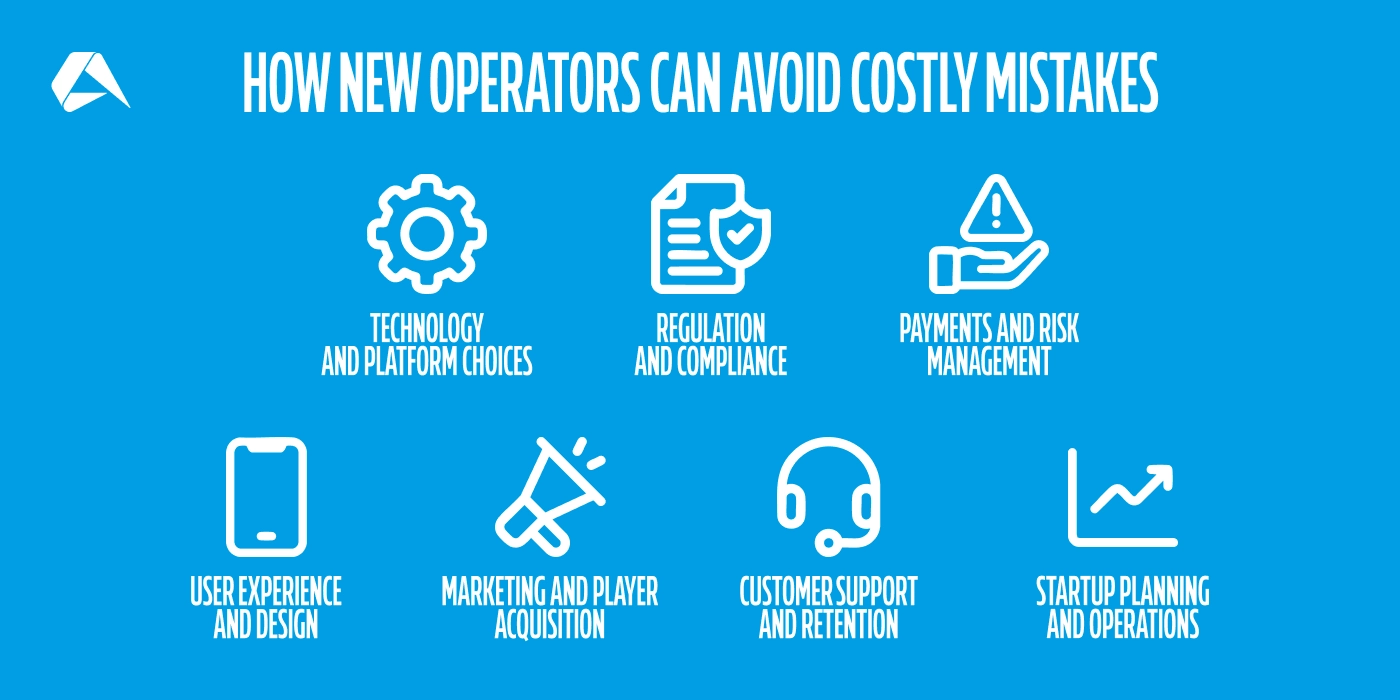
The following sections look at the areas where founders should focus their energy, offering practical advice on how to move forward with confidence and a foundation built to last.
Technology and Platform Choices
Every decision should start with a plan of the markets you want to reach, the features you’ll need, and the scale you expect. That vision guides your choice of technology partner. Look for one that shares your vision and is proven in regulated markets, responsive in development, and committed to innovation, not just maintenance.
From there, align the platform model with your ambitions. White-label speeds entry but limits control, while modular and turnkey options support flexibility and growth. Respect that the most successful operators don’t chase the quickest launch, but rather, invest in a foundation that adapts with them. Choosing well at the start saves painful migrations later and ensures your platform grows as fast as your business does.
Regulation and Compliance
If technology is the doorway, regulation decides whether you can even enter the room. Build compliance into your plan from day one and start with markets you can realistically license. Budget for ongoing audits and reporting, and assign expertise to track evolving rules. Keep in mind that strong compliance is your ticket to stability and expansion. Operators who invest early avoid firefighting later and move faster when new opportunities appear.
Payments and Risk Management
Smooth payments and disciplined risk control are what turn a licence into a working business. Build for localisation from the start, offer trusted regional methods and make withdrawals as fast and easy as possible. Test multiple payment providers so a single outage doesn’t halt transactions. On the risk side, don’t rely solely on automated feeds. Combine technology with experienced sportsbook traders who can spot exposure before it escalates.
User Experience and Design
The harsh reality is that many sportsbook bettors will judge a sportsbook in seconds. To this extent, a clean interface, fast loading, and intuitive navigation matter as much as the odds. Build mobile-first, since most betting now happens on phones, and localise both language and layout so the product feels native in every market. Don’t overload with features to begin with, and focus on clarity and reliability during live play. Furthermore, with compliance as demanding as it is across markets, operators should add responsible gaming tools as standard, not extras.
Marketing and Player Acquisition
Blanket coverage isn’t always the best policy in iGaming. A better policy can be to launch campaigns that align with local culture and habits. Balance acquisition with retention from day one, so budgets aren’t swallowed chasing short-term signups. Localise campaigns to reflect regional sports interests and payment habits, and stay ahead of advertising regulations to avoid wasted spend. Furthermore, it is always good to build trust through consistent branding rather than one-off promotions.
Customer Support and Retention
Attracting players in this industry is hard, and keeping them can even harder. Strong player retention begins with reliable, responsive support. Aim for fast resolution of issues like withdrawals, disputes, or live-betting errors, because every delay erodes trust. Layer in loyalty tools that reward consistent play, and communicate with players in ways that feel personal rather than automated. The operators who succeed don’t see support as a cost, but as a core part of the experience that builds long-term loyalty.
Startup Planning and Operations
From our experience, the best launches come from steady hands, not rushed timelines. Test everything before going live, so the first players see your product at its best. Keep cash flow tight, because compliance fees, marketing campaigns, and payment delays can eat into reserves faster than you expect. Local partnerships matter too. The right allies open doors, not create problems. And when it comes to expansion, pace yourself. Growing into one market properly is always stronger than stretching thin across several.
The Difference Between Launching and Leading
Look closely at the most common mistakes new sportsbooks make, and a pattern emerges. Many errors could have been avoided with the right partner. A strong provider does more than supply the best technology and software. It protects operators from the pitfalls that undo so many startups. Suffice to say, stable platforms mean fewer outages, efficient payments reduce churn, and built-in local compliance keeps regulators onside. Instead of damage control, operators can focus on what matters most, and that’s building a brand and growing their player base.
Altenar was built with these values in mind. Operating in 30-plus regulated markets, our sportsbook platform combines scalability with the flexibility to adapt as strategies develop, while modular design principles let operators tailor features without costly rebuilds. Beyond the tech, risk management and trading support keep exposure under control, and our regulatory knowledge and ongoing product innovation give startups an edge that lasts well beyond launch.
In an industry where mistakes are costly, the right partner lets you focus on marketing and player acquisition while the complex parts are taken care of by professional teams.
Building a sportsbook doesn’t need to be a gamble. Book your private demo today and discover how our proven sportsbook technology, backed by deep market expertise, helps you build a sustainable business.