

On a fundamental level, a blockchain-based loyalty program replaces traditional loyalty points with a digital token recorded on a blockchain. That means, instead of rewards living only inside an operator’s database, they exist on a shared digital ledger. Players earn these tokens through betting or play. They can then use them for rewards, perks, status, or, at least theoretically, trade or transfer them elsewhere.
The appeal is easy enough to understand. Tokens promise a sense of real ownership. They can move beyond a single sportsbook or casino. They can follow a player across brands, products, and even platforms. That’s the idea that tends to spark the most interest.
And there’s another major benefit. A perception that blockchain makes loyalty feel more transparent and modern. It’s an idea that resonates with crypto-native players and with operators looking to position themselves as innovators rather than followers.
But while this basic understanding explains the concept, it does not provide insight into what’s involved in implementation and setting up such a system.
Below, we outline what operators should expect in terms of structure, cost, and the ongoing demands of a blockchain-based loyalty program.
How a Blockchain Loyalty Program Works
In a blockchain sports betting setup, a loyalty program touches far more parts of an operation than many marketing teams expect at the start. Some of the pressures are technical, some financial, and others operational. Let’s look at each of these in turn and explain what they mean in practice:
It Turns a Loyalty Feature Into Core Infrastructure
When you build loyalty on a blockchain, you’re not just adding a new feature to your platform. You’re creating something closer to a financial system, with tokens, immutable records, smart-contract logic, transaction flows, and on-chain bookkeeping. That elevates loyalty from a marketing add-on to a part of how your business handles value, identity, and trust.
It needs infrastructure, including a ledger, wallet support, contract code, ledger monitoring, and audit trails. That’s in a different league from standard CRM or bonus-point systems.
On-Chain vs Off-Chain Data
Once you try to tie real user accounts to blockchain wallets, things can get pretty complicated fast. On blockchains, identities are wallets (anonymous strings of characters). In iGaming, identities are real people who are verified. Bringing those two worlds together means building a translation layer between off-chain accounts and on-chain wallets. That connection must be secure and auditable. This is not a small undertaking.
Wallets, Tokens, and the Player Experience Gap
When loyalty depends on tokens and wallets, you suddenly ask players to handle something closer to crypto than casino bonuses. That means digital wallets, private keys, token balances, and many things that many players don’t understand or trust. Simple actions like checking a balance or redeeming rewards become somewhat technical.
Transaction Speed, Network Fees, and Reliability
When you run loyalty on a blockchain, every token movement is a transaction that costs something. On public chains, that means network (gas) fees and sometimes delays, especially when many people transact at the same time. That’s different from bonus points inside a database, where balances update instantly and invisibly.
For players expecting fast and efficient rewards, the extra wait or small fee can feel strange. It’s a minor issue, but sometimes enough to change how smooth the loyalty experience feels.
Irreversible Errors
Once loyalty lives on-chain, the records are immutable (irreversible). Every transaction, token issuance, and reward transfer is subsequently permanent. If there’s a mistake in contract logic, or a bug in how the system issues tokens, you can’t just fix the database and move on.
Undoing errors, therefore, becomes difficult or impossible. That means smart-contract code must be airtight from the start. Developers often rely on thorough audits and repeated testing to catch flaws.
Typical Cost of Development
By the time a blockchain-based loyalty program is ready for real players, the cost profile can look very different from that of a standard loyalty or CRM upgrade. Here is a rough estimate of the costs involved:
Core Build & Integration Costs (One-Off)
This is the cost of getting a usable system live inside a real iGaming environment. It includes the work needed to issue tokens, connect them to player accounts, and make the whole thing usable for everyday loyalty activity. These are the costs most teams expect. They are also the ones that tend to grow as the project's scope becomes clearer.
Typical cost items include:
-
Token and reward-system development
-
Integration with the existing platform, wallet, and CRM
-
Player-facing loyalty and redemption interface
-
Back-office tools for monitoring balances and activity
-
Initial testing and system validation
Security, Legal & Launch Readiness Costs
This is where blockchain loyalty begins to move into very different territory from traditional programs. Because tokens represent real value, systems must be independently checked and legally defined before launch. These are not optional costs. They are usually required before any public rollout can happen.
Typical cost items include:
-
Independent security audits
-
Legal advice on token structure and jurisdictional treatment
-
Compliance reviews linked to player funds and rewards
-
Risk assessments tied to AML and data protection
-
Launch certification or third-party verification
Ongoing Operational & Maintenance Costs
Once live, a blockchain-based loyalty system continues to incur costs in ways traditional systems usually do not, and this continues for as long as the program operates.
Typical ongoing costs include:
-
Network or transaction fees
-
System monitoring and incident response
-
Ongoing support for wallet and token issues
-
Regular security reviews and updates
-
Platform changes as regulation evolves
Estimated Cost Range (Practical Guidance)
Based on typical industry build patterns, a mid-scale iGaming operator should expect somewhere in the range of:
-
Initial build and launch:
€300,000 to €800,000+
-
Annual running and support costs:
€100,000 to €250,000+ per year
The final expenditure depends heavily on:
-
Scope of the loyalty program
-
Number of supported jurisdictions
-
Level of external audit and legal oversight
-
How tightly the system is embedded in core operations
Note: The cost ranges and breakdowns above are estimates based on published data for generic blockchain and smart-contract projects (apps, DeFi, tokenized platforms). Publicly available data on blockchain-based loyalty systems, especially in regulated iGaming, is limited, mainly because real-world operators typically build under NDA or keep budgets private. As a result, these figures should be treated as budget guidance rather than precise quotes. Actual costs for a fully compliant, live iGaming loyalty rollout may be significantly higher, depending on regulation, integration scope, and audit requirements.
The Non-Technical Challenges
Technical hurdles are only part of the picture. Beyond the initial build, operators face regulatory, operational, support, and player-adoption challenges. These often emerge at launch and determine whether the program succeeds or stalls.
Regulation and Token Classification Risk
In a regulated blockchain sportsbook, transferable loyalty tokens immediately raise questions around financial classification, player funds, and whether rewards begin to resemble regulated assets. In other words, regulators are paying closer attention to the moment loyalty tokens begin to resemble assets with real value. Depending on how a token is structured, whether it can be transferred, traded, or redeemed for money-like rewards, it may start to look less like a promotional tool and more like a financial product. That can trigger extra licensing, reporting, and compliance obligations. In some markets, the rules are still evolving. In others, they are already strict. Either way, uncertainty becomes part of the operating environment.
Data Protection, Privacy, and Player Rights
iGaming platforms are built around strict data-protection rules. Players can request access to their data and request deletion. By design, blockchain does not forget. Once information is written to a ledger, it stays there. Even if personal data is not stored directly on-chain, the links between wallets and real identities still raise questions about privacy, traceability, and long-term storage.
Customer Support and Operations
Traditional loyalty issues are familiar to support teams, but blockchain loyalty introduces a different class of problem. Questions about wallet access, failed transactions, delayed confirmations, etc., create misunderstandings about ownership. This typically means more training, more escalation, and more time per customer service ticket.
Player Education and Adoption Barriers
Not every player wants to think about tokens, wallets, or blockchains when they log in to place a bet. For many, loyalty is meant to be simple and almost invisible. When the process becomes visible, adoption can suffer. Some players hesitate because they don’t understand the system. Others simply don’t trust it. Even well-designed interfaces struggle to hide all of the unfamiliar concepts. When participation drops, so does the commercial case for the entire program. It’s a risk that only becomes clear after launch.
The Pros and Cons of Blockchain Loyalty Programs
Like most major changes in platform design, this brings genuine advantages alongside inevitable compromises:
Pros
-
Perceived player ownership: Feels more substantial than traditional loyalty points.
-
Cross-brand portability potential: Tokens can move between products and platforms.
-
Transparency of rewards: Public ledgers increase trust in balances and history.
-
Appeal to crypto-native audiences: Resonates with token-savvy player segments.
-
Brand innovation positioning: Communicates ambition and forward-thinking.
Cons
-
High build and launch cost: Significantly more expensive than traditional systems.
-
Ongoing operational overhead: Monitoring, support, and audits never entirely stop.
-
Regulatory uncertainty: Token classification varies widely by jurisdiction.
-
Potentially reduced player adoption: Wallets and tokens confuse many mainstream players.
-
Errors harder to reverse: Blockchain records cannot be corrected.
-
Customer support burden: New classes of complaints and disputes emerge.
When a Blockchain Loyalty Program Makes Commercial Sense, and When It Doesn’t
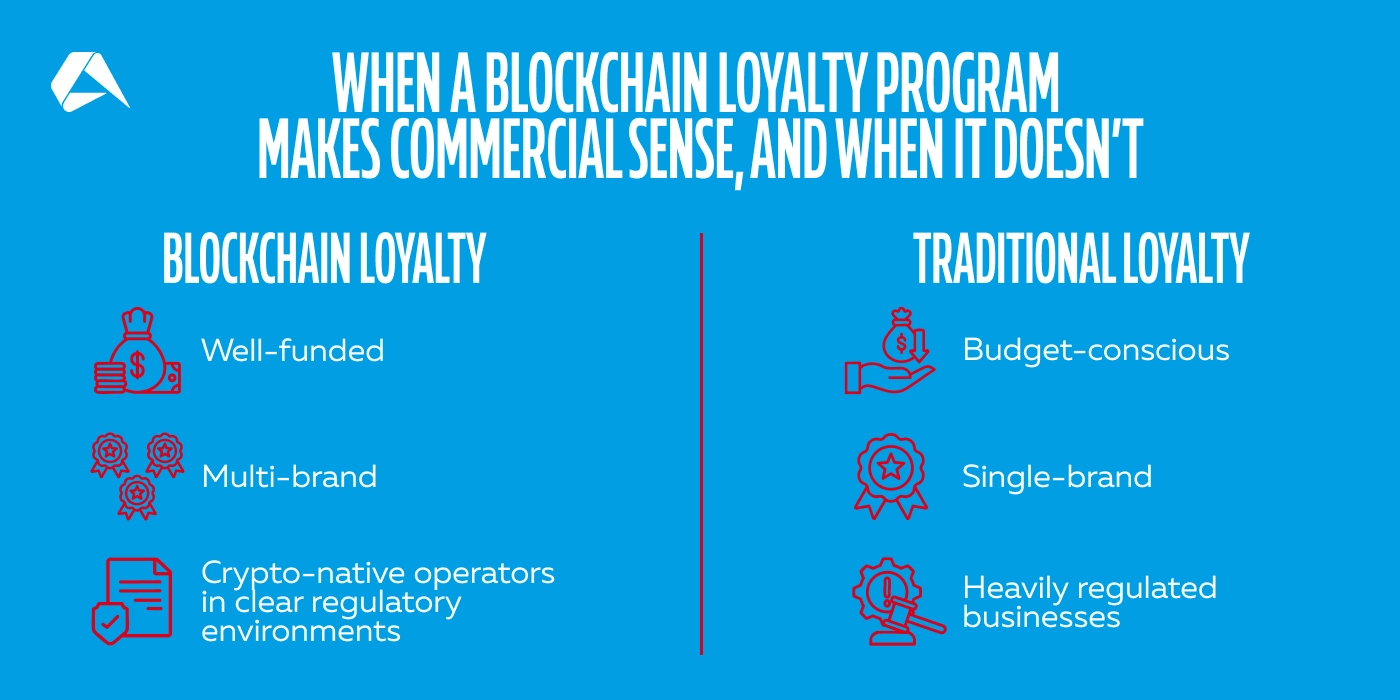
The commercial case for blockchain-based loyalty only comes into focus once you step back from the technology and look at the broader business picture. In the right situation, it can add real strategic value. In the wrong one, it is more likely to become an expensive undertaking.
For operators already active in the crypto gaming industry / blockchain-based gaming industry, or planning deeper digital expansion across multiple platforms, tokenized loyalty can fit more naturally into a wider strategy. Blockchain loyalty starts to make sense when rewards are carried over and shared beyond a single brand. Operators with multiple sportsbooks, casinos, or verticals can use tokens as a shared reward currency across their network. Add tangible benefits that extend beyond in-house rewards, such as merchandise, events, partner platforms, etc., and the value proposition becomes easier to defend.
Audience readiness matters too. Crypto-native or hybrid player bases approach tokens with curiosity rather than suspicion. That changes the level of adoption from the outset.
Regulatory clarity is another issue operators need to consider. In markets where token treatment is reasonably well defined, planning becomes possible. Where rules are still unclear, uncertainty adds to the cost base. Budget strength also plays its part. Typically, this is a long-cycle infrastructure spend, not a short-term marketing experiment. Subsequently, it is more suitable for operators who think in terms of years.
Where Straightforward Loyalty Programs Still Win
However, the commercial case weakens as you move toward the other end of the spectrum. Single-brand sportsbooks and casinos rarely extract enough added value to justify the overhead of a blockchain-based loyalty program, since traditional loyalty systems already do the job with less risk and far lower cost. Operators on a tight budget or new operators face a different trade-off. Funds poured into blockchain loyalty are capital that is not spent on acquisition, product quality, or core platform performance, which are areas that usually make the difference between success and failure at the start of an iGaming project.
Highly regulated, risk-averse markets present additional barriers. Even a well-designed token scheme can struggle under conservative regulatory scrutiny. Delays, additional licensing, or outright restrictions can stall projects before they start to gain momentum.
In short, blockchain loyalty isn’t a universal upgrade for everyone. It’s a strategic tool that only justifies its place under particular commercial conditions.
DISCLAIMER
This information is not intended to be legal advice and is solely extracted from open sources. It should not be relied upon as a substitute for professional legal advice, and Altenar does not accept any liability for its use.
The Bottom Line
In summary, a blockchain-based loyalty program is not a simple upgrade to an existing rewards scheme. At its core, it changes how loyalty value is created, stored, governed, and supported across the business. The appeal is easy to understand. Tokens offer the promise of portability, transparency, and a sense of ownership that traditional points programs lack. For some operators, especially those building multi-brand businesses or serving crypto-native audiences, that can translate into real strategic value.
But the costs, operational demands, and regulatory exposure are just as real. These systems require long-term investment, significant coordination, and a tolerance for uncertainty that not every business is structured to absorb. For this reason, traditional loyalty tools will continue to deliver stronger returns with far less risk for most operators.
Blockchain loyalty, therefore, is not a universal step forward for all iGaming operators. It is a specialized tool, suited to specific commercial situations.
To explore how player engagement, loyalty, and reward systems can evolve alongside your core platform, book a personalized demo of Altenar’s sportsbook and iGaming technology and discuss what makes sense for your operation.