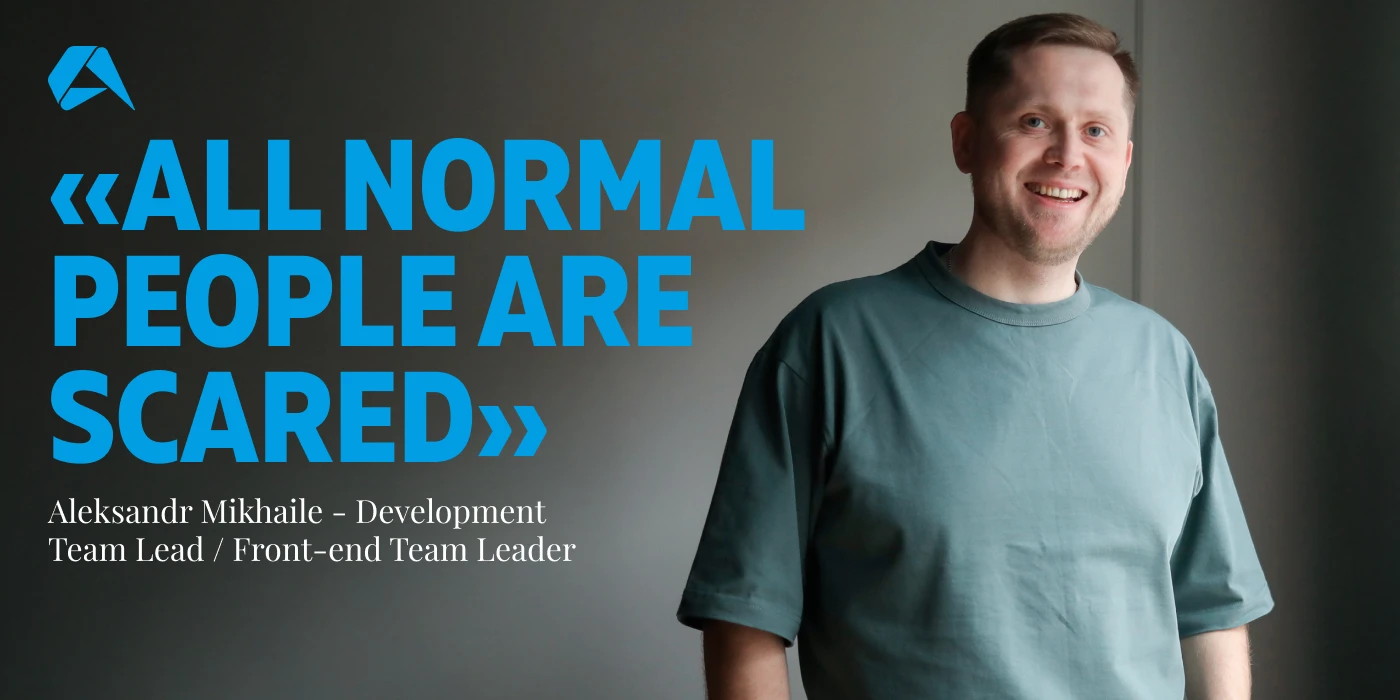
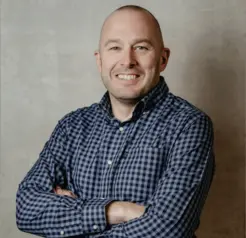
“All Normal People Are Scared”: The Story of a Team Lead Who Found His Way Into IT After Medical School and Restaurants
A few years ago, after a stretch in the restaurant business, Alexander Mikhaylo joined Altenar as a junior developer. Today, he leads a development team.
In this conversation, Alexander talks about abandoning an authoritarian management style, rebuilding a career with a family in the background, and why, in a team, soft skills can matter more than fifteen years of technical experience.
How did your career begin?
I started living independently pretty early. First, I enrolled in medical school in Petrozavodsk to study pediatrics. I spent two and a half years there, then very successfully failed my winter exams and was expelled. I enrolled at the same university again, this time in the Faculty of Forestry Engineering. I studied there for another three years and realized it wasn’t for me. So I left and moved to St. Petersburg.
In St. Petersburg, I got a job in hospitality and later graduated with a degree in economics and enterprise management. I worked as a bartender for a while, then moved up and became a manager, responsible for the bar side of several restaurants in a large chain. I was doing that quite successfully until COVID-19 began. The industry had to survive, and the first people to be laid off were those who were not directly working with their hands, not standing behind the bar, and so on. I was one of them. I had a wife, two children, and suddenly no job. I understood that I had to do something.
And what did you decide to do?
At that point, I was looking in the direction of building websites. I had liked it back in school, which was a very long time ago, in the early 2000s. I decided it was worth returning to that, so I took a course. I completed it and started looking for work.
I went to interviews for quite a long time — about a year and a half. At the same time, I worked part-time in a bar just to bring in some money. Then, one day, I had an interview at Altenar. The next day, they called me and made an offer. I was very surprised, because I had received so many rejections. At that point, I was ready to accept any salary, just to get into the industry. That is how I became a junior developer. It was my first job in IT, and Altenar was my first IT company. I still work here.
So, in just a few years, you went from junior developer to team lead?
In a little over three years, yes. I joined as a junior. I was extremely motivated. I tried to work a lot, and to work hard. I was also used to giving myself completely to the job — not just working by the clock, but working toward something tangible, something that created value.
At some point, my manager simply noticed me and said, “It’s time to move you to mid-level developer.” We had a wonderful manager, Daria Korotkova, who went on maternity leave. In February 2025, I took over the team.
Apart from career growth, what other opportunities do you see at the company for your own development?
I genuinely enjoy managing teams. I feel in my element. Here, I continue to learn how to do that. I have a lot of management experience, but from another field, and I can see that the specifics here are slightly different. So I am adapting to them. And I like this approach more than the authoritarian management style I used before.
Here, everything is different. You have to think about people. And that really is very important.
So developing as a manager is your main growth area?
As a team lead, yes. Learning a different approach, applying it, focusing on scaling the team, developing it, developing people’s strengths, and using motivation to improve effectiveness. I like thinking on a larger scale, and I am interested in moving toward analytics.
Do you ever feel tempted, when someone does something wrong, to go back to that authoritarian method?
Yes, that happens. I try to hold myself back. I practically slap my own hands. It takes self-control. I understand that all people are different. At Altenar, I began to look at things a little differently and to work differently.
What approach am I trying to use now? We were very lucky with the people in our team, because each person has their own strength. For a team to be harmonious, you need people with different strengths in it. I look at them through that lens. I focus on their strengths, so that each person inside the team can see those strengths, too.
How would you describe your current management style in one word? If it is not authoritarian, then what is it?
Supportive. Yes, that word works. It is about human management.
And how exactly do you support employees? How do you help them grow?
Right now, I am trying to develop people’s strengths. For example, I know there is a person on the team who is very strong technically. I try to work with him in a way that helps him keep improving his skills, interact more with the team, and share his knowledge.
Just recently, we were discussing that it would be good for him to run a workshop — not only within the team, but within the company. That would solve two needs at once. First, it would help transfer expertise inside the team and the company. Second, it would show the person that he is good. As an expert, his sense of self-worth would grow.
And then maybe a meetup?
It does feel like that could be the next stage — a meetup. By the way, I would be happy to speak at one myself.
Are there any red flags that help you understand that someone is not right for the team?
No matter how much experience a person has, communication and soft skills are still very important. For me personally, they matter a lot.
Even if someone lacks certain technical skills, that can always be taught. But if a person cannot find common ground with others, if they are quite toxic, then no matter how much of a professional they are, even with fifteen years of experience, they are unlikely to fit into the team. That kind of person is not right for us.
How do you support newcomers in the team?
I should start by saying that I haven’t yet had a full onboarding process. I inherited an already-formed team. Only this summer, one person moved over from another team. First, he had already been at the company for a long time and knew all the internal processes. Second, he was familiar with the specifics of the product, because he had once taken part in our work. There was no need to explain anything to him from scratch.
But I wouldn’t reinvent the wheel. First, you need to introduce the employee to the company’s internal processes and immerse them in the product by having them study the documentation. Then come some minimal tasks, so that they can get familiar with the codebase, our best practices, and the team’s communication processes.
It is important to give real tasks during the probation period, so the person can look, try, and we can see, from our side, how they show themselves. I know there are approaches where a person is not allowed anywhere near production during probation, but our architecture is not built in such a complicated way. The stack is not so complex that we need to keep them away.
Tell us more about the stack. What does the team work with?
We write in TypeScript and use React to build UI. For state management, we use MobX and Zustand — the choice depends on the project and the task. For server state and API requests, we use React Query in some projects. Testing is done with Jest. We use Jira and Confluence for task management and documentation. We document and develop components through Storybook. We also have an internal UI Kit, our design system, which we use to assemble interfaces.
How is the work structured in the team, from planning to implementation?
The company receives a business request to implement a particular tool. Then an analyst works on it, gathers the various requirements, and determines which teams will be involved in the implementation. After that, he or she distributes the epics across teams and adds a technical specification.
When we receive an epic like that, our work is structured as follows. We sit down and speak with the analyst, ask the questions that matter to us, and make sure we understand correctly what is required from our side. Then we work with the epic independently: we carry out technical analysis, research, and decompose it into tasks. Those tasks are then built into our sprint.
We look at dependencies on other teams, whether there is a design from the UX team, whether there is an API contract with the back end. Then we take it into implementation. The next stage is testing, support, and bug fixing. After that, everything goes into the staging environment, where it is tested again, and then into production. A standard story.
What are you proud of?
My family. My wife, my children. I cannot imagine life without them. The way we live, the way we raise our children, the way they grow up before our eyes — that is what I am proud of.
I am also proud that I radically changed the direction of my life, changed my field, and switched to another kind of work. My previous job took up absolutely all my time. There was no work-life balance at all. None. My family barely saw me. Now, of course, everything has turned around. It has been set back on its feet. And life has taken on new colors.
Are there things you would do differently now? For example, would you finish medical school after all?
No, no. I do not regret at all that I did not become a doctor. Not at all.
I spoke with people who did finish university. It is extremely hard work. The level of responsibility is enormous. What people feel inside while doing that job, I cannot even imagine. And to receive so little money for it is simply unfair.
Everything that happens in our life happens for the better. Everything that does not kill us makes us stronger. I am absolutely satisfied. Everything is all right with me. I have a wonderful family and a wonderful job.
Is there anything you regret?
Of course there have been mistakes. Who lives without mistakes? But I can’t remember anything major that I would now regret. The main thing, I believe, is not to make the same mistake twice. A mistake should become experience. You make it, you realize you did something wrong, you draw a conclusion from it — and the next time, you don’t repeat it.
What does your day look like?
Everything depends on the children. When they are in the first school shift, I have to wake up very early to take everyone to school. Then I come home, and the working day begins.
In the morning, there are syncs with the team and cross-functional syncs. We review the results of the previous day and coordinate our next steps. After that, I check task statuses and coordinate processes. Previously, I would take tasks for myself and spend time on development. Now I try to work more on stepping back, looking at the team from the outside, and thinking about what can be improved.
I rarely go out for lunch during the working day, because when you work from home, there is no need. In general, I am not used to going out for lunch.
Is that an echo of your previous work?
Yes. (Laughs.) What else? Usually, there are many calls during the day to discuss one issue or another. At the end, there is a kind of retrospective of what happened that day: summing up, planning what needs to be done tomorrow. Something like that.
Work is over. What comes next?
Then family. Some household things. Walks with the children. Maybe meeting friends.
I wouldn’t say I have a hobby to which I devote a specific part of my life every day. There are simply things I like doing. When I came into IT, I discovered computer games. Not often, but it happens sometimes.
As a child, I was very interested in hiking and outdoor tourism. I love camping. Sometimes, in the summer, my family and I go away for a couple of days with tents. I really like fishing. Sometimes I even go fishing in winter. I like making things with my hands. I built myself an office on the balcony. I like cooking. I cook very well. I like reading before bed. Since coming into IT, I started reading technical literature.
Can you recommend a book for people who manage teams?
Right now, I am reading The Five Dysfunctions of a Team by Patrick Lencioni. Our Iceberg Is Melting by John Kotter is also good. It is about how to implement change in a team.
What advice would you give to people who are just starting to manage others?
I think you should not be afraid to take responsibility. That is the most important thing at the first stage. Do not be afraid of changes in your routine. The things that scare you should be turned into a challenge — accepted, and, in a sense, overcome.
All normal people are scared: what if something doesn’t work out, what if people look at you strangely and you end up feeling like the odd one out. And then there is impostor syndrome. I still have all of that, too. You need to accept it, acknowledge it, and try to do something. Not sit still. Nothing ever comes by itself.