
From The First Whistle to Long-Term Loyalty
Every sports bettor’s story starts somewhere. Maybe it’s a Saturday morning push notification promising enhanced odds on a derby match. Or sometimes it could be an ad flashing across the screen during halftime. Occasionally, it might even be a friend leaning over a pub table with a ‘you’ve got to see this’ heads-up on an accumulator.
From that moment on, dozens of small interactions decide whether that bettor becomes a regular in your book or disappears after one match. Some aspects are in your control, and some aren’t, but either way, they are all part of the same journey.
This article is designed to be a comprehensive guide for mapping out that journey, removing potential obstacles, and keeping bettors engaged from kick-off to full-time and beyond.
Understanding the Player Journey
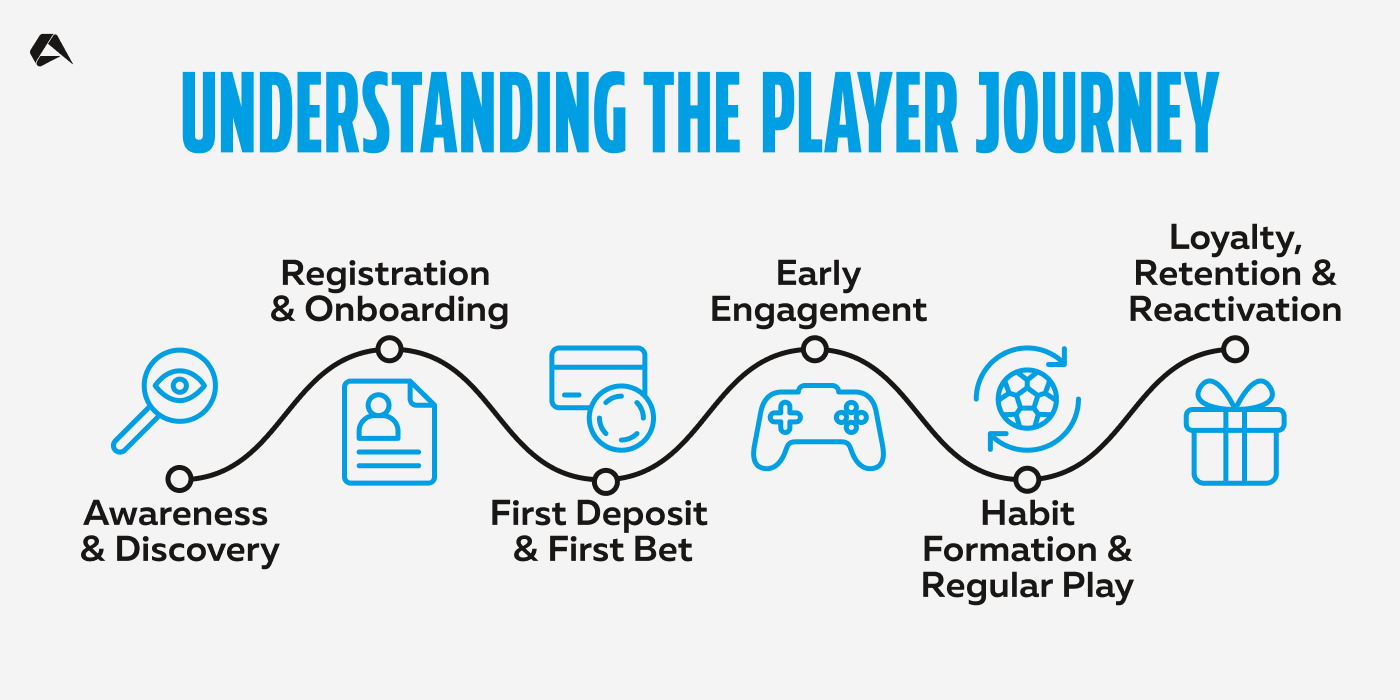
The player journey is the complete lifecycle of a bettor’s relationship with your brand, from the first awareness to long-term loyalty or, in some cases, churn. In iGaming, mapping this journey in its stages offers a blueprint for personalizing experiences, anticipating needs, and intervening before interest fades. Done well, it’s the foundation for reducing churn and increasing lifetime value (LTV) by creating a player experience that feels natural rather than transactional.
In the following list, the journey can be broken into six key stages, with each stage presenting distinct touchpoints, emotional drivers, and opportunities to establish trust.
Stage 1: Awareness & Discovery
Players first encounter your brand through ads, affiliates, social media, or word of mouth.
Stage 2: Registration & Onboarding
The sign-up process, KYC checks, and first impressions of your platform.
Stage 3: First Deposit & First Bet
The important ‘activation’ stage where intent turns into action.
Stage 4: Early Engagement
The first days or weeks where you set habits and demonstrate platform value.
Stage 5: Habit Formation & Regular Play
Establishing consistent activity through relevant offers, events, and personalization.
Stage 6: Loyalty, Retention & Reactivation
Keeping active players engaged and winning back inactive ones.
The Kick-off
For most sports bettors, the journey starts the moment they become aware of your brand. That might be:
-
A social media post tagged with your logo.
-
A targeted ad for odds on tonight’s big game.
-
A friend’s referral code, sweetened with a free-bet offer.
-
A sudden glance at your kiosk in a retail betting shop.
These initial contact points (touchpoints) are like the first few minutes of a match. You can’t win it here, but you can certainly lose it if, for example, you have a sign-up process that drags on into extra time. Ultimately, one wrong move can see a bettor walk out of your stadium at the start of a match.
If the proposition doesn’t feel relevant, the sign-up process appears overly complex, or the offer seems uninspiring and generic, many bettors won’t give you a second chance.
That’s why it is advisable to think about acquisition as more than a single moment. In a real sense, they are entry points that suit different types of bettors: the casual fans, the stats-driven punters, and the accumulator chasers alike.
Once the bettor takes that first step, everything hinges on what happens next. And in this game, the first bet is the real handshake.
The First Bet is the First Impression
Once a bettor has committed to signing up, their focus shifts quickly to the first wager. This stage is a vital moment for building trust. And not just in terms of placing a bet, but in how the entire experience feels.
It goes without saying, yet it’s worth pointing out nonetheless, that onboarding should be effortless and intuitive. If identity verification takes too long, payment methods feel limited, or navigation is unclear, enthusiasm tends to fade quickly. Keep in mind that the energy a bettor brings to their first session is finite. Therefore, every delay or distraction risks losing it.
When the first bet is placed, the bettor is assessing more than the odds. They’re noticing the clarity of how markets are displayed, the ease of the bet slip, and the speed of settlement. Minor frustrations at this stage can leave a lasting negative impression.
The transition from deposit to first wager is the next window where momentum can be lost. You can maintain it by:
-
Presenting relevant markets immediately after deposit.
-
Offering bet slip suggestions tailored to your profile or location.
-
Highlighting in-play opportunities already under way.
The goal is to make the first betting experience fast and rewarding enough to return to. Consider this stage as the beginning of a relationship, and not just a transaction. Get it right, and the rest of the journey becomes far easier.
From here, the challenge shifts to maintaining engagement by identifying the key moments that will bring a bettor back, again and again.
The Moments That Bring Players Back
Once the first bet is placed, the focus should move toward the moments that will make the bettor want to return. Repeat visits are often driven by well-timed prompts, relevant offers, and the sense that there’s always something worth coming back for.
These moments don’t have to be significant or obvious. In fact, subtle triggers usually work best. For instance, a reminder about a live match they showed interest in, a small free bet linked to a recent win, or a notification when odds move in their favor. Each of these can rekindle the same energy they felt during their first session.
The art of retention lies in striking the right balance. That’s to say, staying visible without becoming intrusive. Send too many nudges, and you risk being ignored. Too few, and the player may find their way to another platform.
Strong retention strategies often focus on:
-
Event-driven re-engagement: Linking prompts to specific sports, leagues, or markets the bettor has previously explored.
-
Personalized rewards: Free bets, boosted odds, or tailored promotions tied to recent betting activity.
-
Content that creates anticipation: Short previews, expert tips, or publishing odds for upcoming matches ahead of competitors.
-
Social and competitive elements: Leaderboards, friend challenges, or community discussions that turn betting into a shared experience.
The goal is not just to get them back for the next bet, but to build momentum. When a player begins to see your platform as part of their regular sports-watching routine, you’ve moved beyond transactions and into habit-building. That’s when loyalty starts to kick in.
But for all the ways you can draw players back, there are just as many ways to lose them. Sometimes in a single click.
Where You Can Drop the Ball
No amount of clever retention tactics will work if the core experience isn’t solid. Players rarely walk away after a single bad experience. More often, it is a series of frustrations that may include things like slower load times during peak events, promotions that fail to redeem, in-play bet delays, and so on, that chip away at trust. These aren’t always flagged in player feedback, yet they’re often the real reason engagement drops.
Common exit triggers operators overlook:
-
In-play bet delays that leave players feeling they’ve missed the moment.
-
Slower load times during peak matches, especially on mobile.
-
Promotions that don’t redeem instantly or vanish without warning.
-
Slow settlement of winnings even after obvious outcomes.
-
Overly aggressive session timeouts that break betting flow.
-
Key markets or props missing.
Most of these issues are fixable, but only if you’re actively looking for them. Operators who spot and address them early turn what could have been churn into a loyalty driver.
When you address the drop-off triggers, it clears the path to build positive interaction and momentum.
The kind that forms long-term habits.
Building the Habit
If the last section was about removing the reasons to leave, this one is about creating reasons to return, and to do so naturally, often, and with a sense of anticipation.
Habit isn’t founded on novelty. It’s built on repetition, albeit not the boring kind. The players who stick around on a sports betting platform aren’t necessarily the ones who have good wagering outcomes. To be precise, they’re the ones whose interaction with your brand becomes part of their weekly, even daily, routine.
This is rarely accidental. It’s routine that is greatly influenced by these three things:
-
Consistent touchpoints in how bets, offers, and content are delivered. For example, if you know your player’s favorite league starts at 8pm on Fridays, make your nudge arrive at 7:45 with something relevant.
-
A reason to check in, even without a bet in mind. Players who log in just to see what’s new are far more likely to place a bet once they’re there.
-
Micro-rewards that reinforce engagement without overloading. To this extent, not every incentive has to be monetary. Early access to a market, personalized tips based on previous behavior, or simply fast in-play confirmation can build stickiness.
In many ways, the best retention work doesn’t feel like marketing at all. It will feel natural, like you’ve anticipated the moment they were going to show up anyway.
| What to Spot | Why It Matters | How to Act |
|---|---|---|
| Regular Play Patterns | Shows when and how a player naturally engages. | Time offers or updates to match their peak play windows. |
| Specific Triggers | Identifies what brings them back e.g. favourite team, certain markets. | Personalise comms to those triggers. |
| Early Drop-off Signs | Reveals when interest is fading. | Intervene with relevant incentives or re-engagement content. |
| Trust-Building Moments | Keeps the player’s confidence high. | Ensure quick settlements, efficient navigation, and reliable promos. |
Sports Betting vs Online Casino Journeys
Same Stadium, But Different Games
On the surface, sports betting and online casino share the same broad stages of customer engagement, particularly in terms of awareness, onboarding, habit formation, and long-term retention. Yet the pace, triggers, and motivations differ widely.
In sports betting, the timeline is tied to external events. The customer’s key triggers are match schedules, seasonal tournaments, and changes in the live odds. Engagement is often concentrated into short, high-intensity bursts, such as before kick-off, at halftime, or in-play. The journey is cyclical, with natural ups and downs.
Online casino journeys, however, are far less dependent on the calendar. Players can start and stop at any time, and the appeal is often in the immediate gratification of on-demand play. Engagement is more evenly spread, with spikes driven by new game launches, jackpots, or promotional campaigns, offering operators slightly more control. The subsequent challenge is one of balancing novelty with familiarity, giving players something fresh while keeping core favorites accessible.
With that said, the journeys for these two verticals generate similar emotional triggers. Both hinge on trust in the platform, an easy and intuitive user experience, and a sense of reward, whether through wins, bonuses, or recognition. Similarly, the first positive session matters. A quick deposit and settlement, along with straightforward navigation, set the tone for repeat visits.
The main difference lies in the mindset. Sports bettors often arrive with a specific intent, like a team, match, or market in mind. Casino players are more likely to browse, sampling multiple games within a single session. Understanding these differences allows operators to tailor touchpoints, pacing, and incentives without losing sight of the shared fundamentals that underpin all successful player journeys in the iGaming industry.
Playing the Long Game
Loyalty in sports betting does not typically start with a big win or an extravagant promotion. It’s a bit more subtle than that, found in the small but decisive moments that shape how a player feels about your brand every time they log in. A bet settled within seconds of a match ending. Odds delivered the moment a player starts looking for them. A personalized nudge that recognizes a streak, whether it’s hot or cold. These micro-moments don’t just improve convenience. Combined, they create momentum and a feeling of reliability, and when you get it right, they stack up into something far more potent than any single campaign. It’s trust. And trust, once established, turns casual players into regulars, and regulars into advocates.
The challenge is knowing whether you’re designing enough micro-moments. Are your systems built to respond instantly? Are you anticipating needs before they’re voiced? Because in today's market, players will remember the operators who made the right things happen without them having to ask.
Are you confident your current systems are delivering the right actions at precisely the right moments? Many aren’t. Altenar’s technology is designed to help operators identify and respond to these micro-betting moments, enhancing every stage of the bettor's journey to strengthen retention and keep your platform an integral part of their routine.
Micro-moments create macro results. Discover Altenar’s approach to betting journeys that keep players engaged for the long term. Schedule your platform demonstration now and discover retention from a whole new perspective.