
The US SAFE Bet Bill That Could Change How America Bets
The US sports betting landscape faces a monumental shift with the reintroduction of the SAFE Bet Act (Supporting Affordability and Fairness with Every Bet). Designed to replace the current patchwork of state regulations with a strict federal framework, this legislation targets the industry’s rapid expansion by framing gambling as a public health concern comparable to Big Tobacco.
The Act proposes sweeping changes that every operator must understand, including advertising blackouts between 8 am and 10 pm, a ban on AI-driven microbets and personalized targeting, and the prohibition of credit card deposits. Additionally, it seeks to eliminate proposition bets on college sports and implement nationwide affordability checks.
While the bill currently faces a steep legislative climb in Congress, it signals an inevitable transition toward European-style oversight. Whether or not it passes in full, this push for federal standards serves as an urgent warning for sportsbooks to prepare for stricter compliance and consumer protection measures.
Read the full blog below to discover how the SAFE Bet Act could reshape US sports betting and what operators need to do to stay ahead!
And What it Means for Industry Operators
If you’ve watched a major sporting event lately, it’s an odds-on bet that you already noticed the deluge of sportsbook ads promising no sweat bets (bonus credit refunds on losses), odds boosts, and bonus offers. Throw in the rise of microbets, like wagers on the next play, and it’s no surprise that mobile betting feels less like an occasional flutter and more like a 24/7 marketplace.
That, say US lawmakers, is precisely the problem. And it’s what the newly reintroduced SAFE Bet Act, short for Supporting Affordability and Fairness with Every Bet, is designed to tackle.
What is the SAFE Bet Act?
Introduced in March 2025 by Senator Richard Blumenthal (D-CT) and Representative Paul Tonko (D-NY), the SAFE Bet Act is a sweeping federal proposal that would rewrite the rules of online sports betting in the United States.
Until now, sports betting has mainly been a state-by-state affair. Since the Supreme Court struck down PASPA in 2018, each state has established its own rules, resulting in a patchwork of laws and a variety of player protections. The SAFE Bet Act would change that by creating a federal framework that no state could offer sports betting without first meeting strict standards approved by the Department of Justice.
Is this a Big Tobacco Moment?
This kind of push for national regulation is less about legal structure and more about narrative. Supporters of the SAFE Bet Act have begun describing online betting as the next ‘Big Tobacco’ moment, suggesting that the industry has grown too quickly, with too few limits, and is now heading for a regulatory correction.
It’s a powerful comparison, and one that carries weight in Washington. The idea is that, just as tobacco companies once relied on glamorous advertising and addictive products, betting platforms today use constant nudges, endless betting opportunities, and pervasive marketing to keep players hooked. Whether or not that’s a fair comparison, it does, at the very least, set the tone for the debate - that gambling is being discussed less as a business issue and more as a public health concern.
For established operators, this is a significant development. Once a sector is framed in health-crisis terms, the political appetite for strict controls rises sharply. Advertising, product design, and even loyalty programs are being scrutinized in ways that would have seemed unlikely only a few years ago. And you don’t have to agree with the Big Tobacco analogy to recognize its impact, since it’s already shaping how regulators, media, and the public view the future of sports betting.
What’s Inside the Bill?
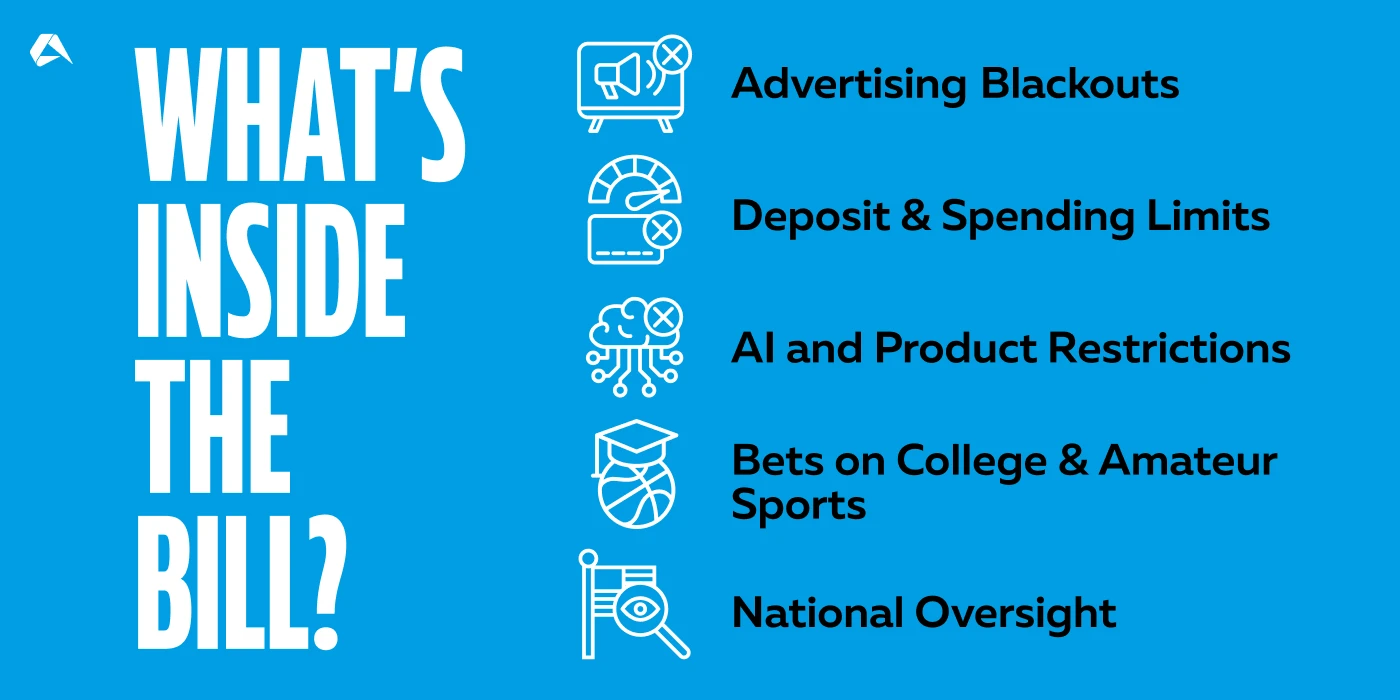
Let’s peel back the layers of the SAFE Bet Act. Below are the key provisions that recommend reshaping how sportsbooks can market, commercialize, and operate, with each corresponding directly to the sections outlined in the bill.
Advertising Blackouts
This proposal slams the brakes on the sportsbook marketing machine. Under Section 103 of the SAFE Bet Act, ads would be barred from broadcasting between 8am and 10pm local time, and entirely removed during live sporting events.
Any ads featuring inducements, like risk-free wagers, welcome promos, enhanced odds offers, or explanations on how to bet, would be prohibited. In essence, it seeks to replace constant promotional pressure with a more balanced approach that emphasizes responsibility and respect for the consumer.
Deposit & Spending Limits
Perhaps the most potentially disruptive feature of the SAFE Bet Act for industry operators is its proposed restrictions on player spending. Under Section 104, bettors could make no more than five deposits in a 24-hour window, eliminating the possibility of topping up accounts repeatedly during a single day.
Funding options would narrow too. Credit cards will be banned outright, with only debit or direct transfers permitted. And before allowing high-value wagers, operators would be required to conduct affordability checks, effectively assessing whether a customer can cover the stake. For operators, this proposal signals a move toward banking-style diligence in betting, adding new layers of cost and responsibility.
AI and Product Restrictions
The SAFE Bet Act takes direct aim at the role of artificial intelligence in betting. Section 105 effectively prohibits platforms from using AI to track individual behavior or to tailor personalized promotions, which are practices that many operators rely on for retention.
It also extends to product design. AI-driven wagering products, including rapid microbets, would be barred entirely. For operators, this cuts into one of the industry’s fastest-growing areas, forcing a rethink of data-driven engagement strategies and the next wave of sportsbook innovation.
Bets on College & Amateur Sports
College sports have long been a gray area in US betting, with many states already banning wagers on in-state teams or limiting proposition bets on student athletes. The proposed Act would go further by setting a uniform national rule. Under Section 106, there would be no proposition bets on any college or amateur athletes, regardless of jurisdiction.
The only exception would be for global events such as the Olympics and Paralympics. For operators, this removes a profitable area of variation between states and anchors the integrity of amateur sports into federal law.
National Oversight
One of the most sweeping changes of all is the intention for federal approval of state markets. Section 102 establishes a system where sports betting is prohibited nationwide unless a state applies to the Department of Justice and demonstrates compliance with federal standards. Approvals are valid for three years and must be renewed.
Alongside this, the Act mandates a national self-exclusion clearinghouse, a SAMHSA survey to track betting behaviors, and a Surgeon General report on public health impacts. For operators, it means operating under both state regulators and the federal government in Washington, D.C.
Levelling the Playing Field Against Offshore Sites
Beyond its restrictions, the Act could strengthen the market by obliging states to support federal crackdowns on offshore operators. For licensed sportsbooks, this has the potential to reduce the unfair competition that attracts players with looser rules and untaxed markets.
Despite what might be perceived as the negative impacts for operators should these proposals pass, by putting enforcement on the federal stage, compliant operators could gain a stronger market in which to compete.
Momentum or Mirage?
For all its sweeping proposals, the SAFE Bet Act remains just that. A proposal. The bill has only just entered the early stages of the legislative process since its introduction earlier this year. As of August 2025, it sits before congressional committees, where hearings, debate, and potential amendments will shape its next move.
There is still a long way to go. The Act would need to clear both the House and the Senate before heading to the President’s desk. Even in the best-case scenario, that journey takes months.
Furthermore, the politics are complicated. Supporters rely on public health arguments, citing polling that shows widespread concern about the growth of betting and strong support for tighter controls.
Opponents point to the rights of states, the billions already tied up in local regulatory systems, and the economic influence of operators, leagues, and media partners. Combine that with intense industry lobbying and concerns about Washington overreach, and it’s clear that the SAFE Bet Act has a steep hill to climb.
Still, even if it never passes in full, its reintroduction signals a likely transition of some description, with Washington now firmly part of the sports betting conversation, which industry operators can’t afford to ignore.
How It Compares With Other Markets
In many ways, the SAFE Bet Act is less a leap into the unknown and more a step into territory that other regulated markets have already defined. The UK, for example, has long applied tighter controls on advertising and affordability checks, while across Europe, inducements and VIP schemes have steadily been reined in.
Industry voices show how polarizing the US debate has become on these issues. According to reporting by one prominent industry media outlet, gaming attorney Jeff Ifrah criticized the bill’s registration requirements as “a lot to process because the first suggestion out of the gate [is] to include an unconstitutional registration requirement”. In the same coverage, industry consultant Brendan Bussmann cautioned that such restrictions could backfire, warning they risk “inflating the illegal market” by pushing players toward offshore sites.
Yet the direction of travel is clear. Washington is catching up with global trends. For multinational operators already used to EU or Canadian standards, greater alignment could reduce compliance duplication and even ease US entry. As for domestic players, it sets a higher benchmark but also creates the opportunity to learn from markets that have already weathered these reforms.
The Road Ahead
Proposals on paper are one thing, but turning them into law is a far more complicated journey. At this stage, the SAFE Bet Act has momentum as a conversation starter rather than as a piece of legislation likely to sail through Congress. With strong state frameworks already in place, deep industry lobbying, and the constitutional resistance to federal overreach, the bill, in its current form, is at best a long shot. In real terms, it is more likely to influence the regulatory debate than to be enacted wholesale.
But that doesn’t mean operators can ignore it. Often in US policymaking, a bold bill like this serves to frame the agenda and soften the ground for incremental reforms. Advertising curbs, credit card restrictions, and affordability checks could easily be broken down into targeted reforms. In that sense, the SAFE Bet Act may still succeed even if it is not passed in its entirety.
If reforms do emerge, it is unlikely they’ll be immediate. Federal legislation of this scale often takes years to evolve, and it is more realistic to expect gradual changes over the latter half of the decade than swift adoption in the next congressional cycle.
For iGaming operators, the key is to treat this as an early warning. The era of light-touch, state-by-state oversight is drawing to a close. The future, whether through federal law or state adoption, will likely involve stricter rules, enhanced protections, and higher compliance costs. And those who anticipate the coming changes will be best positioned to prosper.
The rules are changing fast. Don’t wait for the SAFE Bet Act. Talk to Altenar today to discuss building frameworks that future-proof your sportsbook.