
When operators size up a new sportsbook partner, the conversation invariably sticks to familiar ground. The strength of the platform. Licensing coverage. Technical features. Commercial terms. All massively important, of course, but rarely the thing that decides whether the partnership survives or thrives.
The truth is that most deals live or die in the not-so-glamorous space of support.
Let’s be honest. Support doesn’t sound exciting. More often than not, it’s relegated to the bottom of the RFP (Request for Proposal) checklist, treated as aftercare service once the ink is dry. Yet in today’s competitive iGaming markets, the difference between momentum on day one and a launch that stalls often comes down to whether support is reactive or strategic, generic or local.
That’s the dealbreaker nobody likes to talk about, but every operator eventually discovers.
The Overlooked Factor in B2B Betting Deals
For years, operators have learned the hard way that platform quality alone doesn’t carry a sportsbook across borders. You can have the slickest front end and the strongest odds feeds, but if your partner can’t rapidly resolve a payment blockage on a Saturday night, the advantage fades quickly.
Support, when it works, is invisible. Nobody remembers the downtime that never happened or the compliance issue fixed before it escalated. But when it fails, it’s unforgettable. The irony is that many operators still approach support as a cost to minimize rather than a competitive tool to leverage. In practice, it’s as fundamental to market success as the platform itself.
When Support Stops Being Customer Service and Starts Being Strategy
In most industries, support is there to fix what’s broken. There’s a product that fails and a customer that needs help, for instance. These are essential support processes. However, in sports betting, the pace of live betting, the complexity of local regulations, and the dependence on multiple payment systems often make it too late to fix an issue after the fact. This ultimately makes support not just service, but a strategic action.
Moreover, consider what happens during a major sporting weekend. Odds are moving quickly, deposits are surging, and regulators are watching closely. If a payment flow fails, the damage is more than frustration. It’s measured in lost revenue and regulatory risk. A responsive help desk can only react after the loss. A strategic support team prevents the loss in the first place by anticipating where issues may occur. And that’s the real difference between reactive and strategic customer service.
For this reason, forward-thinking operators now view support as part of the commercial decision itself. It’s not an afterthought bolted on after the deal. It’s a core question. Does this partner give us the confidence to grow markets, handle compliance surprises, and stay online when the pressure’s on? The answer often matters more than the size of the rev share.
Why ‘Local’ Matters Most in iGaming
On paper, iGaming looks borderless. Platforms operate across continents, content streams in real time, and money moves digitally. But when support is tested under pressure, geography still decides whether operators get answers or delays.
Round-the-clock coverage is now standard. This means that someone will always answer the phone. But whether that person is qualified to fix the problem is another matter. Too often, 24/7 means a first-line responder who can log the issue but not resolve it. By the time a compliance officer, payments specialist, or risk analyst is awake and available, the damage may already be done.
That’s why local presence still matters. It isn’t just about being awake in the right time zone, but more about having the right people in place who can act immediately with the authority and context to make decisions. That’s the piece many operators overlook.
Language and cultural details matter just as much. A generic support agent can’t explain to a Swedish regulator why your reporting format complies with local requirements or guide you through player verification hurdles in Spain. The same goes for payments. Brazilian players expect a local payment option like Pix. In Asia, esports has its own options. In Europe, bonus scrutiny is intense. These aren’t bugs to fix. They’re practical realities that require local knowledge at the point of support.
And it shows in outcomes. Operators with established local support teams usually enter new markets faster, adapt features with fewer problems, and avoid the reputational damage for not getting it.
The Competitive Advantage Few Put on the Balance Sheet
Support doesn’t usually get factored into financial models when launching a sportsbook. Operators focus on licensing costs, rev-share percentages, and projected GGR growth. Yet the quality of local support shapes all of these outcomes.
What do we mean by that? Well, let’s consider market entry. The difference between being first to market and lagging behind a competitor is often measured in weeks, sometimes days. Local support teams who know the regulators and understand local player payment preferences and habits are in a position to solve problems before they hit operations. That speed has a tangible commercial value, even if it never shows up in a budget forecast.
Retention is typically another undercounted advantage. When support builds trust with regulators and adds to the player experience, operators spend less time addressing problems and more time planning growth. Over the life of a partnership, that trust compounds into real-world benefits.
In summary, local support is a competitive advantage that many operators undervalue until they see it working for a rival.
Key Advantages of High-Level Local Support
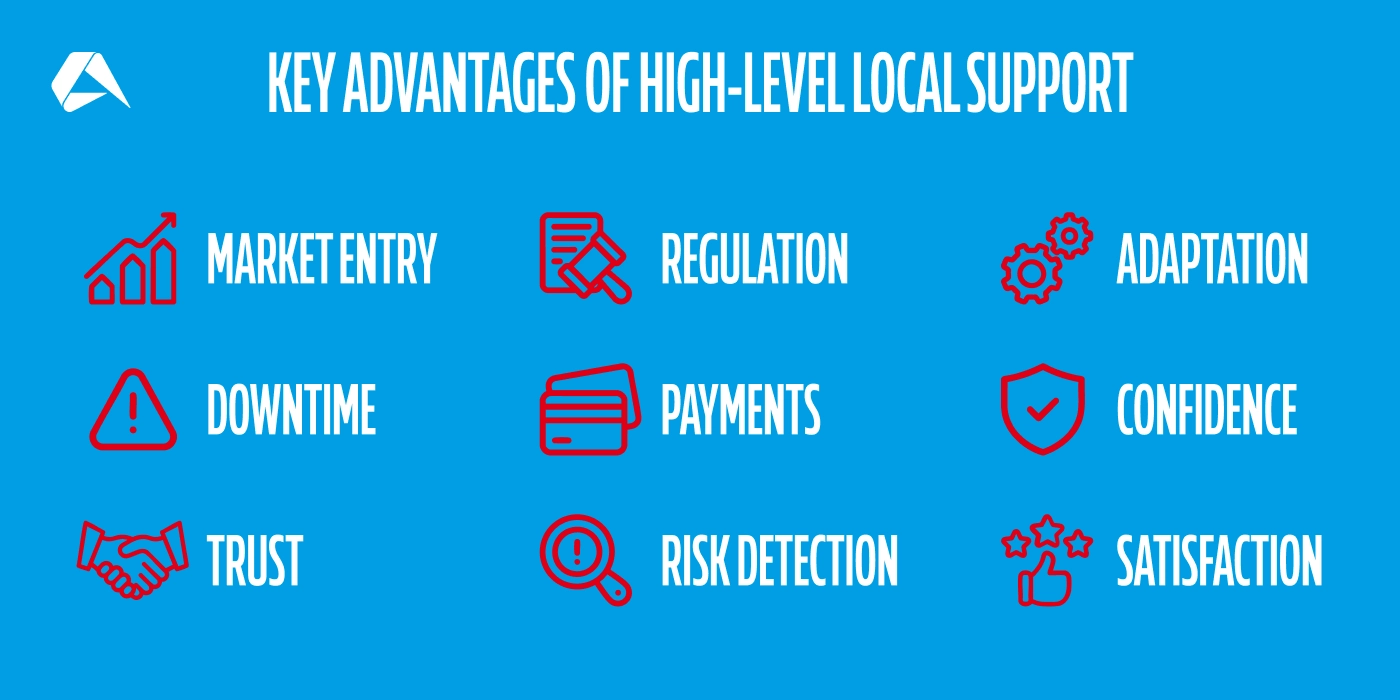
Local support delivers more than peace of mind. It creates measurable advantages for long-term growth:
✔ Faster entry into new markets
✔ Stronger regulatory relationships
✔ Quicker adaptation to compliance changes
✔ Reduced downtime in high-pressure moments
✔ Payment methods tailored to player demand
✔ Early detection of risk and fraud issues
✔ Trust built through cultural and language alignment
✔ Higher player satisfaction and loyalty
✔ Operational confidence during major sporting events
Standard Operational Support vs High-Level Local Support
Most people are familiar with standard operational support. It’s the ticketing system that logs issues, assigns them to a queue, and resolves them on a first-come basis. This model works fine when the problem is simple, such as a password reset, a server issue, or a basic API query. It’s functional, but it’s reactive. The operator waits, the system responds, and little thought is given to context.
High-level local support, on the other hand, is a different proposition. Instead of treating problems as isolated tasks, it positions support as part of the operator’s broader strategy. Local teams know the regulatory climate, the payment situation, and the expectations of players in each jurisdiction. They can spot challenges before they turn into obstacles, and they tailor advice in a way that reflects how the market actually works.
This difference shows in outcomes. A standard system can fix what’s broken. Still, it can’t advise on how to adapt to changes in advertising or bonus rules. It won’t warn you that a payment method is losing popularity in a key region, or that player behavior in a new market indicates a need for tailored risk monitoring. High-level support does all of this because it is embedded in the market, not just in the technology.
Support Comparison Table
| Type | Standard Operational Support | High-Level Local Support |
|---|---|---|
| Approach | Reactive, ticket-based problem solving. | Proactive, strategic, market-aware guidance. |
| Scope | Fixes technical issues as they occur. | Anticipates challenges, adapts to local realities. |
| Knowledge | General product familiarity. | Deep understanding of regulations, payments, and player behaviour. |
| Availability | 24/7, but often remote and generic. | In-market teams are aligned with local time zones and culture. |
| Compliance | Responds when issues are raised. | Advises on upcoming regulatory changes and requirements. |
| Payments | Supports integration at a technical level. | Tailors payment methods to regional player demand. |
| Risk Management | Limited to fraud alerts and system flags. | Active monitoring, early detection, and context-driven advice. |
| Relationship | Transactional. The operator waits for fixes. | Collaborative. Account managers invested in long-term success. |
What Operators Should Expect from High-Level Support
If support is going to be the dealbreaker, operators need to know what ‘good’ really looks like before they sign. In this industry, high-level support means a partner who stays ahead of the trends that define regulated markets. That’s where expectations should be set.
Start with dedicated account management. Too often, suppliers hide overstretched teams behind 24/7 helpline promises. A shrewd operator asks the hard questions, such as how many accounts each manager handles, and whether they will know my book inside out.
Then there’s local presence. Global coverage sounds reassuring, but without staff employed in the markets you care about, what looks like round-the-clock cover can still mean delays across continents. Operators should consider where support is based, the languages covered, and how quickly they can reach compliance specialists in their own jurisdiction.
High-level support also includes regulatory intelligence. The best teams do more than react when a regulator demands changes. They provide early warning, explain the implications, and guide operators toward a solution before it becomes a problem. In this regard, it’s worth asking: do you include compliance advice in your support, or is it billed separately as consultancy?
Technical responsiveness is another overlooked area. Operators should understand how escalation works, which systems monitor risk and fraud in real time, and the average resolution time for issues during peak events.
A strong partner will have monitoring systems in place that catch issues before operators do, like server slowdowns flagged before downtime, suspicious betting activity stopped before payouts, payment failures detected and rerouted before player complaints arrive. This kind of proactive support can be the difference between a minor adjustment and a full-blown crisis.
Finally, the most valuable support acts as a strategic feedback loop. Local teams see payment trends, player behavior, and risk issues first. When that intelligence feeds back into the operator’s strategy, it becomes a growth engine.
Key Questions to Ask Before Signing
Before committing to a supplier, operators should press for clarity. The right questions separate standard operational support from true partnership arrangements.
-
Who will be my dedicated contact, and where are they based?
-
How many operators does each account manager handle?
-
What languages does your support team cover natively?
-
How quickly can issues be escalated across time zones?
-
Do you include compliance guidance as part of support, or charge separately?
-
What monitoring systems are in place to flag problems before they surface?
-
Can you provide examples of how support helped an operator avoid fines or expand into new markets?
-
What’s your average resolution time during high-pressure events?
-
How does your support feed back into product development and localization?
When evaluating a partner, don’t just count the features. Ask the harder questions about who will stand beside you when pressure mounts. The operators who do this well tend to choose relationships that last and deals that truly deliver.
The best way to judge support is to see it in action. Arrange a bespoke demonstration with Altenar today and discover how our high-level local support creates a measurable advantage for ambitious operators worldwide.