
There was a time when bonuses did all the talking. For many years, free bets, boosted odds, and cashback weekends worked because players were still surprised to be rewarded for simply showing up. But now, those days are fading. The industry has reached a point of saturation where the average bettor can predict standard offers before they land in their inbox. Trends currently show that they’re now looking for something harder to imitate - a sense of recognition and belonging.
That’s where premiumization finds its place. For the most part, it’s not about high rollers or extravagant gifts. That’s the old definition. Operators are moving from selling rewards to selling appreciation, which is the idea that experience, access, and personal attention can move the needle more than another free spin or odds boost.
Casinos saw it first in the 1990s. Their VIP tiers and private rewards systems proved that loyalty deepens when a player believes they’ve crossed into a more exclusive circle. Sportsbooks are catching on, though the adaptation isn’t straightforward. Betting habits differ from those in online casinos. Engagement cycles are, on average, shorter, and emotional connection is harder to build around data feeds and fixtures. Yet that’s exactly why this conversation matters, because for many sportsbooks, it’s a largely underexplored source of monetization.
As operators seek ways to increase revenue per player without inflating costs, premiumization offers a different kind of growth path, one that breeds trust and access rather than relying on discounts.
What Sportsbooks Can Learn from Casino Loyalty Systems
Physical casinos have always understood loyalty as a form of theatre. From the host who remembers a player’s drink order to the private room that feels slightly off-limits, every detail is designed to make spending feel like belonging. That instinct to elevate the experience, not just reward it, built the foundation for modern retention models long before the term ‘premiumization’ ever existed.
In the online space, casinos translated those cues into structured loyalty programs. Bronze, Silver, Gold, and beyond. Points systems, birthday bonuses, VIP hosts on call. It’s all rooted in a single truth. When players sense a personal stake in the brand, they stay longer and spend more. Those upper tiers in a loyalty program are more than perks. They’re psychological milestones. Each level offers proof of progress, status, and access to something not everyone can reach.
For sportsbooks, that blueprint remains vastly underused. Most betting platforms still rely on volume-based bonuses or short-term offers, the digital equivalent of free drink tokens in a casino lobby. What’s often overlooked is continuity, linking every wager, win, and milestone into an ongoing journey. This can be achieved by connecting rewards to the rituals of betting, like following a league all season, backing a favorite team, maintaining a win rate, for instance, or simply staying active through the off-season.
New and Proven Models to Monetize Exclusive Experiences
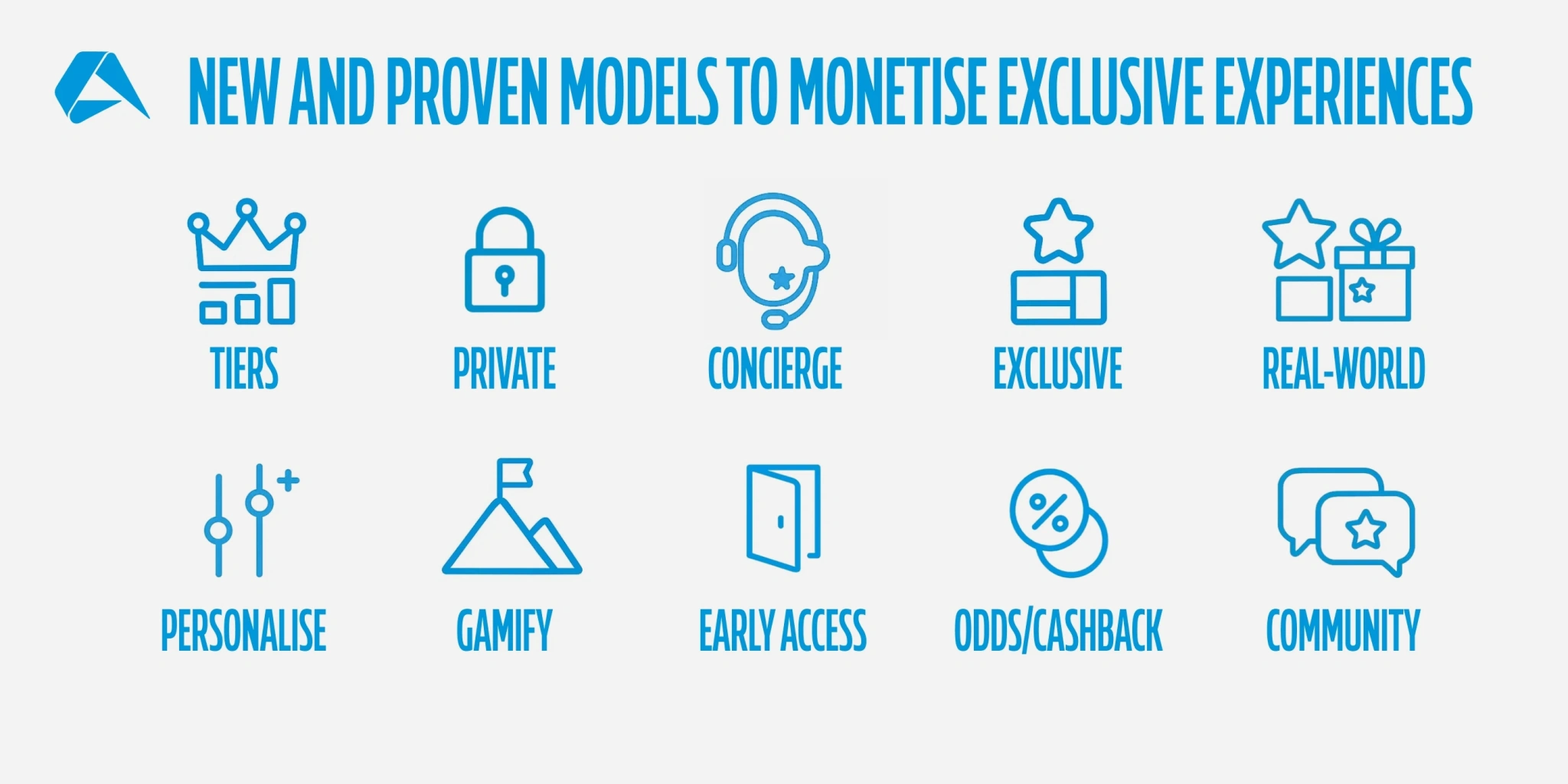
So, while casinos have proven that emotion and structure can turn loyalty into increased revenue, how can online sportsbooks capitalize on this insight? The encouraging news is that the modern sports betting platform is more than equipped to do the same and more, using personalization, data, and design to monetize exclusivity in ways the old VIP casino models never could.
The following list examines how proven casino loyalty systems are being reimagined for sportsbooks and identifies new emerging trends in sportsbook premiumization.
1. Tiered Memberships and Loyalty Clubs
The classic model still earns its place in the current climate. Tiered memberships, ranging from Bronze to Platinum, or club-themed hierarchies, appeal to our basic need for progress and recognition. Sportsbooks can build similar systems by tying rank to betting milestones, seasonal activity, or team allegiance, creating visible stages of achievement.
When players see progress and status, retention naturally follows.
2. Private or High-Stakes Betting Environments
Exclusivity doesn’t need neon lights to work. It just needs boundaries. Invite-only markets with fast or dedicated odds feeds create a sense of privilege that goes beyond volume. For operators, these high-value spaces also open higher-margin opportunities while reinforcing trust through familiarity and recognition.
3. Personal Account Management and Concierge Access
Personal attention turns loyalty into a habit. What casinos once offered through dedicated hosts (relationship builders), sportsbooks can now scale through AI-driven concierges or personalized relationship managers. These methods can anticipate needs, offer timely rewards, and invite players to customized experiences, like early event access to personalized markets.
4. Exclusive Content and Limited Markets
In information-driven industries, scarcity sells. Early access to odds or unique prop bets, for instance, can turn knowledge into a revenue source. A bettor who feels like an insider is less likely to chase bonuses elsewhere.
The trick lies in timing. For maximum impact, release exclusive insights or markets just when anticipation peaks.
5. Turn Digital Rewards into Real-World Experiences
Premiumization finds its emotional high when the screen gives way to real-world experience. Hospitality packages, match tickets, and branded event access transform loyalty from a digital transaction into a tangible memory.
Sportsbooks that partner with clubs and event organizers can anchor their brand in the culture of the sport itself.
6. Micro-Personalization at Scale
AI allows every player to feel like a VIP. By interpreting behavior and preferences in real-time, sportsbooks can deliver micro-rewards, such as tailored offers, personalized dashboards, or dynamic challenges, to thousands of users simultaneously.
This approach captures the intimacy of a host relationship while maintaining operational efficiency.
7. Gamified Progression
Gamification turns repetition into purpose. Seasonal challenges, missions, or achievements can give structure to betting activity and help players feel momentum between events. For example, completing a Champions League streak adds entertainment value that extends beyond odds and outcomes.
8. Early Access, Beta Features, and Premium Tools
Innovation itself can be a reward. Giving top-tier users early access to new bet builders, data visualization tools, or analytics dashboards keeps them invested and curious. It also serves a dual function. Real-time product feedback from engaged users and a strong incentive for others to aspire to that level.
9. Dynamic Odds or Cashback for Premium Tiers
Transparency builds trust, and performance-based rewards make that visible. Premium tiers could offer incremental odds advantages or automated cashback based on net activity. It’s measurable, fair, and directly linked to the value created by the player, which, in many ways, represents a modern evolution of traditional compensation programs.
10. Social and Community Layers
This idea is simple. Loyalty deepens when it’s shared. Private leaderboards, elite chat groups, and invitation-only fantasy leagues, among other initiatives, create microenvironments where bettors find a sense of identity and recognition. When status becomes social currency, retention ceases to be a marketing issue and becomes self-sustaining.
Why Players Will Pay for Premiumization
To understand why premiumization works, it helps to look beyond mechanisms and focus on the emotion driving it. Status.
Premiumization only works because it speaks to something deeper than habit. In real terms, it taps into status. Every loyalty tier, invite-only event, and early-access feature rests on the same psychological foundation, which is essentially that people want to feel part of something others can’t access. In gambling, where emotion drives action, that instinct is magnified. Players aren’t just chasing wins. They invariably want acknowledgement.
Casinos understood this early on. The velvet rope, the private lounge, and so on. All of it signals belonging. In digital sportsbooks, the challenge is replicating that feeling through technology rather than décor. Recognition must be engineered through data, design, and timing. A personalized message after a significant win, a tailored market for a favorite team, or an exclusive dashboard for high performers all recreate that same emotional exchange that says you’ve earned this moment.
Behavioral economics backs this up. Scarcity and social proof are powerful motivators. When access is limited or visible - a badge, a rank, or a leaderboard position, for instance - it transforms behavior. Players stay longer, spend more, and identify more closely with the brand that is providing the recognition.
This is precisely where the concept of belonging moves from soft psychology to hard economics. When a player feels part of an exclusive circle, however it’s framed, the relationship changes. Your platform becomes ‘their’ sportsbook. And in this industry - that’s priceless.
Strategies for Building a Sustainable Premium Model
So if premiumization is about creating emotion, sustainability can best be described as maintaining trust. The most successful loyalty systems for sportsbooks will be the ones that combine ambition with restraint, or in other words, those that reward deeply without drifting into manipulation or regulatory risk.
Here are the points to keep in mind when attempting to build a sustainable model for premiumization:
Build Transparency into Every Tier: Players should always understand why they qualify for a reward, what’s next, and how the system treats them. Unclear or inconsistent benefits create suspicion, while transparency builds the kind of trust that makes loyalty stick. Display progress milestones, explain the logic behind tiers, and use data dashboards to visualize it.
When players can see their path, they invest in it.
Anchor Rewards in Measurable Behavior, Not Volume: Volume-based systems often attract riskier behavior, which in turn attracts regulatory scrutiny. Smarter loyalty design rewards consistency and engagement, rather than spending alone.
Reward bettors for season-long participation, accurate predictions, or social involvement that builds healthier retention trends and lower compliance risk.
Automate the Right Kind of Personalization: AI personalization can easily become intrusive if not guided by restraint. Sustainable models use behavioral data to enhance relevance. That means timely, contextual prompts rather than constant upselling.
Embed Responsible Gaming Tools into Premium Tiers: Premium should never mean pressure. Include visible reminders of limits and self-management tools at every level of the loyalty ladder. Offer timeouts or safer-play options as benefits, not restrictions. A player who feels protected is a player who trusts the brand, and such trust is the foundation of long-term value.
Treat Data Ethics as Part of Your Brand Identity: As loyalty becomes data-driven, how data is handled reflects the integrity of your brand. Operators that communicate how player information is used to improve relevance and avoid exploiting behavior turn privacy into a selling point.
Transparency in data usage doesn’t weaken engagement. It strengthens credibility.
Focus on Lifetime Value, Not Short-Term Benefit: The temptation to over-reward early is understandably strong, but sustainable premiumization matures gradually. Build models that reward participation over seasons, not sessions. Every interaction should feel cumulative, like a long-term relationship.
Operators who master timing will outlast those who burn through incentives.
Keep Premium Experience Scalable: The most sustainable systems blend AI automation with human oversight, where data identifies opportunities, and managers apply judgment. This hybrid model ensures scalability without losing the authenticity of personal recognition.
Implementing Premiumization Strategies in Practice
Making premiumization work starts with getting the basics right in terms of systems, data, and the freedom to experiment. The technology behind a sportsbook has to do more than process wagers. It needs to bridge operational efficiency with personal relevance by recognizing patterns, responding to behavior, and delivering the right experience at the right moment. That’s where a strong Player Account Management system (PAM) and connected CRM come in, linking sportsbook player segmentation, automation, and real-time insight into one operational flow.
Once that foundation is in place, attention should turn to flexibility. Marketing and operations teams need the ability to design and adjust loyalty systems for sportsbooks without needing to call in developers each time. A configurable and integrated bonus system for sportsbooks, combined with a content management system, enables the quick testing of ideas. For example, tiered missions can be implemented one week, followed by hybrid event rewards the next, and so on, to determine what resonates with different segments.
Data then brings everything together. When analytics, risk management, and customer engagement tools share information, decisions become more accurate and loyalty strategies evolve naturally. Premiumization, at its best, grows out of this kind of environment: one that is adaptable, data-informed, and designed with a genuine understanding of the player, rather than relying on static incentives.
Want to learn what premiumization looks like in action? Book a live demonstration with Altenar to see how today’s sportsbook technology supports customer loyalty from the ground up.